
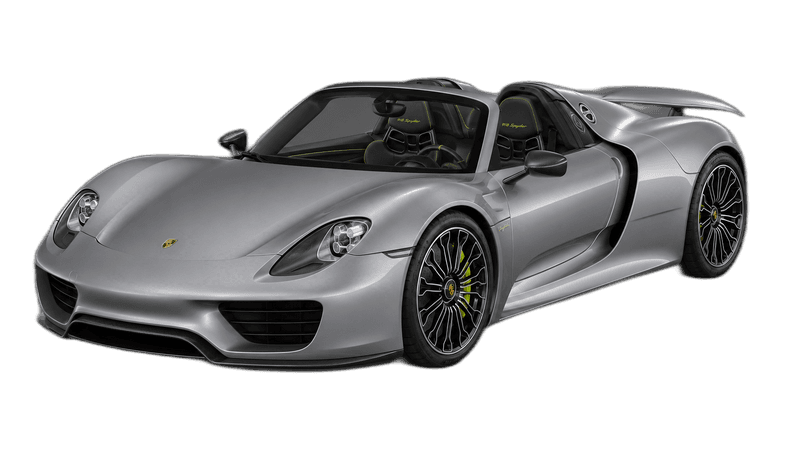
Porsche 918 Spyder
£1,400,000
usadoIndicative market price, updated periodically.
875cv
Potencia
2.6s
0-100 km/h
345km/h
Velocidad Máxima
£1,400,000
Precio Usado
Cómo empuja.
La fuerza g máxima en el instante en que pisas a fondo, estimada a partir del 0–100 y la tracción del coche.
Porsche 918 SpyderG de salida estimada a partir del 0–100 y la tracción: una aproximación honesta, no una cifra medida.
The Porsche 918 Spyder is a 2 seater convertible/cabriolet by Porsche, with 875 bhp, 1280 Nm of torque, a 0-100 km/h time of 2.6 seconds and a top speed of 345 km/h. Indicative used value: approximately £1,400,000. Actual values vary with specification, condition and history.
Dream Car Garage Editorial · Edited by José Teo Lorente Vallecillos · Last updated 27 October 2026
Visión General
We have not driven this car. This review is based on published specifications and the sources listed below.
Three propulsion units, one inspection problem
The 918 Spyder combines a 4.6-litre naturally aspirated V8 with electric motors at the front and rear. Porsche quotes 608 PS from the combustion engine and 286 PS from the electric system, with a quoted system output of 887 PS, or about 875 bhp. Production was limited to 918 cars. The specification integrates plug-in charging, regenerative braking and all-wheel drive rather than adding an electric motor to an otherwise conventional 911.
This is a desk-researched ownership guide. We have not driven this model for this article. Its hybrid system should be assessed as a complete set of mechanical, electrical and software-controlled systems. A car that starts and moves has demonstrated only a small part of that system. Diagnostic records and model-specific expertise are essential.
Battery evidence rather than dashboard reassurance
The high-voltage battery is central to both performance and electric operation. Ask for a Porsche diagnostic assessment that records battery condition, relevant fault history and any completed high-voltage work. A displayed state of charge shows the current charge level, not a complete measurement of battery health. Equally, an isolated warning in an old printout needs context rather than an automatic assumption about pack condition.
Confirm the identity and status of any replacement or repaired components through invoices and diagnostic references. The buying guide discusses the battery, charging system and software as inspection priorities; it does not support assigning a universal remaining life to every car. Storage, charging habits and previous repairs need to be considered for the individual vehicle.
High-voltage work has safety and tooling implications. The inspection should be performed by people qualified for this system, with the appropriate Porsche diagnostic access. A general sports-car inspection is not an adequate substitute.
Ask for a cold start and observe the transition between electric and combustion operation with the seller's permission. A warning-free dashboard at idle is only a starting point; the specialist should check stored faults and verify that the car can complete the tests the diagnostic equipment supports. Do not accept that a warning is normal for the model without a recorded explanation. Production rarity does not simplify maintenance, and a car with long idle periods deserves a more cautious assessment of fluids, seals and battery condition.
Test charging as a complete process
Inspect the charging port, cable, locking mechanism and supplied charging equipment. Then observe a complete charging process using compatible infrastructure. Record whether charging initiates, continues and finishes as expected, and investigate warnings or interruptions rather than clearing them without explanation.
The presence of a cable in the luggage compartment does not establish that the charging system works. Nor does a successful charge on one station establish compatibility with every installation. The goal is to verify the car's supplied equipment and documented behaviour, with specialist diagnosis for anything abnormal.
Ask how the car was stored and charged during periods of limited use. The answer should align with the service history and diagnostic evidence. It is context for inspection, not a guarantee about future battery performance.
Five modes and several cooling circuits
Porsche describes five driving modes spanning electric, hybrid, performance and charging-oriented operation. Where safe and appropriate, a specialist should verify that mode selection and system behaviour agree with the documentation. A fault that appears only in one operating state may not be visible during a short start-up demonstration.
The powertrain also depends on several cooling circuits and electric components at both axles. Inspection should cover visible leaks, damaged lines, underbody protection and stored temperature or cooling faults. Do not reduce this to a conventional radiator check. Each reported repair should identify the affected circuit or component.
Software history matters because control systems coordinate the power units, braking and charging. Request records of applicable updates and campaigns by VIN. Do not assume that a current-looking interface proves that every update was completed.
PCCB, suspension and lightweight equipment
PCCB brakes require inspection for disc damage and measured condition, not just remaining pad material. Wheel, suspension and underbody checks should account for the car's weight, low clearance and possible circuit use. Alignment results and any replaced suspension parts should be explained in the file.
Identify whether the car has the Weissach package and which lightweight components are actually present. Package claims should be verified against the factory build record rather than visual trim alone. Magnesium wheels, where fitted, need appropriate inspection and documented provenance. Any substitution of wheels, exhaust or body components should disclose whether the originals remain with the car.
Tyre specification and age matter on a car with this performance even if mileage is low. Inspect all four tyres and avoid treating a matching brand alone as evidence of correct specification.
Completeness, storage and service continuity
Check both removable roof panels, charging accessories, manuals, keys and model-specific equipment against the delivery specification. Inspect panel seals and storage areas for water ingress or damage. Photographs should show the actual car and its components, not a generic 918 used to illustrate a listing.
A continuous specialist history is more useful than a collection of unexplained receipts. Reconcile service dates with storage periods, ownership changes and campaign completion. A rare car can still have incomplete records, and a complete-looking folder can still omit diagnostic results.
How this review was compiled
We have not driven this model for this article. Porsche museum and production material provide the output, production and hybrid-system facts. StuttCars' 918 buying guide informs the battery, charging, software and equipment inspection checklist; its market and cost claims are not used here. No transaction sample, fault frequency or future value is assumed. Purchase should depend on VIN-specific campaign records and a high-voltage-qualified Porsche inspection.
Especificaciones
Motor
4.6L (4593 cc) V8 plug-in hybrid
Cilindrada
4.6L
Potencia
875 cv
Par Motor
1280 Nm
0-100 km/h
2.6s
Velocidad Máxima
345 km/h
Tracción
AWD
País
Germany
Carrocería
2 seater convertible/cabriolet
Años
2013–2015
Producción
918
Precio Usado
£1,400,000
Specifications are manufacturer-published figures.
Más de Porsche
Destacado en Carpedia
Hypercar Holy Trinity: LaFerrari vs P1 vs 918
Three manufacturers. Three philosophies. One question: when Ferrari, McLaren, and Porsche each build the ultimate car, which one wins?
Best Supercars 2026
The supercar class of 2026 spans from a 875bhp hybrid Porsche to Lamborghini's fire-breathing V12. These are the ten machines that deliver the most visceral driving experiences this side of a hypercar.
The Ultimate Dream Garage 2026
If money were no object and the garage had ten bays, which cars would you choose? Our editorial team has done the hard work, selecting one champion from each category to assemble the definitive Dream Garage of 2026.
Nürburgring Nordschleife: The Green Hell Record Board
Every manufacturer wants a fast Nürburgring time. Only a handful can call themselves record holders. Here is the definitive leaderboard for production and semi-production cars on the most demanding circuit in the world.
Spa-Francorchamps: Where Speed Has No Ceiling
Raidillon. Eau Rouge. Pouhon. Spa-Francorchamps is motorsport's most cinematic stage, a circuit where aero loads, braking precision, and mechanical courage converge. Here are the fastest production cars ever timed across its 7.004 kilometres.
Laguna Seca: America's Greatest Circuit Challenge
WeatherTech Raceway Laguna Seca is the benchmark for production car performance in North America. Its 11 corners, anchored by the iconic Corkscrew descent, expose every aspect of a car's capability. Here are the fastest times ever recorded on this beloved circuit.
Suzuka: The Figure-Eight That Defines Champions
Suzuka Circuit's distinctive figure-eight layout, the only overpass crossing in modern Formula 1, combines technical precision with high-speed commitment across 5.807 km of Japanese engineering philosophy. Here are the production cars that have conquered it most completely.
Bathurst: The Mountain That Breaks Cars
Mount Panorama's 6.213 kilometres of undulating mountain road descend 174 metres from Skyline to the Chase, a circuit that has humbled every category of racing car in its history and remains the ultimate challenge for production car performance in the southern hemisphere.
What Cars Should I Put in My Dream Garage?
A comprehensive guide to building a dream garage at every budget. Five balanced 5-car garages, from under GBP 100K total to unlimited, each covering daily driving, weekends, track days, road trips, and special occasions.
The Definitive Porsche 911 Buyer's Guide
From the 996 bargain bin to the 992 GT3 summit, every generation of the Porsche 911, what to pay, and what to watch for.
McLaren F1: The Car That Changed Everything
The McLaren F1 was designed without compromise, built without cost constraint, and remains unmatched thirty years later.
What Your Dream Garage Says About You
The cars you choose when money is no object say everything about who you are, and nothing about what you drive.
Preguntas Frecuentes
What are the specifications of the Porsche 918 Spyder?
The Porsche 918 Spyder is a 2 seater convertible/cabriolet by Porsche, with 875 bhp, 1280 Nm of torque, a 0-100 km/h time of 2.6 seconds and a top speed of 345 km/h. Indicative used value: approximately £1,400,000. Actual values vary with specification, condition and history.
How much does a Porsche 918 Spyder cost?
Indicative used value: approximately £1,400,000. Actual values vary with specification, condition and history.
How many Porsche 918 Spyder were made?
Porsche produced 918 units of the Porsche 918 Spyder.
What drivetrain does the Porsche 918 Spyder use?
The Porsche 918 Spyder is configured with all-wheel drive.
What type of car is the Porsche 918 Spyder?
The Porsche 918 Spyder is a supercars manufactured by Porsche in Germany. Production ran from 2013 to 2015.