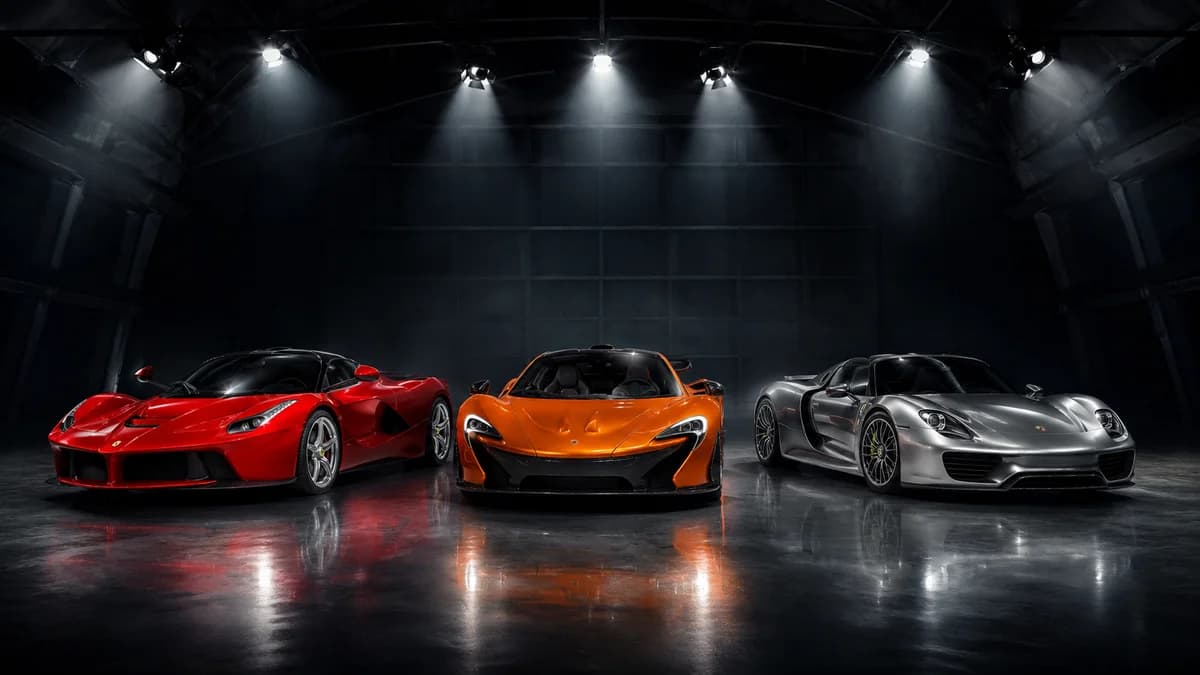
The Setup
In the span of eighteen months between 2013 and 2014, the three most storied names in performance car manufacturing each revealed their vision of the ultimate hybrid hypercar. Ferrari launched the LaFerrari. McLaren unveiled the P1. Porsche presented the 918 Spyder. Each used a combination of internal combustion and electric power to produce north of 900 bhp. Each cost over £1 million. And each took a fundamentally different philosophical approach to the same engineering challenge.
The question everyone asked, "which one is fastest?", was the wrong question. Speed was merely the entry fee. What separated these three cars was something deeper: their respective answers to what a hypercar should be.
LaFerrari: The Emotional Argument
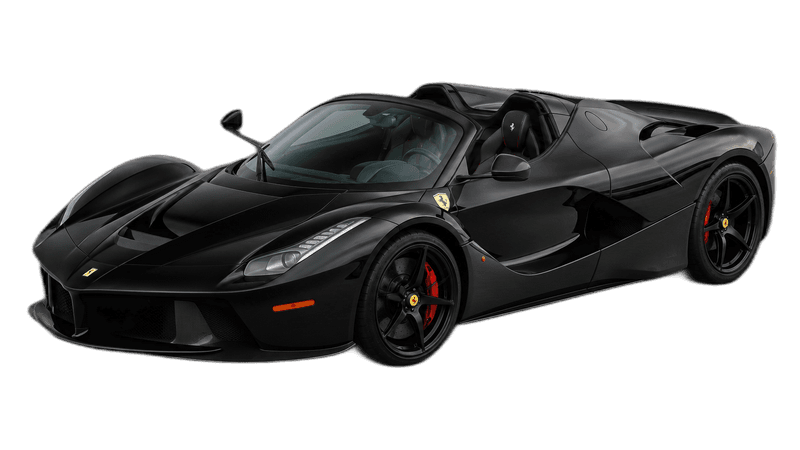
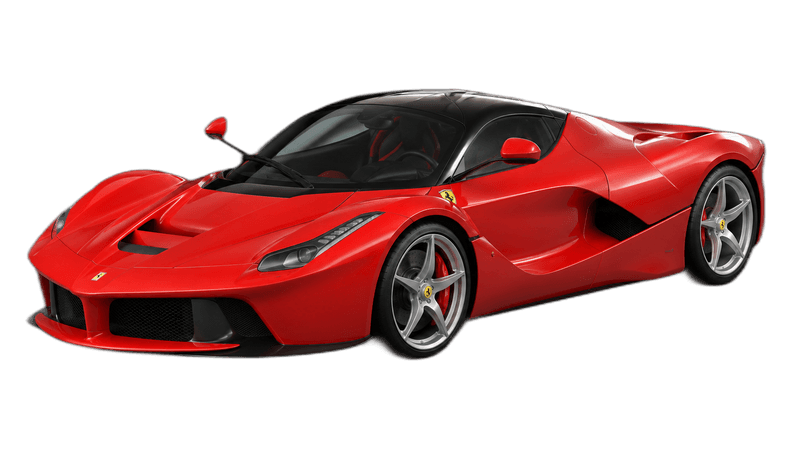
The LaFerrari paired a 6,262 cc naturally aspirated V12, the F140 FE, producing 789 bhp at 9,000 rpm, with a 161 bhp electric motor integrated into the seven-speed dual-clutch gearbox. Total system output: 950 bhp. It was, and remains, the only hybrid hypercar of the three to use a naturally aspirated engine, and that decision defined its entire character.
Where the P1 and 918 used their electric motors to fill torque gaps and boost low-end response, Ferrari used electrification to amplify what its V12 already did brilliantly. The KERS-derived HY-KERS system added instant torque at low revs without diluting the V12's savage top-end scream. The result was a car that felt more visceral than any hybrid had a right to, a 9,000 rpm redline accompanied by electrical assistance that felt like a tailwind rather than a crutch.
Ferrari produced 499 units, priced at approximately €1.15 million. Today, values exceed €3.5 million for standard cars and €5 million for the Aperta (open-top, 210 units). The LaFerrari accelerated from 0-100 km/h in 2.4 seconds and hit 350 km/h. But the numbers don't capture its essence. The LaFerrari was the last Ferrari built primarily to make the driver feel something. That it was also blisteringly fast was almost incidental.
McLaren P1: The Engineering Argument
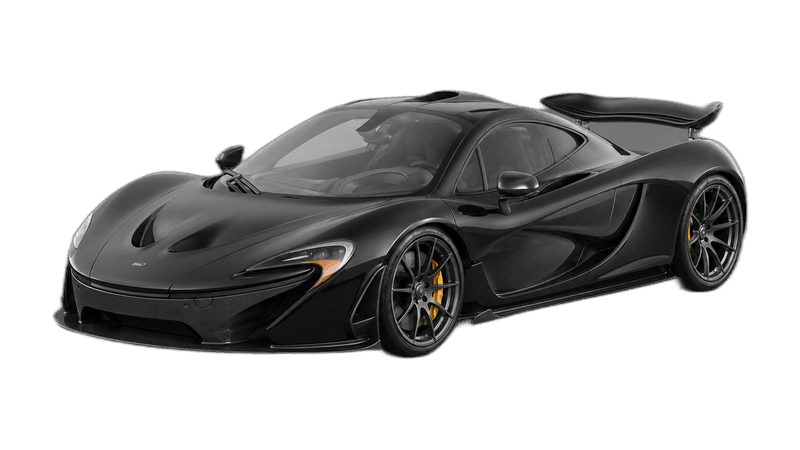
The McLaren P1 paired a 3,799 cc twin-turbo V8 producing 727 bhp with a 177 bhp electric motor, for a combined 903 bhp. Its carbon fibre MonoCage monocoque weighed just 90 kg. Total kerb weight was 1,395 kg: 200 kg less than the LaFerrari. It had active aerodynamics, including a rear wing that doubled as an airbrake and a ride-height system that lowered the car 50 mm in Race mode. The P1 was the only one of the three designed explicitly to be the fastest car on a circuit.
McLaren's brief for the P1 was a single sentence: "The best driver's car in the world on road and track." They didn't say the most beautiful. They didn't say the most exclusive. They said the best. And they meant it.
The P1 produced 600 kg of downforce at 257 km/h, more than either rival. Its Instant Power Assist System (IPAS) used the electric motor to eliminate turbo lag entirely, providing instant torque while the twin turbos spooled. The result was a car that felt naturally aspirated in its throttle response despite being turbocharged, a trick that no other manufacturer has successfully replicated at this level.
McLaren produced 375 units at approximately £866,000. The P1 hit 0-100 km/h in 2.8 seconds and 0-200 km/h in 6.8 seconds. Top speed was electronically limited to 350 km/h. Current market values sit between £1.5 million and £2 million, making it the most affordable of the three, a word that means nothing in this context but tells you something about relative desirability.
Porsche 918 Spyder: The Rational Argument
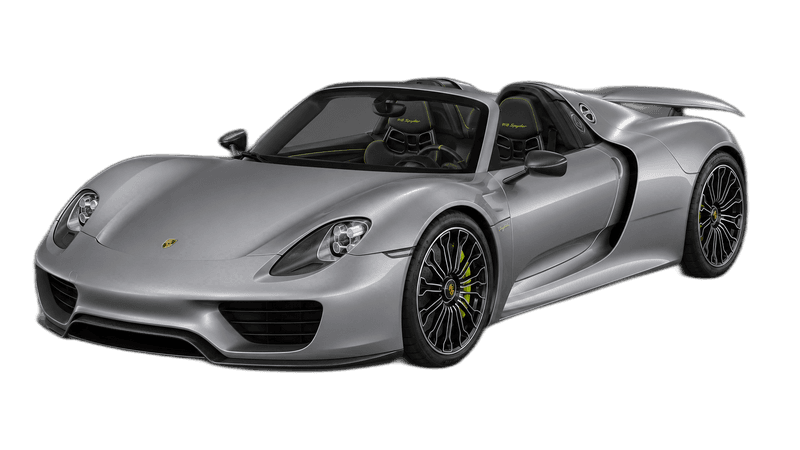
The Porsche 918 Spyder combined a 4,593 cc naturally aspirated V8 (608 bhp, derived from the RS Spyder LMP2 engine) with two electric motors producing a combined 279 bhp, for a total of 887 bhp. It was the only one of the three with all-wheel drive. It was the only one that could run in pure electric mode for 19 km. And it was the only one that Porsche described, with a straight face, as a "daily usable hypercar."
The 918's party trick was its Nürburgring Nordschleife lap time: 6:57 with Marc Lieb at the wheel, making it the first road-legal production car to break the seven-minute barrier. It achieved this not through brute power, the LaFerrari had 63 more bhp, but through traction, balance, and the confidence-inspiring security of all-wheel drive and rear-axle steering. The 918 was the car you could drive at 95% on a damp track and still post a faster time than the LaFerrari at 90%.
Porsche produced 918 units at $845,000 each. Current values hover around £1.8 million. The Weissach Package, which stripped 41 kg through unpainted carbon fibre and magnesium wheels, commands a significant premium. The 918 accelerated from 0-100 km/h in 2.6 seconds, the fastest of the three, and from 0-200 km/h in 7.2 seconds. Top speed: 345 km/h.
The Numbers
On paper, the LaFerrari wins on power (950 bhp), the P1 wins on weight (1,395 kg) and downforce (600 kg), and the 918 wins on acceleration (2.6 seconds to 100 km/h) and lap times (6:57 Nordschleife). But these numbers obscure more than they reveal. Each car was optimised for a different metric because each manufacturer believed that metric mattered most. Ferrari optimised for emotional impact. McLaren optimised for circuit performance. Porsche optimised for usability and all-weather capability.
Choosing between the LaFerrari, P1, and 918 is not an automotive question. It is a philosophical one. Do you want the car that moves you, the car that challenges you, or the car that flatters you?
Which One Wins?
If you want the most spine-tingling driving experience, the car that makes you pull over just to sit and listen to the engine idle, the LaFerrari wins. If you want the purest driving instrument, the car that rewards precision and punishes laziness, the P1 wins. If you want the car you would actually drive every day, in rain or shine, to the office and then to the Nordschleife, the 918 wins.
The correct answer, of course, is all three. The Holy Trinity exists not as a competition but as a triptych, three complementary visions of the same truth. Together, they represent the peak of the internal combustion era, the moment just before electrification went from augmentation to replacement. They will never be equalled, because the conditions that created them, unlimited budgets, no emissions regulations, and three corporate egos locked in a three-way death match, will never recur.