
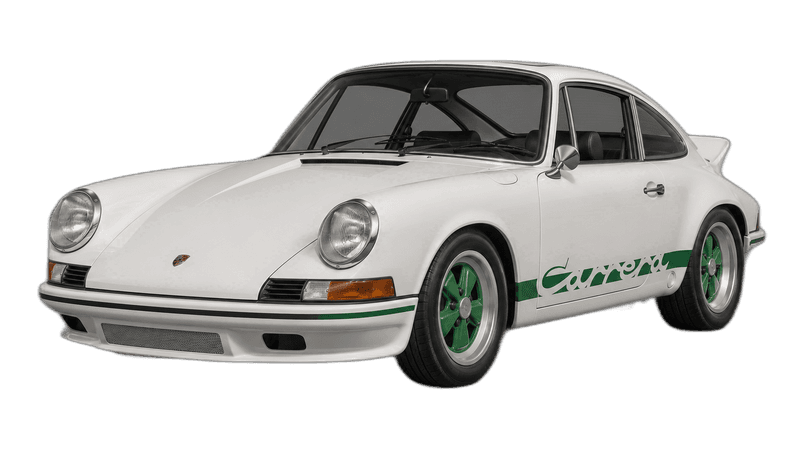
Porsche 911 Carrera RS 2.7
£1,200,000
usedIndicative market price, updated periodically.
210bhp
Power
5.8s
0-100 km/h
245km/h
Top Speed
£1,200,000
Price Used
How hard it pulls.
Peak g-force the instant you bury the throttle, estimated from the car's 0–100 time and drivetrain.
Porsche 911 Carrera RS 2.7Estimated peak launch g from the 0–100 time and drivetrain: an honest approximation, not a measured figure.
The Porsche 911 Carrera RS 2.7 is a 2-seat coupe by Porsche, with 210 bhp, 255 Nm of torque, a 0-100 km/h time of 5.8 seconds and a top speed of 245 km/h. Indicative used value: approximately £1,200,000. Actual values vary with specification, condition and history.
Dream Car Garage Editorial · Last updated 25 October 2026
Overview
We have not driven this car. This review is based on published specifications and the sources listed below.
A homologation car with several configurations
The Carrera RS 2.7 was unveiled in 1972 for the following model year, pairing a 2.7-litre mechanically injected flat-six with a homologation programme. Porsche's historical account records 1,580 examples across different configurations. That total does not mean every car was a stripped Lightweight, nor does it authenticate the identity or current condition of a particular advertised example.
We have not driven this model for this article. This is a desk-researched ownership guide, not our own account of period performance or steering. The car's place in Porsche history explains interest without establishing a financial return. The purchase case needs to survive detailed authentication, structural inspection and a realistic support plan rather than rely on rarity or a familiar silhouette.
Touring and Sport are not interchangeable
M471 Sport and M472 Touring specifications differ in equipment and weight. A figure associated with one lightweight configuration should not be presented as the weight of every RS. Materials and details also require care when examining build and restoration history. Confirm the original specification and document subsequent changes instead of applying a single stripped-interior checklist to all cars.
A Touring converted to a lighter appearance needs an accurate description rather than an assumption that its original identity changed with the seats. Similarly, a restored Sport may have replacement components that require explanation. Obtain build information, historical records and specialist assessment. A plaque, stripe or apparently thin panel is not sufficient authentication, and a seller's confident narrative does not replace identifiable evidence.
RS, RSR and replicas
Distinguish a road RS from an RSR or another competition configuration. Racing equipment, a familiar livery or event photographs cannot establish chassis identity or a claimed competition history by themselves. Ask for records connecting the particular car to the events and owners described. A gap in provenance remains an uncertainty even if the story is repeated in several advertisements.
A well-made replica can offer enjoyment on its own terms without being a factory RS. Verify chassis and engine identities through appropriate records and physical inspection, recognising what a heritage document does and does not confirm. Original production information is not certification of the shell, engine or equipment currently installed after decades of repairs and replacement.
Structure and restoration deserve the first budget
Inspect floors, sills, inner structures, suspension mounting points, screen surrounds and previous welds with an early-911 specialist. Paint quality and panel alignment are useful observations but cannot establish concealed condition. Ask for restoration photographs showing work before finishing. A claimed comprehensive restoration should identify its scope, methods and responsible workshop rather than be accepted as a universal assurance.
Competition use, collision repair and long storage create different questions. Establish whether the shell remained in continuous use, was extensively rebuilt or received replacement sections. No generic rule that every repair destroys desirability or every original panel is sound can substitute for assessment. Obtain written findings, including inaccessible areas and any further investigation needed before committing to a valuation or repair plan.
Injection and engine evidence
The mechanically injected engine needs appropriate expertise, not a modern electronic-management diagnostic routine copied from a later Carrera. Review servicing, fuel-system work, ignition setup and any internal engine repairs. Demonstrate cold starting, warm running and restarting where safe, then investigate poor operation through a coherent process rather than describing every hesitation as normal period character.
Compression or leak-down testing can contribute useful evidence when justified and properly interpreted. It does not authenticate an engine or guarantee future service life. A rebuild invoice should identify what was measured, replaced and reused. Confirm whether the installed unit matches the claimed specification and what records support its identity, distinguishing present condition from historical originality.
Aerodynamics, suspension and brakes
Porsche developed the front spoiler and rear ducktail as a coordinated aerodynamic package. A cosmetic wing alone does not establish the original build or reproduce every aspect of the intended configuration. Inspect mounting, repairs and specification rather than assuming any part with the right outline is equivalent. Body details should be reconciled with records, particularly after competition modifications or restoration.
Assess suspension, dampers, bushes, steering, wheel bearings and brakes. Check tyre specification, age and condition, especially where period appearance is prioritised. An old-looking tyre should not be assumed safe because it suits a display. If circuit use is intended, confirm the event's eligibility, safety and noise requirements rather than relying on the car's racing ancestry or a road registration.
Gearbox, cabin and actual use
Have the five-speed transmission, clutch and linkage assessed by someone familiar with the installation. Operating technique differs from a modern gearbox, but persistent selection problems require diagnosis. Ask about differential and driveline work and investigate vibration. A familiar repair recommendation from another early 911 should not be treated as the established cause without examination.
Test the equipment fitted and check seating, visibility and access for the intended driver. Lightweight or period seats may not suit every body, and modifications need safety and insurance consideration. Decide whether the aim is touring, occasional road use, display or events. Those briefs require different preparation and support, and very limited mileage does not eliminate time-related maintenance.
Costs, value and research limits
Request separate quotations for maintenance, structural work, mechanical repairs and missing model-specific components. Confirm availability and lead times rather than assuming a recognised badge guarantees immediate parts supply. There is no current workshop-price survey here supporting one annual ownership figure. Include insurance, storage, transport and any preparation required by the intended use.
Compare authenticated examples by original specification, documented repairs and condition, distinguishing asking prices from completed transactions. Homologation importance and limited production do not guarantee appreciation, liquidity or recovery of restoration costs. A conventional period 911 or accurately described replica may better suit a buyer interested mainly in road use. Porsche's historical sources explain the RS programme; they do not certify a car for sale or replace an independent inspection.
Specifications
Engine
2.7L flat-6 air-cooled naturally aspirated petrol
Displacement
2.7L
Power
210 bhp
Torque
255 Nm
0-100 km/h
5.8s
Top Speed
245 km/h
Drivetrain
RWD
Country
Germany
Body Style
2-seat coupe
Years
1972–1973
Production
1,580
Price Used
£1,200,000
Specifications are manufacturer-published figures.
More from Porsche


Featured in Carpedia
Frequently Asked Questions
What are the specifications of the Porsche 911 Carrera RS 2.7?
The Porsche 911 Carrera RS 2.7 is a 2-seat coupe by Porsche, with 210 bhp, 255 Nm of torque, a 0-100 km/h time of 5.8 seconds and a top speed of 245 km/h. Indicative used value: approximately £1,200,000. Actual values vary with specification, condition and history.
How much does a Porsche 911 Carrera RS 2.7 cost?
Indicative used value: approximately £1,200,000. Actual values vary with specification, condition and history.
How many Porsche 911 Carrera RS 2.7 were made?
Porsche produced 1,580 units of the Porsche 911 Carrera RS 2.7.
Is the Porsche 911 Carrera RS 2.7 AWD or RWD?
The Porsche 911 Carrera RS 2.7 uses a RWD drivetrain configuration in a 2-seat coupe body style.
What type of car is the Porsche 911 Carrera RS 2.7?
The Porsche 911 Carrera RS 2.7 is a gts manufactured by Porsche in Germany. Production ran from 1972 to 1973.