
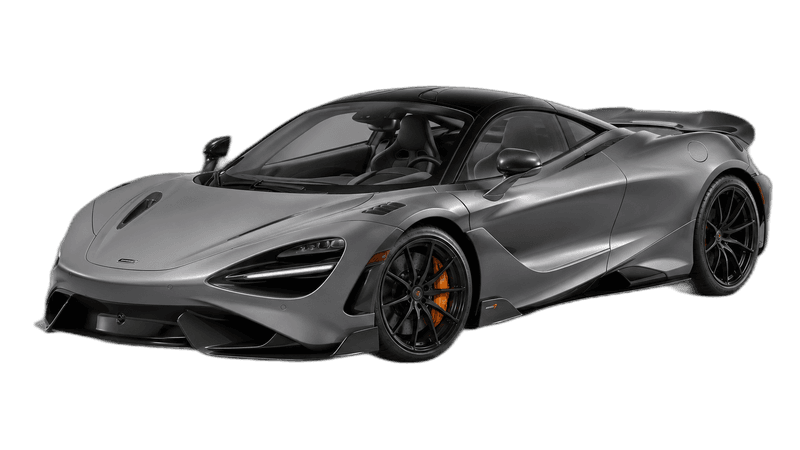
McLaren 765LT
£320,000
usedIndicative market price, updated periodically.
755bhp
Power
2.8s
0-100 km/h
330km/h
Top Speed
£320,000
Price Used
How hard it pulls.
Peak g-force the instant you bury the throttle, estimated from the car's 0–100 time and drivetrain.
McLaren 765LTEstimated peak launch g from the 0–100 time and drivetrain: an honest approximation, not a measured figure.
The McLaren 765LT is a 2-door coupe by McLaren, with 755 bhp, 800 Nm of torque, a 0-100 km/h time of 2.8 seconds and a top speed of 330 km/h. Indicative used value: approximately £320,000. Actual values vary with specification, condition and history.
Dream Car Garage Editorial · Edited by José Teo Lorente Vallecillos · Last updated 27 October 2026
Overview
We have not driven this car. This review is based on published specifications and the sources listed below.
The most powerful Longtail coupe in this series
McLaren revealed the 765LT coupe in 2020 and planned 765 individually numbered cars. Its 4.0-litre twin-turbocharged V8 produces 765 PS, or 755 bhp, and 800 Nm. A seven-speed SSG with a shorter final drive sends power to the rear wheels. Official figures are 2.8 seconds to 100 km/h and 330 km/h. These details distinguish the 765LT from the 675LT and 600LT, whose engine capacities and production runs are different.
This is a desk-researched ownership guide. We have not driven this model for this article. The coupe's production number should not be combined with the separate 765-car Spider run. Special MSO cars and later derivatives also sit outside this catalogue identity.
Engine and transmission detail
The 3,994 cc engine uses LT pistons and, according to PistonHeads, a Senna three-layer head gasket. The dry-sump lubrication system and model-specific transmission final drive make a correct service record important. The shorter final drive contributes to the claimed improvement in in-gear acceleration relative to the 720S, so gearbox identity and any modification should be established rather than assumed.
Ask for invoices that connect routine work to the VIN and record the fluids and parts used. A McLaren specialist should inspect for fluid loss, abnormal noises and stored faults. Battery health deserves particular attention because warning messages and limp-mode behaviour can have electrical as well as mechanical causes. The guide's sensible response is factory-level diagnosis, not clearing codes repeatedly and hoping the symptom disappears.
Any previous warning, reduced-power event or charging-system work should be explained in the file. The original three-year unlimited-mileage warranty is part of the model's history, but the age of these cars means a current buyer should verify what cover, if any, actually remains. A generic statement that a car is still under warranty is not sufficient evidence.
Weight reduction and option reality
The lightest specification removes equipment that many buyers expect to find. Air conditioning, audio and carpets were deleted as standard, with air conditioning and audio available at no cost by request. Carbon racing seats were standard, while Senna seats were optional. These differences mean that an original 765LT can look and feel quite different from another without either being incorrectly modified.
Check the build sheet before judging the cabin. The front luggage compartment is supplemented by storage behind the seats in the coupe, and that space should not be projected onto the Spider. Nose lift was optional, so its presence and operation need verification. A buyer who requires it should not assume that every car has it.
The optional Senna seats should be tried for fit and inspected for wear. Clubsport Pack content included Senna seats, brakes, track telemetry and carbon vents, while the Pro package added six-point harnesses and a titanium harness bar. McLaren linked those packages to camera and parking-sensor equipment. Confirm what is actually fitted and whether any original parts accompany later changes.
Chassis, tyres and braking
The 765LT has a wider front track than the 720S, a lower front ride height, stiffer springs with helper springs and recalibrated Proactive Chassis Control II. McLaren also quotes a substantial downforce increase. Those changes make geometry, tyre condition and suspension inspection central to assessing the car.
Pirelli Trofeo R tyres and ultra-light wheels with titanium bolts were part of the package. Check tyre age, specification, damage and wear on all four corners. Ask for alignment records after suspension, wheel or bodywork repairs. Any vibration or steering offset should be investigated with measurements rather than attributed automatically to the aggressive tyre choice.
Carbon-ceramic brakes use cooled six-piston front and four-piston rear calipers. Inspect discs, pads, brake-fluid history and the condition of cooling hardware. A short road evaluation cannot substitute for a workshop assessment. The report should record any uneven wear or damage and explain what could not be measured.
Active aero, exhaust and cooling
The active rear wing contributes to aerodynamic performance and low-temperature-radiator cooling. Confirm that it deploys, changes position and retracts without warnings, and inspect the mounts and visible carbon surfaces. Non-standard rear wings or disabled aerodynamic functions change more than the appearance.
The quad-exit titanium exhaust is another defining component. Inspect for heat damage, poor repairs and modifications. Thinner glass and polycarbonate in the C-pillars, rear screen and engine-cover area contribute to weight reduction, so replacement panels or glass should be checked for correct specification. An engine window and roof scoop were linked options, not universal equipment.
The underbody should be inspected for impact, missing fasteners and evidence of previous work. Low front bodywork and aerodynamic surfaces can suffer damage that is not visible in ordinary photographs. Any inspection that cannot access these areas should say so explicitly.
Body, cabin and electrical behaviour
Alarm oversensitivity is noted in the ownership guide. Test the alarm and locking behaviour without dismissing repeated warnings as a harmless quirk. Cabin equipment should be checked against the actual options, including climate control, audio, cameras, sensors and telemetry where fitted. A sparse-looking cabin may be original, but missing functionality should still be investigated.
Inspect the carbon panels, paint, glass and polycarbonate for damage and poor repairs. Door and window operation, interior rattles and seat condition belong in the same assessment. The car's track focus does not remove the need for ordinary evidence about water ingress, electrical health and body condition.
Documentation and inspection scope
The history file should establish the individual production number, factory specification, service history, battery and diagnostic work, geometry, brakes and any replacement carbon or glass components. Modifications should be listed with invoices and information about original parts. No claim about future appreciation is required to justify preserving that evidence.
An independent McLaren specialist should inspect the powertrain, diagnostics, battery, chassis, brakes, active aero, body and option content. The final report should distinguish observed condition from the seller's account and identify every unresolved warning or inaccessible area.
How this review was compiled
We have not driven this model for this article. McLaren's legacy page establishes the 4.0-litre powertrain and performance, official Spider launch material confirms the separate coupe and Spider production structure, and PistonHeads supplies the ownership and option detail. The guide does not combine the two 765-car runs, estimate transaction prices or infer long-term reliability from isolated owner reports.
Specifications
Engine
4.0L (3994 cc) twin-turbocharged V8
Displacement
4.0L
Power
755 bhp
Torque
800 Nm
0-100 km/h
2.8s
Top Speed
330 km/h
Drivetrain
RWD
Country
UK
Body Style
2-door coupe
Years
2020–2021
Production
765
Price Used
£320,000
Specifications are manufacturer-published figures.
More from McLaren
Featured in Carpedia
Best Supercars 2026
The supercar class of 2026 spans from a 875bhp hybrid Porsche to Lamborghini's fire-breathing V12. These are the ten machines that deliver the most visceral driving experiences this side of a hypercar.
Spa-Francorchamps: Where Speed Has No Ceiling
Raidillon. Eau Rouge. Pouhon. Spa-Francorchamps is motorsport's most cinematic stage, a circuit where aero loads, braking precision, and mechanical courage converge. Here are the fastest production cars ever timed across its 7.004 kilometres.
Monza: The Temple of Speed
Autodromo Nazionale Monza has been defining outright speed since 1922. Its long straights reward horsepower above all else, yet its three chicanes and the Parabolica demand braking precision and mechanical balance. These are the fastest production cars ever recorded on the most storied circuit in motorsport.
Bathurst: The Mountain That Breaks Cars
Mount Panorama's 6.213 kilometres of undulating mountain road descend 174 metres from Skyline to the Chase, a circuit that has humbled every category of racing car in its history and remains the ultimate challenge for production car performance in the southern hemisphere.
Ferrari SF90 Stradale vs McLaren 765LT vs Lamborghini Revuelto
The SF90, the 765LT, and the Revuelto represent three incompatible answers to a single question: what should a supercar of the highest order feel like? Torque vectors, flyweights, and twelve-cylinder symphonies, the answer depends entirely on what you value.
Frequently Asked Questions
What are the specifications of the McLaren 765LT?
The McLaren 765LT is a 2-door coupe by McLaren, with 755 bhp, 800 Nm of torque, a 0-100 km/h time of 2.8 seconds and a top speed of 330 km/h. Indicative used value: approximately £320,000. Actual values vary with specification, condition and history.
How much does a McLaren 765LT cost?
Indicative used value: approximately £320,000. Actual values vary with specification, condition and history.
How many McLaren 765LT were made?
McLaren produced 765 units of the McLaren 765LT.
What drivetrain does the McLaren 765LT use?
The McLaren 765LT is configured with rear-wheel drive.
What type of car is the McLaren 765LT?
The McLaren 765LT is a supercars manufactured by McLaren in UK. Production ran from 2020 to 2021.