
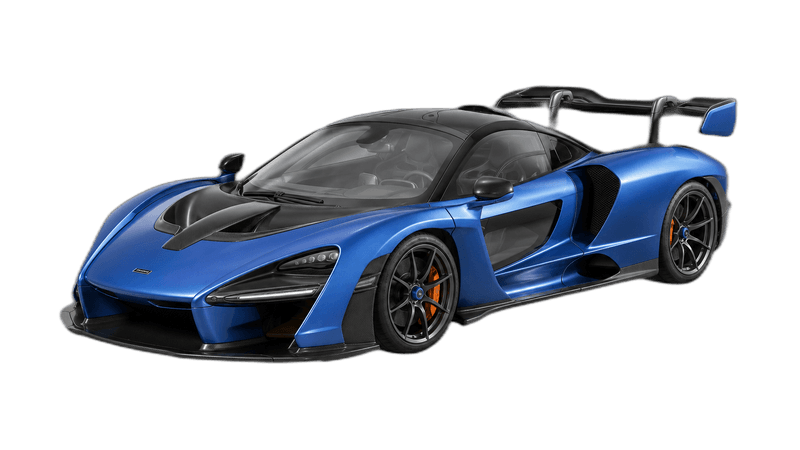
McLaren Senna
£850,000
usedIndicative market price, updated periodically.
789bhp
Power
2.8s
0-100 km/h
335km/h
Top Speed
£850,000
Price Used
The McLaren Senna produces 789 bhp, reaches 100 km/h in 2.8 seconds and has a top speed of 335 km/h. A representative example is worth about £850,000.
How hard it pulls.
Peak g-force the instant you bury the throttle, estimated from the car's 0–100 time and drivetrain.
McLaren SennaEstimated peak launch g from the 0–100 time and drivetrain: an honest approximation, not a measured figure.
Dream Car Garage Editorial · Edited by José Teo Lorente Vallecillos · Last updated 2 November 2026
Overview
We have not driven this car. This review is based on published specifications and the sources listed below.
Scope of this guide
This guide is scoped to the McLaren Senna road car, the limited run of 500 cars with the 4.0L twin-turbo V8 petrol (M840TR, 3994 cc) engine, a seven-speed twin-clutch gearbox and rear-wheel drive, built by hand at the McLaren Production Centre in Woking from 2018 to 2019. It is not a guide to the track-only Senna GTR (75 cars), the Senna LM (35 cars), the road-legal Senna GTR LM (5 cars) or the United States Sabre, which all have more power and different aerodynamics. We say below where they differ, so that you can tell which car an advert or a conversation really means.
We have not driven this model for this article. Everything here comes from three cited sources: OneShift's February 2018 report of McLaren's full technical details, PistonHeads' used buying guide for the Senna, and the government recall checker. We also read Wikipedia, Carscoops, Autobuzz, Ultimate Car Page and several recall summaries, and we flag each point that rests on them. Where sources disagree we say so rather than choose quietly.
The figures at a glance
- Engine: 4.0L twin-turbo V8 petrol (M840TR, 3994 cc), mid-engine, built by McLaren and described by PistonHeads as a heavily modified version of the 720S engine.
- Power: 789 bhp, which is McLaren's 800 PS converted (800 x 0.98632 is about 789). PistonHeads and Wikipedia print 789 hp, and Wikipedia also gives 799 PS and 588 kW.
- Torque: 800 Nm, which is 590 lb ft, between 5,500 and 6,700 rpm, with 700 Nm available from 3,000 rpm.
- 0-100 km/h: 2.8 seconds, quoted by McLaren as 0-62 mph.
- Top speed: 335 km/h (208 mph) in our catalogue, with a conflicting 340 km/h (211 mph) in launch coverage, explained below.
- Drive: rear-wheel drive, with the engine behind the cabin, so a mid-engine layout.
- Gearbox: seven-speed twin-clutch automatic with paddle control.
- Weight: 1,198 kg dry as claimed by McLaren, 1,309 kg on PistonHeads and 1,374 kg kerb on Wikipedia.
- Body: two-seat carbon-fibre coupe with dihedral doors on a carbon MonoCage III tub.
What the Senna is
McLaren revealed the car online in December 2017 and showed it at the Geneva show in March 2018. PistonHeads calls it the third car in the Ultimate Series, after the 1992 F1 and the 2013 P1. It was priced at 750,000 pounds before options on PistonHeads' account, and OneShift says the price included taxes in the United Kingdom. We write those sums in words and treat them as history, not a valuation. OneShift says all 500 cars were allocated to buyers, that each took about 300 hours to assemble, and that the last build slot was auctioned in December 2017 for around 2 million pounds for the Ayrton Senna Institute. Wikipedia gives the exact result as 1,916,793 pounds.
The Senna is a road-legal car designed around circuit use. OneShift lists a carbon-fibre double-element rear wing that doubles as an air brake, a hydraulic suspension with RaceActive Chassis Control II and double wishbones at both ends, carbon-ceramic brakes with six-piston front calipers, and Pirelli P Zero Trofeo R tyres in 245/35 ZR19 front and 315/30 ZR20 rear sizes. PistonHeads adds that the car makes up to 800 kg of downforce at 155 mph and that in Race mode the ride height drops by 39 mm at the front and 30 mm at the rear.
Why the quoted power and speed vary
Power is the first number to pin down. McLaren's own unit is metric horsepower, so 800 PS is the headline, and OneShift prints 800 PS (789 bhp) at 7,250 rpm. Our conversion agrees. PistonHeads' table gives 789 hp with no PS or bhp label, and a headline from one Indian outlet quoted 778 bhp, which Wikipedia's reference list records but which does not match any other source we read. Treat 789 bhp, 800 PS and 799 PS as the same engine rounded differently.
Top speed is the real disagreement. OneShift, Carscoops and Autobuzz, which report McLaren's February 2018 figures, give 340 km/h (211 mph). Wikipedia, which cites McLaren's Facts and Figures page, and PistonHeads give 335 km/h (208 mph), and that is what our catalogue uses. McLaren's own specification page would not return its figures to us, so we could not check which is current, and a seller who quotes either number is quoting a published claim, not a measurement.
PistonHeads' table gives 0-62 mph in 2.7 seconds while its text says 2.8 seconds, so we use 2.8 seconds, which agrees with OneShift and Carscoops. Carscoops also gives 0-200 km/h in 6.8 seconds and the quarter mile in 9.9 seconds. PistonHeads quotes 0-100 mph in 5.1 seconds and a stop from 124 mph in 100 metres. None of these are our measurements.
Production dates and numbers
The catalogue range is 2018 to 2019, which is the production span Wikipedia lists, with model years 2019 and 2020. PistonHeads labels the car 2018-20, which is the on-sale period. A United States recall record gives a build window of 15 June 2018 to 26 June 2019 for the cars it covers, which fits 2018 to 2019. We therefore changed the end year from 2020 to 2019 for the road car and flag it as a judgement. PistonHeads questions whether every one of the 500 cars has actually been built and sold, so ask for the build number and McLaren's confirmation, not a seller's word.
How the Senna differs from the track and special cars
The Senna GTR is track-only, with about 814 hp, wider bodywork and a race gearbox, and 75 were built. The Senna LM has the same 814 hp, solid doors and titanium panels, and 35 were made. The GTR LM is a road-legal GTR with 833 hp and a 9,000 rpm redline, with five cars. The Sabre is a United States car developed by McLaren Special Operations with 824 hp, and Wikipedia says 15 were built while PistonHeads says 16 reputedly were. None of those cars are covered here. PistonHeads also mentions XP development cars, which are not customer cars.
Engine and gearbox
The M840TR is a twin-turbo V8 derived from the 720S unit, with new intake manifolds, camshafts, high-pressure fuel pumps and exhaust, according to PistonHeads. The exhaust is inconel and titanium, with three outlets on most cars and two on United States cars, and there is a roof-mounted carbon intake snorkel. PistonHeads quotes 22.8 mpg combined and 280 g/km of carbon dioxide on the official cycle, so treat fuel economy as a figure for the brochure and not for a circuit day.
Because there is not enough Senna fault data, PistonHeads borrows its reliability notes from the 720S. We repeat that limit plainly: no source we read gives a Senna-specific engine fault list, and we make none up. What PistonHeads does give is a service routine, which it assumes matches the 720S, of every 10,000 miles or 12 months. It quotes 871 pounds including VAT for a 20,000-mile service covering engine oil, oil filter, coolant and clutch oil, and 1,248 pounds including VAT at 40,000 miles when gearbox oil is added, with a brake fluid change near 120 pounds. These are 2023 prices for a different car, so ask a McLaren retailer for a current Senna quote.
Suspension, brakes and body
The RaceActive system links the dampers hydraulically and can alter ride height. PistonHeads says some 720S owners report adaptive damper leaks and that some describe the suspension hydraulic accumulators as consumable items, so ask for the service history of the dampers and accumulators. Brembo carbon-ceramic brakes are smaller and lighter than the previous generation. Check disc wear, because carbon-ceramic replacement is expensive and we have no sourced price for it.
The body panels are carbon, around 60 kg in total, and the front splitter has a detachable front section. Paint is a concern: PistonHeads says McLaren is protective of paint codes, so a repair after a track-day incident can be hard to match, and it describes some corrosion and bubbling on the 570S, not the Senna. Look for splitter and diffuser damage, stone chips, and any evidence of panel repair or repaint.
What to check before buying
- Confirm the car is a 2018 to 2019 Senna road car and not a GTR, LM or Sabre, and ask McLaren to verify the build number and specification.
- Ask for the full service record and check that all work was done by McLaren or an approved retailer, since PistonHeads warns that using non-approved tools can affect warranty cover and that warning lights may need a special key to reset.
- Ask about damper and accumulator work, hydraulic leaks and any ride height warnings.
- Inspect the carbon-ceramic discs, the centre-lock wheels and the tyre age.
- Look for chips and cracks in the front splitter, side intakes and rear diffuser.
- Check the lithium battery and its trickle charger, which PistonHeads says come as standard.
- Test the dihedral doors, glass and optional equipment such as the telemetry cameras and Bowers and Wilkins audio.
- Check that any paint code or colour matches the build record.
- Run the registration or VIN through the recall check described below.
Recalls and the DVSA check
A United States recall, NHTSA campaign 19V613, covered 129 Sennas from 2018 and 2019 because the engine wiring harness could rub against a metal heat shield on the link pipe and cause an engine stall. McLaren's fix was to reroute the harness, and the record shows a campaign reference of 04S and notices to owners from 18 October 2019. A search summary also listed a later United States campaign, 20V231, for a fire risk linked to a foam pad near the fuel tank on several McLaren models including the Senna, and we did not open that notice. A UK news report headline from September 2019 said the Senna was recalled over an engine issue, and a trade report said McLaren had informed the DVSA, but we only saw those through search summaries and we found no UK campaign number. Run the registration or VIN through the government recall check, and ask a McLaren retailer to confirm that any campaign was completed.
Verdict
The Senna is a hand-built, mid-engine, rear-wheel drive car with 789 bhp, 800 Nm, a 2.8 seconds sprint to 100 km/h and a 335 km/h claimed top speed. It is limited to 500 cars, it asks for a McLaren-approved service routine, and its sourced reliability evidence is thin. If you are considering one, verify the build, read the damper and recall history, and treat the quoted numbers as manufacturer claims with the caveats above. We have not driven it, so rely on an inspection, not on this guide alone.
Specifications
| Engine | 4.0L twin-turbo V8 petrol (M840TR, 3994 cc) |
|---|---|
| Displacement | 4.0L |
| Power | 789 bhp |
| Torque | 800 Nm |
| 0-100 km/h | 2.8s |
| Top Speed | 335 km/h |
| Drivetrain | RWD |
| Country | UK |
| Body Style | 2 seater fixed-head coupe with dihedral doors |
| Years | 2018–2019 |
| Production | 500 |
| Price Used | £850,000 |
Specifications are manufacturer-published figures.
Frequently Asked Questions
What is a McLaren Senna worth?
A representative example is worth about £850,000. Actual values vary with specification, condition and history.
How much power does the McLaren Senna have?
The McLaren Senna produces 789 bhp and 800 Nm of torque.
How fast is the McLaren Senna from 0 to 100 km/h?
The McLaren Senna accelerates from 0 to 100 km/h in 2.8 seconds.
What is the top speed of the McLaren Senna?
The McLaren Senna has a top speed of 335 km/h.
What engine does the McLaren Senna have?
The McLaren Senna uses a 4.0L twin-turbo V8 petrol (M840TR, 3994 cc).
How many McLaren Senna were made?
McLaren produced 500 units of the McLaren Senna.
When was the McLaren Senna built?
The McLaren Senna was built from 2018 to 2019.
Is the McLaren Senna all-wheel drive?
No. The McLaren Senna is configured with rear-wheel drive.
More from McLaren
Featured in Carpedia
Best Supercars 2026
The supercar class of 2026 spans from a 875bhp hybrid Porsche to Lamborghini's fire-breathing V12. These are the ten machines that deliver the most visceral driving experiences this side of a hypercar.
Nürburgring Nordschleife: The Green Hell Record Board
Every manufacturer wants a fast Nürburgring time. Only a handful can call themselves record holders. Here is the definitive leaderboard for production and semi-production cars on the most demanding circuit in the world.
Laguna Seca: America's Greatest Circuit Challenge
WeatherTech Raceway Laguna Seca is the benchmark for production car performance in North America. Its 11 corners, anchored by the iconic Corkscrew descent, expose every aspect of a car's capability. Here are the fastest times ever recorded on this beloved circuit.
Bathurst: The Mountain That Breaks Cars
Mount Panorama's 6.213 kilometres of undulating mountain road descend 174 metres from Skyline to the Chase, a circuit that has humbled every category of racing car in its history and remains the ultimate challenge for production car performance in the southern hemisphere.