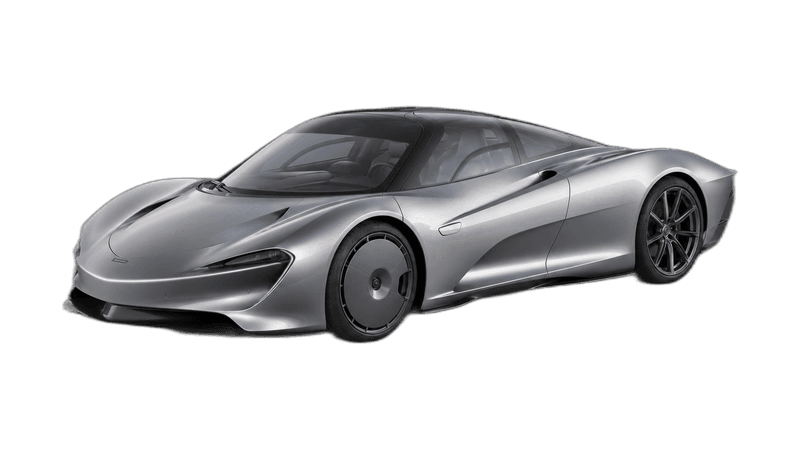
McLaren Speedtail
£2,200,000
usedIndicative market price, updated periodically.
1055bhp
Power
2.9s
0-100 km/h
403km/h
Top Speed
£2,200,000
Price Used
The McLaren Speedtail produces 1055 bhp, reaches 100 km/h in 2.9 seconds and has a top speed of 403 km/h. A representative example is worth about £2,200,000.
How hard it pulls.
Peak g-force the instant you bury the throttle, estimated from the car's 0–100 time and drivetrain.
McLaren SpeedtailEstimated peak launch g from the 0–100 time and drivetrain: an honest approximation, not a measured figure.
Dream Car Garage Editorial · Edited by José Teo Lorente Vallecillos · Last updated 2 November 2026
Overview
We have not driven this car. This review is based on published specifications and the sources listed below.
Scope of this guide
This guide is scoped to the standard production McLaren Speedtail, the 106-car, three-seat, mid-engine, rear-wheel drive hyper-GT with the 4.0L twin-turbo V8 petrol hybrid powertrain (3994 cc), first built in late 2019 with deliveries from February 2020. It is not a guide to the XP development prototypes, to one-off special commissions built on the same car, or to McLaren's other hypercars such as the P1 and the F1, which have their own entries. Where sources disagree with each other or with our catalogue, we say so in the section on figures that differ.
We have not driven this model for this article. Everything here comes from three cited sources: an evo report from 23 December 2019 on the end of testing, a PistonHeads "Spotted" feature by John Howell (31 July 2022) with a specification table, and the government recall checker. We also read a McLaren press release as reposted by Motorsport.ie (23 December 2019), a PistonHeads sales report by Matt Bird (9 May 2021), a Goodwood Road and Racing review by Andrew Frankel (13 August 2020) and a reference-site summary. Those extra pages are flagged where we use them, and we read several of them only as summaries, so treat them as pointers and check the originals.
What the car is
The Speedtail was revealed in October 2018 as McLaren's first Hyper-GT and the fastest road car the company had made. The headline layout is a central driving seat with a passenger seat on each side and slightly behind, which is the arrangement of the McLaren F1, and a long, low carbon-fibre body well over 5 metres long. PistonHeads quotes 5.2 metres, and a reference summary gives 5,137 mm. The engine sits behind the cabin, so the car is mid-engine, and the drive goes to the rear wheels only through a seven-speed dual-clutch gearbox.
The production run was fixed at 106 cars, the same number as the F1, and all of them were already spoken for before deliveries began. That matters for buying: there is no new-car queue, every car is a used car, and each one was ordered to a personal specification.
Engine, hybrid system and figures
The powertrain is a 4.0L twin-turbo V8 petrol hybrid. PistonHeads gives the V8 as 3,994 cc, with an electric motor between the engine and the gearbox. A reference summary puts the V8 alone at about 756 PS and 800 Nm, but McLaren's own split is not on any page we could read, so treat that as unconfirmed.
The combined figures we use are 1070 PS, which is 1055 bhp, and 1150 Nm. The 1055 bhp is our conversion of 1,070 PS using 0.98632, and the McLaren press release as reposted by Motorsport.ie prints both, "1,070PS (1,055bhp)". The torque figure is 848 lb ft in evo and PistonHeads, which is 1150 Nm. Acceleration is claimed at 2.9 seconds for 0-62 mph in Goodwood's review, which we treat as the 0-100 km/h time (62 mph is 99.8 km/h), with 6.6 seconds to 124 mph (200 km/h) and about 13 seconds to 186 mph (about 300 km/h). The top speed is 403 km/h (250 mph), and Goodwood says production cars are electronically limited to it.
Figures that differ between sources
This is the part to read before you quote a number to a seller or an insurer.
- Power: the October 2018 launch coverage printed 1,050 PS, about 1,035 bhp, and a reference summary still shows 1,036 hp for that figure. The later McLaren figure is 1,070 PS, which is 1055 bhp. Our catalogue used to say 1,036 bhp and now says 1055 bhp. PistonHeads writes "1,070hp" for the same number, which is a PS figure with the wrong label, and one Hagerty review prints 1,022 bhp, which no other source supports.
- 0-100 km/h: PistonHeads says 3.0 seconds for 0-62 mph, while Goodwood and a reference summary give 2.9 seconds. We use 2.9 seconds and say plainly that it is a claim.
- 0-186 mph: evo and the launch coverage say 12.8 seconds, the December 2019 release says under 13 seconds, and PistonHeads and Goodwood say 13 seconds. Nobody we read gives a measured time for a customer car.
- Weight: a reference summary gives 1,430 kg dry and 1,597 kg kerb, while Goodwood says 1,500 kg. We give no single figure.
- Top speed: the 403 km/h run was made on the XP2 development car, more than 30 times at the Kennedy Space Center runway in Florida, according to the press release. Customer cars can reach it only in Velocity mode.
- Years: the stored 2019 to 2020 range matches the start of build and the first deliveries, but cars were still being registered in 2021, and we found no source for a final completion date.
What it costs
Prices are a mix of new and used. The new price started at 2.1 million pounds before options and, according to PistonHeads, typically reached 3 million pounds by the time a car left Woking. Goodwood says paint options alone could cost up to 100,000 pounds. PistonHeads listed a 924-mile car (chassis 61) at 2,499,000 pounds in May 2021, and another with more options and lower mileage at 2,650,000 pounds. Those are asking prices from one dealer feature, not sale results, so do not treat them as a valuation.
Running costs are thinly documented. PistonHeads gives an official 18.1 mpg and 357 g/km of CO2, which says little about real use. A search summary of a video report quotes one owner paying about 2,200 dollars for a service and calling it a bargain compared with his other cars. That is a single anecdote that we saw only as a snippet, so it is not a service price list. We found no sourced figure for insurance, tyres, brakes or battery replacement, and we give none.
Technology and what is unusual
Several features are unique to this car and are where a specialist inspection earns its fee.
- Rear control surfaces: evo describes patented hydraulic carbon ailerons at the rear, in place of a normal spoiler. Goodwood says test cars completed over 70,000 deployments without problems, but that is a test claim and not an ownership record.
- Velocity mode: evo says this lowers the car by 35 mm and retracts the side aero pods. It is needed for the top speed.
- Wheels and tyres: evo notes 21-inch forged aluminium wheels with bespoke Pirelli tyres, and the front wheels carry fixed carbon covers. Ask about the age and source of the tyres.
- Battery and charging: evo says the battery sits between the passenger cell and the engine. Goodwood says the car cannot run on electricity alone and the battery can be charged by an induction pad. A reference summary gives 1.647 kWh, but we could not confirm that from McLaren.
- Braking: PistonHeads quotes 132 metres to stop from 124 mph.
- Cabin: three screens for driving data, navigation and entertainment, with buttons kept out of the driver's line of sight, and, according to a reference summary, cameras in place of door mirrors. Goodwood warns that a tall driver's seat pushes back into the shoulder room of the passengers behind.
Known faults and recalls
We did not find a model-specific fault list, and PistonHeads has no used buying guide for this car at the time of writing. We saw no Speedtail recall in the pages we read, and a third-party recall aggregator reported none in the United States, but that is not proof. The factory service bulletin we saw listed only by title (a clam and harness rework in an NHTSA bulletin archive) is not a recall, and we did not read it.
What to check before buying
- Confirm which of the 106 production cars it is, and ask for the chassis number and the original specification sheet. Experimental XP prototypes have also appeared for sale, and they are a different proposition.
- Ask for the full McLaren service history, including any bulletin or software work, and who carried it out.
- Test the rear ailerons, the Velocity mode sequence and the camera mirrors with the car on a ramp as well as on the road, and ask for the fault log.
- Ask about the battery condition and the induction charger, and whether the car has sat unused. Low-mileage cars have been offered at 30 and 924 miles.
- Check the tyres and wheel covers, and the carbon splitter and diffuser for damage.
- Check the car's registration status. A reference summary says the car does not meet United States safety standards, and one auction listing described a car delivered to a McLaren dealership there despite not being road legal.
- Sit in the central seat and each passenger seat before you commit, because the packaging is unusual.
- For a car on UK plates, run the registration through the recall check below.
Recalls and the government check
For a car with UK registration, use the government's check-vehicle-recall service to see whether any recall is outstanding on that specific vehicle. We did not run it for any car, and we have not confirmed that any recall exists, so a clean result on the day is worth more than our summary. For a car outside the UK, ask the importing dealer or McLaren for the equivalent check in that market.
Verdict
The McLaren Speedtail is 1055 bhp, 1150 Nm, a claimed 2.9 seconds to 100 km/h and 403 km/h, rear-wheel drive and mid-engine, in a run of 106. It is a car to buy on history and specification rather than on a price guide, because supply is tiny, options vary and the running-cost evidence is thin. We have not driven it, so use the cited sources and a specialist inspection to decide.
Specifications
| Engine | 4.0L twin-turbo V8 petrol hybrid |
|---|---|
| Displacement | 4.0L |
| Power | 1055 bhp |
| Torque | 1150 Nm |
| 0-100 km/h | 2.9s |
| Top Speed | 403 km/h |
| Drivetrain | RWD |
| Country | UK |
| Body Style | 3 seater fixed-head coupé |
| Years | 2019–2020 |
| Production | 106 |
| Price Used | £2,200,000 |
Specifications are manufacturer-published figures.
Frequently Asked Questions
What is a McLaren Speedtail worth?
A representative example is worth about £2,200,000. Actual values vary with specification, condition and history.
How much power does the McLaren Speedtail have?
The McLaren Speedtail produces 1055 bhp and 1150 Nm of torque.
How fast is the McLaren Speedtail from 0 to 100 km/h?
The McLaren Speedtail accelerates from 0 to 100 km/h in 2.9 seconds.
What is the top speed of the McLaren Speedtail?
The McLaren Speedtail has a top speed of 403 km/h.
What engine does the McLaren Speedtail have?
The McLaren Speedtail uses a 4.0L twin-turbo V8 petrol hybrid.
How many McLaren Speedtail were made?
McLaren produced 106 units of the McLaren Speedtail.
When was the McLaren Speedtail built?
The McLaren Speedtail was built from 2019 to 2020.
Is the McLaren Speedtail all-wheel drive?
No. The McLaren Speedtail is configured with rear-wheel drive.