
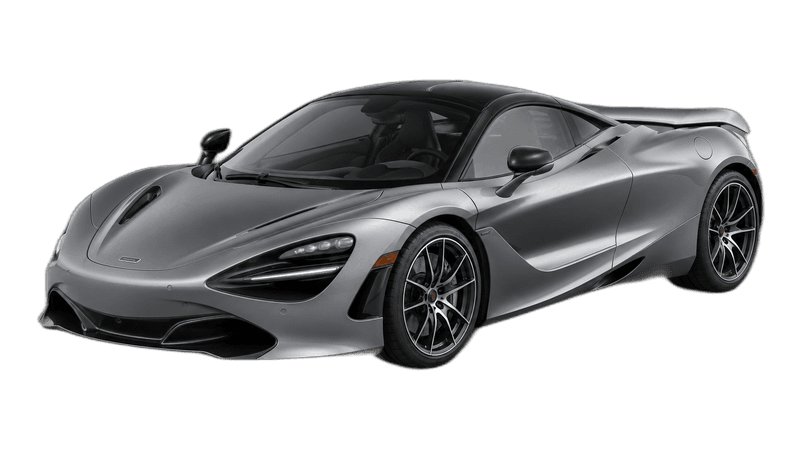
McLaren 720S
£185,000
usedIndicative market price, updated periodically.
710bhp
Power
2.9s
0-100 km/h
341km/h
Top Speed
£185,000
Price Used
How hard it pulls.
Peak g-force the instant you bury the throttle, estimated from the car's 0–100 time and drivetrain.
McLaren 720SEstimated peak launch g from the 0–100 time and drivetrain: an honest approximation, not a measured figure.
The McLaren 720S is a 2-door coupe by McLaren, with 710 bhp, 770 Nm of torque, a 0-100 km/h time of 2.9 seconds and a top speed of 341 km/h. Indicative used value: approximately £185,000. Actual values vary with specification, condition and history.
Dream Car Garage Editorial · Last updated 28 October 2026
Overview
We have not driven this car. This review is based on published specifications and the sources listed below.
Monocage II and the 710 bhp V8
The McLaren 720S is a rear-wheel-drive coupe with a 3,994 cc twin-turbo V8 producing 720 PS, approximately 710 bhp, and 770 Nm. Its Monocage II structure and second-generation Proactive Chassis Control distinguish it from the earlier Sports Series. McLaren's technical table lists 2.9 seconds to 100 km/h and 341 km/h, while the page overview separately says 2.8 seconds. The catalogue retains the table's 2.9-second figure and does not hide that discrepancy.
We have not driven this model for this article. This desk-researched guide uses McLaren's official 720S page, the PistonHeads 720S buying guide and McLaren's recall portal. The independent article dates from 2021, so its service and warranty prices are not current quotations. No official model-specific production total is established by these sources, and the scraped year in the catalogue count is removed.
Adaptive dampers and accumulator history
PistonHeads identifies adaptive-damper leaks and accumulator issues as inspection areas. Ask a McLaren specialist to assess the dampers, hydraulic components, ride height and any suspension warnings. Request invoices for previous work and ask whether the symptom returned. A firm ride or a warning-free dashboard alone does not establish the condition of the system.
Compare tyre wear with geometry, damper condition and any suspension repairs. If the car has seen circuit use, ask for subsequent inspections and fluid work rather than treating that use as automatic evidence of damage. If it has been stored, ask about recommissioning. The useful evidence is the individual car's measured condition, not a general reputation for the model.
Front lift and underbody access
Demonstrate the front lift where fitted and investigate warning messages, settling or incomplete operation. PistonHeads discusses front-lift concerns on the 720S. Inspect the front splitter, undertrays and visible suspension areas independently, because a functioning lift does not prove that the underside has avoided contact.
Ask which trays were removed and which areas remained inaccessible. Record any fluid residue, fastener damage or previous repair and obtain current quotations for further work. Do not accept a polished upper body as a substitute for an underbody inspection, especially on a low car with hydraulic lift equipment.
Brake-banjo campaign and carbon-ceramics
The buying guide discusses a brake-banjo recall affecting certain 2019 and 2020 cars. Do not assume that every 720S is affected or that a similar model year proves completion. Confirm the actual VIN with McLaren's regional recall route and an authorised retailer, and retain evidence of the work performed.
Measure the carbon-ceramic discs and pads and review brake-fluid history. Surface appearance alone cannot establish remaining service life. Ask for any brake warnings, post-track inspections and current estimates for identified work. A recall record and a consumables measurement answer different questions, so both belong in the inspection file.
Glass and body inspection
PistonHeads reports glass cracks as an ownership concern. Inspect the windscreen and other glass carefully, and have any mark assessed on its size, location and repair history rather than dismissed or exaggerated. Check the wipers and washers, and ask whether glass was replaced and why.
Inspect the active rear spoiler, front splitter and body panels for damage, alignment and previous repairs. The 720S's aerodynamic equipment should be demonstrated through appropriate controls and diagnosis rather than improvised high-speed testing. Record replaced panels or trim and compare them with the factory build record where available.
Cabin trim and equipment
The buying guide mentions loose or discoloured trim. Inspect the seats, dashboard, switches and fitted carbon or leather options for condition and secure attachment. Test seat adjustment, windows, mirrors, climate control and lighting. A low odometer does not establish that the cabin has avoided wear or poor repairs.
Demonstrate the infotainment, Bluetooth, navigation, cameras and audio functions. The 720S system is distinct from earlier IRIS equipment, so do not import every earlier-model complaint. Ask for software and battery history, and investigate any recurring warning rather than simply clearing it before the viewing.
Engine and transmission evidence
Observe the V8 cold and warm, inspect accessible fluids and request diagnostic records before clearing warnings. Ask for annual or 10,000-mile service evidence as appropriate to the car, including oil, filters and any coolant or turbo-related work. The guide's prices are not current estimates for this individual vehicle.
Assess the twin-clutch gearbox through normal operation and model-appropriate diagnostics. Do not use repeated launches as a substitute for a service history or compare it directly with a single-clutch automated manual. Ask about software updates and whether any warning or shift issue returned after repair.
Service continuity and recall route
Build a dated file of annual maintenance, suspension work, brake campaigns, diagnostics, storage and recommissioning. Regular use with complete invoices can be more informative than low mileage and long gaps. Confirm current service requirements with a McLaren specialist and obtain written estimates for immediate work.
McLaren's official recall portal links regional recall routes. Use the appropriate region or an authorised retailer with the actual VIN, and retain confirmation of completed campaigns. The portal is not a single worldwide all-campaign lookup, and a clear result does not verify unrelated servicing.
Method and limits
An independent 720S inspection should combine adaptive-suspension assessment, lift operation, measured brakes, VIN-specific campaign checks, glass, trim and diagnostics. Record anything not demonstrated and arrange follow-up for material omissions. Separate owner accounts from measurements and completed repairs.
We have not driven this model for this article. No present valuation, investment return or universal reliability claim is offered. The official page establishes the model and exposes the 2.8/2.9-second presentation difference, while the dated buying guide supplies bounded inspection prompts. Production remains unset, and the individual car's history matters more than an unsupported total.
Specifications
Engine
4.0L (3994 cc) twin-turbo V8
Displacement
4.0L
Power
710 bhp
Torque
770 Nm
0-100 km/h
2.9s
Top Speed
341 km/h
Drivetrain
RWD
Country
UK
Body Style
2-door coupe
Years
2017–2023
Price Used
£185,000
Specifications are manufacturer-published figures.
More from McLaren




Featured in Carpedia
Best Supercars Under €500,000 in 2026
Eight supercars between €200,000 and €500,000 that represent the pinnacle of attainable performance, from the McLaren 720S to a Ferrari 458 Italia at its depreciation floor.
Laguna Seca: America's Greatest Circuit Challenge
WeatherTech Raceway Laguna Seca is the benchmark for production car performance in North America. Its 11 corners, anchored by the iconic Corkscrew descent, expose every aspect of a car's capability. Here are the fastest times ever recorded on this beloved circuit.
Suzuka: The Figure-Eight That Defines Champions
Suzuka Circuit's distinctive figure-eight layout, the only overpass crossing in modern Formula 1, combines technical precision with high-speed commitment across 5.807 km of Japanese engineering philosophy. Here are the production cars that have conquered it most completely.
What Cars Should I Put in My Dream Garage?
A comprehensive guide to building a dream garage at every budget. Five balanced 5-car garages, from under GBP 100K total to unlimited, each covering daily driving, weekends, track days, road trips, and special occasions.
Ferrari SF90 Stradale vs McLaren 765LT vs Lamborghini Revuelto
The SF90, the 765LT, and the Revuelto represent three incompatible answers to a single question: what should a supercar of the highest order feel like? Torque vectors, flyweights, and twelve-cylinder symphonies, the answer depends entirely on what you value.
Best First Supercars to Buy in 2026
Eight supercars that reward first-time ownership without punishing inexperience, selected for mechanical approachability, established specialist networks, and the kind of driving experience that earns its licence.
Frequently Asked Questions
What are the specifications of the McLaren 720S?
The McLaren 720S is a 2-door coupe by McLaren, with 710 bhp, 770 Nm of torque, a 0-100 km/h time of 2.9 seconds and a top speed of 341 km/h. Indicative used value: approximately £185,000. Actual values vary with specification, condition and history.
How much does a McLaren 720S cost?
Indicative used value: approximately £185,000. Actual values vary with specification, condition and history.
What drivetrain does the McLaren 720S use?
The McLaren 720S is configured with rear-wheel drive.
What type of car is the McLaren 720S?
The McLaren 720S is a supercars manufactured by McLaren in UK. Production ran from 2017 to 2023.