Ferrari 250 GTO
296cv
Potenza
280km/h
Velocita Massima
The Ferrari 250 GTO produces 296 bhp and has a top speed of 280 km/h.
Dream Car Garage Editorial · Edited by José Teo Lorente Vallecillos · Last updated 3 November 2026
Panoramica
We have not driven this car. This review is based on published specifications and the sources listed below.
Scope of this guide
This guide is scoped to the Ferrari 250 GTO, the front-engine, rear-wheel drive berlinetta that Ferrari built from 1962 to 1964 with a 3.0L V12. It is not a guide to the 4.0-litre cars that sometimes get counted beside it, such as the three cars the sources call 330 GTO and the 330 LM that RM Sotheby's catalogues as a "330 LM / 250 GTO", and it is not a guide to the 250 GT SWB that came before it. Where a source mixes these cars together we say so. The Ferrari 250 GTO is an auction-only car. Nobody buys one from a showroom or a classified advert, so this page is a reading guide for people who want to understand the car and the paperwork around it. It cannot replace a specialist inspection or Ferrari Classiche certification, and it should not be used to value or bid on a particular chassis.
We have not driven this model for this article. Everything below comes from pages we opened and read: the English Wikipedia article, the RM Sotheby's catalogue page for chassis 3765, a ferrarifl.com blog page on the car, a supercars.net report on the 2014 Bonhams sale of chassis 3851 GT, a ConceptCarz summary of the 2023 sale, and an article on Ferrari Classiche at ferraris-online.com. Several other pages refused or failed to load and are listed in the section called What we could not find.
The figures at a glance
- Engine: 3.0L V12, the Tipo 168/62 Comp/62, a 60 degree V12 with a single overhead camshaft per bank, two valves per cylinder, dry sump lubrication and six Weber 38 DCN carburettors. Displacement is 2,953 cc and compression ratio is 9.7:1 (Wikipedia).
- Power: 296 bhp, which is Wikipedia's "300 PS (296 hp; 221 kW) at 7,500 rpm". The ferrarifl.com page prints "296 hp (300 PS) @ 7,500 rpm".
- Torque: 294 Nm at 5,500 rpm on Wikipedia, and the ferrarifl.com page gives 217 lb-ft at 5,500 rpm, which is the same figure in other units. Both are secondary sources, not a Ferrari document.
- 0-100 km/h: no figure shown. We found no 0-100 km/h time in any page we read. The ferrarifl.com page gives about 5.4 s to 60 mph, which is a different measurement, and we do not convert it.
- Top speed: 280 km/h. The ferrarifl.com page says "~174 mph", and 174 mph is 280 km/h. It is the only top speed we found, it is approximate, and Wikipedia gives none, so treat it as a rough period figure and not a measured result.
- Drive: front-engine, rear-wheel drive, with a five-speed manual gearbox with Porsche-type synchromesh (Wikipedia).
- Size and weight: wheelbase 2,400 mm; length, width and height 4,325 mm, 1,600 mm and 1,210 mm; weight listed as 880 to 950 kg on Wikipedia, and about 880 kg dry on ferrarifl.com.
- Built: 36 cars between 1962 and 1964, though the count depends on what you include, as explained below.
Where the figures disagree
Power is the first disagreement. Wikipedia and ferrarifl.com both give 300 PS and 296 hp, which are the same output in metric and mechanical horsepower. RM Sotheby's catalogue page simply says the standard car makes "300 horsepower" with six Weber carburettors. We chose 296 bhp because the bhp label belongs to the mechanical unit and 296 is what 300 PS converts to; 300 is the PS number with the wrong unit attached. We also looked for a 302 bhp figure and did not see it in any page we read. One specialist page we opened, from a UK Ferrari workshop, gave a V8 layout, a turbocharged engine and a power and top speed that match a different, later Ferrari, so we discarded it entirely.
Top speed looks like a conflict but is not one. Some write-ups say 280 km/h and others 174 mph, and those are the same number. The real problem is that only one page we read gives either figure.
Production is the other big disagreement. Wikipedia and ferrarifl.com count 36 cars: 33 Series I cars with 1962 to 1963 bodywork and 3 Series II cars with 1964 bodywork built new. Both say four earlier Series I cars were updated to Series II bodies in 1964, and ferrarifl.com adds that they are inside the 36, not extra. Wikipedia says some counts reach 39 by adding three 4.0-litre cars, and ferrarifl.com says "some sources cite 39". RM Sotheby's says 34 cars were built with Tipo 1962 coachwork, which is one more than the 33 Series I cars the other two pages give, and it does not mention 36, 39 or Series II at all. A supercars.net report calls chassis 3851 GT "the 19th of 36". We use 36 because Wikipedia, ferrarifl.com and the supercars.net report all give it, and we flag the rest.
History and what changed by year
The sources describe the 250 GTO as a racing berlinetta from 1962. Wikipedia credits Giotto Bizzarrini as chief engineer and the usual designer, says he left Ferrari in 1962, and says Sergio Scaglietti built the bodies and Mauro Forghieri oversaw further development. It also says the design was collaborative and cannot be pinned on one person. Wikipedia lists the first production chassis as 3223GT and 3387GT, though its text and its chassis table disagree on whether they were completed in late 1961 or in 1962, so we do not give a first-car date. The ferrarifl.com page says the car sold new in the United States for about $18,000, while Wikipedia's table gives $18,500 for 1962; both are for the US and neither is a Ferrari price list we saw.
Buyers were chosen, not sold to. The ferrarifl.com page says the car was offered only to buyers personally approved by Enzo Ferrari and Luigi Chinetti, and that eight of the 36 cars were right-hand drive. By 1964 the factory offered the revised Series II bodywork. The ferrarifl.com page says chassis 3413, a Series II car, went back to Scaglietti in 1964 with its original engine and gearbox intact. That is a useful example of why chassis histories matter: a car's body, engine and gearbox can have separate stories.
Series I, Series II and the cars that are not this car
Three groups are easy to confuse, so check which you are reading about.
- Series I, with the original 1962 to 1963 bodywork. RM Sotheby's describes its chassis 3765 as the only example originally built with a 4-litre engine and notes that Ferrari converted it to 250 GTO specification in May 1963, when a 3-litre engine numbered 670/62E was fitted. The page calls it the 14th of 34 cars with Tipo 1962 coachwork.
- Series II, with 1964 bodywork, three built new and four earlier cars updated. Some writers call the new ones the 250 GTO 64.
- The 4.0-litre cars: the three 330 GTO cars and, in the sources, the 330 LM and 330 LMB names. They are a different engine and a different car. RM Sotheby's calls 3765 the "only example originally equipped with a 4-liter engine", and says Ferrari later fitted a 3-litre engine. If an advert says GTO but talks about a 4.0L engine, that is not the car in this guide.
What to check before buying
Because the car is auction-only, the checking happens in the catalogue and the archive long before anyone raises a paddle. We have not inspected any car, so this is a reading list drawn from what the catalogues emphasise.
- Provenance and chassis number. Each of the 36 cars has a number such as 3851 GT or 3413. RM Sotheby's lists the factory build sheets, a history report by Rosso Corsa Consulting, owner correspondence and period racing coverage for chassis 3765. Expect that depth of paper, and be suspicious of a car without it.
- Body. Ask whether the body is Series I or Series II, whether it was changed in 1964, and whether it is the original body for that chassis. RM Sotheby's mentions the coachwork being refinished in yellow in 1967, so colour history matters too.
- Engine and gearbox. Check whether the engine and gearbox are the ones recorded for the chassis. The 3851 GT report says that car crashed at Montlhery and was repaired by Ferrari in Italy, which shows how a racing history can include damage and repair.
- Replicas and disputes. Wikipedia's reference list includes news headlines about an alleged fake and about a legal dispute over a gearbox. We did not read those stories, so we draw no conclusion beyond saying that a buyer should expect the question to be asked.
- Certification. See the next section.
Ferrari Classiche and the Red Book
Ferrari Classiche is the maker's own heritage department. An article on ferraris-online.com says it was introduced in 2005 and that its restoration shop opened in July 2006. Certification ends with a bound Red Book. The same article says a metallurgy test costs about $1,500, that the research fee for most 1960s cars is $3,125, and that certification of a 250 GTO cost $16,250 in the article's "today", up from $7,500 in 2010. The page is undated; the writer compares 2010 with "today" and talks about a seven-year change, which suggests about 2017, but that date is our inference. Do not treat those fees as current. The article also says a certified car needs a stamped annual service at a Classiche workshop to keep its status. Ferrari's own Classiche pages loaded blank for us, so these are one writer's claims and not a Ferrari statement. For a car like this, a Red Book is a starting point and not a substitute for a specialist inspection.
Running costs and known issues
We found no service schedule, no engine rebuild interval, no parts price list and no insurance figure for the 250 GTO, so we give none. The pages we read are about racing history, auction results and certification, not ownership. We also found no list of recurring faults, and we will not guess at one. Any seller or specialist who quotes you a running cost should be asked for the invoices behind it.
Recalls and safety
We found no recall or safety notice for the 250 GTO in any page we read, and we did not open a recall database for it. These are 1960s competition cars, not mass-market road cars, and the absence of a recall in our sources is not evidence that nothing needs attention. Treat brakes, fuel system, steering and tyres as items for the specialist inspection.
Market and value notes
Auction history is the best-documented part of the story, and the pages disagree in small ways. Wikipedia's table lists these results: $2,500 in 1969 for chassis 3223GT, $6,000 in 1971 for 3589GT, $1,600,000 in 1987 for 4757GT at an FBI auction, $38,115,000 in 2014 for 3851GT at Bonhams Quail Lodge, $48,405,000 in 2018 for 3413GT at RM Sotheby's Monterey, $51,705,000 on 13 November 2023 for 3765LM at RM Sotheby's New York, and $38,500,000 on 17 January 2026 for 3729GT at Mecum in Florida. RM Sotheby's and ConceptCarz both confirm the $51,705,000 result for chassis 3765, and ConceptCarz gives the date as 13 November 2023. Wikipedia's text gives the 2018 sale as 25 August in one place and 26 August in another, so we leave the day out. The ferrarifl.com page reports a private sale of about $70 million and a "typical" 2026 range of about $38,000,000 to $52,000,000. These are single results for particular cars with particular histories, not a price list, and the 2023 car was a 4-litre works car converted to GTO specification, which is not typical. We could not open the Hagerty valuation page, so we have no insurer valuation.
What we could not find
- No 0-100 km/h time, which is why the figures section says no figure shown for it.
- No torque figure from Ferrari itself, only the Wikipedia and ferrarifl.com figures above.
- No running costs, service intervals, known faults or recalls.
- Ferrari's own 250 GTO and Classiche pages loaded blank. We did not try to get round any of them.
- Any official Ferrari statement of the production count, and any single page that settles 34, 36 or 39.
About the photograph
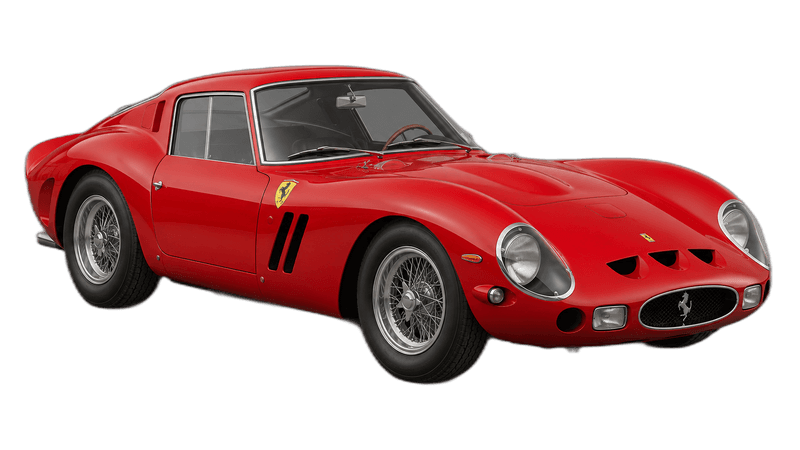
The page uses the catalogue photograph, and its credit is listed on the credits page.
Verdict
The Ferrari 250 GTO in this guide is a front-engine, rear-wheel drive 3.0L V12 berlinetta with a stated 296 bhp (300 PS) and 294 Nm, a rough period top speed of 280 km/h, and 36 cars built from 1962 to 1964 on the count most pages agree on. The numbers are secondary-source figures, the 0-100 km/h time is missing, and the production total depends on whether you count the Series II cars and the 4.0-litre cars. A web guide cannot carry the weight of a purchase that runs to tens of millions of dollars. Use the catalogue, the chassis paperwork, an independent specialist inspection and Ferrari Classiche certification to decide, and remember that we have not driven or inspected any example.
Sources
- Wikipedia: Ferrari 250 GTO (specifications, production, auction table)
- RM Sotheby's: 1962 Ferrari 330 LM / 250 GTO by Scaglietti, chassis 3765 (catalogue page)
- ferrarifl.com: Ferrari 250 GTO specs, price and production
- supercars.net: 1962 Ferrari 250 GTO, s/n 3851 GT, 2014 Bonhams Quail Lodge
- ConceptCarz: RM Sotheby's sale of Ferrari 330 LM / 250 GTO, November 2023
- ferraris-online.com: Ferrari Classiche revisited (Red Book process and fees, undated)
Specifiche
| Motore | 3.0L V12 |
|---|---|
| Cilindrata | 3.0L |
| Potenza | 296 cv |
| Coppia | 294 Nm |
| Velocita Massima | 280 km/h |
| Trazione | RWD |
| Paese | Italy |
| Carrozzeria | 2-door coupé |
| Anni | 1962–1964 |
| Produzione | 36 |
Specifications are manufacturer-published figures.
Domande Frequenti
How much power does the Ferrari 250 GTO have?
The Ferrari 250 GTO produces 296 bhp and 294 Nm of torque.
What is the top speed of the Ferrari 250 GTO?
The Ferrari 250 GTO has a top speed of 280 km/h.
What engine does the Ferrari 250 GTO have?
The Ferrari 250 GTO uses a 3.0L V12.
How many Ferrari 250 GTO were made?
Ferrari produced 36 units of the Ferrari 250 GTO.
When was the Ferrari 250 GTO built?
The Ferrari 250 GTO was built from 1962 to 1964.
Is the Ferrari 250 GTO all-wheel drive?
No. The Ferrari 250 GTO is configured with rear-wheel drive.