
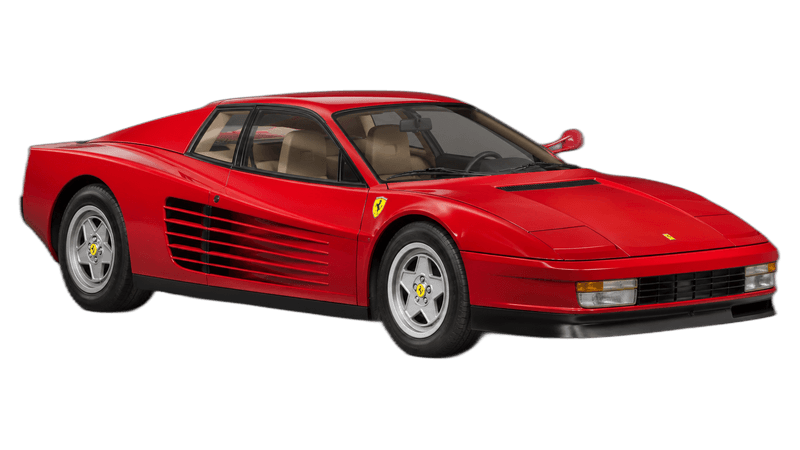
Ferrari Testarossa
385bhp
Power
5.8s
0-100 km/h
290km/h
Top Speed
How hard it pulls.
Peak g-force the instant you bury the throttle, estimated from the car's 0–100 time and drivetrain.
Ferrari TestarossaEstimated peak launch g from the 0–100 time and drivetrain: an honest approximation, not a measured figure.
The Ferrari Testarossa is a 2-door coupé by Ferrari, with 385 bhp, 490 Nm of torque, a 0-100 km/h time of 5.8 seconds and a top speed of 290 km/h.
Dream Car Garage Editorial · Edited by José Teo Lorente Vallecillos · Last updated 3 November 2026
Overview
We have not driven this car. This review is based on published specifications and the sources listed below.
Scope of this guide
This guide is scoped to the Ferrari Testarossa, the Pininfarina-styled two-door coupe that Ferrari revealed in Paris in 1984 and built until 1991. It is a mid-engine car with rear-wheel drive, a flat-12 engine and a five-speed manual gearbox. It is the original car only. The 512 TR (1991 onward) and the F512 M (1994 to 1996) are developments of the same design with more power and different mechanical details, and we mention them only so that you can tell them apart in an advert. The one-off Testarossa Spider and the coachbuilt conversions are also outside the scope, apart from a short note below.
We have not driven this model for this article. We are an editorial desk that reads sources, and everything below comes from pages we opened: Wikipedia, the Goodwood Insurance buyer's guide, the Classic Trader buying guide (dated 28 January 2021), the Supercars.net profile, the Autocade entry, an article on Petrolicious that reproduces a buying guide, and two RM Sotheby's lot pages. This page is for research, not a buying recommendation, and a web guide cannot replace an inspection by a specialist who knows these cars.
The figures at a glance
- Engine: 4.9L naturally aspirated flat-12, 4,943 cc, with double overhead camshafts and four valves per cylinder (48 valves in total), dry-sump lubricated, per Wikipedia. RM Sotheby's calls it a horizontally opposed 12-cylinder, and Bosch KE-Jetronic fuel injection is named on the 1986 lot page.
- Power: 385 bhp. Ferrari's European figure is 390 PS at 6,300 rpm, which Goodwood and Wikipedia print. We convert 390 PS to bhp by multiplying by 0.98632, which gives about 385 bhp, and Wikipedia prints the same 385 hp. We use 385 bhp everywhere on this page.
- Torque: 490 Nm at 4,500 rpm, the figure in the Goodwood guide and in Wikipedia's text.
- 0-100 km/h: 5.8 seconds. Wikipedia gives 5.8 seconds for 0-100 km/h. Goodwood gives 5.8 seconds for 0-62 mph, which is within a fraction of a kilometre per hour of the same thing. We did not relabel any 0-60 mph time as a 0-100 km/h time.
- Top speed: 290 km/h. Wikipedia labels it an estimate of 290 km/h (180 mph). Goodwood gives 180 mph and Supercars.net gives about 290 km/h. A claimed speed from a car of this era is a manufacturer-style estimate, not an independent measurement we can vouch for.
- Drive: rear-wheel drive through a five-speed manual. Classic Trader says there was one five-speed gearbox option throughout, with minor updates in 1988.
- Production: 7,177 cars of the original Testarossa, 1984 to 1991.
- Weight: 1,506 kg per Goodwood and Supercars.net, but 1,708.2 kg in Wikipedia's table. See the next section.
Where the sources disagree
We say plainly where our sources do not agree, and which figure we chose.
Power is the first case. The sources we read give 390 PS, 390 bhp, 390 hp, 385 bhp and 380 bhp. Some of the spread is only units, because 390 PS is about 385 bhp. Some is real. Wikipedia lists 385 PS (380 hp) for early US cars, Classic Trader says US cars with catalytic converters made 10 bhp less than European cars, and Autocade says 380 PS after a catalytic converter was added. Wikipedia's table also lists lower figures for catalyst cars, 370 PS and 381 PS depending on years. The RM Sotheby's 1986 lot page says 380 bhp and the 1987 lot page says 390 horsepower. We chose 385 bhp as the European 390 PS output converted, and the buyer should expect a US-market or catalyst car to be a little lower.
Torque differs as well. Wikipedia's text and Goodwood say 490 Nm, while Supercars.net says 480 Nm at 4,500 rpm and Wikipedia's own table lists 480 Nm for the 1984 to 1989 cars. We chose 490 Nm because two sources print it in their headline specification.
Acceleration is reported on different yardsticks. Supercars.net gives about 5.2 seconds for 0-60 mph, Classic Trader gives 5.3 seconds, Wikipedia mentions a Motor Trend 0-60 mph time of 5.29 seconds, and RM Sotheby's says just over five seconds. Those are 0-60 mph figures. Wikipedia lists 5.7 seconds for the later catalyst car and 6.1 seconds for the US car at 0-100 km/h. We kept 5.8 seconds as the headline for the standard European car.
Production is the most important disagreement for a catalogue. Wikipedia, Classic Trader, Autocade, Supercars.net and an RM Sotheby's lot description all give 7,177 for the original car. Wikipedia breaks the family down as 7,177 original cars, 2,261 of the 512 TR and 501 of the F512 M, which adds up to 9,939 for 1984 to 1996, and we checked that the sum is correct. So 7,177 does not include the 512 TR or F512 M. Supercars.net also prints 8,177 on one listing that conflicts with its own table, which looks like a typo, and we ignored it. We did not find a source in our reading that gives a different count for the original run.
Dates also vary. Wikipedia and RM Sotheby's date the reveal to the 1984 Paris Motor Show, and RM Sotheby's says the car was unveiled the evening before the show opened at the Lido nightclub on the Champs-Elysees. The Petrolicious article says the car was introduced in 1985, and Autocade gives the run as 1984 to 1992. Wikipedia lists the original run as 1984 to 1991. We use 1984 to 1991, with 1984 meaning the reveal rather than the first customer delivery.
Weight is the last disagreement. Goodwood and Supercars.net say 1,506 kg, Goodwood calling it dry, while Wikipedia lists a kerb weight of 1,708.2 kg. The gap is large enough that we would not quote either as a definitive figure.
History and design
Both Wikipedia and RM Sotheby's describe the Testarossa as the replacement for the Berlinetta Boxer, the 512 BB. Goodwood notes that the mid-engine flat-12 line began in the early 1970s with the 365 GT4 BB, and that the Testarossa added a four-valve engine and improved packaging. Classic Trader calls the 4.9-litre unit an evolution of the 512BBi engine. Autocade credits Pininfarina with the styling, and the Petrolicious article says the side strakes feed the side-mounted radiators.
The car was a pop-culture icon. Goodwood links its appeal to Miami Vice, the Outrun video game and its poster-wall status, and RM Sotheby's says the 1986 car it sold represents the model that starred alongside Don Johnson and Philip Michael Thomas. Goodwood describes the car as large, wide and heavy, with non-assisted steering and a stiff gated manual shift, and says the engine sits above the gearbox, so handling at the limit demands respect. We have no way to judge that ourselves, and we note it as Goodwood's view.
Changes over the run
Sources agree that small changes happened year by year, though they disagree on exact timing.
- The early mirror. Early cars had a single high-mounted driver's-side mirror, called the monospecchio. RM Sotheby's describes it as mounted high on the A-pillar and calls it the flying mirror. Classic Trader says it resulted from a misreading of European law and that low-mounted mirrors were standard from 1986. Wikipedia says the US driver's mirror was lowered for 1987 and a passenger mirror added. Goodwood says early cars with this mirror and centre-lock wheels command a premium, and Classic Trader warns that a high mirror on a later car may be an aftermarket fitting.
- Wheels. Wikipedia says the 1985 model year had magnesium single-bolt knock-off wheels on Michelin TRX tyres, standard 16 inch wheels from 1986, and a five-bolt pattern from mid-1988. Classic Trader says the TRX system was short-lived and that single-bolt wheels changed to five-stud in 1988, while Goodwood says conventional five-stud wheels appeared in 1987. We cannot settle the year, so check the individual car.
- 1986 and 1987. Classic Trader says US-spec cars gained large rear safety bumpers and a third brake light in 1986 and a passive restraint system in 1987 with subtle dashboard changes.
- 1988 and 1989. Classic Trader says gearbox internals were updated in 1988 and that catalytic converters became standard on European cars in 1989. Goodwood says engines after 1987 had upgrades, including a chain-driven water and oil pump that many earlier cars have since been retrofitted with.
- Spider. Wikipedia describes one official convertible, commissioned in 1986 by Gianni Agnelli, which Ferrari declined to put into production, and says it sold at auction in 2016 for 1.3 million US dollars. Several firms built unofficial conversions.
What to check before buying
This list comes from the Goodwood and Classic Trader guides. It is a set of questions to put to a specialist, not an inspection.
- Cambelts. Goodwood says every five years, and notes it is an engine-out job and a chance to renew the clutch and ancillaries. Classic Trader says every 15,000 miles or three years. Those intervals do not agree, so ask the specialist what the car's history and use call for.
- Service history. Classic Trader recommends annual service or about 6,000 to 7,000 miles, and says neglected engines can be very costly to repair. Cars that sat unused may need a recommissioning service, and Goodwood says lack of use can gum up coolant pipes.
- Water pumps. Classic Trader says cars made before 1989 can suffer early failures and have a factory update. Look for evidence it was done.
- Rubber and pipes. Seals, pipes and air-conditioning hoses perish or harden if a car stands.
- Gearbox. Second gear may be hard to engage until the oil warms, which Classic Trader says is normal, and Goodwood says a cold engine can run lumpy and the gearbox feels stiff.
- Brakes and suspension. A pulsing brake pedal suggests warped rotors, and the shocks and bushes need regular checks because the car is heavy.
- Bodywork and corrosion. Most panels are aluminium, so Classic Trader does not treat rust as a major concern, but Goodwood warns that the steel frame, doors and roof can hide costly corrosion, and names the wheel arch inners, sills and side strakes. Check panel alignment and that the side strakes are straight.
- Electrics and interior. Switches and buttons are a weak point, and replacement trim and switchgear can take some searching.
- Tyres and wheels. Goodwood says metric tyres can be hard to find and centre-locks can come loose.
- Recalls. Classic Trader says US cars had recalls for passive restraint seatbelts and a steering column locknut, and that buyers should check the fixes were done. We did not search any recall database ourselves.
Running costs
Classic Trader gives running costs a one-star rating, meaning expensive, and Goodwood says upkeep is costly whether the car is driven or stored. Classic Trader says the clutch is typically replaced around every 15,000 miles and can be combined with the cambelt job to save labour. We did not find a published repair bill from a source we could cite, so we give no cost for a cambelt service or an engine-out job. Anyone quoting one without a source is guessing. Classic Trader gives fuel economy as 22 mpg.
Market and value notes
The prices below come from specific pages and dates, cover different cars, and are not a price list.
- Classic Trader, 28 January 2021: a good Testarossa with a few miles had been around 70,000 US dollars for some time, values may have dipped slightly in the previous year, and good examples were becoming pricey. It lists Ferrari Classiche certification, right-hand drive, early single-mirror cars, mileage and colour as value factors.
- RM Sotheby's, Arizona 2017: a 1986 monospecchio car with fewer than 8,000 miles and Ferrari Classiche certification sold for 151,250 US dollars.
- RM Sotheby's, Fort Lauderdale 2014: a 1987 car with two owners carried an estimate of 60,000 to 70,000 US dollars and was listed as not sold.
- Supercars.net lists sales between 2010 and 2015, including 57,750 US dollars for a 1989 car at RM Monterey in 2010, 50,000 US dollars for a 1988 car at Mecum Monterey in 2014, and 264,000 US dollars for a 1989 car at RM Monterey in 2012. It gives a new price of 181,000 US dollars in the US and 62,666 pounds sterling in the UK.
- The Petrolicious article, which appears to date from November 2017, listed project cars at 50,000 to 60,000 pounds sterling, good cars at 60,000 to 100,000, concours cars at 100,000 to 130,000, and a 200,000 pound sterling auction high for a 1987 car.
Goodwood adds that high production numbers mean less pressure to treat the car as an investment than some other Ferraris, and that condition, history and evidence of regular use matter more than mileage.
What we could not find
The Ferrari.com page for the Testarossa returned no usable content to us, so we have no maker document for any figure here. Our specifications therefore come from Wikipedia, Goodwood, Classic Trader and auction essays, none of which is a factory source. We did not find a source that settles the exact power, torque or weight of every market and year, and we found no maker-confirmed cambelt interval. We found no recall data beyond the two US items named by Classic Trader, no crash-safety data, and no verified repair costs. We also did not find a first-party delivery start date, only the Paris reveal.
About the photograph
This page uses the catalogue photograph for the car. Its credit is listed on the credits page.
Verdict
The original Ferrari Testarossa is a mid-engine, rear-wheel-drive coupe with a 4.9L naturally aspirated flat-12 making about 385 bhp and 490 Nm, a quoted 5.8 seconds to 100 km/h and an estimated 290 km/h top speed, with 7,177 built between 1984 and 1991. The numbers carry caveats, because power, torque and weight vary by source, market and catalytic converter fitment. The practical advice from the guides we read is to insist on service records, to treat the engine-out cambelt and clutch work as a normal cost of ownership, to check the water pump update and rubber hoses, and to look past the aluminium panels at the frame, doors and roof. We have not driven it, so use the sources, the seller's records and an independent specialist inspection to decide.
Sources
- Wikipedia: Ferrari Testarossa
- Goodwood Insurance: Ferrari Testarossa buyer's guide
- Classic Trader: The Ferrari Testarossa buying guide (28 January 2021)
- Supercars.net: 1984-1991 Ferrari Testarossa
- Autocade: Ferrari Testarossa
- Petrolicious: Ferrari Testarossa buying guide
- RM Sotheby's: 1986 Ferrari Testarossa Monospecchio (Arizona 2017)
- RM Sotheby's: 1987 Ferrari Testarossa (Fort Lauderdale 2014)
Specifications
Engine
4.9L naturally aspirated flat-12
Displacement
4.9L
Power
385 bhp
Torque
490 Nm
0-100 km/h
5.8s
Top Speed
290 km/h
Drivetrain
RWD
Country
Italy
Body Style
2-door coupé
Years
1984–1991
Production
7,177
Specifications are manufacturer-published figures.
More from Ferrari
Frequently Asked Questions
What are the specifications of the Ferrari Testarossa?
The Ferrari Testarossa is a 2-door coupé by Ferrari, with 385 bhp, 490 Nm of torque, a 0-100 km/h time of 5.8 seconds and a top speed of 290 km/h.
How many Ferrari Testarossa were made?
Ferrari produced 7,177 units of the Ferrari Testarossa.
What drivetrain does the Ferrari Testarossa use?
The Ferrari Testarossa is configured with rear-wheel drive.
What type of car is the Ferrari Testarossa?
The Ferrari Testarossa is a supercars manufactured by Ferrari in Italy. Production ran from 1984 to 1991.