Ferrari F40
£3,200,000
usedIndicative market price, updated periodically.
478bhp
Power
4.1s
0-100 km/h
324km/h
Top Speed
£3,200,000
Price Used
The Ferrari F40 produces 478 bhp, reaches 100 km/h in 4.1 seconds and has a top speed of 324 km/h. A representative example is worth about £3,200,000.
How hard it pulls.
Peak g-force the instant you bury the throttle, estimated from the car's 0–100 time and drivetrain.
Ferrari F40Estimated peak launch g from the 0–100 time and drivetrain: an honest approximation, not a measured figure.
Dream Car Garage Editorial · Edited by José Teo Lorente Vallecillos · Last updated 3 November 2026
Overview
We have not driven this car. This review is based on published specifications and the sources listed below.
Scope of this guide
This guide is scoped to the Ferrari F40, the road-going two-seater that Ferrari built from 1987 to 1992. It is a mid-engine car with a longitudinal twin-turbocharged V8 behind the cabin, a five-speed manual gearbox and rear-wheel drive. It covers the road car in its European form and in the catalyst-equipped form sold in the United States. It does not cover the competition cars built on the same basis: the F40 LM, which the sources describe as a Michelotto-built racer for IMSA rules, the Competizione it was renamed as, and the GTE. One source counts 19 LM and Competizione cars built between 1989 and 1994, and another says only 19 LM cars were produced. If an advert says LM, treat it as a different and far more expensive purchase.
We have not driven this model for this article. Everything below comes from pages we read: specialist and press buying guides, an auction-house catalogue essay, an auction-house explainer, a Ferrari specialist's model page and the UK government recall checker. We have not owned, inspected or tested an F40, and we cannot tell you what one is like to live with from experience. Where the sources disagree we say so, and we say which figure we chose.
The figures at a glance
- Engine: 2.9L twin-turbo V8, 2936 cc. Evo prints 2936cc and a Ferrari specialist's table prints 2,936.25 cc, so the displacement is not in dispute.
- Power: 478 bhp at 7000 rpm. See the next section for why other numbers appear.
- Torque: 577 Nm at 4000 rpm, from the specialist's technical table. The press guides print 425 or 426 lb-ft instead, and one converts 425 lb-ft to 576.2 Nm. We use 577 Nm.
- 0-100 km/h: 4.1 seconds, from the same technical table. This is the only source we read that quotes the figure in kilometres per hour. A 1988 test by Sport Auto, reported by supercars.net, measured 4.7 seconds.
- Top speed: 324 km/h, which the specialist's table and supercars.net both print and which the press guides give as 201 or 202 mph.
- Drive: rear-wheel drive through a five-speed manual gearbox.
- Weight: 1100 kg is printed by Evo, Auto Express, PistonHeads and the specialist's table (which calls it dry weight). Supercars.net's table gives 1235 kg and its text gives 1,369 kg, and the Sotheby's explainer gives 2,765 lb for European spec and 3,018 lb for US spec, so weight depends on the car and the definition.
- Production: 1311 or 1315 cars, discussed below.
- Years: 1987 to 1992.
Why the power figure varies
Four numbers appear for the same engine. Evo, Auto Express, PistonHeads, the RM Sotheby's catalogue essay and supercars.net all print 478 as the headline, in bhp or hp. The specialist's table prints 351.5 kW (478 hp) at 7,000 rpm. Supercars.net's performance section and the same specialist's article text both print 471 hp instead, and supercars.net also prints 479 bhp in one caption. By our own arithmetic, 351.5 kW is about 471 mechanical horsepower, which suggests that 478 is the metric horsepower figure and 471 the mechanical one. None of the sources we read says this, so it is our inference, not a fact from a source. We use 478 bhp because it is the figure the manufacturer's rating is reported as in most of our sources, and we ask readers to expect to see 471 as well. Supercars.net adds that most experts claim well over 500 hp, which is an opinion we cannot test.
Top speed and acceleration claims
The 324 km/h figure is a quoted maximum, not the only number. Supercars.net says Ferrari's launch claim was 342 km/h (213 mph) and lists third-party results of 321 km/h from Sport Auto in 1988, 326 km/h from Quattroruote in 1989, 315 km/h from Road & Track and 317 km/h from Car and Driver in 1989. The 0-60 mph times are scattered even more: 3.7 seconds on Evo and Auto Express, 3.8 seconds on RM Sotheby's and supercars.net, 4.1 seconds on PistonHeads (called a factory figure) and 4.2 seconds from Car and Driver (via supercars.net) and in the Sotheby's explainer. We chose 4.1 seconds for 0-100 km/h because it is the only figure in that unit, and we flag that it is a quoted figure from one table.
History and what changed by year
Evo says Ferrari built the F40 in 12 months to mark the company's 40th birthday and describes it as a response to the Porsche 959. The specialist's page says it was unveiled in July 1987 and shown at the Frankfurt Motor Show later that year, while the RM Sotheby's essay says it was introduced at the 1987 Frankfurt show. Sources agree that it grew out of the 288 GTO and its Evoluzione development cars; they disagree on how many Evoluzione cars there were, with supercars.net and the RM Sotheby's essay saying five and the Sotheby's explainer saying six were left over. Enzo Ferrari died in 1988, and the Sotheby's explainer calls the F40 the last model built during his lifetime, while the RM Sotheby's essay calls it the last supercar developed under his leadership. The body is carbon fibre and Kevlar on a tubular steel frame, and Motor Sport says the car had no carpets and thin paint that shows the weave.
Changes during the run matter to buyers:
- The first 50 or so cars had sliding Plexiglas windows, later replaced by wind-down windows (Auto Express, supercars.net).
- The early cars were built without catalytic converters and without adjustable suspension. The RM Sotheby's essay says US deliveries began in 1990 with catalysts and air conditioning, and supercars.net says catalysts arrived with the 1990 model year, engine code F 120 D 040. PistonHeads and Auto Express put the change at 1991 onward. We do not have a source that settles 1990 against 1991, so check the individual car's build date.
- Adjustable ride height was added later, and Motor Sport says it was added because some cars sat too low for speed bumps.
- The Sotheby's explainer says 213 cars were made for the US market, most in the 1990 and 1991 model years, with small black impact bumpers. The RM Sotheby's essay also gives 213 for the US.
Production, and why we use 1311
Evo says production reached 1311 in 1992, and the Sotheby's explainer and supercars.net also print 1311, with supercars.net adding that some sources say 1315. PistonHeads, Auto Express, the RM Sotheby's lot, Motor Sport and the specialist's page print 1315. We found no page explaining the four-car difference. PistonHeads, RM Sotheby's and the specialist's page say Ferrari originally planned 400 cars, while Evo says 450. We use 1311 because Evo, the Sotheby's explainer and supercars.net give it as the final tally, but more of our sources print 1315, so treat it as about 1,300 cars.
What to check before buying
The advice below comes from PistonHeads (December 2017) and Auto Express (November 2018). Neither is recent, and we have not inspected a car.
- Fuel cells: Ferrari recommends replacing the rubber fuel cells every ten years, according to both guides. US-specification cars have more durable aluminium tanks. Ask for the date of the last replacement.
- Cambelt: PistonHeads says every two years or 6,000 miles, and Auto Express says every two years without fail.
- Oil leaks: both guides name the cam covers as a known leak point, and Auto Express adds the turbo cooling pipes. PistonHeads warns that hot turbos and exhausts can ignite oil.
- Turbos: Auto Express says they should be trouble-free unless the car has been driven very hard or on track. PistonHeads lists smoke, extra noise or lost performance as warning signs.
- Brakes: Auto Express calls them probably the weakest link, and PistonHeads says they fade under fast road use or on track.
- Clutch: short-lived, especially with repeated standing starts.
- Electrics: PistonHeads says fuses are a weak point and that an uprated fuse box is a good sign.
- Body: carbon and Kevlar panels are costly to repair, the front splitter is easily damaged, and the Perspex windows and engine cover scratch or are expensive.
- Authenticity: both guides recommend a Ferrari Classiche certificate. The RM Sotheby's lot we read had a Classiche Red Book issued in January 2008.
- Right-hand drive: Auto Express says only seven right-hand-drive cars were made, for the Sultan of Brunei, while PistonHeads says all were left-hand drive. These two disagree and we cannot resolve it.
Running costs and known failures
Every cost below is from a single named source and is dated. These are not current prices, and we have not converted them.
- PistonHeads, 7 December 2017: a routine service every 3,000 miles costs around 1,000 pounds at a specialist, a cambelt service around 2,000 pounds, and a fitted clutch around 4,000 pounds. A full set of brake discs and pads costs 6,000 pounds.
- Auto Express, 5 November 2018: more than 6,000 pounds for brake discs and pads and around 4,000 pounds for a clutch, both with the article's caveat that they may be out of date.
- PistonHeads says a clutch often lasts about 20,000 miles with careful driving and as little as 5,000 miles with hard use.
We found no failure rate data and no insurance, storage or fuel cost in any source. The specialist's model page gives no intervals or costs.
Recalls and safety
We read the GOV.UK recall page. It says safety recalls can be checked by registration number and that, without one, the vehicle recalls checker needs make, model and year of manufacture. It says the manufacturer tells you about non-safety recalls. We did not run it. The F40 was built in Maranello between 1987 and 1992, and PistonHeads says about 78 reached the UK, so recall coverage depends on the market the car was first sold in. We could not verify a recall list for this model from any source, and that is not the same as saying none exists. Ask a Ferrari main dealer or a specialist with the chassis number.
Market and value notes
Prices vary by market and by date, and we do not convert them. PistonHeads in December 2017 gave the 1987 UK landed price as 160,000 pounds and a current price of 850,000 pounds upwards. Auto Express in November 2018 gave a 1987 list price of 163,000 pounds and market values of around 500,000 to 800,000 pounds. Evo gives 193,000 pounds new and Motor Sport circa 250,000 pounds at launch, so launch prices disagree. In dollars, the Sotheby's explainer reports a launch list price of roughly 400,000 dollars and a 1990 car at 3.5 million dollars at auction in June 2024. The RM Sotheby's Miami 2025 lot, a 1991 car with 3,435 miles, sold for 3,580,000 dollars. The Sotheby's explainer says Europe favours the earliest European-specification cars. Auto Express agrees that pre-1991 cars lacking catalysts and cars with fixed suspension are more desirable. One sale is not a valuation.
What we could not find
We found no official Ferrari specification sheet, so the 577 Nm, 4.1 seconds and 324 km/h figures rest on a specialist's table that we cannot tie to a maker document. We found no source with a failure-rate study, a current parts price list, or insurance cost. We did not read Wikipedia or owners' forums.
About the photograph
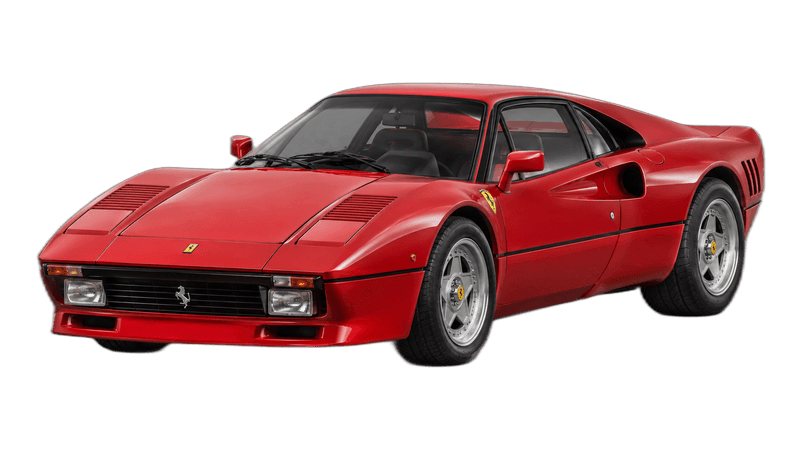
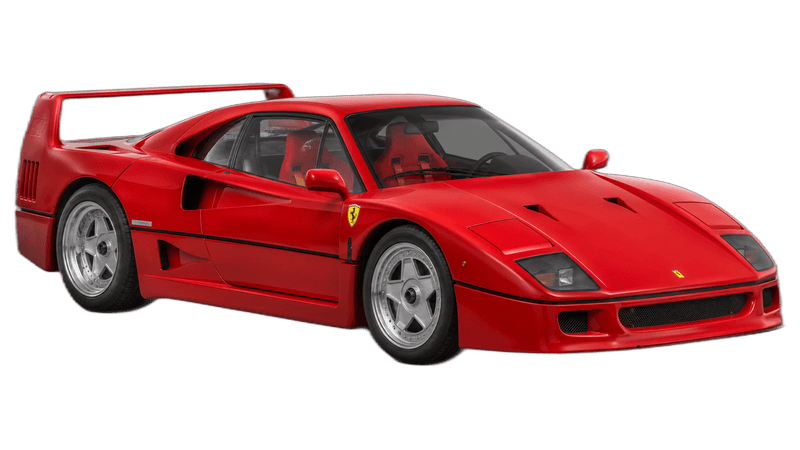
The page uses the catalogue photograph for this car, and its credit is listed on the credits page.
Verdict
The F40 in this guide is a rear-wheel drive, mid-engine road car with a 2.9L twin-turbo V8 rated at 478 bhp and 577 Nm, with quoted figures of 4.1 seconds to 100 km/h and 324 km/h flat out, and the sources agree on little beyond the engine and the years. Its ownership cost is driven by fuel cells, cambelts, brakes and costly carbon-Kevlar panels, and its value by catalysts, suspension and originality. We have not driven it, so use the sources, a specialist inspection and the car's papers to decide.
Sources
- PistonHeads: Ferrari F40 PH Used Buying Guide (7 December 2017)
- Auto Express: Ferrari F40 buying guide and review 1987-1992 (5 November 2018)
- RM Sotheby's: 1991 Ferrari F40, Miami 2025, lot catalogue essay
- Sotheby's: Everything you need to know about the Ferrari F40
- SB Race Engineering: Ferrari F40 model page and technical specifications
- Evo: A-Z supercars, Ferrari F40
- Supercars.net: 1987-1992 Ferrari F40
- Motor Sport: Buying guide, Ferrari F40 (26 March 2020)
- DVSA vehicle recall check
Specifications
| Engine | 2.9L twin-turbo V8 |
|---|---|
| Displacement | 2.9L |
| Power | 478 bhp |
| Torque | 577 Nm |
| 0-100 km/h | 4.1s |
| Top Speed | 324 km/h |
| Drivetrain | RWD |
| Country | Italy |
| Body Style | 2-door coupé |
| Years | 1987–1992 |
| Production | 1,311 |
| Price Used | £3,200,000 |
Specifications are manufacturer-published figures.
Compare with
Frequently Asked Questions
What is a Ferrari F40 worth?
A representative example is worth about £3,200,000. Actual values vary with specification, condition and history.
How much power does the Ferrari F40 have?
The Ferrari F40 produces 478 bhp and 577 Nm of torque.
How fast is the Ferrari F40 from 0 to 100 km/h?
The Ferrari F40 accelerates from 0 to 100 km/h in 4.1 seconds.
What is the top speed of the Ferrari F40?
The Ferrari F40 has a top speed of 324 km/h.
What engine does the Ferrari F40 have?
The Ferrari F40 uses a 2.9L twin-turbo V8.
How many Ferrari F40 were made?
Ferrari produced 1,311 units of the Ferrari F40.
When was the Ferrari F40 built?
The Ferrari F40 was built from 1987 to 1992.
Is the Ferrari F40 all-wheel drive?
No. The Ferrari F40 is configured with rear-wheel drive.