
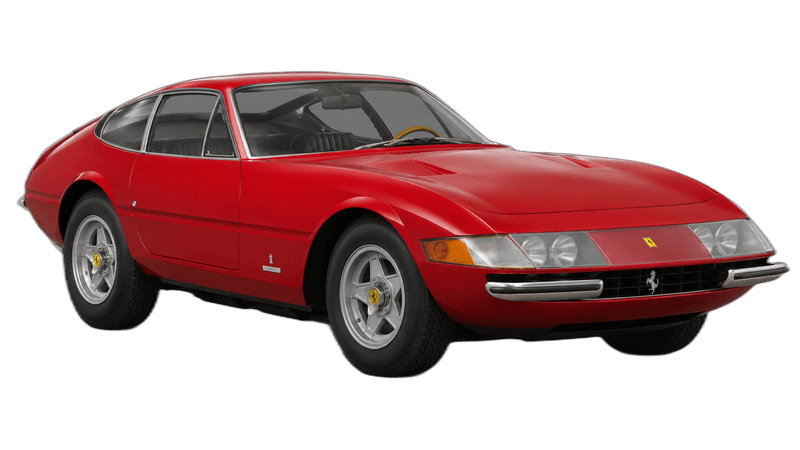
Ferrari 365 GTB/4 Daytona
347bhp
Power
280km/h
Top Speed
The Ferrari 365 GTB/4 Daytona is a 2-door coupé by Ferrari, with 347 bhp, 431 Nm of torque and a top speed of 280 km/h.
Dream Car Garage Editorial · Edited by José Teo Lorente Vallecillos · Last updated 3 November 2026
Overview
We have not driven this car. This review is based on published specifications and the sources listed below.
Scope of this guide
This guide is scoped to the Ferrari 365 GTB/4 Daytona, the two-door berlinetta that Ferrari unveiled in 1968 as the successor to the 275 GTB/4 and built until 1973. It is a front-engine car with a V12 ahead of the cabin, a five-speed gearbox mounted at the rear axle and rear-wheel drive. We cover the coupe in detail and the open GTS/4 spider where the sources treat it separately. The 15 competition cars are mentioned only so that you can recognise the term in an advert.
We have not driven this model for this article. We are an editorial desk that reads sources, and everything below comes from pages we opened: Wikipedia, a TopSpeed model profile, the RM Sotheby's catalogue page for a 1972 spider sold at Amelia Island in 2015, a Petrolicious buying article dated 29 May 2013, and the Supercars.net page on the spider. This is a collector car that changes hands rarely and at high prices. A guide like this cannot replace an inspection by a specialist who knows the model, and this page is for research, not a buying recommendation.
The figures at a glance
- Engine: 4.4L naturally aspirated V12. This is the Tipo 251 Colombo-type engine, a 60 degree V12 with four camshafts and two valves per cylinder. Displacement is 4,390 cc in Wikipedia, TopSpeed, RM Sotheby's and Supercars.net, with a bore and stroke of 81 by 71 mm.
- Power: 347 bhp. Wikipedia prints 352 PS, equal to 347 hp, at 7,500 rpm. TopSpeed, RM Sotheby's and Petrolicious print 352 (hp or bhp) and Supercars.net prints 353 bhp. We think the 352 figures are the metric PS rating, and 352 PS converts to about 347 bhp using the factor 0.98632. We show 347 bhp because that is the figure Wikipedia states as horsepower. Sources do not agree on the unit, so treat any value from 347 to 353 as the same claimed output.
- Torque: 431 Nm. Wikipedia prints 431 N·m at 5,500 rpm, TopSpeed prints 317 lb-ft at 5,500 rpm, which is about 430 Nm, and Supercars.net prints 432.5 Nm at 5,000 rpm for the spider. We use the Wikipedia figure of 431 Nm.
- Top speed: 280 km/h, which Wikipedia gives as 174 mph, and TopSpeed, RM Sotheby's and Petrolicious also give 174 mph. Supercars.net lists about 278.4 km/h, or 173 mph, though its text also mentions a 180 mph record, which conflicts with its own table. We use 280 km/h as the claimed figure. Wikipedia attributes it to a single 1995 book, so it is a published claim, not a result we can verify.
- 0-100 km/h: no figure shown. The sources give 0-60 mph, not 0-100 km/h. Wikipedia, TopSpeed and RM Sotheby's print 5.4 seconds to 60 mph, and Petrolicious prints about 5.6 seconds to 60 mph. A 0-60 mph time is not a 0-100 km/h time, so we do not relabel it.
- Drive: rear-wheel drive through a five-speed manual transaxle.
- Weight: 1,200 kg dry in Wikipedia, or 2,646 lb in TopSpeed. This is a dry figure, so a road-ready car weighs more.
- Size: 4,425 mm long, 1,760 mm wide, 1,245 mm high on a 2,400 mm wheelbase, per Wikipedia.
- Carburation: six Weber twin-barrel carburettors, 40 DCN/20 per Wikipedia and 40 DCN17 per RM Sotheby's for the spider they sold. Wikipedia adds that 40 mm Solex twin carburettors were used alternatively.
Where the sources disagree
We would rather show the disagreements than hide them. On power, 347 bhp, 352 hp and 353 bhp are close and probably differ by unit and rounding, as explained above. On top speed, 280 km/h and 278.4 km/h differ by under two km/h.
The largest disagreement is production. Wikipedia and TopSpeed give 1,284 coupes and 122 spiders, a total of 1,406, which Wikipedia calls the generally accepted figure. Petrolicious also gives 1,284 berlinettas and 122 spyders. RM Sotheby's says 1,406 in total including 121 genuine spiders. Supercars.net says the spider was limited to 122 cars in its text but its auction listings show 121, 122 and even 124. TopSpeed says the 1,406 total includes 15 race cars, and Wikipedia says the same, yet 1,284 plus 122 already equals 1,406, so either the competition cars sit inside the coupe count or the figures do not reconcile. Neither source says which. We use 1,284 as the coupe count because three sources print it as the berlinetta number, and we say plainly that the whole Daytona family is usually put at 1,406.
Dates also vary. Wikipedia and TopSpeed say the car appeared at the 1968 Paris show, while RM Sotheby's says only that it was unveiled in 1968. Petrolicious says sales began in early 1969. We therefore treat 1968 as the year the car was shown and 1968 to 1973 as the stated production span. Wikipedia's infobox labels the layout front-mid, while its text, TopSpeed and Petrolicious describe a front-engined car, which is how we describe it.
History and the Daytona name
The Daytona was introduced as the replacement for the 275 GTB/4. TopSpeed names Scaglietti as the body builder and Leonardo Fioravanti at Pininfarina as the designer of the initial prototype. Petrolicious says Scaglietti built all bodies except the prototypes. Critics reportedly called the front-engine layout a dinosaur at launch, because the Lamborghini Miura had put its engine behind the driver, per Petrolicious.
The name Daytona refers to Ferrari's 1-2-3 finish at the 1967 24 Hours of Daytona. TopSpeed says the official name is 365 GTB/4, and Petrolicious says the Daytona name was never official but stuck. The spider was shown as a prototype at the Frankfurt show in September 1969 according to RM Sotheby's. Wikipedia lists the GTS/4 as 1971 to 1973, and Petrolicious says it reached the US market in 1971. Production ended in 1973 when the 365 GT4 Berlinetta Boxer took over, which put its engine behind the cabin.
Variants and what changed over the run
- Early cars: Petrolicious says early cars had fixed headlamps under a Plexiglas panel, which did not meet US rules, and RM Sotheby's says the first spider had Plexiglas-covered headlights while production cars had pop-up headlights. Petrolicious says early Plexiglas cars sell for a slight premium in some markets, especially Japan.
- US and European specification: Petrolicious says US cars carry side marker lights and smog equipment. Wikipedia gives a compression ratio of 9.3:1, or 8.8:1 for the US version.
- Right-hand drive: Wikipedia lists 156 UK right-hand-drive coupes, and of the 122 factory spiders, 7 were right-hand drive.
- GTS/4 spider: RM Sotheby's says 96 spiders were slated for the US. Supercars.net says the spider uses steel inner fenders and rear bulkhead in place of the coupe's fibreglass parts, with extra bracing.
- Competition cars: Wikipedia lists 15 cars in three batches of five, with lightweight aluminium and fibreglass bodies. It gives about 400 bhp for the 1972 batch and about 450 bhp for 1973.
- Converted spiders: Petrolicious says about 100 berlinettas were converted to spiders in the late 1970s and early 1980s, by Sport Auto in Modena using new old stock Scaglietti parts, and warns against claims that Scaglietti itself did the work.
What to check before buying
Our sources are not a Daytona inspection manual, and we found no dedicated buyer's guide from a major press title. What follows is taken from the Petrolicious article, which is one author's opinion.
- Get a specialist pre-purchase inspection. Petrolicious says to expect that the car has been restored at least once.
- Rust. Petrolicious says the car is prone to rust, especially around the rear wheel arches, and that the body is steel over a tubular steel chassis with aluminium bonnet, boot lid and early doors.
- Specification. Confirm whether the car is European or US specification, and whether side markers and smog equipment have been altered.
- Spider claims. Be sceptical of converted spiders and of dealer stories about who converted them.
- Tipo A. Petrolicious says not to pay extra for a rare Tipo A claim, which it says usually means a European car with pop-up headlights.
- Tool kit. Petrolicious says the original tool kit can be worth up to 10,000 US dollars.
- Documentation. The RM Sotheby's spider came with its original books, tool kit, a Ferrari Classiche certification binder and service invoices, and that is the sort of paperwork to ask for.
Running costs and known issues
Cost data is thin. Petrolicious says a full engine rebuild can cost up to 50,000 US dollars and puts fuel economy at best 11 US mpg. We found no service schedule or failure rates, so we give none. The same article lists its own observations: the gearbox is precise but unhurried and second gear should be avoided when cold, steering is heavy at low speed, brakes can fade under hard use, the factory air conditioning struggles in hot climates, and the rear can break away in the wet. It also says the car takes a long time to warm up. Treat these as one writer's experience.
Recalls and safety
We found no recall notice in any page we read, but we did not search a recall database, so that is not a clean bill of health. A car of this age has no modern crash structure, and we found no crash-test or safety-equipment data.
Market and value notes
Prices vary a lot and a handful of sales do not make a valuation. Petrolicious, in May 2013, quoted about 500,000 US dollars for a low-mileage perfect berlinetta, about 300,000 US dollars for one needing restoration and at least 900,000 US dollars for a spider. RM Sotheby's sold a 1972 spider, chassis 15417, for 3,300,000 US dollars at Amelia Island in 2015. That car was Ferrari Classiche certified and had been driven only about 150 miles in nearly 12 years of Florida ownership. The Supercars.net table lists the same chassis number at 1,210,000 US dollars on another sale, with no date shown, which shows how far values moved. TopSpeed reports a 1972 Le Mans-raced car sold at Mecum Monterey in 2017 for 950,000 US dollars. These figures cover different cars and years, so treat them as a spread, not a price list.
What we could not find
We found no maker page we could read: the Ferrari website pages we tried returned empty content, so we do not cite them. Our power, torque and speed figures therefore come from Wikipedia and specialist or auction pages, not from a Ferrari document. We found no 0-100 km/h time, so that field has no figure shown. We found no settled production count, no service schedule, no failure rates, no recall data and no crash data. Everything we say about checking a car comes from one opinion article.
About the photograph
This page uses the catalogue photograph for the car. Its credit is listed on the credits page.
Verdict
The 365 GTB/4 Daytona is a front-engine, rear-wheel-drive V12 berlinetta with a claimed 347 bhp, 431 Nm and 280 km/h, and with no 0-100 km/h figure shown in the sources we read, only a roughly 5.4 second 0-60 mph claim. What a buyer is paying for is rarity, with 1,284 coupes and 122 spiders on the commonly quoted numbers, and for provenance. Our reading suggests asking for documentation, having rust checked around the arches, confirming specification and being cautious about converted spiders. We have not driven it, so use the sources, the seller's records and an independent specialist inspection to decide.
Sources
Specifications
Engine
4.4L naturally aspirated V12
Displacement
4.4L
Power
347 bhp
Torque
431 Nm
Top Speed
280 km/h
Drivetrain
RWD
Country
Italy
Body Style
2-door coupé
Years
1968–1973
Production
1,284
Specifications are manufacturer-published figures.
More from Ferrari
Frequently Asked Questions
What are the specifications of the Ferrari 365 GTB/4 Daytona?
The Ferrari 365 GTB/4 Daytona is a 2-door coupé by Ferrari, with 347 bhp, 431 Nm of torque and a top speed of 280 km/h.
How many Ferrari 365 GTB/4 Daytona were made?
Ferrari produced 1,284 units of the Ferrari 365 GTB/4 Daytona.
What drivetrain does the Ferrari 365 GTB/4 Daytona use?
The Ferrari 365 GTB/4 Daytona is configured with rear-wheel drive.
What type of car is the Ferrari 365 GTB/4 Daytona?
The Ferrari 365 GTB/4 Daytona is a gts manufactured by Ferrari in Italy. Production ran from 1968 to 1973.