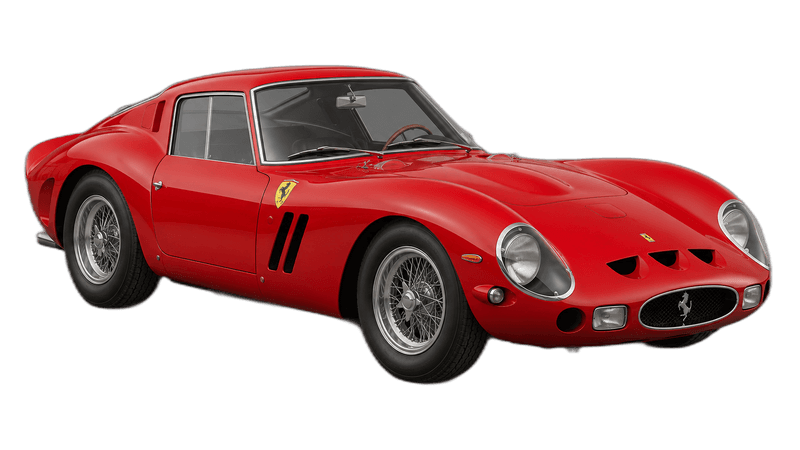
Ferrari 288 GTO
£6,300,000
usedIndicative market price, updated periodically.
395bhp
Power
4.9s
0-100 km/h
305km/h
Top Speed
£6,300,000
Price Used
The Ferrari 288 GTO produces 395 bhp, reaches 100 km/h in 4.9 seconds and has a top speed of 305 km/h. A representative example is worth about £6,300,000.
How hard it pulls.
Peak g-force the instant you bury the throttle, estimated from the car's 0–100 time and drivetrain.
Ferrari 288 GTOEstimated peak launch g from the 0–100 time and drivetrain: an honest approximation, not a measured figure.
Dream Car Garage Editorial · Edited by José Teo Lorente Vallecillos · Last updated 3 November 2026
Overview
We have not driven this car. This review is based on published specifications and the sources listed below.
Scope of this guide
This guide is scoped to the Ferrari 288 GTO, the road-going homologation special that Ferrari showed at the Geneva motor show in March 1984. It is a mid-engine car with the V8 mounted longitudinally behind the cabin, and it is rear-wheel drive through a five-speed manual gearbox. Ferrari built it so that a Group B racing version could be homologated, which needed 200 identical road cars. Group B was cancelled before the car raced, so the 288 GTO never competed.
Two other cars share the name and are easy to confuse with it. The 288 GTO Evoluzione was a much more extreme car built with the help of Michelotto, and the sources we read say only five or six were made. The Group B racer that the Evoluzione was meant to become never contested a race. This guide covers the standard road car only. Where we mention the Evoluzione it is to separate it from the road car, not to advise on buying one.
We have not driven this model for this article. We are an editorial desk that reads published sources, and we have not owned, inspected or tested a 288 GTO. Everything below comes from pages we opened, and we say where those pages disagree.
The figures at a glance
- Engine: 2.9L twin-turbo V8, Ferrari type F114B, 2,855 cc, longitudinal, mid-mounted, four valves per cylinder.
- Power: 395 bhp. Wikipedia prints 400 PS (294 kW; 395 bhp) at 7,000 rpm. Specialist dealer pages print 400 bhp, which looks like the same 400 figure carried over with the English unit.
- Torque: 496 Nm at 3,800 rpm (366 lb-ft in the same Wikipedia table). Sports Car Market prints 365 lb-ft, which is the same figure rounded differently.
- 0-100 km/h: 4.9 seconds. This is a catalogue-style figure, discussed below.
- Top speed: 305 km/h, the maker's claim of 189 mph.
- Drive: rear-wheel drive, five-speed manual, left-hand drive only according to the dealer pages we read.
- Weight: 1,160 kg dry, according to Wikipedia and Ultimate Specs. Ultimate Specs also lists 1,280 kg kerb weight.
- Production: 272 cars.
Where the sources disagree
Power is the first disagreement. Wikipedia, Ultimate Specs and Supercars.net all give 400 PS or 395 horsepower, while DK Engineering and Sports Car Market print 400 bhp. We store 395 bhp because it is the conversion of 400 PS given by Wikipedia, and we note that the 400 bhp pages appear to be using the same underlying number.
Top speed is the second. Ferrari claimed 189 mph, which Wikipedia converts to 304 km/h and Supercars.net and Ultimate Specs print as 305 km/h. Sports Car Market says 190 mph. Wikipedia also reports that Road and Track measured 179 mph, or 288 km/h, in its own test. We use 305 km/h because it is the maker-claimed figure and the most widely printed one, and we treat it as a claim, not a measurement.
The acceleration figure is the third. Road and Track measured 0-60 mph in 5.0 seconds according to Wikipedia and to Sports Car Market. DK Engineering prints 4.8 seconds for 0-60 mph, Supercars.net prints 4.9 seconds for 0-60 mph, and Ultimate Specs prints 4.9 seconds for 0-100 km/h. None of the pages we could open gives a Ferrari-published 0-100 km/h time. We keep 4.9 seconds because it is the middle of the printed range, but a 0-100 km/h time is slightly longer than a 0-60 mph time, so treat it as approximate.
Production is the fourth. Wikipedia, DK Engineering, Supercars.net, Ultimate Specs, Sports Car Market and the Hagerty articles all give 272. Hagerty first says 271 and then corrects itself to 272. A search summary also mentioned 277 or 278 when the Evoluzione cars are counted, but we did not open those pages, so we do not use that figure. Sports Car Market describes it as 200 cars for homologation plus 72 more.
Engine size is the fifth. The 2,855 cc figure appears in Wikipedia, DK Engineering, Supercars.net and Ultimate Specs. The name 288 refers to roughly 2.8 litres and eight cylinders, and Hagerty calls it a 2.8-litre V8, while the displacement in cubic centimetres rounds to 2.9 litres. We say 2.9L twin-turbo V8 and keep 2,855 cc as the exact number.
History and what changed by year
Ferrari unveiled the 288 GTO at Geneva in March 1984. It was based on the 308 GTB but had a wheelbase 100 mm longer according to Sports Car Market, 2,450 mm according to Wikipedia, and an engine turned to sit longitudinally. The body styling was by Leonardo Fioravanti at Pininfarina, with Nicola Materazzi named as chief engineer. The engine used twin IHI turbochargers at 0.8 bar boost, Behr intercoolers and Weber-Marelli injection. Wikipedia gives a compression ratio of 7.6:1.
The sources disagree on when production ended. Wikipedia says 1984 to 1987. Ultimate Specs says 1984 to 1986. DK Engineering says production ended in early 1986. Sports Car Market lists 1984 and 1985. Hagerty says production ceased in October 1985 at about 20 cars a month, and that the last car, built for Niki Lauda with chassis number 58329, was ready in March 1986. We propose 1986 as the end year because the last car was completed then, but series production appears to have finished in late 1985.
Colour and specification were narrow. DK Engineering says the cars were Rosso Corsa and left-hand drive. Sports Car Market says air conditioning and electric windows were the only factory options, while DK Engineering lists a luxury package, full leather trim and rear fog lights. Wikipedia lists Goodyear NCT tyres in 225/55 VR16 at the front and 255/50 VR16 at the rear, with 265/50 VR16 on US cars.
The Evoluzione and the Group B racer
The Evoluzione is a separate, far rarer car. Wikipedia gives 650 hp at 7,800 rpm, 940 kg, and six built, being five production cars and one prototype, against a planned 20. Hagerty says five were built, and also gives 650 bhp and about 940 kg. Top speed claims differ: Wikipedia says reportedly 225 mph and Hagerty says 229 mph. Neither is a measured figure. Hagerty reports that chassis 79888 was offered by RM Sotheby's in October 2022 and that its owner had spent 119,000 pounds on a service and repaint. None of these numbers applies to the road car.
What to check before buying
We have not inspected one, so this list comes from what the dealer and auction pages we read describe, plus our own reading of what a buyer should ask. It is not a verified inspection procedure.
- Ask for documentation of every engine-out service and cam belt change. DK Engineering's 2014 listing describes major service, replacement cam belts, engine removal and a turbocharger overhaul as the sort of work a specialist carried out.
- Ask whether the car has Ferrari Classiche certification. DK Engineering's other listing says that car received it in 2016.
- Look at the bodywork history. A Sports Car Market article from 2002 says an accident history significantly hurt a car's value and that originality cannot be bought back.
- Check panel materials against the paperwork. Wikipedia describes steel doors with a Kevlar bonnet, while Sports Car Market describes aluminium doors, boot lid and bonnet. A specialist should be able to say which is correct for a given car.
- Ask for the body number and the chassis number and match them to the paperwork. DK Engineering notes that its 1984 car was one of the earliest delivered with a numbered body, and Sports Car Market says the chassis number is under the engine cover at the right rear corner of the frame.
- Ask how the car has been stored. A DK Engineering listing describes a car owned from 2002 to 2013 that was started periodically but rarely driven, which is a normal pattern for these cars and a reason to ask for a thorough recommissioning record.
Running costs and known failures
Published cost information is thin. DK Engineering's 2015 listing gives a top-end engine rebuild and full detail at approximately 75,000 pounds retail, in the car's 30th year. That is one dealer's figure for one car. DK Engineering's 2014 listing gives no amounts. A Sports Car Market article dated July 2002 estimates a tune-up at 1,000 dollars and distributor caps at 125 dollars, which are old figures for a different time and currency. A Sports Car Market piece on a car sold in May 2007 gives no dollar figures for maintenance, but lists service of the fuel system, ignition and brakes, a full fluid change and a belt service. It also calls the car extremely well engineered and reliable. We did not find a source that lists specific failures, so we do not claim any.
Recalls and safety
We found no recall notice for the 288 GTO in any source we read. That is not the same as a clean record, because we did not query a recall database for a particular chassis number. The sources we read do not discuss crash testing or safety equipment either. Ask a specialist what has been updated on the car in front of you.
Market and value notes
Sports Car Market gives an original list price of 80,000 dollars. It says values exceeded one million dollars in the late 1980s, then fell, and that a 2001 Bonhams Gstaad sale on 18 December made 223,797 dollars including premium. A May 2007 RM sale in Maranello is reported by Sports Car Market at 594,000 dollars. Hagerty's article on the Evoluzione sale reports a standard 288 GTO selling for 4.4 million dollars at an RM Sotheby's Monterey sale, though the page text we read did not give a year we could confirm. These are individual results, not a valuation, and they show how far the market has moved. We did not open Hagerty's valuation tool, which sent us to a login page, and we did not log in.
What we could not find
Ferrari's own model page loaded empty for us, so we have no maker-published specification. RM Sotheby's lot page for the Evoluzione redirected and gave us no essay text. We did not use the Hagerty valuation page for the same reason. We found no Ferrari-published 0-100 km/h time, so that figure has no figure shown from the maker and rests on the third-party pages above. We found no failure rates, no parts price list, no insurance cost and no service schedule, so we give none. We also did not find a recall record or a verified weight for a specific road car.
About the photograph
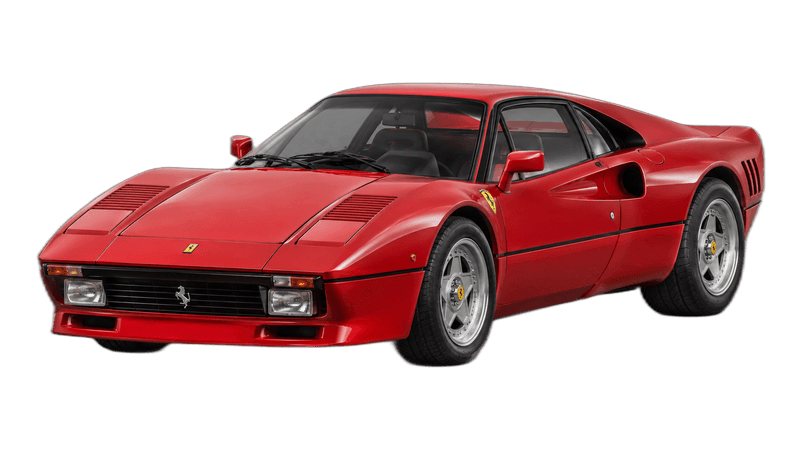
The page uses the catalogue photograph, and its credit is listed on the credits page.
Verdict
The 288 GTO is a 2.9L twin-turbo V8 road car with 395 bhp, 496 Nm, a claimed top speed of 305 km/h and rear-wheel drive. It is a small-volume Group B homologation special, 272 cars, built in 1984 to 1986. The numbers that matter to a buyer are not the performance figures, which sources round differently, but the history file: engine-out service records, belt changes, accident history and certification. Costs we could verify are few, and one dealer's 75,000 pound rebuild figure is a warning, not a budget. We have not driven it, so rely on the sources, a Ferrari specialist inspection and the seller's records.
Sources
- Wikipedia: Ferrari 288 GTO (specifications, Road and Track test figures, Evoluzione)
- DK Engineering archive: Ferrari 288 GTO (1984), body number 6, 2014 overhaul
- DK Engineering archive: Ferrari 288 GTO (1985), 2015 top-end rebuild and Classiche certification
- Hagerty UK: One of five Ferrari 288 GTO Evoluziones is for sale
- Hagerty UK: The last Ferrari 288 GTO was Enzo Ferrari's apology to Niki Lauda
- Sports Car Market: 1985 Ferrari 288 GTO analysis (2002)
- Sports Car Market: Ferrari 288 GTO analysis (2007 RM Maranello sale)
- Supercars.net: 1985 Ferrari 288 GTO
- Ultimate Specs: Ferrari 288 GTO specifications
Specifications
| Engine | 2.9L twin-turbo V8 |
|---|---|
| Displacement | 2.9L |
| Power | 395 bhp |
| Torque | 496 Nm |
| 0-100 km/h | 4.9s |
| Top Speed | 305 km/h |
| Drivetrain | RWD |
| Country | Italy |
| Body Style | 2-door coupé |
| Years | 1984–1986 |
| Production | 272 |
| Price Used | £6,300,000 |
Specifications are manufacturer-published figures.
Frequently Asked Questions
What is a Ferrari 288 GTO worth?
A representative example is worth about £6,300,000. Actual values vary with specification, condition and history.
How much power does the Ferrari 288 GTO have?
The Ferrari 288 GTO produces 395 bhp and 496 Nm of torque.
How fast is the Ferrari 288 GTO from 0 to 100 km/h?
The Ferrari 288 GTO accelerates from 0 to 100 km/h in 4.9 seconds.
What is the top speed of the Ferrari 288 GTO?
The Ferrari 288 GTO has a top speed of 305 km/h.
What engine does the Ferrari 288 GTO have?
The Ferrari 288 GTO uses a 2.9L twin-turbo V8.
How many Ferrari 288 GTO were made?
Ferrari produced 272 units of the Ferrari 288 GTO.
When was the Ferrari 288 GTO built?
The Ferrari 288 GTO was built from 1984 to 1986.
Is the Ferrari 288 GTO all-wheel drive?
No. The Ferrari 288 GTO is configured with rear-wheel drive.