Ferrari F50
£8,200,000
usedIndicative market price, updated periodically.
513bhp
Power
3.9s
0-100 km/h
325km/h
Top Speed
£8,200,000
Price Used
The Ferrari F50 produces 513 bhp, reaches 100 km/h in 3.9 seconds and has a top speed of 325 km/h. A representative example is worth about £8,200,000.
How hard it pulls.
Peak g-force the instant you bury the throttle, estimated from the car's 0–100 time and drivetrain.
Ferrari F50Estimated peak launch g from the 0–100 time and drivetrain: an honest approximation, not a measured figure.
Dream Car Garage Editorial · Edited by José Teo Lorente Vallecillos · Last updated 3 November 2026
Overview
We have not driven this car. This review is based on published specifications and the sources listed below.
Scope of this guide
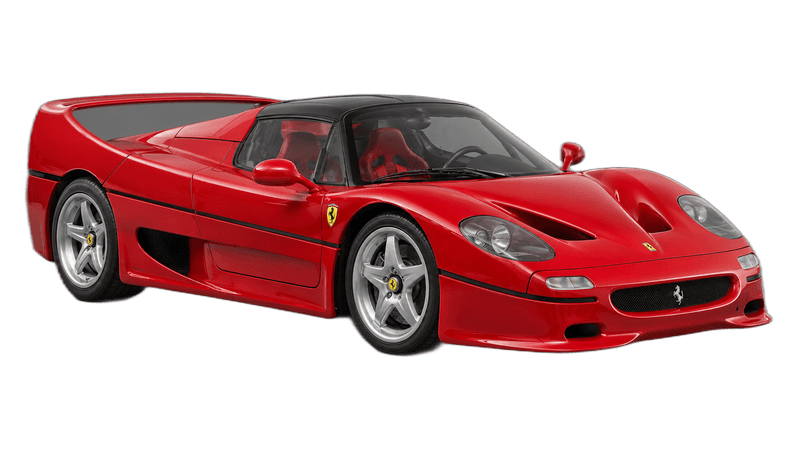
This guide is scoped to the Ferrari F50, the two-seat, mid-engine road car that Ferrari showed at the Geneva Motor Show in March 1995 to mark its fiftieth anniversary. It is rear-wheel drive, with a naturally aspirated V12 behind the seats and a six-speed manual gearbox. Pininfarina designed the body, and the car is built around a carbon-fibre monocoque. We cover the road car only.
Two other things carry the F50 name and are not covered. The first is the F50 GT, a racing version developed with Dallara and Michelotto for the BPR Global GT Series. The sources we read say it was cancelled before it raced and that only three were made, one of them described as the prototype, so it is a different object from the 349-car road run. The second is any one-off or coachbuilt special; we read nothing about one and make no claim about them. Some pages we saw quote about 750 horsepower for the engine, and that figure belongs to the GT race car, not the road car.
We have not driven this model for this article. We are an editorial desk that read sources, and we have not owned, inspected or tested an F50. Everything below comes from pages we opened, and where they disagree we say so.
The figures at a glance
- Engine: 4.7L naturally aspirated V12, the Ferrari Tipo F130B, a 65 degree V12 with five valves per cylinder, 85 mm bore and 69 mm stroke. The displacement is 4,698 cc (RM Sotheby's) or 4,698.5 cc (SB Race Engineering), which is why the catalogue holds 4698.
- Power: 513 bhp. Wikipedia gives 382 kW, 520 PS and 513 hp at 8,500 rpm. Ecurie also prints 513 bhp.
- Torque: 471 Nm at 6,500 rpm, per Wikipedia and SB Race Engineering. The supercars.net page rounds it to 470 Nm.
- 0-100 km/h: 3.9 seconds. SB Race Engineering prints 3.87 seconds, which we round to 3.9 seconds.
- Top speed: 325 km/h, which every source that gave a figure agrees on. Wikipedia labels it a claim and cites Ferrari, and supercars.net gives 202 mph, which is the same speed.
- Drive: rear-wheel drive, six-speed manual with a limited-slip differential.
- Weight: 1,230 kg dry. Supercars.net also lists 1,380 kg as the kerb weight.
- Production: 349 cars, built from March 1995 to July 1997.
- Body: a two-door, two-seat targa with a removable carbon-fibre roof panel and a fixed rollbar. Our catalogue said coupe, but the sources we read call it a targa top.
Where the sources disagree
The power figure is the one most often quoted three ways. Wikipedia gives 520 PS and 513 hp for the same engine, and 513 bhp is simply 520 PS expressed in the British unit. RM Sotheby's, SB Race Engineering and Sports Car Market all print 520 hp or 520 bhp, which is the metric figure read as if it were imperial horsepower. Supercars.net prints both 520 hp and 512 PS. We chose 513 bhp because the page that separates the units gives 520 PS and 513 hp for the same engine, and the catalogue field is in bhp. Treat a seller's 520 hp as the same engine and not a more powerful one.
The 0-100 km/h time is not settled either. RM Sotheby's prints 3.7 seconds, SB Race Engineering prints 3.87 seconds, and Wikipedia, citing a Car and Driver test from January 1997, gives 3.8 seconds to 97 km/h, which is 60 mph. Supercars.net also gives 3.8 seconds to 60 mph. Sports Car Market gives 3.7 seconds to 60 mph. These are different measurements, taken in different ways. We kept 3.9 seconds because 3.87 seconds is a stated 0-100 km/h figure and sits just above the 60 mph tests, as it should, since 100 km/h is slightly faster than 60 mph. Do not treat it as a precise number.
The torque figure also appears as 520 Nm in one search summary. That is the F50 GT value on Wikipedia, so we did not use it for the road car.
For production, every page we read says 349 cars. We looked for a different count, such as a total near 55x, and found none, and none of the road-car pages we read says whether the prototype is in the 349. Gtspirit mentions a prototype only in connection with the three F50 GT cars. We kept 349.
History and what changed
The sources tell the story of an engine first. Supercars.net says the V12 started from a 3.5L unit used in early 1990s Formula 1 cars and was enlarged to 4.7 litres, with titanium connecting rods, forged pistons and an 11.3:1 compression ratio. Ecurie and RM Sotheby's tie it to the 1990 Ferrari 641 and to the 1990 F1 season respectively. Supercars.net adds that Ferrari had run a naturally aspirated V12 in the 333 SP sports car in 1994 and used that as the chance to make a successor to the turbocharged F40.
The car arrived with no power steering, no power-assisted brakes, no ABS and no electronic driver aids, according to supercars.net and SB Race Engineering. RM Sotheby's describes a minimal cabin with adjustable drilled pedals and gauges controlled by a small computer. Colours listed by supercars.net are two shades of Rosso Corsa red, yellow, black and silver, and Sports Car Market lists red, Barchetta Red, yellow, black and Nurburgring Gray.
We found no year-by-year changes of the kind a buyer might want, such as running revisions or equipment updates. The road car is simply described as built between 1995 and 1997, with the last one leaving Maranello in July 1997. Sports Car Market says the first ten cars went to Europe and that United States deliveries began in July 1995.
What to check before buying
None of the pages we read is a buying guide, so this list is our reading of what they mention and is not a specialist's inspection checklist.
- Ask for the full service history. The RM Sotheby's lot we read listed services by mileage and by workshop, which is the kind of record to look for. The page mentioned no cam belt service, and we did not find the interval, so ask a Ferrari specialist.
- Ask about the fuel bladders. SB Race Engineering says the car has rubber fuel cells inside the structure, between the cabin and the engine mounting points, and RM Sotheby's puts a rubber bladder tank behind the driver. A forum comment summarised in a search result warned that an old bladder could leak and harm the carbon tub, but we did not open that thread, so treat it as an unverified question for the seller.
- Ask when the clutch was last done and who did it, because the job is large (see below).
- Check the chassis plate and engine number against the documents. Sports Car Market says the chassis plate is riveted to the bulkhead in the front compartment and the engine number is on the front left of the block.
- Check the mileage in the context of the price. Sports Car Market argued in 2002 that mileage affects perceived value more than mechanical performance.
- Get an independent specialist inspection. The car has a carbon-fibre monocoque, no ABS and no driver aids, so ordinary road-car checks are not enough.
Running costs and known failures
We found very little reliable cost data, and we do not give a total running cost. The only specific figures are in The Drive, which was updated on 26 November 2019. It says an F50 clutch replacement means removing the whole rear subframe and transaxle. It quotes right around $5,000 in parts, based on a 2008 FerrariChat thread, and a starting labour rate of approximately $1,415 listed by TheSupercarRooms, and a minimum of $7,000 out the door. It says replacing the FIA-standard fuel bladders costs $18,000, based on a 2010 FerrariChat thread. The Drive uses dollar signs although the shops it names are in the United Kingdom, and it says the shop that did the work, Joe Macari Service, did not release its price. These are old, second-hand numbers and prices have probably risen, as the article itself notes.
Sports Car Market, in an article dated 1 December 2002, lists a tune-up at $6,000 for a 1997 car. That is also old and from one car.
We found no source giving a failure rate, an engine-out service interval or a price for a cam belt service on an F50. SB Race Engineering's page covers specifications and says nothing about servicing. Anyone quoting a failure rate for the F50 without a source is guessing.
Recalls and safety
The GOV.UK recall checker says that for cars you can look up safety recalls using a registration number on the MOT service, or by make, model and year. It also says the manufacturer will tell you about recalls for reasons other than safety. Recall coverage depends on the market the car was sold in, and we could not verify a recall list for the F50, so we state none. Ask an authorised Ferrari dealer or a specialist about any open campaign for the chassis number.
On safety more generally, the sources say the car has no ABS, no power-assisted braking and no electronic aids. That is a feature of the design, not a defect, but it matters to anyone expecting a modern car's safety systems.
Market and value notes
Prices in the sources span decades and cannot be compared directly. We give each with its source and do not convert currencies.
- Sports Car Market, 2002: the original list price was $475,000 plus taxes, one car sold for $528,000 including premium at an RM auction in Monterey on 16 and 17 August 2002, and a lower-mileage car made $401,271 at a Monaco sale in May 2002.
- Ecurie: an article dated 2 June, with no year in the text but a 2016 copyright notice, said Auctions America was offering a car at Santa Monica on 25 and 26 June with an estimate of $1.8m to $2.1m.
- RM Sotheby's: a 1996 car, number 215 of 349, sold for 1,232,000 euros at the sale the page calls Villa Erba 2015. The page shows no estimate and no sale date.
- SB Race Engineering says top-condition, low-mileage examples are in the range of $5.5 million to $7 million USD as of 2025. Supercars.net gives the same range with no date we could find. These are the pages' own claims and not verified sale results.
The spread from the 2002 prices to the 2025 claim is a reason to ask what a particular car is actually worth now, and not to rely on any figure on this page.
What we could not find
We could not open Ferrari's own F50 page in a usable form, so the maker's figures reach us only through Wikipedia, which cites Ferrari. We found no Ferrari service schedule, no cam belt interval, no engine-out price, no parts price list and no recall list for the F50. We found no price when new in the manufacturer's own words; the Sports Car Market figure is the only list price we read. We found no year-by-year changes and no source on the number of right-hand-drive cars.
About the photograph
This page uses the catalogue photograph, and its credit is listed on the credits page.
Verdict
The Ferrari F50 in this guide is the 1995 to 1997 road car: a mid-engine, rear-wheel drive targa with a 4.7L naturally aspirated V12, 513 bhp, 471 Nm, a claimed 325 km/h top speed, 3.9 seconds to 100 km/h and 349 built. The headline numbers are agreed to within a few percent across the sources. The costs are not, and the best-documented ones, a clutch job and fuel bladders, are large and dated. A buyer should lean on the service history, the state of the fuel bladders and an independent specialist inspection far more than on any figure here. We have not driven it, so use the sources, a specialist and the seller's records to decide.
Sources
- Wikipedia: Ferrari F50 (specifications, production, F50 GT)
- RM Sotheby's: 1996 Ferrari F50, Villa Erba lot
- SB Race Engineering: Ferrari F50 specifications
- Supercars.net: 1995 Ferrari F50
- Sports Car Market: 1997 Ferrari F50 (1 December 2002)
- The Drive: what it takes to do a clutch replacement on an F50 (updated 26 November 2019)
- Ecurie: 1995 Ferrari F50 auction listing
- GTspirit: ultra rare Ferrari F50 GT, one of three
- GOV.UK vehicle recall check
Specifications
| Engine | 4.7L naturally aspirated V12 |
|---|---|
| Displacement | 4.7L |
| Power | 513 bhp |
| Torque | 471 Nm |
| 0-100 km/h | 3.9s |
| Top Speed | 325 km/h |
| Drivetrain | RWD |
| Country | Italy |
| Body Style | 2-door targa |
| Years | 1995–1997 |
| Production | 349 |
| Price Used | £8,200,000 |
Specifications are manufacturer-published figures.
Frequently Asked Questions
What is a Ferrari F50 worth?
A representative example is worth about £8,200,000. Actual values vary with specification, condition and history.
How much power does the Ferrari F50 have?
The Ferrari F50 produces 513 bhp and 471 Nm of torque.
How fast is the Ferrari F50 from 0 to 100 km/h?
The Ferrari F50 accelerates from 0 to 100 km/h in 3.9 seconds.
What is the top speed of the Ferrari F50?
The Ferrari F50 has a top speed of 325 km/h.
What engine does the Ferrari F50 have?
The Ferrari F50 uses a 4.7L naturally aspirated V12.
How many Ferrari F50 were made?
Ferrari produced 349 units of the Ferrari F50.
When was the Ferrari F50 built?
The Ferrari F50 was built from 1995 to 1997.
Is the Ferrari F50 all-wheel drive?
No. The Ferrari F50 is configured with rear-wheel drive.