
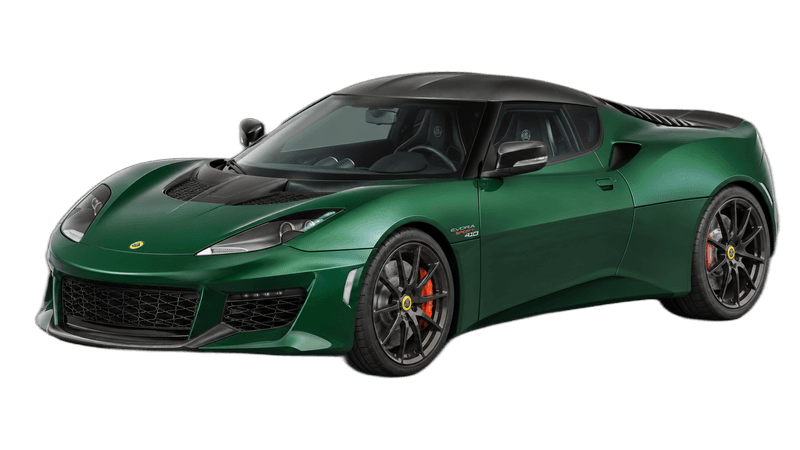
Lotus Evora Sport 410
410cv
Potencia
4.2s
0-100 km/h
306km/h
Velocidad Máxima
Cómo empuja.
La fuerza g máxima en el instante en que pisas a fondo, estimada a partir del 0–100 y la tracción del coche.
Lotus Evora Sport 410G de salida estimada a partir del 0–100 y la tracción: una aproximación honesta, no una cifra medida.
The Lotus Evora Sport 410 is a 2-door coupé by Lotus, with 410 bhp, 410 Nm of torque, a 0-100 km/h time of 4.2 seconds and a top speed of 306 km/h.
Dream Car Garage Editorial · Edited by José Teo Lorente Vallecillos · Last updated 3 November 2026
Visión General
We have not driven this car. This review is based on published specifications and the sources listed below.
Scope of this guide
This guide is scoped to the Lotus Evora Sport 410, the lightened and slightly more powerful version of the supercharged Evora that Lotus showed at the Geneva motor show in 2016. It is a two-seat, mid-engine, rear-wheel drive coupé with a supercharged 3.5 litre V6 behind the seats and a six-speed manual gearbox as standard, with a six-speed automatic as an option. Our catalogue lists it under the short name Evora 410, but the page is about the Sport 410 as Lotus named it. It is not a guide to the earlier Evora S or to the base supercharged Evora that Lotus calls the Four Hundred, and it is not a guide to the GT410 Sport that replaced it.
We have not driven this model for this article. We are an editorial desk that reads sources, and everything below comes from pages we opened: Wikipedia, evo, Goodwood, Motoring Research, PistonHeads, Auto Express, Top Gear Netherlands, Ultimate Car Page, GTspirit (which reproduces the launch press release), L'argus and Carscoops. We have not inspected, owned or tested a car. This page is for research, not a buying recommendation, and it cannot replace an inspection by a Lotus specialist.
The figures at a glance
- Engine: 3.5L supercharged V6, 3,456 cc, the Toyota-derived all-aluminium 24-valve 2GR-FE, mounted mid-engine behind the seats.
- Drivetrain: rear-wheel drive, six-speed manual standard, six-speed automatic optional.
- Power: 410 bhp at 7,000 rpm. Lotus and several magazines print 410 hp or 410 bhp, while Wikipedia and PistonHeads print 416 PS or 416 hp. Converting 416 PS at 0.98632 gives about 410.3 bhp, so the sources agree on 410 bhp and we use that figure throughout.
- Torque: 410 Nm at 3,500 rpm. The launch press release and two other pages print 410 Nm, and the 302 lb ft printed by evo, Goodwood and PistonHeads converts at 1.35582 to about 409.5 Nm, which rounds to 410 Nm. Wikipedia prints 420 Nm (310 lb ft) and we explain below why we did not use it.
- 0-100 km/h: 4.2 seconds for the manual car. This is the 0-62 mph time printed by evo and PistonHeads, and 62 mph is almost exactly 100 km/h (62.14 mph), so we treat it as the metric benchmark. We have not relabelled any 0-60 mph time as a 0-100 km/h time.
- Top speed: 306 km/h for the manual car. Five of the pages we read print 190 mph, and 190 mph multiplied by 1.60934 is 305.8 km/h. The automatic is quoted at 174 mph, about 280 km/h.
- Weight: 1,325 kg kerb weight in most sources, and 1,270 kg dry in two of them.
- Years: shown in February and March 2016, deliveries from June 2016, replaced in January 2018.
- Production: no figure shown for a total. The sources give a cap of 150 cars per year, which is not a total.
History and what changed
Lotus revealed the Sport 410 in the run-up to the 2016 Geneva show. Wikipedia calls it a slightly enhanced version of the Four Hundred, and the launch press release says it shares its supercharged 3.5 litre six-cylinder with the Lotus 3-Eleven. The press release also says deliveries begin in June 2016, with a US version to follow, and that production is limited to 150 units per year. PistonHeads repeats the figure as about 150 built per year, and the Top Gear Netherlands first drive words it as limited to 150 units without saying per year.
The recipe was the familiar Lotus one of adding lightness. Goodwood says the weight dropped by 70 kg compared with the Four Hundred, even with an added gearbox oil cooler, and Auto Express quotes 1,325 kg after the 70 kg reduction. evo gives the same 1,325 kg kerb weight. Motoring Research quotes 1,270 kg dry, and PistonHeads gives the same 1,270 kg dry weight with the optional Janspeed titanium exhaust. We read the two numbers as different measures and not as a disagreement, but the pages do not spell out the basis for every figure.
The changes listed by the pages we read include:
- Carbon fibre: roof, rear deck or tailgate and front and rear aero pieces. Goodwood lists roof, rear deck and front and rear valances, Motoring Research lists roof, rear quarter panels and tailgate, and Wikipedia adds a front access panel. PistonHeads says a one-piece carbon bootlid replaces a five-panel design, saves 12 kg and removes the need for a boot strut.
- Seats: the rear seats are deleted, which makes it strictly a two-seater according to Goodwood, and one-piece carbon bucket seats trimmed in Alcantara are fitted. PistonHeads says each new seat saves 9 kg.
- Wheels and battery: forged wheels unique to the Sport 410 save 7 kg of unsprung mass according to PistonHeads, and a lithium-ion battery saves 11.3 kg according to Goodwood and Motoring Research.
- Equipment deleted: air conditioning, stereo and a lot of sound insulation are removed as standard. Motoring Research says there is no radio, sat-nav or reversing camera as standard, and Auto Express says the air conditioning and infotainment screen are optional extras.
- Chassis: the ride height is 5 mm lower, the dampers are revalved, and PistonHeads quotes damping stiffer in compression by 25 per cent at the front and 20 per cent at the rear. Michelin Pilot Sport Cup 2 tyres are fitted as standard.
- Aero: Goodwood says a new front splitter and rear spoiler raise downforce to 18 kg at 100 mph (from 8.6 kg) and 64 kg at 150 mph (from 32 kg).
Lotus claims a lap of its Hethel test track in 1 minute 28 seconds, about three seconds quicker than the Four Hundred. The press release and Motoring Research give the 1 minute 28 seconds time, while Auto Express and PistonHeads repeat only the three-second gain.
Which figures we chose, and why
Power and torque
The Sport 410 name is itself the power figure in British horsepower, and evo says the car makes an even 410 bhp at 7,000 rpm. Wikipedia and PistonHeads print the metric figure of 416 PS or 416 hp, and L'argus prints 416 ch. Top Gear Netherlands converts the car to 415 pk for the Dutch market. These are all the same output expressed in different units or rounded differently, and the stated conversion from 416 PS gives 410.3 bhp.
Torque is where the sources actually disagree. The launch press release, Ultimate Car Page and L'argus print 410 Nm at 3,500 rpm. evo, Goodwood and PistonHeads print 302 lb ft. Wikipedia prints 310 lb ft and 420 Nm. Carscoops, writing about the GT410 Sport in January 2018, prints 420 Nm (309 lb ft) for that later car. We think the 420 Nm figure belongs to the GT410 Sport and has leaked into the Sport 410 entry on Wikipedia, but we cannot prove that from the pages we read. We chose 410 Nm because the maker's press release and the unit conversion of the magazines both land there.
Acceleration
The sources give a spread of numbers and several are not on the same basis. Goodwood and Auto Express print 4.0 seconds for 0-60 mph, with Goodwood giving 3.9 seconds for the automatic. Wikipedia prints 3.9 seconds in its text and 4.0 seconds in its table for the manual. The launch press release and Ultimate Car Page print 3.9 seconds for 0-60 mph. evo prints 4.2 seconds for 0-62 mph, PistonHeads prints 4.2 seconds for the manual and 4.1 seconds for the automatic over 0-62 mph, and Motoring Research prints 3.9 seconds for 0-62 mph without naming the gearbox. Top Gear Netherlands and L'argus print 4.1 seconds for 0-100 km/h, though neither says which gearbox that applies to. We use 4.2 seconds because two pages agree on it for the 62 mph basis and one of them states that it is the manual car. It is a reasonable reading but not the only one.
Top speed
Five of the pages we read print 190 mph for the manual car, which is 306 km/h by our conversion, and Wikipedia prints 306 km/h directly. The launch press release and Ultimate Car Page print 186 mph, which converts to about 299 km/h, and Wikipedia gives 186 mph for the Four Hundred. We use the 190 mph figure because it is the one the later magazine reviews repeat, and the 186 mph figure appears only in the launch material and one specialist page.
Years and production
Wikipedia gives only the 2016 show, evo says it arrived in 2016, and Ultimate Car Page lists 2016 to 2017. Carscoops says the GT410 Sport, introduced in January 2018, officially replaces the older Evora Sport 410. That is why we show 2016 to 2018. No page we read gives a last build date or a total production count for the Sport 410, so there is no figure shown for either. The annual cap of 150 cars is a ceiling, and a ceiling is not the number actually built.
Running costs and ownership notes
Official combined fuel economy is 29.1 mpg (imperial) according to Goodwood, Wikipedia and PistonHeads (which labels it NEDC). Goodwood and Wikipedia give CO2 of 225 g/km for the manual and 230 g/km for the automatic. evo says owners report high 20s to low 30s for mpg and a fill roughly every 300 miles, and that Sport 410 cars registered from April 2017 pay 195 pounds a year in vehicle tax, with earlier registrations at a higher rate.
On reliability, evo says Evoras of all types are proving mechanically reliable, crediting the Toyota engine. It also lists problems that mainly affect earlier or other cars, such as electrical glitches that can cause door-lock problems, ill-fitting trim, early clutch master cylinder trouble, clutch bearings that can make gearbox noise, and oil line failures on the earliest supercharged Evora S cars from 2010 and 2011, which were mostly dealt with under warranty or recall. It says the Recaro seats tend to show wear earlier than you might expect. We do not know how many of these apply to the Sport 410, and we have found no recall notice specific to it.
What to check before buying
Only evo gave us specifics, so this is a short list and not a full inspection scheme. It says to confirm that any recall work has been done and to review the history. It says to check the tyres, because the Sport originally used Michelin Pilot Sport Cup 2 tyres and the suspension suits that tyre. And it says to remember that air conditioning and infotainment were optional, so some cars lack them. Motoring Research and Auto Express both tell us the stock equipment is spare, so a car with air conditioning and a stereo has had extras specified or fitted. A thorough pre-purchase inspection by a qualified Lotus specialist is the sensible step for a car of this kind.
Market and value notes
The UK launch price was 82,000 pounds according to Goodwood, evo, PistonHeads, Auto Express and Motoring Research, which says that is about 10,000 pounds more than the Four Hundred. Ultimate Car Page prints a launch price of 79,900 pounds, and GTspirit's press release text does not give a price. evo says the Sport 410 now sells for between 45,000 and 55,000 pounds on the used market. That is a magazine statement on the version of the page we read, not an auction result or a valuation, and prices move, so check live listings before relying on it. Auto Express says the optional titanium exhaust cost 5,500 pounds when new.
What we could not find
- No last build date and no total production count for the Sport 410: the sources only give a cap of 150 cars per year, so there is no figure shown for the total.
- No agreed torque, acceleration or top speed. The differences are explained above and the figures we use are our reading of them.
- No Sport 410 specific recall or fault list. The reliability notes above come from general Evora coverage.
- The press release is reproduced by GTspirit and not read on a Lotus Cars page.
About the photograph
The page uses the catalogue photograph for this model, and its credit is listed on the credits page.
Verdict
The Evora Sport 410 is a modest-looking update on paper, with ten extra horsepower and 70 kg less weight, but the pages we read agree that the lighter, firmer and sparser car is the more focused Evora, and they put its cost at about 10,000 pounds over the car it replaced. Our figures are 410 bhp, 410 Nm, 4.2 seconds to 100 km/h in the manual car and 306 km/h, with the caveat that torque, acceleration and top speed are all quoted differently by different outlets. Check the equipment list, the tyres and any recall history, expect a firm ride, and treat this page as a research aid rather than a buying recommendation.
Sources
- Wikipedia: Lotus Evora
- evo: Lotus Evora (2009-2021) review
- Goodwood: Lotus Evora Sport 410 review
- Motoring Research: Lotus Evora Sport 410 review
- PistonHeads: Lotus Evora Sport 410 review
- Auto Express: Lotus Evora Sport 410 review
- Top Gear Netherlands: Lotus Evora Sport 410 first drive
- Ultimate Car Page: Lotus Evora Sport 410
- GTspirit: Official 2017 Lotus Evora Sport 410 (press release text)
- L'argus: Lotus Evora Sport 410 at Geneva 2016
- Carscoops: Lotus launches new Evora GT410 Sport (January 2018)
Especificaciones
Motor
3.5L supercharged V6
Cilindrada
3.5L
Potencia
410 cv
Par Motor
410 Nm
0-100 km/h
4.2s
Velocidad Máxima
306 km/h
Tracción
RWD
País
United Kingdom
Carrocería
2-door coupé
Años
2016–2018
Specifications are manufacturer-published figures.
Más de Lotus
Preguntas Frecuentes
What are the specifications of the Lotus Evora Sport 410?
The Lotus Evora Sport 410 is a 2-door coupé by Lotus, with 410 bhp, 410 Nm of torque, a 0-100 km/h time of 4.2 seconds and a top speed of 306 km/h.
What drivetrain does the Lotus Evora Sport 410 use?
The Lotus Evora Sport 410 is configured with rear-wheel drive.
What type of car is the Lotus Evora Sport 410?
The Lotus Evora Sport 410 is a sports cars manufactured by Lotus in United Kingdom. Production ran from 2016 to 2018.