
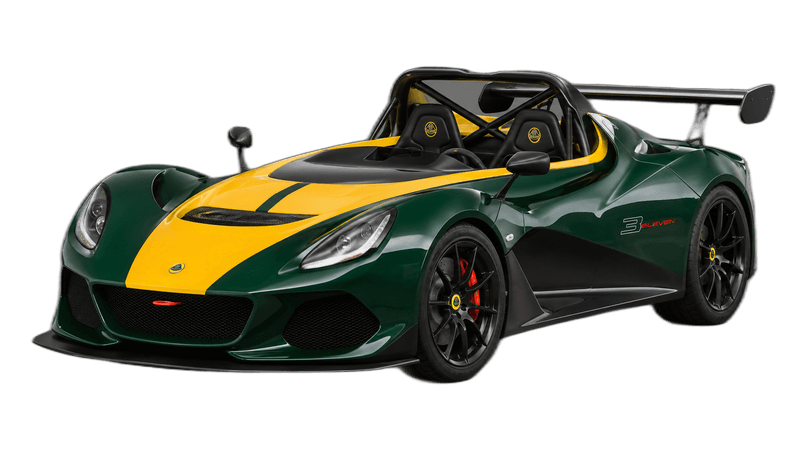
Lotus 3-Eleven
410bhp
Power
3.4s
0-100 km/h
280km/h
Top Speed
How hard it pulls.
Peak g-force the instant you bury the throttle, estimated from the car's 0–100 time and drivetrain.
Lotus 3-ElevenEstimated peak launch g from the 0–100 time and drivetrain: an honest approximation, not a measured figure.
The Lotus 3-Eleven is a open track car by Lotus, with 410 bhp, 410 Nm of torque, a 0-100 km/h time of 3.4 seconds and a top speed of 280 km/h.
Dream Car Garage Editorial · Edited by José Teo Lorente Vallecillos · Last updated 3 November 2026
Overview
We have not driven this car. This review is based on published specifications and the sources listed below.
Scope of this guide
This guide is scoped to the Lotus 3-Eleven in its Road specification, the limited-run open track car that Lotus sold from 2016 to 2018. It is a two-seat, mid-engine car with rear-wheel drive, a supercharged V6 behind the seats and no conventional windscreen. Lotus sold the 3-Eleven in two specifications, called Road and Race, and they differ in power, torque, weight, gearbox, aerodynamics and, according to some sources, top speed. Our catalogue entry gives 410 bhp, which is the Road figure, so this guide describes the Road car and treats the Race car as the comparison. It is not a guide to the later 3-Eleven 430, which Lotus announced in February 2018 as a separate run of twenty cars, although we mention it for context.
We have not driven this model for this article. We are an editorial desk that reads sources, and everything below comes from pages we opened: Wikipedia, an evo report dated 14 January 2016, PistonHeads (27 June 2015), GTspirit (27 June 2015 and 22 February 2018), AutoGuide (June 2015), The Manufacturer, the Lotus Drivers Guide genealogy page and its reproduction of the Lotus 3-Eleven 430 press introduction, NOLN, Conceptcarz (a specification page and a valuation page) and the RM Sotheby's lot page for an Auburn Fall 2019 car. Like most pages about a car this rare, they are news and reference pages, not owner reports. This guide is for research, not a buying recommendation, and a guide cannot replace an inspection by a specialist who knows these cars.
The figures at a glance
- Engine: 3.5L supercharged V6, the Toyota-sourced 2GR-FE unit of 3,456 cc as Wikipedia describes it, in the form first used in the Lotus Evora 400, with an integrated water-to-air charge cooler according to the Lotus Drivers Guide.
- Layout: mid-engine, rear-wheel drive. Conceptcarz lists the engine location as front, which contradicts every other source and which we treat as an error.
- Power: 410 bhp at 7,000 rpm for the Road car. Wikipedia prints 410 bhp (416 PS, 306 kW) and Conceptcarz prints 410 hp. Converting 416 PS at 0.98632 gives about 410.3 bhp, and converting 306 kW at 1.34102 gives the same. The Race car is rated at 460 bhp.
- Torque: 410 Nm at 3,000 rpm for the Road car. Wikipedia prints 410 Nm (302 lb ft) and Conceptcarz prints 302 lb ft and 409 Nm. Converting 302 lb ft at 1.35582 gives about 409.5 Nm, so the sources agree. The Race car is listed at 525 Nm.
- 0-100 km/h: 3.4 seconds for the Road car, from the Lotus 3-Eleven 430 press introduction, which compares the 430 with the previous car. The Lotus Drivers Guide genealogy page also prints 3.4 seconds for 0-100 km/h. The 0-60 mph time for the Road car is 3.3 seconds in evo, The Manufacturer, NOLN and Conceptcarz, and the two should not be confused: 3.3 seconds is a 0-60 mph time, and we use only the 3.4 seconds figure for 0-100 km/h.
- Top speed: 280 km/h (174 mph) for the Road car, with a conversion check: 174 mph at 1.60934 is 280.0 km/h. This is the figure that sources disagree on most, and we explain our choice below.
- Weight: 925 kg dry for the Road car (evo, The Manufacturer, Conceptcarz and the Lotus 3-Eleven 430 press introduction by implication) and 890 kg for the Race car.
- Gearbox: six-speed close-ratio manual with a Torsen-type limited-slip differential on the Road car, against a six-speed Xtrac sequential gearbox with paddle shift on the Race car.
- Production: limited to 311 cars worldwide, per Lotus launch material quoted by evo, PistonHeads, NOLN and others.
Road and Race, and which one the catalogue entry describes
The catalogue entry lists 410 bhp, 3.4 seconds to 100 km/h and 280 km/h. Every one of those figures belongs to the Road car in the sources we read. The Race car is the more extreme specification: 460 bhp, 525 Nm, 890 kg dry, a 2.9 second 0-60 mph time and 3.0 seconds to 100 km/h on the Lotus Drivers Guide genealogy page. We therefore describe the Road car and say so plainly. If you are looking at a Race car, the power, torque, weight, gearbox, aero and tyre details here do not apply to it.
Power at launch is a separate point of confusion. At the unveiling in June 2015, the press release text on GTspirit and PistonHeads quoted a single 450 hp (456 PS) figure and 332 lb ft of torque, and said 0-60 mph in less than three seconds. By the January 2016 pricing announcement, evo and The Manufacturer gave 410 bhp for the Road car and 460 bhp for the Race car. The Lotus Drivers Guide genealogy page even prints both sets in different parts of one page. We chose the later split figures because the later pages are explicit about which version each number describes, and because Wikipedia and the Lotus 3-Eleven 430 press introduction line up with them.
History and what changed over the run
Lotus showed the 3-Eleven at the 2015 Goodwood Festival of Speed and announced it as the quickest and most expensive Lotus yet, according to AutoGuide's launch report. The press release on GTspirit says production would start in February 2016 with deliveries in April 2016, while evo and The Manufacturer say deliveries started in March 2016. We cannot reconcile those dates and so describe the production start loosely as early 2016.
The chassis uses Lotus extruded and bonded aluminium construction. GTspirit quotes Lotus describing a bespoke chassis based on the proven Lotus design of extruded and bonded aluminium sections, with lightweight double wishbones front and rear, Eibach springs and adjustable Ohlins dampers. evo and PistonHeads add that the composite body is claimed to be 40 percent lighter than an equivalent glass-reinforced plastic body, built with resin glues, and that a lithium-ion battery saves 10 kg. Brakes are AP Racing four-piston calipers on 332 mm discs, with Lotus-tuned ABS and traction control. Wheels are forged aluminium, 18 inch at the front and 19 inch at the rear, with 225/40 ZR18 and 275/35 ZR19 tyres.
The cabin is minimal. PistonHeads notes two seats with a removable passenger seat and a tonneau cover for a single-seater look, a TFT instrument display, a quick-release steering wheel, a fire extinguisher and a battery kill switch. On the Road car the seat is a Lotus sports seat with a four-point harness and the tyres are Michelin Pilot Super Sport. The Race car uses an FIA-approved seat, a six-point harness and Michelin Cup 2 tyres.
Aerodynamics
evo reports claimed downforce at 150 mph of 150 kg for the Road car and 215 kg for the Race car, and NOLN repeats the same pair. GTspirit and NOLN list the shared aero parts as a front splitter, flat floor, rear diffuser and rear splitter, with the Race car adding twin canards and an adjustable rear wing. These are manufacturer claims in the sources we read, not figures we can verify.
The 3-Eleven 430
In February 2018 Lotus announced the 3-Eleven 430. The press introduction on the Lotus Drivers Guide gives 430 hp (436 PS) at 7,000 rpm, 440 Nm, 920 kg dry, 3.1 seconds for 0-60 mph, 3.2 seconds for 0-100 km/h and a top speed of 180 mph (290 km/h), in a limited series of twenty cars. GTspirit's 2018 article adds a UK price of 102,000 pounds including VAT and on-the-road costs, a downforce increase of 44 kg to 265 kg and a rear wing 50 mm higher than before. Wikipedia lists the 430 as a separate production of twenty cars in 2018 and 2019. It is a different car from the one this guide covers, and we do not count it in the 311.
Where the sources disagree
We say so where sources disagree instead of choosing silently.
- Top speed. Evo, PistonHeads, GTspirit (2015) and AutoGuide give the Road car 180 mph (290 km/h) and the Race car 174 mph (280 km/h), which makes some sense because the Race car carries more downforce. The Manufacturer, NOLN, Conceptcarz, the Lotus Drivers Guide genealogy page and, importantly, the Lotus 3-Eleven 430 press introduction give the Road car 174 mph (280 km/h) and the Race car 180 mph (290 km/h). Wikipedia, as we read it, prints 180 mph (290 km/h) for both. We chose 280 km/h for the Road car because the maker's own 2018 comparison table, as reproduced by the Lotus Drivers Guide, uses 174 mph (280 km/h) for the previous car. We still flag that the early launch material said the opposite.
- Power and torque. Launch text said 450 hp and 332 lb ft for the shared engine; later pages split into 410 bhp and 460 bhp, with Wikipedia and the Lotus Drivers Guide genealogy page giving Road torque of 410 Nm and Race torque of 525 Nm. We use the split figures.
- 0-100 km/h. The Road 0-60 mph time is 3.3 seconds. Wikipedia prints 3.3 seconds in a row labelled 0-62 mph (0-100 km/h), which appears to merge two measures. The Lotus figure for 0-100 km/h is 3.4 seconds, and we use that.
- Production. The Lotus Drivers Guide genealogy page prints 291 made in a table and a limit of 311 in its text. All other sources give 311, and Wikipedia gives 311 produced for the 3-Eleven and twenty for the 430. We use 311, noting it is described as a limit by Lotus.
- Years. Wikipedia and the Lotus Drivers Guide give production dates of 2015 to 2018, while the car was launched in 2015 and deliveries started in 2016. Our catalogue years of 2016 to 2018 describe the delivery period.
Market, value and what to check
Specific buying advice is thin. We found no owner-written buying guide for this car, and nothing in the sources we opened lists known faults, recalls or service intervals, so we do not invent them. What we can report is limited to a few price points and a general caution.
Launch prices, per evo on 14 January 2016, were from 82,500 pounds for the Road car and 97,083 pounds before VAT (116,500 pounds including VAT) for the Race car. PistonHeads in June 2015 quoted a slightly different Road launch price of 82,000 pounds and a different Race price, which shows prices moved between announcement and sale. We do not know what any used car costs in the UK today.
For auction results, the RM Sotheby's lot page for the Auburn Fall 2019 sale lists a 2017 3-Eleven, described as the 22nd of 311 produced and the first US delivery example, offered with less than two hundred miles from new, full delivery paperwork and service records and an original MSRP of over 157,000 dollars. The page shows 110,000 dollars Sold. The Conceptcarz valuation page records two sales in total, 110,000 dollars in 2019 and 126,500 dollars at Mecum Monterey in August 2021, and explicitly warns that two sales are a very small sample. That page gives an average of 118,250 dollars. Prices from this tiny sample do not tell you what any particular car is worth today.
If you are researching a purchase, the points that follow from the sources are practical rather than technical. Confirm whether the car is a Road or a Race specification, because the specifications differ so much. Ask for the delivery paperwork and the service history, because RM Sotheby's treats those as part of the appeal. Check the car's mileage, and whether it has been used on track. The rarity means that there is no large pool of cars to compare with, and a guide cannot replace a specialist inspection of the supercharged V6, the chassis and the bonded composite body.
What we could not find
- Torque and 0-100 km/h for the Road car were found, but in only a few places. Where a source printed only a 0-60 mph time we did not relabel it.
- Race-only or Road-only lap times from independent testers: no figure shown. We only found manufacturer claims, such as a Hethel lap of 1 minute 19.5 seconds for the car at its most extreme setting, and a Nurburgring time of 7 minutes 6 seconds with traffic reported by evo.
- Reliability data, recalls, running costs and service intervals. None of the pages we read give any, so we make no claims about them.
- Neither is cited here.
- Dedicated owner-written buying guides, which we did not find.
About the photograph
The page uses the catalogue photograph, and its credit is listed on the credits page.
Verdict
The Lotus 3-Eleven is a very short-run, mid-engine, rear-wheel drive track car whose Road specification, the one our catalogue entry describes, makes 410 bhp and 410 Nm from a 3.5L supercharged V6, weighs 925 kg dry and reaches 100 km/h in 3.4 seconds according to the maker's own later figures. The Race car is stronger on paper at 460 bhp, and the early launch material is inconsistent about which of the two is faster at the top end, so treat any top speed with some care. The only used-market data we could find is a pair of US auction results and a pair of launch price lists, which are not enough to value a car. For a buyer, the right next step is to find the exact specification and history of an individual car and to have it inspected by a Lotus specialist. This page is for research only.
Sources
- Wikipedia: Lotus 3-Eleven
- evo: Lotus 3-Eleven pricing and specification confirmed
- PistonHeads: Lotus 3-Eleven official
- The Manufacturer: Lotus 3-Eleven, the most powerful road car to wear a Lotus badge
- Lotus Drivers Guide: 3-Eleven genealogy
- Lotus Drivers Guide: 3-Eleven 430 press introduction
- GTspirit: Official 2016 Lotus 3-Eleven
- GTspirit: Official Lotus 3-Eleven 430, 20 units worldwide
- AutoGuide: Lotus 3-Eleven revealed as quickest, most expensive Lotus ever
- NOLN: Fast, Faster, Lotus 3-Eleven
- Conceptcarz: 2018 Lotus 3-Eleven specifications
- Conceptcarz: Lotus 3-Eleven valuation analysis
- RM Sotheby's: 2017 Lotus 3-Eleven, Auburn Fall 2019
Specifications
Engine
3.5L supercharged V6
Displacement
3.5L
Power
410 bhp
Torque
410 Nm
0-100 km/h
3.4s
Top Speed
280 km/h
Drivetrain
RWD
Country
United Kingdom
Body Style
Open track car
Years
2016–2018
Production
311
Specifications are manufacturer-published figures.
More from Lotus
Frequently Asked Questions
What are the specifications of the Lotus 3-Eleven?
The Lotus 3-Eleven is a open track car by Lotus, with 410 bhp, 410 Nm of torque, a 0-100 km/h time of 3.4 seconds and a top speed of 280 km/h.
How many Lotus 3-Eleven were made?
Lotus produced 311 units of the Lotus 3-Eleven.
What drivetrain does the Lotus 3-Eleven use?
The Lotus 3-Eleven is configured with rear-wheel drive.
What type of car is the Lotus 3-Eleven?
The Lotus 3-Eleven is a track focused manufactured by Lotus in United Kingdom. Production ran from 2016 to 2018.