Lotus Elan M100
£6,000
usedIndicative market price, updated periodically.
162bhp
Power
220km/h
Top Speed
£6,000
Price Used
The Lotus Elan M100 produces 162 bhp and has a top speed of 220 km/h. A representative example is worth about £6,000.
Dream Car Garage Editorial · Edited by José Teo Lorente Vallecillos · Last updated 3 November 2026
Overview
We have not driven this car. This review is based on published specifications and the sources listed below.
Scope of this guide
This guide is scoped to the Lotus Elan M100, the front-engine, front-wheel drive two-seat roadster that Lotus sold from 1989 until 1995 and that revived the Elan name after fourteen years. We focus on the turbocharged SE, which most buyers chose and which the catalogue entry describes, and we mention the naturally aspirated Elan 1.6, the American-specification cars and the Series 2 where they change the numbers. It is a glassfibre-bodied car on a steel backbone chassis. It is not a guide to the original rear-wheel drive Elan of the 1960s, and it is not a guide to the Kia Elan that Kia built in South Korea later in the nineties with a different engine.
We have not driven this model for this article. We are an editorial desk that reads sources, and everything below comes from pages we opened: the specialist pages sportscar2.com and automobile-sportive.com, PistonHeads, conceptcarz.com, the specification databases ultimatespecs.com and carbaze.com, an online auction listing from The Market, a tyre dealer's blog and Wikipedia. We did not find a current Lotus Cars page for this model. This guide is for research, not a buying recommendation, and it cannot replace an inspection by a specialist who knows these cars.
The figures at a glance
- Engine: 1.6L turbocharged inline-four. It is a 1,588 cc, twin-cam, 16-valve engine derived from an Isuzu unit (Wikipedia and sportscar2.com name it the Isuzu 4XE1) and extensively reworked by Lotus, with multipoint fuel injection and a turbocharger on the SE.
- Power: 162 bhp. Wikipedia, PistonHeads, conceptcarz.com and The Market listing all print 162 bhp or 162 hp for the Turbo SE. Sportscar2.com prints 165 bhp at 6600 rpm, and ultimatespecs.com prints 165 PS (also 163 HP) at 6600 rpm. Converting 165 PS with the factor 0.98632 gives about 162.7 bhp, so the metric and imperial figures describe essentially the same rating. We use 162 bhp everywhere in this guide because four sources print it directly.
- Torque: 201 Nm. Sportscar2.com prints 148 lb ft at 4200 rpm, and 148 multiplied by 1.35582 gives just under 201 Nm, which we state as 201 Nm. Ultimatespecs.com prints a rounded two hundred Nm (147 lb ft, which converts to about 199 Nm). The sources agree to within rounding. Wikipedia, PistonHeads and conceptcarz.com give no torque figure.
- 0-100 km/h: no figure shown. The sources we read give 0-60 mph times, not 0-100 km/h times, and we do not relabel one as the other. Ultimatespecs.com does print a 0-100 km/h figure of 7.2 seconds, but it is a single database entry with no stated test source, and it sits oddly beside the 6.5 to 6.7 second 0-60 mph magazine figures, so we left the catalogue field empty. See the next section for the 0-60 mph evidence.
- Top speed: 220 km/h. Wikipedia and ultimatespecs.com print 137 mph (220 km/h), and 137 mph multiplied by 1.60934 is about 220.5 km/h. Carbaze.com also prints 220 km/h.
- Drive: front-wheel drive with a five-speed manual gearbox. Conceptcarz.com calls it the only Lotus with front-wheel drive.
- Weight and size: ultimatespecs.com and carbaze.com give a kerb weight of 1,020 kg. Ultimatespecs.com lists a 3.8 metre overall length (3,802 mm), a 2,250 mm wheelbase and a 185 litre boot, and PistonHeads says the car was shorter than a contemporary Ford Escort.
- Years: 1989 to 1995, covering the first series built from November 1989 to July 1992 and the Series 2 built from June 1994 to September 1995.
Where the sources disagree
We say so where sources disagree instead of choosing silently. On power, the figures for the turbo car are 162 bhp, 164 PS (Wikipedia), 165 bhp, 165 PS and 163 HP depending on the page, while the Series 2 is quoted at 155 bhp. On the naturally aspirated Elan 1.6, sportscar2.com, Wikipedia, PistonHeads and conceptcarz.com give 130 bhp or 130 hp, whereas automobile-sportive.com prints 132 DIN horsepower at 7200 rpm, which is consistent with Wikipedia's 132 PS.
On acceleration, Autocar and Motor are quoted by Wikipedia as measuring 0-60 mph in 6.5 seconds, and conceptcarz.com and The Market give the same time, while sportscar2.com and ultimatespecs.com print 6.7 seconds. Sportscar2.com adds 0-100 mph in 17.2 seconds and a standing quarter mile in 15.0 seconds. The Series 2 is given as 7.5 seconds to 60 mph by sportscar2.com, Wikipedia and conceptcarz.com. On launch prices, PistonHeads gives 21,620 pounds for the Turbo SE, whereas Wikipedia gives 17,850 pounds for the Elan 1.6 and 19,850 pounds for the Turbo SE. We cannot reconcile those, and they may refer to different dates or markets.
On development cost, PistonHeads says Lotus spent 37 million pounds, while Wikipedia and the tyre dealer's blog say about 35 million pounds. On the date the Series 2 ended, the blog says July 1995, while sportscar2.com, Wikipedia and conceptcarz.com say September 1995. We use September 1995 because three sources agree on it.
History and where the M100 sits
Sportscar2.com says General Motors bought Lotus in 1986 and that design work on the M100 began that year. Conceptcarz.com describes an earlier prototype, the M90 and later X100, designed by Oliver Winterbottom with a Toyota engine and gearbox, before Peter Stevens' Type M100 was approved in late 1986. Automobile-sportive.com gives a longer chronology: Mike Kimberley first approached Colin Chapman about a small convertible in 1980, the project was shelved after Chapman died in 1982, a market study moved the design to front-wheel drive in 1985, and a first rolling prototype followed in 1987. Wikipedia and sportscar2.com date the launch to August 1989, at the Motorfair in Earl's Court, London.
Conceptcarz.com says development took just under three years and included 19 crash cars, 42 development vehicles and nearly one million test miles. We cannot verify those numbers beyond that page. It also says each new car was test-driven for about 30 miles at the Hethel factory before shipping.
The commercial story was hard. PistonHeads says the launch coincided with recessions in the UK and US, that Lotus claimed capacity of up to 3,000 cars a year but never came close, and that Lotus claimed a two-year UK waiting list at launch that did not last. The Mazda MX-5 reached the UK in March 1990 with 115 hp, at 14,249 pounds according to the same article, and both Wikipedia and conceptcarz.com blame it for the disappointing early sales. Sportscar2.com says Lotus was sold to Bugatti in 1993 and that the loss-making M100 was discontinued. Kia then acquired the rights, and Wikipedia and conceptcarz.com say Kia Motech built the car in Ansan from 1996 to 1999, with 1,056 built, using a 1.8L Kia engine of 151 PS. The automobile-sportive.com page and PistonHeads give 1,000 for the Kia cars. We keep those out of our scope.
Variants and what changed over the run
- Elan 1.6 (naturally aspirated): 130 bhp, 105 lb ft at 4200 rpm (about 142 Nm), 0-60 mph in 7.6 seconds and 122 mph, according to sportscar2.com. Wikipedia and conceptcarz.com say 129 of them were built; sportscar2.com says all but 130 of the first series were turbo SEs; automobile-sportive.com says 180 and that it was sold only in the UK in right-hand drive. These counts disagree and we have no way to reconcile them.
- Elan SE (turbo): the car the catalogue describes. Sportscar2.com lists 148 lb ft at 4200 rpm, 0-60 mph in 6.7 seconds, 137 mph and 32.1 mpg overall fuel consumption.
- American specification: sportscar2.com calls it a limited edition of 559 cars with a redesigned, longer nose to meet US regulations, a different rear spoiler and 16-inch wheels. Conceptcarz.com also says 559, PistonHeads says 560, and automobile-sportive.com says 539.
- Series 2: sportscar2.com, Wikipedia and conceptcarz.com say eight hundred cars were built between June 1994 and September 1995 for the UK market only, using surplus engines and gearboxes. Catalytic converters were fitted, power fell to 155 bhp (Wikipedia gives 157 PS) and the 0-60 mph time rose to 7.5 seconds. Sportscar2.com also lists a new dashboard, uprated power steering, stiffer suspension, and anti-lock brakes on Series 2 cars only. The tyre dealer's blog says the Series 2 body was slightly longer and heavier to accommodate US-style safety equipment, which we could not confirm elsewhere.
The first series total is 3,855 cars from November 1989 to July 1992 on sportscar2.com, conceptcarz.com, Wikipedia and the tyre dealer's blog. Ultimatespecs.com prints 3726 units for the SE. Adding the first series total to the Series 2 run gives 4,655, which is a total for the whole model. No source we read prints that sum itself: PistonHeads says about 4,700 cars across two production runs, and automobile-sportive.com prints a total of 6,374 that includes the Kia cars. So this figure is our own addition of two published counts, and because no source prints it, we show no production figure in the catalogue.
Chassis, handling and reception
PistonHeads says front-wheel drive was chosen for packaging and for a safer, more forgiving feel, with suspension geometry tuned to limit dive, squat and torque steer. It says Autocar named the car the quickest point-to-point car in the UK at the time and that a motoring magazine praised its unmatched poise. The tyre dealer's blog quotes a view that it was the finest front-wheel drive car bar none. Those are the opinions of the sources, not our own. Automobile-sportive.com lists the drawbacks buyers saw at the time as the front-wheel drive layout, a little-known Japanese engine supplier, a price well above the MX-5, servicing availability, gearshift feel and a gloomy cabin. Conceptcarz.com says the glassfibre body sits over a rigid steel backbone chassis, and PistonHeads mentions a fabric roof with integral tonneau cover and pop-up headlights.
What to check before buying
Two of the pages we read give specifics, and we report them as stated, not as our own findings.
- Rear suspension corrosion. PistonHeads says the rear suspension can rust. Ask a specialist to inspect it.
- Cambelt age. The PistonHeads article, describing one example, says the cambelt was last changed in 2019 and that Lotus specifies a six-year interval. Treat that as one owner's statement and ask for the maker schedule and invoices.
- Oil changes. The same article says a 6,000-mile oil change interval is recommended.
- Interior trim. Broken interior trim can be difficult to source, and early reviews mentioned poor ergonomics and damp carpets, per PistonHeads.
- Engine condition. PistonHeads says the engines are durable if well maintained, but it also says an elderly example needs ongoing maintenance.
- Underside and small items. The Market's auction listing for a 1992 SE Turbo notes peeling paint and underseal on the underside with minor surface corrosion, rusty rear valance screws, perishing short upper door seals, worn areas on the folding roof and rubbing on the driver's seat. That is one car, not a list of typical faults.
- Modifications. The same listing describes a car with a turbo conversion said to raise power to around 195 bhp. Ask whether any car you view has been modified and who did the work.
- Which car it is. The naturally aspirated cars, the American-specification cars and the Series 2 differ in power, equipment and body. Check the paperwork against the engine and chassis numbers.
Running costs and known issues
We found no source giving servicing prices, parts prices or failure rates, so we give none. Fuel use is the only running figure: sportscar2.com prints 32.1 mpg overall for the turbo SE and 32.8 mpg for the naturally aspirated car, and automobile-sportive.com prints 8 L/100 km for the naturally aspirated car. PistonHeads reports an example whose MOT history showed recurring advisories for suspension play and brake wear, which is one car and not a pattern we can generalise.
Market and value notes
We have only dated or sourced price points, and they are not a valuation. The Market sold a modified 1992 SE Turbo for 8,050 pounds on 8 August 2019, and the seller's own opinion, which is not an established market price, was that a good example would sell for 5,000 to 8,000 pounds. Sportscar2.com, undated, puts a good 1989 to 1992 car at 5,000 to 10,000 pounds. PistonHeads, in an article we believe dates from about 2021 because it cites a January 2021 MOT, says a 1991 Turbo SE listed at 10,995 pounds was the cheapest M100 in the classifieds and that values fell with Elise values but had recently started to recover. Prices will have moved since, so check current listings and sold results.
What we could not find
We found no figure shown for a 0-100 km/h time from a magazine or maker source, and no torque figure from Wikipedia, PistonHeads or conceptcarz.com. We did not open a Lotus Cars page, and we found no recall notices, crash-test results, parts prices or failure rates. We found no source that prints a production total for the first series and the Series 2 together.
About the photograph
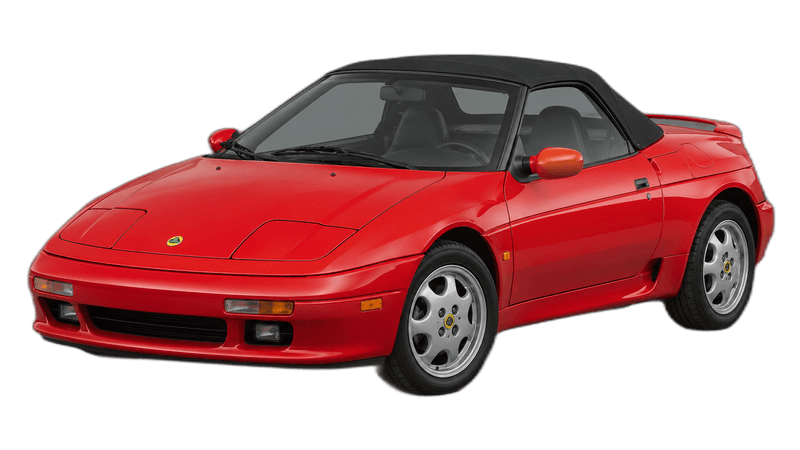
This page uses the catalogue photograph for the car. Its credit is listed on the credits page.
Verdict
The Elan M100 SE is a front-engine, front-wheel drive roadster with a 1.6L turbocharged inline-four making 162 bhp and 201 Nm, a quoted 220 km/h, and a kerb weight of about 1,020 kg. The sources agree that it was highly regarded for its handling and agree that it sold poorly against the MX-5, with roughly 4,655 cars built across two runs by our own addition of published counts. Power is the figure that varies most, from 155 bhp for the catalytic Series 2 to 165 bhp on some pages. We have not driven it, so treat every figure here as a published claim and use the seller's records and an independent specialist inspection to decide.
Sources
- sportscar2.com: Lotus M100 Elan
- PistonHeads: Lotus Elan M100, the brave pill
- conceptcarz.com: 1991 Lotus Elan M100
- ultimatespecs.com: Lotus Elan M100 SE 1.6i Turbo specs
- Wikipedia: Lotus Elan
- automobile-sportive.com: Lotus Elan M100 guide
- carbaze.com: Lotus Elan SE specifications
- The Market: 1992 Lotus Elan M100 SE Turbo listing
- Psycho on Tyres: M100 tag archive
Specifications
| Engine | 1.6L turbocharged inline-four |
|---|---|
| Displacement | 1.6L |
| Power | 162 bhp |
| Torque | 201 Nm |
| Top Speed | 220 km/h |
| Drivetrain | FWD |
| Country | United Kingdom |
| Body Style | 2-door roadster |
| Years | 1989–1995 |
| Price Used | £6,000 |
Specifications are manufacturer-published figures.
Frequently Asked Questions
What is a Lotus Elan M100 worth?
A representative example is worth about £6,000. Actual values vary with specification, condition and history.
How much power does the Lotus Elan M100 have?
The Lotus Elan M100 produces 162 bhp and 201 Nm of torque.
What is the top speed of the Lotus Elan M100?
The Lotus Elan M100 has a top speed of 220 km/h.
What engine does the Lotus Elan M100 have?
The Lotus Elan M100 uses a 1.6L turbocharged inline-four.
When was the Lotus Elan M100 built?
The Lotus Elan M100 was built from 1989 to 1995.
Is the Lotus Elan M100 all-wheel drive?
No. The Lotus Elan M100 is configured with front-wheel drive.