
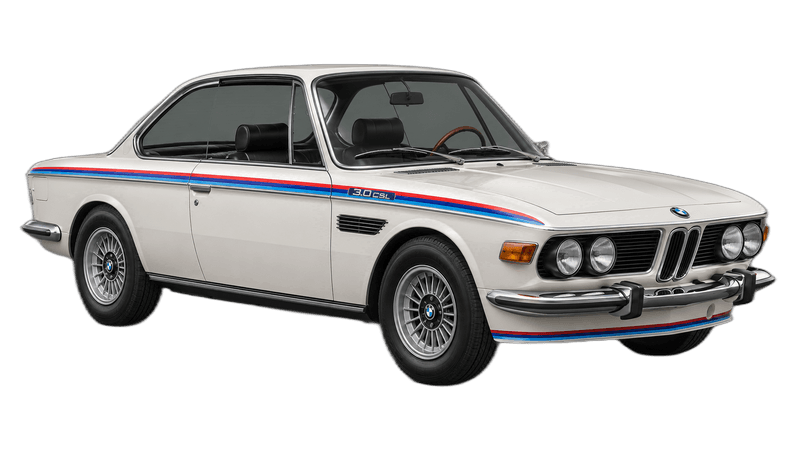
BMW 3.0 CSL
203cv
Potencia
220km/h
Velocidad Máxima
The BMW 3.0 CSL is a 2-door coupé by BMW, with 203 bhp, 286 Nm of torque and a top speed of 220 km/h.
Dream Car Garage Editorial · Edited by José Teo Lorente Vallecillos · Last updated 3 November 2026
Visión General
We have not driven this car. This review is based on published specifications and the sources listed below.
Scope of this guide
This guide is scoped to the BMW 3.0 CSL, the lightweight homologation version of the E9 coupe that BMW built from 1971 to 1975 so that it could go touring car racing. It is a front-engine car with rear-wheel drive, an in-line six-cylinder engine and a four-speed manual gearbox. It is not a guide to the standard 3.0 CS or the 3.0 CSi, which we mention only for comparison, and it is not a guide to the competition cars, which grew to a 3,498 cc four-valve engine according to RM Sotheby's.
We have not driven this model for this article. We are an editorial desk that reads sources, and everything below comes from pages we opened: Wikipedia's article on the BMW E9, a BMW Group Classic product page, an RM Sotheby's lot page for a 1973 car offered in Monterey in 2023, a supercars.net profile, a Conceptcarz profile, a more-cars.net data page, a Silodrome article and a Sport Car Market profile. The CSL was a rare, race-bred coupe and the better cars rarely come to market. A guide like this cannot replace an inspection by a specialist who knows the model, and this page is for research, not a buying recommendation.
One scoping choice matters. The car changed during its run, so no single set of figures describes all of it. The catalogue name says 3.0, but the final and most powerful cars had a bigger engine. We chose the final specification, the 1973 to 1975 car, for the figures below, and we explain the earlier engines in the sections that follow.
The figures at a glance
- Engine: 3.2L inline-six, a two-valve, single-overhead-cam BMW M30 unit with fuel injection. Wikipedia gives 3,153 cc (3.2 L) for the 1973 to 1975 cars, and the BMW Group Classic page also gives 3153 cc.
- Power: 203 bhp. Wikipedia's text gives 206 PS (203 hp; 152 kW) at 5,600 rpm for the final version, while its engine table says 207 PS and 204 bhp. BMW Group Classic prints 151 kW and 206 bhp at 5,600 rpm. We converted 206 PS with the factor 0.98632, which gives about 203 bhp, and 151 kW with 1.34102 gives about 202.5 bhp, so we use 203 bhp.
- Torque: 286 Nm at 4,200 rpm. Wikipedia, Conceptcarz and more-cars.net all give 286 Nm.
- 0-100 km/h: no figure shown. The only 0-100 km/h time we could open comes from one data page, and the other sources give 0-60 mph times, which are a different measurement, so we have not converted them. See the next section.
- Top speed: 220 km/h. BMW Group Classic prints 220 km/h (137 mph), and Conceptcarz and more-cars.net also give 220 km/h.
- Drive: rear-wheel drive, with a four-speed manual gearbox per Conceptcarz.
- Weight: sources disagree, from 1,165 kg to 1,270 kg. See below.
- Production: 1,265 cars in total, per Wikipedia, made up of 765 left-hand drive and 500 right-hand drive cars for the UK.
- Price when new: BMW Group Classic prints DM 37.580 for the 206 PS car. No other launch price appears in the sources we read, apart from an original list price of about 12,000 US dollars on a Sport Car Market page, which also says the car was never sold in the United States.
Where the sources disagree
Sources disagree in several places and we say so rather than choosing silently.
- Displacement. Wikipedia says the early cars used the 3.0 CS engine, listed as 2,986 cc, that a bore increase in August 1972 raised it to 3,003 cc, and that a stroke increase in 1973 made it 3,153 cc. supercars.net gives 2,985 cc for a 1973 car, and Silodrome also says 2,985 cc for the first series, 3,003 cc for the second and 3,153 cc for the third. Conceptcarz rounds to 3200 cc. We found no 3,203 cc figure in any page we read, so we do not use one. The 3,003 cc engine is real but belongs to the middle period, not the whole run.
- Power. Wikipedia gives 180 PS (178 bhp) for the first cars, 200 PS (197 bhp) at 5,500 rpm for the 3,003 cc cars and 206 or 207 PS for the final cars. Silodrome gives 180 hp, 200 hp and 206 hp for the three generations. The current catalogue figure of 200 is therefore a PS figure for the middle engine, and 200 PS is about 197 bhp. Some pages mix units: supercars.net prints 206 bhp beside a 2,985 cc engine, and Sport Car Market says 3,003 cc and 206 bhp together. We think the 206 figure belongs to the 3,153 cc engine, which is how Wikipedia, BMW Group Classic and Silodrome pair them, but we could not check this against a factory document.
- Acceleration. more-cars.net gives 7.5 for 0-100 km/h. supercars.net gives 7.0 seconds for 0-60 mph and Conceptcarz gives 7.3 seconds for 0-60 mph. Those are different speeds, and the two disagree even on that basis, so we did not relabel either as a 0-100 km/h time. The 6.9 seconds in the current catalogue row does not appear in any page we read. We show no figure for 0-100 km/h because the only 0-100 km/h time we could open, 7.5 seconds, comes from a single data aggregator and we do not think one such page is enough to publish.
- Top speed. BMW Group Classic, Conceptcarz and more-cars.net say 220 km/h. supercars.net says 137 mph, which is the same figure in other units.
- Torque. 286 Nm (Wikipedia, Conceptcarz, more-cars.net), 210 lb-ft at 4,300 rpm (supercars.net, which pairs it with 206 bhp) and 215 lb-ft at 4,200 rpm (Silodrome). We chose 286 Nm because three pages agree and Wikipedia ties it to 4,200 rpm and the 3,153 cc engine. For the 3,003 cc engine Wikipedia gives 272 Nm at 4,300 rpm.
- Weight. supercars.net and more-cars.net say 1,165 kg, Conceptcarz says 1,270 kg, and Silodrome says 1,270 kg against 1,420 kg for the 3.0 CS. Wikipedia gives no weight. We do not put a weight in the figures list because we cannot say which is right.
- Weight saved. supercars.net says about 200 kg compared with the standard 3.0 CS and Silodrome says almost 200 kg. Sport Car Market says about 300 lb (136 kg). RM Sotheby's says roughly 470 pounds was removed.
- Years. supercars.net says BMW showed the CSL at Geneva in March 1971 and that fuel injection arrived in September 1972. Wikipedia says the car was introduced in May 1972 as a homologation special, but its engine table starts at 1971. Sport Car Market gives 1971-72 for the production years of its car. BMW Group Classic dates the final car from July 1973 to October 1975. We use 1971 to 1975, which is what supercars.net and Wikipedia's table support, and the 1975 end date is backed by BMW Group Classic.
The lightweight alloy-panel cars
The L in CSL stands for leicht, the German word for light, according to Silodrome. The sources agree on how weight was saved. Wikipedia says BMW used thinner steel for the body, deleted trim and soundproofing, and fitted aluminium alloy doors, bonnet and boot lid, with Perspex side windows. Silodrome says the entire unibody structure was built from thinner-gauge steel and names the same alloy doors, bonnet and boot lid. supercars.net adds thinner glass and removed sound deadening. RM Sotheby's mentions plastic windows, aluminium components and thinner-gauge steel but does not list the panels. Conceptcarz describes the body as unit steel with aluminium panels.
Wikipedia adds that UK-market cars kept soundproofing, electric windows and standard bumpers, so they were not quite as light. This matters when comparing quoted weights and savings, because a left-hand drive car and a right-hand drive car may not have been built to the same level of weight reduction. We found no source that weighs the two side by side.
The aero cars and the Batmobile
Wikipedia says the final version was homologated in July 1973 with a large front air dam, short fender fins, a roof-edge spoiler and a tall rear wing, and that the full package earned the nickname Batmobile. Silodrome says the rear wing was not fitted at the factory but was shipped in three parts for the owner to install, because German road rules then prohibited wings. Wikipedia says the wings were shipped in the boot for the same reason. BMW Group Classic says the package had not been licensed for road use and was sometimes sold as a motorsport accessory. RM Sotheby's says the 1973 devices were developed with Alpina to reduce drag and lift.
How many aero cars were built is not clear. Silodrome describes its featured 1975 car as one of the first 110 Batmobiles built, but gives no total. BMW Group Classic says only 169 units of the model had been made by October 1975, and more-cars.net lists a total of 167. We could not tell whether those figures count only the 206 PS cars, the cars sold with the aero kit or something else, and the BMW Group Classic page carries a footer saying its content was created using AI, so we treat its 169 with caution. Wikipedia gives no separate count of aero-equipped cars. We therefore do not state one, and none of these small numbers should be confused with the 1,265 total.
Production count
We use 1,265, from Wikipedia, which splits it into 765 left-hand drive and 500 right-hand drive cars. supercars.net also says approximately 1,265 built from 1971 to 1975, and says fewer than 500 were right-hand drive. Conceptcarz lists 1,039 units for 1971 to 1976 and Sport Car Market gives 1,039 for 1971 to 72, so these two pages disagree with the 1,265 figure and with each other on the years. We could not reconcile them. The 1,265 figure is the one supported by the most pages, and it is a figure for the whole CSL line, not for the aero cars alone.
What to check, and what the rarity means
Our sources are auction and market pages, not workshop manuals, so this list reflects what they emphasise and is not a specialist checklist.
- Which CSL it is. The three engine generations, the alloy-panel cars and the aero cars are different things. Sport Car Market ranks a fuel-injected CSL without the Batmobile wings just below fully equipped track or road Batmobiles and above carbureted, comfort-package and CSi models, so identification affects value.
- Originality of the aero parts. Because BMW Group Classic says the package was sometimes sold as a motorsport accessory and the wing was shipped separately, the history of any aero kit is worth asking about. RM Sotheby's notes that BMW allowed one restorer to take moulds from another CSL in its collection to replicate Group 2 bodywork, so restored cars can carry reproduced parts.
- Restoration versus preservation. Sport Car Market says a repaint kept its profile car out of concours preservation classes, though it retained much of its originality.
- Chassis number. Sport Car Market says the number is stamped into the firewall on its car. The profile gave none, so we repeat no numbers.
- Registration and use. Sport Car Market says its car could be driven on the street only in states that license privately imported cars, and that California is not one of them. The RM Sotheby's car is listed as bill of sale only and remains eligible for vintage racing.
Running costs and known issues
We found almost no running-cost data. Sport Car Market lists a tune-up cost of 700 US dollars on its profile, without a date or an itemised invoice, so we treat it as one data point and not a typical figure. We found no tyre, insurance, engine-rebuild or injection-service costs, no rust guide and no list of known faults in the pages we read, so we give none. Anyone quoting repair costs for this model without a source is guessing.
Recalls and safety
We found no recall notice for the CSL in any page we read, but that is not a clean bill of health, because we did not search a recall database. We found no crash-test or safety-equipment data. The car is a homologation special from the early 1970s, and a buyer should ask a specialist what braking, lighting and restraint upgrades a particular car has received.
Market and value notes
Prices are scattered and a few sales do not make a valuation. Sport Car Market says a 1972 car sold for 187,500 US dollars including buyer's premium at Bonhams' Quail Lodge Auction on 14 August 2015, and that a 1975 Batmobile sold for 218,400 US dollars at Bonhams Dubai in October 2010. Its valuation range of 32,000 to 55,000 US dollars is clearly out of step with those results and should be read as stale. RM Sotheby's offered a restored 1973 car at Monterey in 2023 with an estimate of 800,000 to 1,000,000 US dollars, and it is marked as not sold. supercars.net says clean examples now sell for more than half a million dollars, without a date. These figures cover different cars, years and conditions, and we are not giving a valuation.
What we could not find
We found no BMW factory document giving a torque or acceleration figure for the final car, so the 0-100 km/h time and the weight come from enthusiast and data pages that disagree. We found no settled count of aero cars, no running costs beyond the single tune-up figure, no recall data and no crash-safety data. We did not open the BMW Group Archive. The current catalogue row says 6.9 seconds, 3003 cc and 200 for power, and we found support for 3003 cc and 200 PS only in the 1972 to 1973 period, and found no support for 6.9 seconds.
About the photograph
This page uses the catalogue photograph for the car. Its credit is listed on the credits page.
Verdict
The CSL is a front-engine, rear-wheel-drive coupe whose final form had a 3.2L inline-six making 203 bhp and 286 Nm, a claimed 220 km/h and no 0-100 km/h time we trust enough to publish, with 1,265 built across the whole run. What you are buying is light alloy panels, a small number of aero cars and a racing story, and the sources show that the details vary by year. The practical advice from our reading is to work out exactly which engine and body specification a car has, to check the history of any aero parts, to have the car looked at by someone who knows the E9, and to treat all quoted prices as examples, not a price guide. We have not driven it, so use the sources, the seller's records and an independent specialist inspection to decide.
Especificaciones
Motor
3.2L inline-six
Cilindrada
3.2L
Potencia
203 cv
Par Motor
286 Nm
Velocidad Máxima
220 km/h
Tracción
RWD
País
Germany
Carrocería
2-door coupé
Años
1971–1975
Producción
1,265
Specifications are manufacturer-published figures.
Más de BMW

Preguntas Frecuentes
What are the specifications of the BMW 3.0 CSL?
The BMW 3.0 CSL is a 2-door coupé by BMW, with 203 bhp, 286 Nm of torque and a top speed of 220 km/h.
How many BMW 3.0 CSL were made?
BMW produced 1,265 units of the BMW 3.0 CSL.
What drivetrain does the BMW 3.0 CSL use?
The BMW 3.0 CSL is configured with rear-wheel drive.
What type of car is the BMW 3.0 CSL?
The BMW 3.0 CSL is a sports cars manufactured by BMW in Germany. Production ran from 1971 to 1975.