
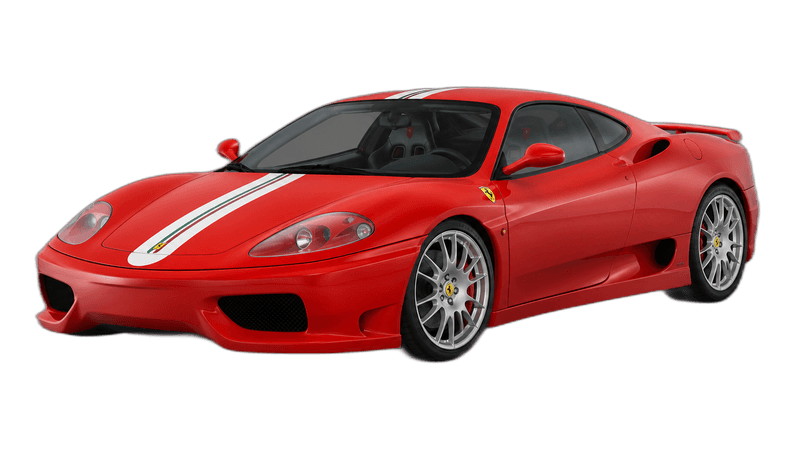
Ferrari 360 Challenge Stradale
£200,000
usedIndicative market price, updated periodically.
419bhp
Power
4.1s
0-100 km/h
300km/h
Top Speed
£200,000
Price Used
How hard it pulls.
Peak g-force the instant you bury the throttle, estimated from the car's 0–100 time and drivetrain.
Ferrari 360 Challenge StradaleEstimated peak launch g from the 0–100 time and drivetrain: an honest approximation, not a measured figure.
The Ferrari 360 Challenge Stradale is a 2 seater fixed-head coupé by Ferrari, with 419 bhp, 373 Nm of torque, a 0-100 km/h time of 4.1 seconds and a top speed of 300 km/h. Indicative used value: approximately £200,000. Actual values vary with specification, condition and history.
Dream Car Garage Editorial · Last updated 3 November 2026
Overview
We have not driven this car. This review is based on published specifications and the sources listed below.
Scope of this guide
This guide is scoped to the Ferrari 360 Challenge Stradale, the road-legal, lightened and sharpened version of the 360 Modena that Ferrari showed at the Geneva motor show in March 2003 and built through 2003 and 2004. It is a 3.6L V8 naturally aspirated, mid-engine, two-seat coupe with rear-wheel drive and the F1 paddle-shift gearbox only. It is not a guide to the standard 360 Modena or 360 Spider, to the single-make 360 Challenge race car that inspired it, to the 360 GT competition cars, or to the later F430 Scuderia, which is a different car with a different engine. An advert that says only "360 CS" or "Challenge" can mean any of those, so we say below how to tell them apart.
We have not driven this model for this article. Everything here comes from three cited sources: evo's 2026 review and buying guide for the car, PistonHeads' June 2022 Spotted report on a 2003 example, and the government recall checker. We also read the specification page and article for the car on supercars.net, a 2024 RM Sotheby's lot description for an early car, a dealer archive entry from DK Engineering and PistonHeads Spotted reports from 2014 and 2016, and we flag every point that rests on them. Ferrari's own website returned an access-denied response to our requests, its press site did not respond and an online archive was offline, so we could not read the maker's original 2003 material and we did not try to get round that. Prices here are history, not valuations.
The figures at a glance
- Engine: 3.6L V8 naturally aspirated, a 3586 cc five-valve-per-cylinder all-aluminium unit mounted behind the cabin. PistonHeads' spec box prints 3,598 cc for the same engine, which is the nominal 3.6 litre figure written differently, and we store 3586 cc as supercars.net gives it with an 85 mm bore and 79 mm stroke.
- Power: 419 bhp at 8,500 rpm. Ferrari's headline for this car is generally printed as 425, and supercars.net prints it as 425 bhp while PistonHeads prints 425 hp. Ferrari rated its engines in metric horsepower (PS), and 425 PS converts to about 419 bhp (425 x 0.98632). evo prints 420 bhp, which is the same figure rounded. We could not read the maker's own page to confirm the unit, so treat 419 bhp as our conversion of a 425 PS headline, and expect to see both numbers in adverts.
- Torque: 373 Nm, which is 275 lb ft at 4,750 rpm on supercars.net and PistonHeads.
- 0-100 km/h: 4.1 seconds. The sources we read print this as 0-60 mph (supercars.net says it reaches sixty in 4.1 seconds), not as 0-100 km/h, so we treat it as the 0-100 km/h claim and a true 0-62 mph time would be a touch longer. It is a manufacturer-era claim, not a test we made.
- Top speed: 300 km/h. supercars.net gives about 299.3 km/h (186 mph), so the round 300 km/h is a headline and not a verified run.
- Drive: rear-wheel drive through a six-speed F1 single-clutch automated manual. There was no manual option from the factory, as PistonHeads and evo both say.
- Weight: evo and PistonHeads quote 1,280 kg for the lightest specification, which they say is up to 110 kg less than a standard 360. A 2016 PistonHeads report says 90 kg and a 2014 one says 110 kg, so the saving depends on options. Dimensions on supercars.net are 4,477 mm long, 1,922 mm wide and 1,184 mm high.
What actually changed from the 360 Modena
The Challenge Stradale was developed from lessons in the Ferrari Challenge one-make series. PistonHeads reports that the rough plan was to optimise it about 80 per cent for the road and 20 per cent for the track, which is the formula later copied by the 430 Scuderia and the Pista cars. The aluminium body and chassis are the Modena's, so the shell is not a new design.
The engine gained about 25 bhp over the Modena's 395 bhp. evo credits titanium internal parts, a revised intake with polished ports, a compression ratio raised from 11.0:1 to 11.2:1, reduced internal friction, a blueprinted build and a new exhaust, which supercars.net says has a valve that bypasses most of the silencing. The gearbox shifts in about 150 milliseconds in Race mode, according to evo and supercars.net. The car also has launch control and a traction control that can be switched off.
The chassis got stiffer titanium springs and adjustable damping, and RM Sotheby's says the car sits 15 mm lower. The brakes are carbon-ceramic with 380 mm discs and six-piston front calipers, which evo says are the same as the Enzo's, and PistonHeads also mentions Enzo-derived ceramic brakes. Tyres are Pirelli P Zero Corsa in 225/35 ZR19 at the front and 285/35 ZR19 at the rear on supercars.net's list. A new carbon undertray and reshaped bumpers, sills and rear deck gave more downforce at speed. The interior is stripped: carbon bucket seats, a carbon door card and exposed metal floor. Air conditioning stayed. A dealer archive entry says Ferrari claimed a lap of Fiorano about 3.5 seconds quicker than the Modena, and we cannot check that.
How many were built, and when
The build count is the weakest number in this guide. RM Sotheby's and the DK Engineering archive both say 1,288, and the Commons description of the car we use for the photograph says the same. supercars.net gives 1274, and PistonHeads says "over 1,200". We found no official Ferrari figure in anything we could read, so our catalogue stores 1,288 as the most commonly quoted number, not as a certainty. Production ran across 2003 and 2004, per evo and supercars.net, but registrations can lag: the RM Sotheby's car, for example, is titled as 2005. A car described as a 2005 Challenge Stradale is therefore not necessarily a different variant.
Early cars matter to collectors. RM Sotheby's says its lot was one of the first ten built and was delivered new in 2003 to the former head of the Ferrari Formula 1 team, with a custom plaque. As on all Stradales, a plate on the passenger side celebrates the run of constructors' championship wins that began in 1999. That sort of provenance is a selling point, not a spec, and you should ask for paperwork before you pay for it.
The gearbox and the driving
Both PistonHeads and evo are clear that the F1 gearbox is the car's one awkward trait. evo says the single-clutch automated manual feels slow and a little clumsy at first and that you need to lift slightly before upshifts and take care at low speed. PistonHeads says Race mode is where the gearbox makes sense. evo's driving verdict praises the grip, the flat cornering and the sound of the V8, and says the steering is relaxed in ratio compared with modern Ferraris. Those are magazine opinions, not ours: we have not driven the car and offer no verdict on how it feels.
Running costs and what to check before buying
- Engine belts: evo says the three-year cambelt change should be confirmed. On a Ferrari V8 this is a major job, so ask for invoices rather than a stamp in a book.
- Brakes: the carbon-ceramic discs are the big cost. evo says Ferrari's own advice in the mid-to-late 2000s was to replace the discs after every two sets of pads, at a cost then of more than 12,000 pounds. Ask for a measured wear report on discs and pads, and be wary of a car whose brakes have never been looked at.
- Clutch: evo recommends a Ferrari dealer or specialist diagnostic test to read clutch and pad wear on the automated gearbox before purchase.
- Exhaust: evo says the exhaust butterfly valves can stick, and that a replacement tailpipe starts at about 1,300 pounds per side. Listen for a valve that does not open.
- Interior: Alcantara on the dash top can fade, and a click that seems to come from the glovebox is usually a ball joint, according to evo.
- Body: owner advice we saw in search snippets says the lightweight bumpers and carbon bonnet are costly to repair after damage, but we did not read the original page, so treat that as unconfirmed and ask a specialist for a damage check.
- Specification: check which options the car has. Plastic sliding side windows were a rare factory option, per evo, and the roll bar, four-point harnesses, stereo and leather change both weight and daily comfort.
- Value history: PistonHeads' 2016 report says a low-mileage car cost about 49,995 pounds in a late-2011 magazine advert, and 2022 PistonHeads listed a 2003 car at 187,950 pounds against a price new of 133,025 pounds quoted in its 2014 report. Those are historic asking prices, not valuations.
- Run the registration through the recall check described below.
Recalls and the DVSA check
We did not run the government checker, because it needs a registration number or the manufacturer, model and year, and we are not looking at a specific car. The page says you can use a registration number to see safety recalls that have not been checked or fixed, and the MOT history, or enter the manufacturer, model and year. It also says non-safety recalls come from the manufacturer directly. We found no recall notice for the Challenge Stradale in any source we read, and absence from our sources is not a clean bill of health. A car imported from Italy or elsewhere may not appear in the UK data, so also ask a Ferrari dealer to check for outstanding campaigns by chassis number.
About the photograph
The picture at the top of this page shows a red 2004 car with the Italian-colour stripe at a 2025 custom car show in Canada. The photographer released it under a public-domain dedication, we cropped and resized it, and we blurred a tiny distant background detail. A stripe, wheels and trim vary between cars, so do not use the picture to judge a particular example.
Verdict
The Ferrari 360 Challenge Stradale in this guide is 419 bhp (a 425 PS headline), 373 Nm, a claimed 4.1 seconds to 100 km/h and about 300 km/h, with rear-wheel drive and a mid-engine layout, in a run of roughly 1,288 cars. It is a lightened, firmer and louder 360 whose value sits in its originality, brake condition and paperwork. If you are shopping for one, confirm the specification and chassis, insist on belt, clutch and brake records, and treat the figures above as claims with the caveats stated. We have not driven it, so use the sources and a proper specialist inspection to decide.
Specifications
Engine
3.6L V8 naturally aspirated
Displacement
3.6L
Power
419 bhp
Torque
373 Nm
0-100 km/h
4.1s
Top Speed
300 km/h
Drivetrain
RWD
Country
Italy
Body Style
2 seater fixed-head coupé
Years
2003–2004
Production
1,288
Price Used
£200,000
Specifications are manufacturer-published figures.
More from Ferrari
Frequently Asked Questions
What are the specifications of the Ferrari 360 Challenge Stradale?
The Ferrari 360 Challenge Stradale is a 2 seater fixed-head coupé by Ferrari, with 419 bhp, 373 Nm of torque, a 0-100 km/h time of 4.1 seconds and a top speed of 300 km/h. Indicative used value: approximately £200,000. Actual values vary with specification, condition and history.
How much does a Ferrari 360 Challenge Stradale cost?
Indicative used value: approximately £200,000. Actual values vary with specification, condition and history.
How many Ferrari 360 Challenge Stradale were made?
Ferrari produced 1,288 units of the Ferrari 360 Challenge Stradale.
What drivetrain does the Ferrari 360 Challenge Stradale use?
The Ferrari 360 Challenge Stradale is configured with rear-wheel drive.
What type of car is the Ferrari 360 Challenge Stradale?
The Ferrari 360 Challenge Stradale is a supercars manufactured by Ferrari in Italy. Production ran from 2003 to 2004.