Ford Mustang Boss 302
290cv
Potenza
The Ford Mustang Boss 302 produces 290 bhp.
Dream Car Garage Editorial · Edited by José Teo Lorente Vallecillos · Last updated 3 November 2026
Panoramica
We have not driven this car. This review is based on published specifications and the sources listed below.
Scope of this guide
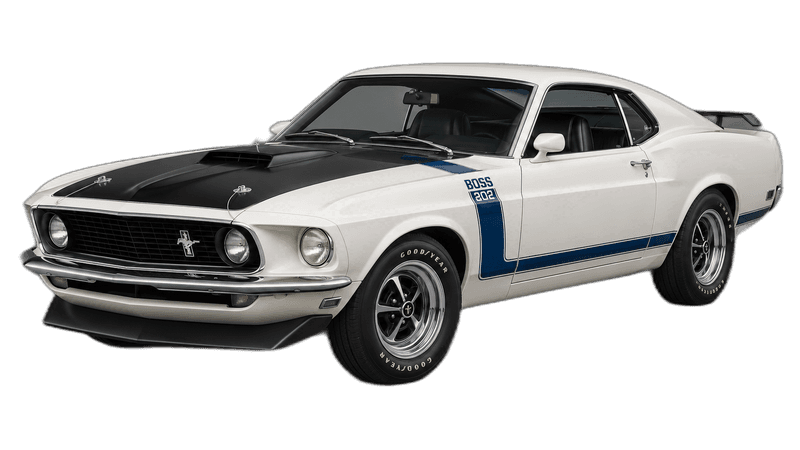
This guide is scoped to the Ford Mustang Boss 302 of 1969 and 1970, the homologation special that Ford built so that it could race in the SCCA Trans-Am series. It is a front-engine, rear-wheel drive, two-door fastback (Ford's literature called the 1969 shape the SportsRoof) with a 302 cubic inch V8 and a four-speed manual gearbox. It is not a guide to the 2012 and 2013 Boss 302 sold decades later. The Wikipedia article on the Boss 302 engine says plainly that an entirely new Boss 302 engine was introduced for the 2012 Mustang, so the later car shares a name and not an engine with the car described here.
We have not driven this model for this article. We are an editorial desk that reads sources, and everything below comes from pages we opened: two RM Sotheby's lot pages, Sports Car Market, Old Cars Weekly, the Audrain Auto Museum, MustangSpecs, a Spud's Archive build-data page, and three Wikipedia articles. Some of those are auction listings written to sell a car, and some are enthusiast pages, so we flag where they disagree. This is a collector car that changes hands only occasionally. A guide like this cannot replace an inspection by a specialist who knows these cars, and this page is for research, not a buying recommendation.
The figures at a glance
- Years: 1969 and 1970 model years only. Audrain says the Boss 302 was built only in those two years, and Wikipedia says Ford dropped it after 1970.
- Engine: 4.9L naturally aspirated V8, a 302 cubic inch overhead-valve small-block with a four-barrel carburettor. Bore and stroke are 4.00 by 3.00 inches (101.6 by 76.2 mm) in Wikipedia's engine article. Multiplying those out gives roughly 4,942 cc, which is our own arithmetic. Wikipedia prints 4.9 L, Audrain prints 4.95 L, and one Wikipedia infobox rounds to 5.0 L. We use 4.9 L.
- Power: 290 bhp. Every source we read rates the engine at 290 hp, and Wikipedia's engine article calls that figure conservative and gross. The rpm at which it is quoted varies by source: 4,600 rpm in one place in Old Cars Weekly and 5,000 rpm in another section of the same article, 5,200 rpm in Wikipedia's engine article, and 5,800 rpm in Audrain and in Wikipedia's article on the first-generation Mustang. We cannot settle which is right, so we quote the figure and not the rpm.
- Torque: 393 Nm. Wikipedia's engine article prints 290 lb-ft (393 N m) at 4,300 rpm, Audrain prints 290 ft-lbs at 4,300 rpm, and MustangSpecs prints 290 lb-ft. Wikipedia's first-generation article gives the same 290 lb-ft but at 2,600 rpm, which looks like an outlier. This is also a gross, period-style figure.
- 0-100 km/h: no figure shown. The only acceleration times we found are 0-60 mph times, and we do not relabel those as 0-100 km/h. They are 6.9 seconds to 60 mph in Wikipedia and in the RM Sotheby's Arizona 2017 lot page, 6.5 seconds to 60 mph in MustangSpecs with no test cited, and "under 7 seconds" in Old Cars Weekly.
- Top speed: no figure shown. None of the pages we read gives a measured top speed. Wikipedia's box shows 98 mph, but the RM Sotheby's Arizona lot page gives 14.6 seconds to 98 mph in the quarter mile, so that number is a quarter-mile speed and not a top speed.
- Drive: rear-wheel drive with a four-speed manual gearbox.
- Weight: 3,300 lb in MustangSpecs. Wheelbase is 108 inches in Old Cars Weekly and in RM Sotheby's.
- Price when new: 3,720 US dollars base for 1970 in RM Sotheby's, MustangSpecs, Sports Car Market and Wikipedia. Old Cars Weekly gives a base sticker of about 3,600 dollars for 1969.
Where the sources disagree
The power rating is the one number everyone agrees on, and almost every other number moves around. Below is how we handled the disagreements.
Production
Production counts differ, and we think that matters more than any other disagreement on this page. Sports Car Market lists 1,628 for 1969 and 7,013 for 1970, a total of 8,641. Wikipedia's article on the first-generation Mustang says 1,628 Boss 302s were sold through 1969, and its Boss 302 article says 7,013 were sold, although it does not label that figure by year. MustangSpecs prints 7,013 for 1970, and Spud's Archive says 1,628 fastback Boss 302s were produced. Against that, RM Sotheby's Miami 2024 lot page says 7,014 examples were built for 1970, and Old Cars Weekly gives 1,934 for 1969 and 6,318 for 1970.
We chose 1,628 and 7,013 because several unrelated pages repeat those numbers and because Sports Car Market prints both together. Having read both, we add them to 8,641 for the two years. The other figures may come from different counting methods, such as built versus sold or retail versus factory, but no page we read says so, so that is a guess and not a finding. Treat 8,641 as the best-supported total and not as an exact one.
Homologation
RM Sotheby's says the SCCA required at least 6,500 Boss 302s and that Ford built 514 more than that. Old Cars Weekly says Trans-Am rules required 1,000 copies for production status. These cannot both describe the same rule, and we have not found a page that explains the difference.
Naming
Wikipedia's Boss 302 article says the name came from the designer Larry Shinoda answering "the boss's car" when asked what he was working on. Sports Car Market says the name honoured Bunkie Knudsen, the Ford executive who recruited Shinoda. We report both and choose neither.
Rev limit
Old Cars Weekly gives a 6,000 rpm limiter, and Wikipedia's engine article gives a 6,150 rpm redline. These may be different things, but we cannot tell from the pages.
How underrated was 290 bhp?
Several pages say the rating understates the engine. Old Cars Weekly says estimates of the real output come closer to 400 hp. MustangSpecs says knowledgeable sources consider the specifications extremely conservative. RM Sotheby's Arizona 2017 lot page says later dyno tests suggest the rating was rather pessimistic. Wikipedia's engine article says conservatively rated at 290 hp gross at 5,200 rpm, with no net figure and no independent dyno data.
None of those pages prints a dyno sheet, and the estimates are not consistent with one another, so we do not give a corrected power number. The sensible reading is that 290 bhp is a gross factory rating, that it is widely believed to be low, and that the true figure is unproven in the sources we read. Gross ratings of this era are also measured differently from modern net figures, so comparing 290 bhp with a current car is not like for like.
History and what changed over the run
The engine was developed in 1968 for the SCCA's 1969 Trans-Am series, which limited engines to 5 L, and per Wikipedia it was offered only in the Boss 302 Mustang, although the Mercury Cougar Eliminator could also be ordered with it. Audrain's account is that Ford hired Semon "Bunkie" Knudsen from General Motors, that he wanted the best-handling street car on the market, and that he gave the design work to Larry Shinoda, who is also linked to the 1967 Camaro Z/28. Old Cars Weekly calls the Boss 302 Ford's answer to the Camaro Z/28.
The engine used a four-bolt-main block with canted-valve heads derived from the planned 351 Cleveland design, per Wikipedia's engine article, which also gives 10.5:1 compression, forged pistons and a Holley 780 cfm carburettor with a manual choke. Old Cars Weekly mentions a stronger crankshaft and the same 10.5:1 compression.
1969
The 1969 car was built from about spring 1969. Spud's Archive shows one concours-restored car ordered on 29 April 1969, built on 17 June 1969 and retailed on 25 July 1969, and Sports Car Market describes a car built in July 1969 and sold new in September 1969. The Spud's build data shows the engine code G, described as the 302-4V Boss 290 hp V8, a close-ratio four-speed gearbox, a 3.91 Traction-Lok rear axle and F60x15 tyres. Wikipedia says that in 1969 the racing programme was hampered by non-mechanical problems, including tyre trouble and slow pit stops. Audrain says the Z/28 won the SCCA title in 1969.
1970
For 1970 the sources list a long run of changes. Wikipedia and RM Sotheby's mention hockey-stick side stripes and a new grille treatment with the headlamp layout changed. MustangSpecs says the quad-headlamp setup gave way to a dual-lamp design with non-functional fender intakes. Wikipedia adds a Hurst shifter as standard, new exhaust and suspension, slightly smaller intake valves and cast aluminium valve covers in place of chrome. RM Sotheby's says the smaller valves were for drivability, with power unchanged at 290. Audrain and MustangSpecs both mention a rear sway bar, and Audrain lists the optional Shaker hood scoop, rear window slats, a rear spoiler and Boss 302 fender decals. RM Sotheby's adds that disc front brakes were standard.
Ford won the 1970 Trans-Am Manufacturers' Championship according to RM Sotheby's, Sports Car Market and Wikipedia, with Wikipedia naming Bud Moore as running the factory effort on Goodyear tyres. Wikipedia says Ford dropped the Boss 302 after 1970.
One Arizona 2017 RM Sotheby's page reports that 832 Boss 302s were built in Grabber Orange in 1970. That is a colour count and not a year total, and we flag it because it is easy to misread.
What to check before buying
This list comes from the Sports Car Market profile of a Mecum Kissimmee sale and from the build documents the auction pages cite. It is not an inspection procedure, and we have not inspected any car.
- Chassis number. Sports Car Market says it sits on the driver's side of the dash, visible through the windshield. The cars we saw described have a G in the VIN as the engine code, but we would not accept a single code as proof of identity on its own, which is our own caution and not a source's claim.
- Engine number. Sports Car Market says it is stamped inside the block behind the cranking motor, with a tag on the coil mounting bolt that is often missing. A matching-numbers claim, which several listings make, needs checking against these locations.
- Paperwork. The pages mention the invoice, Protect-O-Plate, warranty card, a Marti Report, a drive-out tag and a dealer tag. Marti reports appear on both RM Sotheby's lots, and one says that, per the report, the car is the only 1970 Boss 302 built with its specification and colour combination.
- Originality. Sports Car Market notes that the example it profiled kept its smog system, spare tyre and most of its original paint, interior and chrome, and says originality is increasingly valued even though an unrestored car may lose ground against a nut-and-bolt restoration.
- Shaker hood and other options. Sports Car Market says a Shaker hood adds appeal and can raise value. Check whether it is original to the car.
- Restoration quality. RM Sotheby's describes a rotisserie restoration on one car and a single repaint on another. A restoration is not a defect, but it is a reason to ask for photographs and receipts.
Running costs and known issues
We found no source giving running costs, a service schedule, failure rates or a list of common faults for the Boss 302, so we give none. We have not tried to estimate repair bills. Anyone quoting them without a source is guessing. Old Cars Weekly notes the four-bolt main caps and a stronger crankshaft, and Wikipedia notes solid lifters, but we found no page that turns those details into maintenance advice, so please ask a specialist.
Recalls and safety
We found no recall notice for the Boss 302 in any page we read, but that is not a clean bill of health, because we did not search a recall database. The cars have front disc brakes and rear drums per RM Sotheby's, a live rear axle on leaf springs, and no modern crash structure. We found no crash-test data. If you intend to use one on the road, ask a specialist about brakes, steering and fuel system condition.
Market and value notes
Prices vary widely with condition, paperwork and options, and a few sales do not make a valuation. Here are the data points we read, with their sources.
- Sports Car Market reports a 1970 car that sold at Mecum Kissimmee, lot S131, on 26 January 2013 for 71,020 dollars including buyer's premium. In the same article it gives a Sports Car Market valuation of 32,000 to 54,000 dollars, says cars with weak documentation can sell in the low-to-high 40,000 dollar range, and lists other Kissimmee sales of 42,400 dollars for an unrestored yellow 1969 and 121,900 dollars for a concours-restored 1970.
- RM Sotheby's Arizona 2017, lot 279, sold a Grabber Orange 1970 car with one repaint for 48,400 dollars.
- RM Sotheby's Miami 2024, lot 106, sold a 1970 Grabber Orange car with a rotisserie restoration for 89,600 dollars. The page does not state the sale date.
Those sales cover different years, conditions and auction houses, and the Sports Car Market valuation is from an article about a 2013 sale, so it will be out of date. Treat them as a spread and not a price list. We have not checked current listings.
What we could not find
We found no measured top speed and no 0-100 km/h time, so those are marked no figure shown. We found no running cost data, no recall data, no crash-safety data and no common-fault list. We did not find a settled explanation of the production differences, the homologation rule, the rpm at which 290 hp is quoted, or the origin of the name. The Boss 302 Registry home page loaded but its history pages were not read. We did not run any registry or VIN search.
About the photograph
This page uses the catalogue photograph for the car. Its credit is listed on the credits page.
Verdict
The 1969-1970 Boss 302 is a front-engine, rear-wheel drive fastback with a 4.9L naturally aspirated V8 rated at 290 bhp and 393 Nm, a rating the sources widely call conservative though none proves it. A quoted 0-60 mph time of about 6.9 seconds shows it was quick for its day, and about 8,641 were built across the two years on the best-supported counts, with the sources disagreeing on the split. The practical advice from our reading is to check the chassis and engine numbers, insist on documentation such as a Marti report, ask whether the car is original or restored, and treat all price guides as rough. We have not driven it, so use the sources, the seller's records and an independent specialist inspection to decide.
Sources
- RM Sotheby's: 1970 Ford Mustang Boss 302 (Miami 2024, lot 106)
- RM Sotheby's: 1970 Ford Mustang Boss 302 (Arizona 2017, lot 279)
- Sports Car Market: 1970 Ford Mustang Boss 302 (Mecum Kissimmee 2013 profile)
- Old Cars Weekly: Car of the Week, 1969 Boss 302 Mustang
- Audrain Auto Museum: 1970 Ford Mustang Boss 302
- MustangSpecs: 1970 Ford Mustang Boss 302 in-depth guide
- Spud's Archive: 1969 Mustang Boss 302 build data
- Wikipedia: Ford Mustang Boss 302
- Wikipedia: Ford Mustang (first generation)
- Wikipedia: Ford Boss 302 engine
Specifiche
| Motore | 4.9L naturally aspirated V8 |
|---|---|
| Cilindrata | 4.9L |
| Potenza | 290 cv |
| Coppia | 393 Nm |
| Trazione | RWD |
| Paese | United States |
| Carrozzeria | 2-door fastback coupé |
| Anni | 1969–1970 |
| Produzione | 8,641 |
Specifications are manufacturer-published figures.
Domande Frequenti
How much power does the Ford Mustang Boss 302 have?
The Ford Mustang Boss 302 produces 290 bhp and 393 Nm of torque.
What engine does the Ford Mustang Boss 302 have?
The Ford Mustang Boss 302 uses a 4.9L naturally aspirated V8.
How many Ford Mustang Boss 302 were made?
Ford produced 8,641 units of the Ford Mustang Boss 302.
When was the Ford Mustang Boss 302 built?
The Ford Mustang Boss 302 was built from 1969 to 1970.
Is the Ford Mustang Boss 302 all-wheel drive?
No. The Ford Mustang Boss 302 is configured with rear-wheel drive.