Ford Sierra RS500 Cosworth
£88,000
usedIndicative market price, updated periodically.
224bhp
Power
248km/h
Top Speed
£88,000
Price Used
The Ford Sierra RS500 Cosworth produces 224 bhp and has a top speed of 248 km/h. A representative example is worth about £88,000.
Dream Car Garage Editorial · Edited by José Teo Lorente Vallecillos · Last updated 3 November 2026
Overview
We have not driven this car. This review is based on published specifications and the sources listed below.
Scope of this guide
This guide is scoped to the Ford Sierra RS500 Cosworth, the 500-car homologation run that Ford had Aston Martin Tickford build in 1987 from finished Sierra RS Cosworth three-door hatchbacks. It is a front-engine, rear-wheel drive car with a 2.0L turbocharged inline-four from Cosworth, and it was sold new in the United Kingdom with right-hand drive. It is not a guide to the ordinary Sierra RS Cosworth, which we mention only for comparison, and it is not a guide to any other Cosworth-engined Ford.
We have not driven this model for this article. We are an editorial desk that reads sources, and everything below comes from pages we opened: Wikipedia, two articles from Motor Sport magazine (one from September 1987 and one from May 2017), the RS Owners Club, Autozine, Motor1 and PistonHeads. This is a collector and competition car that rarely comes to market, so a guide like this cannot replace an inspection by a specialist who knows the RS500. This page is for research, not a buying recommendation.
The figures at a glance
- Engine: 2.0L turbocharged inline-four, a Cosworth YBD-family unit per Wikipedia (the infobox lists YBD, YBG and YBJ for the wider range). Displacement is 1,993 cc on the RS Owners Club and Autozine pages and 1,994 cc on PistonHeads. We use 1,993 cc because two pages agree on it, and we read the one-cubic-centimetre gap as rounding.
- Power: 224 bhp. Motor Sport (September 1987) gives 224 bhp at 6000 rpm for the road cars, the 2017 Motor Sport article says standard output was 224bhp, and the RS Owners Club prints 224bhp at 6000rpm. Wikipedia prints 227 PS (224 hp; 167 kW), and 227 PS times 0.98632 is about 224 bhp, so the metric and imperial figures match. PistonHeads prints 227hp, which we treat as the metric figure with the wrong unit.
- Torque: 277 Nm. Wikipedia gives 277 N-m (204 lb-ft) at 4500 rpm, Motor1 gives 204 lb-ft (277 Nm), and PistonHeads gives 204lb ft at 4,500rpm. Autozine prints 206 lb-ft instead. We use 277 Nm because three pages agree on it.
- 0-100 km/h: no figure shown. The sources give 0-60 mph times, and we do not relabel a 0-60 mph time as a 0-100 km/h time. The reasoning is in the performance section below.
- Top speed: 248 km/h. The sources print 154 mph, and we convert it at 1.609 km/h per mph to about 248 km/h. That conversion is ours.
- Drive: rear-wheel drive with a five-speed manual, per PistonHeads. The Wikipedia infobox confirms front-engine, rear-wheel drive.
- Production: 500 cars, per every page we read.
- Price when new: 19,950 pounds sterling per Motor Sport (September 1987) and the RS Owners Club.
What the RS500 is
Ford built the Sierra RS Cosworth in 1986 as a road car that would let the company go touring-car racing in Group A. The RS500 was the second step. Motor Sport (September 1987) says it was built under the Evolution rule, which allowed an extra 10 percent of production above the 5000-unit annual minimum, and that the car was meant for Group A. Wikipedia says the RS500 was announced in July 1987 and homologated in August 1987. Motor Sport (2017) says Ford built 500 Sierra Cosworths for the conversion and contracted the tuning firm Tickford to convert the last 500, because race teams wanted the car.
The two magazines describe the build slightly differently. Wikipedia says the 500 donor cars were standard RS Cosworths made at Genk, Belgium, in December 1986. Motor Sport (1987) says the run was built from 1986 Sierra RS Cosworths set aside at Genk and that four white prototypes were registered in Essex and delivered in December 1986. Motor Sport (2017) says the first car went into build on 9 April 1987 and the last emerged on 30 August, and that cars were built in random order, so chassis numbers do not follow build sequence. We therefore treat 1987 as the build year. The production row lists 1987 to 1988 and we found no page that supports 1988 as a build year, so we propose 1987 as both first and last year.
What Tickford changed
Motor Sport (September 1987) describes a four-stage process and says Tickford was given a contract worth more than half a million pounds sterling. Tickford handled drawings, engineering, type approval, body engineering, proving-ground testing and small-run production, and it also did quality control, with no Ford staff on that task. The article names managing director John Thurston and manufacturing manager Brian Tennant.
- Stage 1: the car was stripped, then fitted with the larger rear spoiler, a 30 mm Gurney flap extension and an electrical override for the radio aerial.
- Stage 2: the engine was removed and the revised front spoilers and bumper units were built up.
- Stage 3: an enlarged turbocharger, a larger intercooler, a new plenum, a revised inlet tract and new electronics for the secondary fuel injectors were fitted.
- Stage 4: RS500 badges were applied and the front splitter was fitted, having been stowed in the boot for transport.
- Quality control: a static inspection, then an eight-mile road test, then a final inspection.
Wikipedia lists thicker cylinder-block walls, a larger Garrett AiResearch T04 turbo, a larger intercooler, a second set of Weber injectors that is non-functional on road cars, and uprated fuel, oil and cooling systems and airbox. Motor Sport (1987) says the original 204 bhp engines went back to Ford and that Cosworth at Wellingborough began delivering production engines in April 1987. The 2017 article says engines that had never run were exchanged for RS500 units, and that logbooks were not altered, so every RS500 has what it calls the wrong engine number. It also says the 500 removed engines are unaccounted for.
Performance claims compared
The sources do not agree on performance, and none of them gives a time in the form we need for the catalogue.
- Autozine: 154 mph and 0-60 mph in 6.1 seconds, marked as tested by Autocar. For the standard RS Cosworth it shows 145 mph and 6.2 seconds.
- RS Owners Club: 154mph and 0-60mph of 6.2, with no unit printed beside the 6.2.
- Motor1 (29 July 2017): 0-62 mph (0-100 km/h) in 6.2 seconds and 153 mph (246 km/h).
- Wikipedia: no RS500 acceleration or top speed. It gives 6.5 seconds to 60 mph and 149 mph (240 km/h) for the standard three-door RS Cosworth, quoting the 1986 catalogue.
The production row shows 6.0 seconds and 240 km/h. Neither is supported by anything we read for the RS500. The 240 km/h figure is the standard RS Cosworth catalogue speed from Wikipedia, and 6.0 seconds does not appear on any page. Motor1 labels its 6.2 as a 0-62 mph time and brackets 0-100 km/h, but the RS Owners Club has the same 6.2 as a 0-60 mph figure and Autozine has 6.1 for 0-60 mph, so we suspect Motor1 reused a 0-60 mph number. Because we cannot show that a 0-100 km/h test was run, we give no figure shown for 0-100 km/h. For top speed we use 154 mph, which two pages carry (Autozine and the RS Owners Club) and Motor1 comes close to, converted to 248 km/h. Motor1 prints 153 mph and 246 km/h, which is within about two km/h.
Motor Sport (1987) says torque was not noticeably improved over the standard car, and that road-car power was about 10 percent higher than standard. That fits the numbers: 224 bhp against the 204 bhp of the standard engine that Motor Sport and Autozine both quote.
Road car versus race car
The competition car is the reason the RS500 exists, and the sources are keen to separate it from the road car. Motor Sport (1987) says the secondary injection system is inactive on road cars and that competition use or tuning could reach about 400 bhp. Motor Sport (2017) says race teams reached 485bhp out of the box and eventually a reliable 525bhp, and that period claims of 550bhp or more were exaggerated, according to Rouse and Soper. It adds that the car would top 180mph on long straights such as Fuji and Bathurst. Motor1 says the track-only version made 500 hp. These are race figures and do not describe the road car. Wikipedia cites Motor Sport magazine for a claim that the RS500 won 84.6 percent of the races it entered, and PistonHeads repeats that claim. We have not checked it against race results.
Colours and identification
Motor Sport (2017) says all cars were meant to be black, but 392 were black, 52 were Moonstone Blue and 56 were white, including four prototypes. The RS Owners Club prints the same three numbers. Wikipedia gives 56 white and 52 Moonstone Blue, and Motor Sport (1987) says 52 white and 52 Moonstone Blue with the rest black. The 1987 white count is the outlier, so we use the three-way agreement.
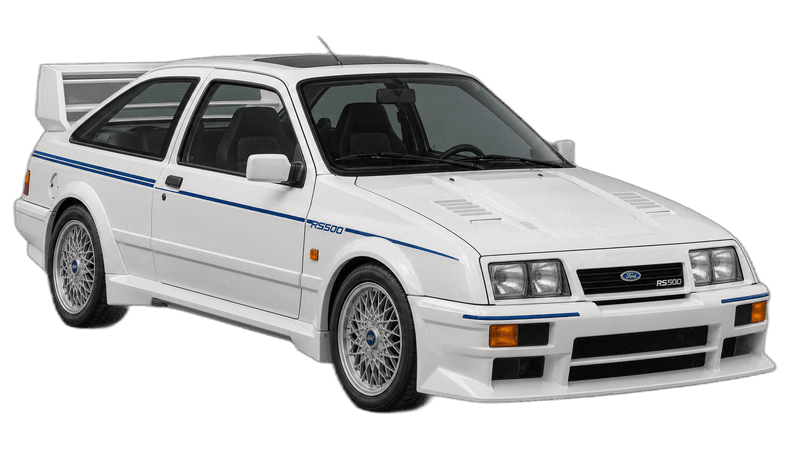
The visible differences listed on Wikipedia are a lower rear spoiler, a Gurney flap on the upper whale-tail wing, RS500 badges, and a redesigned front bumper whose intake grilles replace the fog lamps. Motor Sport (1987) adds the front splitter, a secondary rear wing and relocation holes in the trailing-arm rear suspension. The RS Owners Club lists 15 x 7 alloy wheels and eight injectors in total, four of them fitted but not working in road trim.
What to check before buying
This is a rare, high-value car and the following is a list assembled from the pages we read, not a substitute for a specialist.
- Authenticity. With only 500 built, ask for the documents that tie the car to the Tickford conversion. The 2017 Motor Sport article says chassis numbers do not follow build order, so the number alone proves little.
- The engine number. Motor Sport (2017) says every RS500 carries what it calls the wrong engine number, because logbooks were not altered. A mismatch on its own is therefore expected, and the useful check is what the specialist finds on the engine itself.
- Originality of the parts that make it an RS500: the secondary injectors, the larger turbo and intercooler, the splitter and wing details, and the badges. Wikipedia and Motor Sport (1987) describe each.
- Race history. Because the car was a base for racing, check whether a particular example was converted to competition specification, since the road and race figures above are very different.
- Colour and records. Compare the car with the colour figures above and ask for its registration history.
- Mileage. PistonHeads (1 September 2026) describes a one-owner car with 15,340 recorded miles, and Motor1 describes a car with under 11,000 miles. These are single examples, so do not treat them as typical.
Running costs and known issues
We found no service schedule, no parts-price list, no repair costs and no failure rates for the RS500, so we give none. The only economy figure we saw is 25 MPG in the PistonHeads spec table, with no test conditions. That table also lists a new price of 16,370.40 pounds sterling for the car, which disagrees with the 19,950 pounds in Motor Sport (1987) and the RS Owners Club. We use the Motor Sport figure because it is dated 1987 and matches the club page. Wikipedia gives the weight of the 1986 to 1987 three-door RS Cosworth as 1,217 kg and no RS500-specific figure, so we show none.
Recalls and safety
We found no recall notice or crash-test data for this model in any page we read. That is not a clean bill of health, because we did not search a recall database. A 1987 car with this level of power deserves a specialist check of brakes, tyres and suspension before any road use.
Market and value notes
Prices on the pages we read are far above the original price, and a few data points do not make a valuation.
- Motor1 (29 July 2017): a car with under 11,000 miles sold at the Silverstone Auctions Classic Sale for 114,750 pounds sterling, against an estimate of 90,000 to 100,000 pounds plus a 15 percent buyer's premium.
- PistonHeads (1 September 2026): a one-owner car was advertised at 199,995 pounds sterling. The writer says there is not an RS500 on the site for less than 125,000 pounds, and that nothing bar a GT40 costs quite so much.
Autozine counts 5,542 Sierra RS Cosworths in total including the RS500, which is one way to see how small the 500 run is.
What we could not find
We found no Ford press kit or brochure, so the power, torque and speed figures come from magazine, club, auction-news and reference pages, not from Ford. We found no original 1987 road test and no 0-100 km/h time we could trust.
About the photograph
This page uses the catalogue photograph for the car. Its credit is listed on the credits page.
Verdict
The RS500 is a front-engine, rear-wheel drive three-door hatchback with a 2.0L turbocharged inline-four rated at 224 bhp and 277 Nm, a quoted 248 km/h (154 mph), and no 0-100 km/h figure shown because no source gave one we could trust. What makes it special is the Tickford conversion, the 500-car run built in 1987, and the racing record behind it. From our reading, the practical advice is to prove the car's identity, understand why its engine number differs from the logbook, check that the RS500 parts are present, and find out whether it ever raced. We have not driven it, so use the sources, the seller's records and an independent specialist inspection to decide, and treat this page as research, not a buying recommendation.
Sources
- Wikipedia: Ford Sierra RS Cosworth (RS500 section)
- Motor Sport magazine: How the RS500s were created (May 2017)
- Motor Sport magazine: Industry insight, Ford Sierra Cosworth RS500 (September 1987)
- RS Owners Club: Sierra RS500
- Autozine: Ford Sierra RS Cosworth (1986)
- Motor1: Low-mileage Ford Sierra Cosworth RS500 sold for 150,000 dollars (29 July 2017)
- PistonHeads: Ford Sierra Cosworth RS500 Spotted
Specifications
| Engine | 2.0L turbocharged inline-four |
|---|---|
| Displacement | 2.0L |
| Power | 224 bhp |
| Torque | 277 Nm |
| Top Speed | 248 km/h |
| Drivetrain | RWD |
| Country | United Kingdom |
| Body Style | 3-door hatchback |
| Years | 1987 |
| Production | 500 |
| Price Used | £88,000 |
Specifications are manufacturer-published figures.
Frequently Asked Questions
What is a Ford Sierra RS500 Cosworth worth?
A representative example is worth about £88,000. Actual values vary with specification, condition and history.
How much power does the Ford Sierra RS500 Cosworth have?
The Ford Sierra RS500 Cosworth produces 224 bhp and 277 Nm of torque.
What is the top speed of the Ford Sierra RS500 Cosworth?
The Ford Sierra RS500 Cosworth has a top speed of 248 km/h.
What engine does the Ford Sierra RS500 Cosworth have?
The Ford Sierra RS500 Cosworth uses a 2.0L turbocharged inline-four.
How many Ford Sierra RS500 Cosworth were made?
Ford produced 500 units of the Ford Sierra RS500 Cosworth.
When was the Ford Sierra RS500 Cosworth built?
The Ford Sierra RS500 Cosworth was built from 1987 to 1987.
Is the Ford Sierra RS500 Cosworth all-wheel drive?
No. The Ford Sierra RS500 Cosworth is configured with rear-wheel drive.