Ford GT40 Mk II
£9,500,000
usedIndicative market price, updated periodically.
485bhp
Power
330km/h
Top Speed
£9,500,000
Price Used
The Ford GT40 Mk II produces 485 bhp and has a top speed of 330 km/h. A representative example is worth about £9,500,000.
Dream Car Garage Editorial · Edited by José Teo Lorente Vallecillos · Last updated 3 November 2026
Overview
We have not driven this car. This review is based on published specifications and the sources listed below.
Scope of this guide
This guide is scoped to the Ford GT40 Mk II, the big-block racing coupe that Ford, Shelby American and Holman and Moody ran in 1966 and 1967. It is mid-engine, with the V8 mounted longitudinally (Ultimate Car Page), not front-engine, and it is rear-wheel drive. This is a competition car, not a road car. We found nothing in any source describing a roadgoing Mk II, and the catalogue lists it as track focused. For that reason we give no ownership or running-cost advice beyond what a source states, and we found no source that states any. This page is about the engine, the numbers and where they disagree, the 1966 Le Mans result, how the Mk II differs from the Mk I and the Mk IIB, and how rarity and provenance work for individual chassis.
We have not driven this model for this article. We are an editorial desk that reads sources. Everything below comes from pages we opened: Ultimate Car Page (a history text in two parts and a specification sheet), Supercars.net, Wikipedia, the RM Sotheby's catalogue page for one chassis, the official 24 Hours of Le Mans website, Goodwood and a Ford archive article. These cars almost never come to market. A page like this cannot replace a specialist inspection of a specific chassis, and it is for research, not a buying recommendation.
The figures at a glance
- Engine: 7.0L naturally aspirated V8. Wikipedia describes a highly modified 427 cu in (7.0 L) big-block Ford FE engine, a side-oiler taken from the Galaxie, and its infobox lists 6,997 cc. Supercars.net also lists 6,997 cc (427.0 cubic inches). Ultimate Car Page lists 6,982 cc with a bore and stroke of 107.2 mm by 96.1 mm, a compression ratio of 10.5:1, a cast iron block, an aluminium head, a single Holley 780 CFM carburettor and dry-sump lubrication. We use 6,997 cc, the figure that matches the 427 cubic inch name, and note that the 15 cc gap is between sources.
- Power: 485 bhp. Ultimate Car Page gives 485 bhp (362 kW) at 6,200 rpm, and Supercars.net gives 485.0 bhp (361.7 kW) at 6,200 rpm. Both agree, though they may share an origin. We found a lower figure elsewhere, covered below.
- Torque: 644 Nm. Ultimate Car Page and Supercars.net both give 644 Nm (475 lb ft). They disagree on the engine speed: Ultimate Car Page says 3,200 to 3,600 rpm and Supercars.net says 5,000 rpm.
- 0-100 km/h: no figure shown. We found no 0-100 km/h time. Ultimate Car Page lists 8.0 s for 0-100 mph, which is a different measurement and we do not convert it.
- Top speed: 330 km/h. Supercars.net lists about 205 mph (about 329.9 km/h). This is a catalogue-style figure, not a timed record. Other numbers are discussed in the section on top speed.
- Gearbox: a Ford T-44 four-speed manual (Ultimate Car Page) with ratios of 2.22, 1.43, 1.19 and 1.00 and a 2.77:1 final drive.
- Weight: 1,207 kg (Ultimate Car Page) or 1,111 kg (Supercars.net). See the disagreement section.
- Dimensions (Ultimate Car Page): 4,140 mm long, 1,778 mm wide, 1,029 mm high, on a 2,413 mm wheelbase, with a 159 litre fuel tank.
Where the sources disagree
Several numbers do not match across the pages we read, and we say so rather than picking silently.
- Power. Ultimate Car Page and Supercars.net both say 485 bhp. The RM Sotheby's page for chassis P/1016 says the 427 engine, developed with Holman and Moody's stock-car experience, generally developed 450 bhp, and that a 7-litre engine fitted for 1967 Le Mans testing was capable of 490 bhp. Ultimate Car Page's history text adds that the Mk IIB twin-carburettor system was good for an additional 15 bhp, which would make 500 bhp on its own numbers. We use 485 bhp because two spec sheets give it with an engine speed, and we treat 450 and 490 as figures for particular engines and dates. Wikipedia's article, as far as we read it, gives no Mk II power figure.
- Engine size. 6,997 cc (Wikipedia, Supercars.net) against 6,982 cc (Ultimate Car Page), as above.
- Weight. Ultimate Car Page lists 1,207 kg (2,661 lb). Supercars.net lists a curb weight of 1,111 kg (2,450 lb). Wikipedia's infobox gives a range of 816 to 1,043 kg, but labels it as a Mk IIA weight and the same article says the later J-car was 300 lb lighter than the Mk II, which does not fit that range. We give the two spec-sheet numbers and no single answer.
- Top speed. See below.
- Number built. See the rarity section, where the count is the biggest disagreement.
- Le Mans second place. Supercars.net captions its photographs inconsistently about the Miles and Hulme car, calling it second in one place and race winning in another. We rely on the 24 Hours of Le Mans website, Goodwood and Wikipedia for the order.
Top speed and the Mulsanne claim
The catalogue figure of 330 km/h comes from the same source that gives the 485 bhp: Supercars.net lists about 205 mph (about 329.9 km/h). Ultimate Car Page's specification sheet gives 346 km/h (215 mph). The Supercars.net article text says that the 1965 427 car could reach 210 mph down the Mulsanne straight, which is a claim about the earlier car rather than about the 1966 Mk II. The RM Sotheby's page reports that in April 1967, during Le Mans trials, chassis P/1016 was timed at 203 mph on the Mulsanne Straight. At 1.609344 km per mile that is about 327 km/h. That is a single timed run in a test, with a car carrying Mk IIB upgrades, not a verified maximum.
Wikipedia gives a Mulsanne speed only for the later Mk IV, which reached 213 mph on the 3.6-mile straight at the 1967 race, and no Mk II Mulsanne speed. So the evidence runs from about 203 mph timed to 215 mph claimed. We keep 330 km/h because it sits inside that range and is backed by a stated figure, but we would not describe it as a measured top speed, and the 346 km/h figure and the 327 km/h timed figure are both plausible neighbours. The speed also depended on gearing and on the circuit.
History: from the Mk I to the Mk II
The GT40 began as a small-block car. Wikipedia says the Mk I used the 289 cu in (4.7 L) engine with a ZF five-speed gearbox, and that Holman and Moody and Shelby American each altered the design to accept the larger 427 cu in engine. The Mk II also took a Kar Kraft-built four-speed, which Wikipedia says replaced the ZF unit. Ultimate Car Page notes the Mk II's longer nose, fins on the engine cover for drag and stability, and ventilated brakes with rear fresh-air intakes, and says the 427 car carried more than 100 kg over its nearest rival in 1965.
The 427 car made its Le Mans debut in 1965. Ultimate Car Page names two big-block Shelby American entries, McLaren and Miles in the number 1 car and Amon and Hill in the number 2 car, both quickest in qualifying and both out with gearbox trouble. Ford's own archive article says the company had finished no cars at Le Mans in 1964 or 1965. The Mk II proper arrived in 1966. Ultimate Car Page says eight chassis were taken from the Slough production line and updated to Mk II specification by Shelby American. Holman and Moody and Shelby American each adapted the design for the big engine, according to Wikipedia.
Daytona, Sebring and Le Mans in 1966
Ultimate Car Page says five Mk IIs started the 1966 Daytona 24 Hours, Ken Miles and Lloyd Ruby won, and the four survivors finished 1-2-3-5. Wikipedia describes Daytona as a Mk II 1-2-3 and says Sebring was won by the X-1 Roadster with a Mk II second and a Mk I third. Ultimate Car Page says a Mk II was second at Sebring behind a prototype GT that also had a 427 V8. The Le Mans website describes Sebring as a Ford podium sweep and names Miles and Ruby as the winning drivers. These accounts frame Sebring differently, and we do not resolve the difference here.
At Le Mans in June 1966, Ultimate Car Page says eight Mk IIs were entered: three from Holman and Moody, three from Shelby American and two from Alan Mann Racing. The Le Mans website says Ford fielded eight cars against Ferrari's seven, that none of Ferrari's works prototypes crossed the finish line, and that Ford scored its first victory in the race. The Ford archive article says Ford swept the podium, finishing first, second and third.
Goodwood gives the order by chassis. P/1046, the number 2 car of Bruce McLaren and Chris Amon, was first. P/1015, the number 1 car of Ken Miles and Denny Hulme, was second. P/1016, the car of Ronnie Bucknum and Dick Hutcherson, was third. Goodwood calls the result a controversial staged 1-2-3 finish. Wikipedia says the Miles and Hulme car had led by four laps before a stop for brake rotors, the team arranged for the cars to cross the line together, and the organisers ruled McLaren and Amon the winners because they had started further back and so covered the greater distance. Wikipedia lists the winner's distance as 4,843.09 km at an average of 125.39 mph (201.80 km/h). We did not find the third car's lap deficit in any source we could open.
The Mk IIB and 1967
Ultimate Car Page says the Mk IIs were updated to B specification for the opening races of 1967, with the twin-carburettor system adding 15 bhp. Wikipedia lists redesigned bodywork, twin Holley carburettors, two top vents removed and a spare wheel moved to the rear. Six Mk IIs were entered at the 1967 Daytona 24 Hours and, per Ultimate Car Page, all succumbed to gearbox failure. Wikipedia and Ultimate Car Page trace this to badly heat-treated shafts. Two Mk IIBs were entered at Le Mans as back-ups for the new Mk IV, and accidents ended both races early. Guy Ligier and Jo Schlesser won the Reims 12 Hours in June 1967, which Ultimate Car Page calls the last win for a Mk II and the only one for a Mk IIB.
This is why the catalogue lists the car as 1966 to 1967. The RM Sotheby's page adds that P/1016 became a test mule for the Mk IIB after Le Mans, gaining bigger disc brakes, wider rear wheels and a roll cage, and that it keeps those upgrades. The labels Mk II, Mk IIA and Mk IIB are not used consistently by the sources we read. Wikipedia attaches Mk IIA to a weight range without describing it, and we found no count for either variant.
Rarity, chassis and provenance
Rarity of a Mk II is about individual chassis, not a production run. The number built is not settled. Ultimate Car Page's specification sheet says 11 plus two prototypes, and its history says a total of 11 Mk IIs were built in 1966, eight on standard production chassis and three on chassis originally supplied to Alan Mann. The RM Sotheby's page calls P/1016 the fourth of eight Mark II examples built. A search snippet from a market analysis also gave eight, but we did not open that page. Wikipedia gives no Mk II total, only that around 100 GT40s were made overall. We therefore recommend leaving the production count empty.
Prices in the sources are sparse. RM Sotheby's lists P/1016, the Le Mans third-place car, as sold for 9,795,000 US dollars at its Monterey sale in 2018 (lot 124); Wikipedia gives the same figure for 2018 and calls it the highest GT40 auction price at that time. Ultimate Car Page says the winning chassis is in private hands and reportedly changed hands for around 10 million US dollars, without a date. Those are two famous cars, so they are not a price list for the model. We found no source that gives an auction result for any Mk II in another condition or without race history.
For a car like this, the value sits in documented history: which team ran it, who drove it, and what was changed afterwards. The RM Sotheby's page, for instance, gives the engine number for P/1016 and records the Mk IIB changes it later received. We cannot verify any of that against the metal.
What we could not find
We found no maker data sheet for the Mk II, no torque curve beyond the two matching spec-sheet numbers, no 0-100 km/h time, no timed Mk II top speed from a race and no single production count. A Ford media PDF about Daytona 1966 returned a server error twice, so we did not use it. We did not look for running costs because this is a competition car, and we found no recall or safety data. We found no third-place lap deficit for 1966.
About the photograph
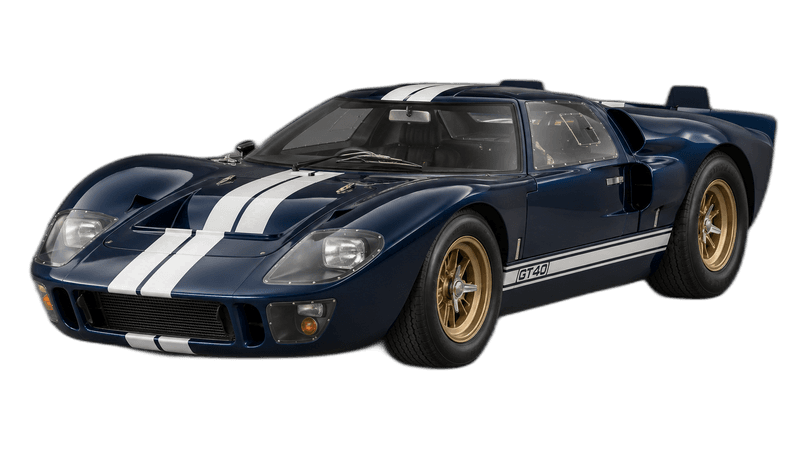
This page uses the catalogue photograph for the car. Its credit is listed on the credits page.
Verdict
The Ford GT40 Mk II is a mid-engine, rear-wheel-drive racing coupe. Its 7.0L naturally aspirated V8 is rated at 485 bhp and 644 Nm by two specification sheets, with 330 km/h as the top speed we keep from the sources and an acknowledged spread from about 327 to 346 km/h. It matters because of what it did in 1966: Ford swept the podium at Le Mans, and the Mk II followed it with the Mk IIB season of 1967. A guide cannot replace a specialist inspection, and this page is for research, not a buying recommendation. We have not driven it, and 0-100 km/h remains no figure shown.
Sources
- Ultimate Car Page: Ford GT40 Mk II, history (page 2)
- Ultimate Car Page: Ford GT40 Mk II, history (page 3)
- Ultimate Car Page: Ford GT40 Mk II specification
- Supercars.net: 1966 Ford GT40 Mark II
- Wikipedia: Ford GT40
- RM Sotheby's: 1966 Ford GT40 Mk II, chassis P/1016 (Monterey 2018)
- 24h-lemans.com: 1966, Ford's first wins at Le Mans and Sebring
- Goodwood: The amazing life and times of Ford's Le Mans 66 GT40s
- Ford From the Road: Ford at Le Mans, 60 years later
Specifications
| Engine | 7.0L naturally aspirated V8 |
|---|---|
| Displacement | 7.0L |
| Power | 485 bhp |
| Torque | 644 Nm |
| Top Speed | 330 km/h |
| Drivetrain | RWD |
| Country | United States |
| Body Style | 2-door racing coupé |
| Years | 1966–1967 |
| Price Used | £9,500,000 |
Specifications are manufacturer-published figures.
Frequently Asked Questions
What is a Ford GT40 Mk II worth?
A representative example is worth about £9,500,000. Actual values vary with specification, condition and history.
How much power does the Ford GT40 Mk II have?
The Ford GT40 Mk II produces 485 bhp and 644 Nm of torque.
What is the top speed of the Ford GT40 Mk II?
The Ford GT40 Mk II has a top speed of 330 km/h.
What engine does the Ford GT40 Mk II have?
The Ford GT40 Mk II uses a 7.0L naturally aspirated V8.
When was the Ford GT40 Mk II built?
The Ford GT40 Mk II was built from 1966 to 1967.
Is the Ford GT40 Mk II all-wheel drive?
No. The Ford GT40 Mk II is configured with rear-wheel drive.