Ford RS200
£240,000
usedIndicative market price, updated periodically.
250bhp
Power
224km/h
Top Speed
£240,000
Price Used
The Ford RS200 produces 250 bhp and has a top speed of 224 km/h. A representative example is worth about £240,000.
Dream Car Garage Editorial · Edited by José Teo Lorente Vallecillos · Last updated 3 November 2026
Overview
We have not driven this car. This review is based on published specifications and the sources listed below.
Scope of this guide
This guide is scoped to the Ford RS200 in its 250 bhp road-car form, the two-door coupe that Ford built in the mid-1980s so that the RS200 could be homologated for Group B rallying. It is a mid-engine, all-wheel drive car with a 1.8L turbocharged inline-four, a Cosworth BDT, mounted longitudinally behind the cabin. It is not a guide to the RS200 Evolution with the enlarged 2.1 litre BDT-E engine, and it is not a guide to the Group B rally cars, which produced far more power. We mention those cars only so that their numbers are not confused with the road car's.
We have not driven this model for this article. We are an editorial desk that reads sources, and everything below comes from pages we opened: Wikipedia, Autozine, Silodrome, Supercar Nostalgia, GTspirit, a Bonhams lot page, and two Gooding and Company lot pages. The RS200 is a collector and competition car that rarely comes to market. A guide like this cannot replace an inspection by an RS200 specialist, and this page is for research, not a buying recommendation.
The figures at a glance
- Engine: 1.8L turbocharged inline-four, the Cosworth BDT, a 16-valve twin-cam unit. Gooding describes it as a 1,803 cc DOHC Cosworth BDT with Bosch electronic fuel injection and a single turbocharger with an air-to-air intercooler. Wikipedia and Autozine also give 1,803 cc.
- Power: 250 bhp. Wikipedia, Autozine and GTspirit print 250 hp and Bonhams and Gooding print 250 bhp, and we treat these as the same number. The sources disagree on the engine speed: Autozine says 6,500 rpm and Gooding says 6,000 rpm.
- Torque: 292 Nm. Autozine prints 215 lb-ft at 4,500 rpm, and we convert that to newton metres at 1.35582 Nm per lb-ft, which gives about 291.5 and rounds to 292 Nm. This is the only road-car torque figure we found, so treat it as single-source. Wikipedia states no road-car torque.
- 0-100 km/h: no figure shown. The only road-car acceleration figure we found is a 0-60 mph time of 6.1 s from an Autocar test, quoted by Autozine, and we do not relabel a 0-60 mph time as a 0-100 km/h time.
- Top speed: 224 km/h. Autozine prints 139 mph from the same Autocar test and gives no kilometre figure. We convert at 1.609344 km/h per mph, which gives about 223.7 and rounds to 224 km/h. The catalogue previously held 225 km/h, which we could not trace to any page.
- Drive: all-wheel drive, a five-speed manual gearbox, per Wikipedia, Autozine and Gooding. Autozine adds that the centre differential offers three choices of front-to-rear torque split and that all three differentials use viscous coupling locking.
- Production: 200 is the homologation figure that Wikipedia, Bonhams, Gooding and GTspirit quote. Other pages give lower built counts, covered below.
- Price when new: Wikipedia gives 49,995 pounds sterling in 1985. Bonhams says around 50,000 pounds sterling.
Road car versus Evolution and rally figures
The most common mistake with this car is to mix its road figure with its competition figures. Wikipedia sets out the three side by side. The road car is 1,803 cc and 250 hp, with upgrade kits over 300 hp. The Evolution is the BDT-E at 2,137 cc, and Wikipedia gives its power as 550 hp to 815 hp, with a typical 580 hp at 8,000 rpm and 400 lb-ft at 5,500 rpm. The Group B rally car is 1,803 cc, and Wikipedia gives 450 PS (331 kW, 444 hp) at 8,000 rpm and 360 lb-ft at 5,500 rpm. The PS to bhp conversion, multiplying by 0.98632, gives 443.8 for 450 PS, which matches Wikipedia's 444 hp.
Supercar Nostalgia, in an article about the Evolution, says the Evolution had a quoted 506 bhp at 7,500 rpm on 1.5 bar of boost, and 580 bhp at 7,700 rpm on 1.6 bar with hot cams. Gooding's lot page for an Evolution gives an estimated 600 to 700 bhp depending on the engine control unit. These figures disagree with one another and with Wikipedia's range, and none of them applies to the road car. Bonhams says the engine produced 250 bhp in road-going trim and up to 500 bhp in rally tune.
Wikipedia's performance figures are for the Group B rally car only: 3.8 s from rest to 60 mph, 7.3 s to 100 mph, the standing quarter mile in 11.4 s, and 118 mph in top gear at 8,900 rpm. That last number reflects gearing in rally trim and is not a road-car top speed. Supercar Nostalgia says 0-62 mph in as little as 3 seconds and 170 mph depending on gearing, but it does not make clear which car it describes, so we use neither. The Autocar figures quoted by Autozine are the only ones we found that are labelled as a test of a well run-in car with the road engine.
History and development
Wikipedia says Ford abandoned the Escort RS 1700T project in 1983, and that led to the RS200. Bonhams says the project commenced in 1983 with production of 200 cars planned, and that the car was first publicly displayed in 1984. Wikipedia says it was first shown at the Belfast Motor Show, without a date, while Supercar Nostalgia gives a Turin Motor Show debut in November 1984. We cannot reconcile the two, and both may be true of different showings.
Bonhams says Audi's Quattro had shown the effectiveness of four-wheel drive, which made Ford rethink a rear-wheel drive approach. It credits Stuart Turner with masterminding the project and John Wheeler, Ford's Motor Sports Chief Engineer, with overseeing it. Silodrome and Bonhams credit Tony Southgate, a former Formula 1 designer, with the design. Bonhams says Ghia styled the car, Tickford built the composite bodyshells at Newport Pagnell, and Reliant built most of the production cars at Shenstone. Silodrome calls it designed from the ground up as a four-wheel drive, mid-engine, space-frame chassis car. Bonhams describes the engine as mounted behind the driver.
The rally record was short. Bonhams says the car's first World Championship event was the 1986 Swedish Rally, where it finished third overall, and Wikipedia names Kalle Grundel as the driver who finished third at that event. Bonhams says the RS200 won 19 international events before the governing body ended Group B at the close of 1986 after fatal accidents, some involving spectators. Silodrome gives 19 wins and 32 podium finishes. Supercar Nostalgia says the Group B application was rubber stamped on 1 February 1986 and that the BDT-E was homologated for rallycross and Group C2 on 1 December 1986. Wikipedia says Evolution cars ran in the FIA European rallycross championships from August 1986 to October 1992, and that Martin Schanche won the 1991 title.
Production numbers and dates
The catalogue count of 200 is the number Group B required, and several pages repeat it as a build count. Wikipedia says 200 road cars were required and that Reliant built 200, plus spare parts for more than 20 more for racing teams. Bonhams says the car was homologated in February 1986 after the required 200 examples had been built. Gooding calls its 2017 Scottsdale lot one of only 200 road models produced, and GTspirit calls its car one of just 200 road-going versions ever produced. Silodrome says one of only 200 built because of homologation.
Other pages give lower figures. Autozine says 144 units were produced in 1985-86 and that only 90 of them were the 250 hp road cars, with around 20 converted to Evolution form. Supercar Nostalgia documents 152 RS200s and says 24 of those were converted to Evolution trim, 21 left-hand drive and three right-hand drive, and it does not reconcile this with the 200 requirement. Bonhams offers another explanation of the gap, saying that Ford stripped down 120 RS200s and rebuilt them as road-legal cars to be sold at around 50,000 pounds sterling. A search summary attributed a figure of 148 to Classic Driver, but that page returned an access-forbidden error when we tried to open it, so we do not rely on it.
We keep 200 as the production count because most of the pages we read give it, but it is best read as the homologation count and the commonly quoted figure, not an audited total of customer cars. Wikipedia adds that about 24 of the original 200 were later converted to Evolution specification, that Ford produced a further 20 road cars to homologate the Evolution changes, and that a separate S Version consisted of 20 cars, 16 standard and four Evolution spec, proposed by a Canadian entrepreneur whose deal fell through.
For dates, Wikipedia gives production as 1984 to 1986, but 1984 is also the year the car was first shown, and Supercar Nostalgia says the first production RS200 was completed in September 1985. Autozine gives 1985-86 for production. We therefore propose 1985 as the first year and 1986 as the last. Silodrome says the featured car was first registered for the road in 1989, and the Gooding lot called its car believed to be one of the last RS200s to leave the Ford factory. GTspirit calls its car the last of the 200, chassis number 169, which agrees with the chassis number Gooding gives for its Ghia-coachwork car. That agreement suggests both pages describe the same car, but we have not confirmed it.
What the rarity means for a buyer
We found no used buying guide for the RS200, no list of known faults, no service schedule and no recall notice, so we give none. What the sources do show is a car whose paperwork matters more than its mechanical trivia.
- Which car is it. Because the road cars, the Evolution conversions and the rally cars share a name, the chassis number, the build specification and the history decide what a car is. Autozine and Supercar Nostalgia both say some road cars were converted to Evolution trim, and Wikipedia says Evolution cars sell for significantly more than standard cars.
- Whether the engine is original. Wikipedia says upgrade kits over 300 hp exist for the road car, so power output alone does not tell you what is under the bonnet.
- Provenance and mileage. The Gooding lot lists books and service receipts, a comprehensive recent service, and 2,004 km on the odometer, and Silodrome lists 17,090 miles for a car first registered in 1989. Ask for the same level of record on any car you consider.
- Parts and specialists. Bonhams says Tickford built the composite bodyshells, which suggests that body parts are specialist items, but no page we read says how easy parts are to find.
- Inspection. Use an RS200 specialist. Nothing here replaces one.
Market and value notes
The prices below come from auction pages and from Wikipedia. A few sales do not make a valuation, and the cars differ in specification and history.
- Goodwood Collector's Motor Cars Auction, Bonhams, 12 July 2013: Silodrome reports an estimate of 120,000 to 150,000 US dollars for a road car with 17,090 miles. It gives no result.
- Scottsdale Auctions 2017, Gooding and Company, Lot 115: a Ghia-coachwork road car with 2,004 km, estimate 275,000 to 350,000 US dollars. The page we read lists no result.
- Bonhams London lot page for a Group B rally coupe: estimate 140,000 to 160,000 pounds sterling. The page does not give a result or a date.
- Evolution cars, which are a different and more valuable car: Gooding sold an Evolution for 539,000 US dollars at Pebble Beach Auctions 2015 against an estimate of 500,000 to 700,000, and Wikipedia reports 550,000 US dollars for an Evolution at Bonhams in 2017 and 486,000 pounds sterling for an Evolution at Iconic Auctioneers in November 2023.
Wikipedia also notes that Ford and Boreham Motorworks teased a Remaster of the RS200 in June 2024. We found no further detail and did not follow it up.
Recalls and safety
We found no recall notice for the RS200 in any page we read, but we did not search a recall database. We found no crash-test data and no safety-equipment list. The sources do tell a safety story about the category: Group B was ended after the 1986 season following fatal accidents, as Bonhams and Wikipedia both note. A car of this age and performance deserves a specialist check of brakes, tyres and suspension before use.
What we could not find
We found no Ford press kit or brochure, so the road-car power, torque and speed figures come from Wikipedia, an enthusiast reference site and auction pages, not from Ford. We found no road-car torque in newton metres, only 215 lb-ft, and no top speed in kilometres per hour, only 139 mph. We found no 0-100 km/h time and no road-car weight. We found no running costs, no failure rates, no fuel-consumption figure and no recall data. We could not settle the built count between 144, 152 and 200.
About the photograph
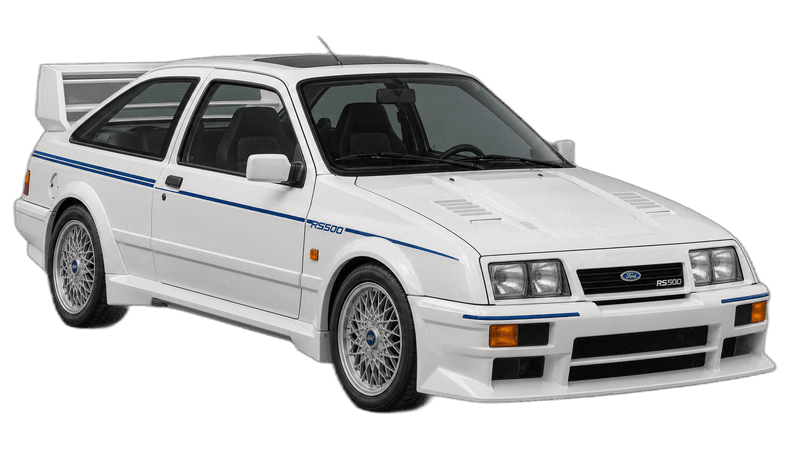
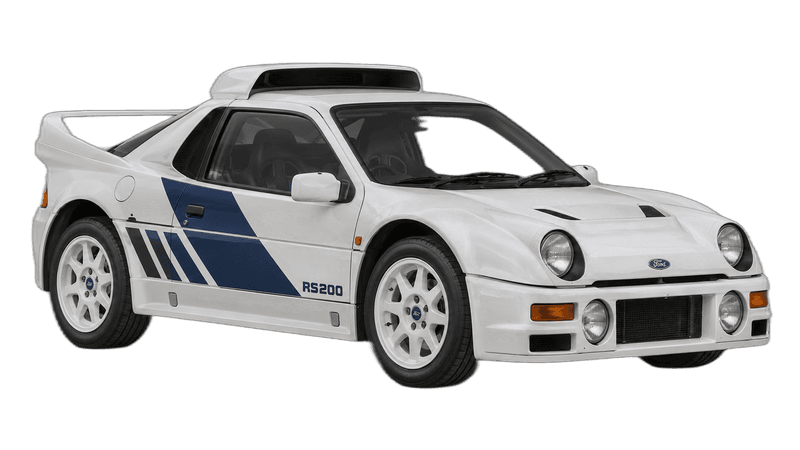
This page uses the catalogue photograph for the car. Its credit is listed on the credits page.
Verdict
The Ford RS200 road car is a mid-engine, all-wheel drive coupe with a 1.8L turbocharged inline-four rated at 250 bhp, a derived 292 Nm of torque, and a derived 224 km/h top speed from an Autocar test, with no 0-100 km/h figure shown because no source gave one. It was built for homologation in 1985 and 1986, the commonly quoted count is 200, and the documented build count may be lower. Keep the road car's numbers apart from the Evolution's 2.1 litre engine and the rally cars' figures, and confirm chassis, specification and history before drawing any conclusion about a particular car. We have not driven it, so use the sources, the records of any car you consider and an independent specialist inspection, and treat this page as research, not a buying recommendation.
Sources
- Wikipedia: Ford RS200
- Autozine: Ford RS200
- Silodrome: Ford RS200 Coupe (Bonhams Goodwood 2013 estimate)
- Supercar Nostalgia: Ford RS200 Evolution historical and technical appraisal
- Bonhams: Ford RS200 Group B rally coupe lot page
- Gooding and Company: 1986 Ford RS200 (Scottsdale 2017, Lot 115)
- Gooding and Company: 1986 Ford RS200 Evolution (Pebble Beach 2015)
- GTspirit: Last 1986 Ford RS200 to be sold by RM Sotheby's (1 November 2015)
Specifications
| Engine | 1.8L turbocharged inline-four |
|---|---|
| Displacement | 1.8L |
| Power | 250 bhp |
| Torque | 292 Nm |
| Top Speed | 224 km/h |
| Drivetrain | AWD |
| Country | United Kingdom |
| Body Style | 2-door coupé |
| Years | 1985–1986 |
| Production | 200 |
| Price Used | £240,000 |
Specifications are manufacturer-published figures.
Frequently Asked Questions
What is a Ford RS200 worth?
A representative example is worth about £240,000. Actual values vary with specification, condition and history.
How much power does the Ford RS200 have?
The Ford RS200 produces 250 bhp and 292 Nm of torque.
What is the top speed of the Ford RS200?
The Ford RS200 has a top speed of 224 km/h.
What engine does the Ford RS200 have?
The Ford RS200 uses a 1.8L turbocharged inline-four.
How many Ford RS200 were made?
Ford produced 200 units of the Ford RS200.
When was the Ford RS200 built?
The Ford RS200 was built from 1985 to 1986.
Is the Ford RS200 all-wheel drive?
Yes. The Ford RS200 is configured with all-wheel drive.