
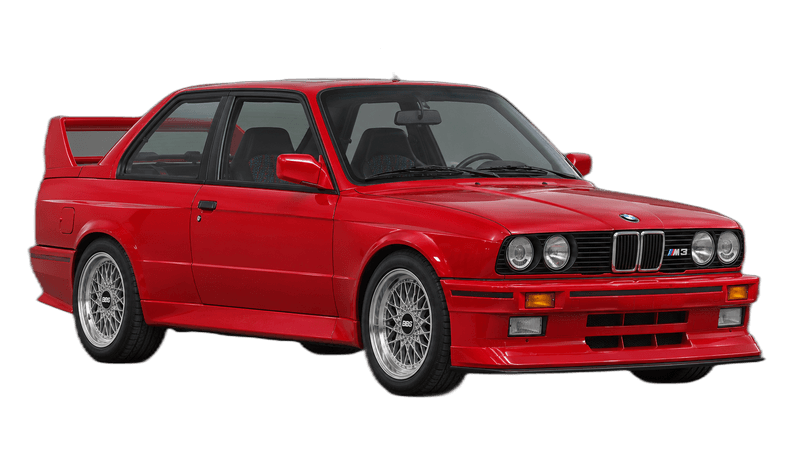
BMW M3 Sport Evolution (E30)
235cv
Potenza
6.5s
0-100 km/h
248km/h
Velocita Massima
Quanto spinge.
La forza g di picco nell'istante in cui affondi l'acceleratore, stimata dal tempo 0–100 e dalla trazione.
BMW M3 Sport Evolution (E30)G di partenza stimata dal tempo 0–100 e dalla trazione: un'approssimazione onesta, non un dato misurato.
The BMW M3 Sport Evolution (E30) is a 2-door coupé by BMW, with 235 bhp, 240 Nm of torque, a 0-100 km/h time of 6.5 seconds and a top speed of 248 km/h.
Dream Car Garage Editorial · Edited by José Teo Lorente Vallecillos · Last updated 3 November 2026
Panoramica
We have not driven this car. This review is based on published specifications and the sources listed below.
Scope of this guide
This guide is scoped to the BMW M3 Sport Evolution (E30), the final homologation special of the first-generation M3, shown by BMW Motorsport in 1990 and limited to 600 cars. It is a front-engine, rear-wheel drive two-door coupe with a naturally aspirated four-cylinder engine enlarged to about 2.5 litres. It is not a guide to the standard 2.3-litre E30 M3, to the earlier Evolution I and Evolution II cars, or to the Johnny Cecotto and Ravaglia special editions. We mention those only where a source compares them with the Sport Evolution.
We have not driven this model for this article. We are an editorial desk that reads sources, and everything below comes from pages we opened: BMW Group Classic, two RM Sotheby's lot pages, Wikipedia, Supercars.net, Motor1 Germany, PistonHeads, more-cars.net, TopSpeed and BMWBlog. This is a collector car that rarely comes to market, so a guide like this cannot replace a specialist inspection by someone who knows these cars. This page is for research, not a buying recommendation.
The figures at a glance
- Engine: 2.5L naturally aspirated inline-four, the S14, with 2,467 cc displacement. BMW Group Classic, Wikipedia, Supercars.net, Motor1 Germany, PistonHeads and more-cars.net all give 2,467 cc, enlarged from the 2.3-litre engine of the standard M3.
- Power: 235 bhp. Wikipedia, Supercars.net and more-cars.net give 238 PS, which is 175 kW, at 7,000 rpm. We converted 238 PS to bhp at a factor of 0.98632, which gives about 235 bhp, and 175 kW at 1.34102 gives the same figure. Some pages label the same output 238 hp or 238 bhp, which is loose labelling of the metric figure, and we treat them as the same engine rating.
- Torque: 240 Nm at 4,750 rpm, or 177 lb-ft. Wikipedia, Supercars.net and more-cars.net agree, and PistonHeads gives 177 lb-ft.
- 0-100 km/h: 6.5 seconds. Supercars.net and more-cars.net give it, and more-cars.net presents it as the claimed figure. Treat it as a claim, not a measured result.
- Top speed: 248 km/h, or 154 mph. BMW Group Classic, Supercars.net and more-cars.net give it. Wikipedia says 250 km/h.
- Drive: rear-wheel drive through a five-speed manual with a dogleg pattern on European cars, according to RM Sotheby's.
- Weight: about 1,200 kg in Supercars.net, PistonHeads and more-cars.net. BMW Group Classic only says the car was 25 kg lighter than its predecessor.
- Production: 600 cars. Every source we read that gives a number says 600.
- Price when new: DM 85,000 in Germany according to BMW Group Classic, Motor1 Germany and more-cars.net.
Where the sources disagree
We found real disagreement, and we say so rather than choosing silently.
On power, the output is 238 PS in the metric sources and 238 hp or 238 bhp in several others. These are not the same unit, because 238 PS is about 235 bhp. We use 235 bhp, stated with its conversion, because it matches Wikipedia, Supercars.net and the kilowatt figure. Note that 220 PS is the output of the earlier Evolution II, and Wikipedia and TopSpeed both give that figure for the earlier car, so it must not be attached to the Sport Evolution.
On top speed, 248 km/h is the more common figure, and Wikipedia's 250 km/h is a rounder number from a general-purpose page. We chose 248 km/h because the maker's classic page and two other sources agree on it. Motor1 Germany, TopSpeed and others also print top speeds for the standard M3 or the Evolution II on the same page, and we did not use those for this car.
On acceleration, 6.5 seconds comes from sources that do not show a test. PistonHeads, in a 2009 article, gives 6.1 seconds for 0-60 mph and 16.0 seconds for 0-100 mph, and Supercars.net lists 6.2 seconds for 0-60 mph. Those are different measurements, so we did not convert them into a 0-100 km/h time.
On years, the sources do not agree. BMW Group Classic lists production from December 1989 to March 1990, Motor1 Germany says January to March 1990, PistonHeads says late 1989 and early 1990, and one RM Sotheby's lot gives a production date of 18 January 1990. more-cars.net says 1990 only, and Supercars.net says 1990 and early 1991. BMWBlog says the cars were built between 1980 and 1990, which cannot be right for a car that did not exist before 1985. We treat 1990 as the model year and note that the first cars may have been built in late 1989.
On the 600 figure, RM Sotheby's adds that 500 were built for the public and 100 were race customer chassis. We found that split on only one page, so we report it as RM Sotheby's account and not as an established fact.
Why the Sport Evolution exists
The E30 M3 was built so that BMW could race in Group A touring-car championships. According to the RM Sotheby's Miami lot, the car was built for homologation in the German touring-car championship, where BMW, Mercedes-Benz and Opel competed. The same page says FIA rules cut homologation quotas to 500 chassis during the racing season, which led to the Sport Evolution. TopSpeed says Group A originally asked for 5,000 road-legal copies, and credits direct input from engineer Paul Rosche for the final car. Supercars.net says that BMW Motorsport unveiled the car in Munich in 1990 and that it was assembled by hand at the Garching facility.
What changed from the standard M3
The sources agree on the main points. The Sport Evolution received a stroked engine instead of a turbocharger, as Supercars.net puts it, taking displacement from 2.3 to 2.5 litres. PistonHeads and Motor1 Germany add oil-jet piston cooling, revised valves and a more aggressive cam. RM Sotheby's mentions a more aggressive crankshaft and a ported exhaust manifold.
The body and chassis were also changed. Wikipedia and BMW Group Classic describe a new front bumper with larger openings, brake cooling ducts in place of the front foglights, and an adjustable rear wing. RM Sotheby's describes adjustable front and rear aerodynamic settings called Normal, Monza and Nurburgring. Motor1 Germany lists a suspension lowered by 10 mm, 16-inch BBS wheels, thinner side glass, a lighter tailgate and a 62-litre fuel tank, while more-cars.net lists a 70-litre capacity, so the sources differ on tank size and we do not state one as fact. Inside, Recaro seats, red seat belts and Alcantara or suede on the steering wheel, gear knob and handbrake are mentioned by several pages. Only two colours were offered, Black (Glanzschwarz or Jet Black) and Brilliant Red (Misano or Brilliantrot), which every colour list we read agrees on.
What the rarity means when you look at one
None of the pages we read is a buying guide. PistonHeads gives no faults or inspection points, and no source gives failure rates or repair costs, so we do not invent any. What the sources do show is what auction houses emphasise when they sell these cars:
- A matching-numbers engine. The RM Sotheby's Munich lot names the engine number and calls the car matching numbers.
- Documentation. The same lot includes owner's guides and a BMW Classic Birth Certificate.
- Originality of the interior. The RM Sotheby's Miami lot describes the original Anthracite cloth and suede trim as presentable for a car with limited use.
- Modification. The BMWBlog car from 2021 carried an aftermarket exhaust, H&R Cup suspension and a short shifter, and had 128,000 km. Whether such changes matter is for a specialist to judge.
- Mileage. The Munich lot had 34,447 km at cataloguing, and the Miami lot had 26,683 miles.
Because the cars are few and valuable, a specialist inspection and a full history check matter more than anything this page can tell you.
Market and value notes
We only report prices that a source gives, with the source and date. RM Sotheby's Miami 2024 lists a Sport Evolution sold for 268,800 US dollars; the page does not state the sale date beyond Miami 2024. RM Sotheby's Munich 2025 lists another sold for 325,625 euros; again the page gives no exact sale date. BMWBlog reported on 15 October 2021 that a Collecting Cars auction had a top bid of 120,000 US dollars with 33 bids at the time of writing; the page does not report the final price. In 2009, PistonHeads said a good example could cost between 20,000 and 30,000 pounds and that the car cost about 35,000 pounds new in the UK, which is a historical figure and not a current value. Prices are now far higher than the 2009 range suggests, and these few results do not form a market index.
What we could not find
We could not find a torque or acceleration figure in a BMW archive document. BMW Group Classic does not list torque or 0-100 km/h and says its text was created using AI, so we treated it as a secondary source. We found no independent measured 0-100 km/h time for the Sport Evolution, so 6.5 seconds remains a quoted figure. We found no recall information, no reliability statistics and no running-cost data. We also did not find a primary source that settles the production start date or the 500 and 100 split.
About the photograph
The page uses the catalogue photograph, and its credit is listed on the credits page.
Verdict
The BMW M3 Sport Evolution is the most developed of the E30 M3 road cars: 2,467 cc, 235 bhp, 240 Nm, a quoted 6.5 seconds to 100 km/h and 248 km/h, with 600 built. The numbers come from sources that quote claims, and the one older road test we found used different units. What the car offers is rarity and its place at the end of the E30 M3 story, not practical ownership data, because the pages we read give none. Use this page for research, and rely on a qualified specialist, documented history and an independent inspection for any real decision. We have not driven it.
Sources
- BMW Group Classic: BMW M3 (E30) Sport Evolution (Evolution III)
- Wikipedia: BMW M3
- RM Sotheby's: 1990 BMW M3 Sport Evolution, Miami 2024
- RM Sotheby's: 1990 BMW M3 Sport Evolution, Munich 2025
- Supercars.net: BMW M3 Sport Evolution
- Motor1 Germany: BMW M3 Sport Evolution (1990)
- PistonHeads: BMW E30 M3 Sport Evolution (PH Heroes)
- more-cars.net: BMW M3 Sport Evolution (E30)
- TopSpeed: 1990 BMW E30 M3 Sport Evolution
- BMWBlog: 1990 E30 BMW M3 Sport Evolution auction (15 October 2021)
Specifiche
Motore
2.5L naturally aspirated inline-four
Cilindrata
2.5L
Potenza
235 cv
Coppia
240 Nm
0-100 km/h
6.5s
Velocita Massima
248 km/h
Trazione
RWD
Paese
Germany
Carrozzeria
2-door coupé
Anni
1990
Produzione
600
Specifications are manufacturer-published figures.
Altre di BMW

Domande Frequenti
What are the specifications of the BMW M3 Sport Evolution (E30)?
The BMW M3 Sport Evolution (E30) is a 2-door coupé by BMW, with 235 bhp, 240 Nm of torque, a 0-100 km/h time of 6.5 seconds and a top speed of 248 km/h.
How many BMW M3 Sport Evolution (E30) were made?
BMW produced 600 units of the BMW M3 Sport Evolution (E30).
What drivetrain does the BMW M3 Sport Evolution (E30) use?
The BMW M3 Sport Evolution (E30) is configured with rear-wheel drive.
What type of car is the BMW M3 Sport Evolution (E30)?
The BMW M3 Sport Evolution (E30) is a super saloons manufactured by BMW in Germany. Production ran from 1990 to 1990.