
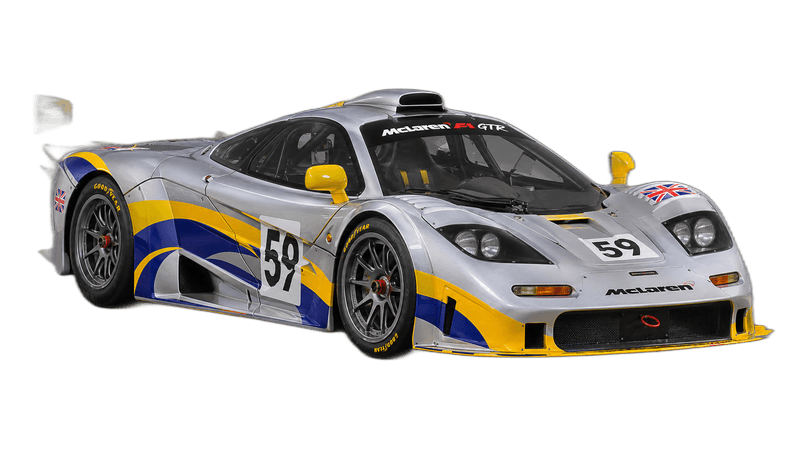
McLaren F1 GTR
600cv
Potencia
330km/h
Velocidad Máxima
The McLaren F1 GTR is a 2-door racing coupé by McLaren, with 600 bhp and a top speed of 330 km/h.
Dream Car Garage Editorial · Edited by José Teo Lorente Vallecillos · Last updated 3 November 2026
Visión General
We have not driven this car. This review is based on published specifications and the sources listed below.
Scope of this guide
This guide is scoped to the McLaren F1 GTR, the racing version of the McLaren F1 that ran in the BPR Global GT series, the FIA GT Championship and at Le Mans from 1995 to 1998. It is a carbon-monocoque coupe (supercars.net) with a mid-engine layout, a BMW V12 sitting behind the driver. We describe it as rear-wheel drive, which is what the catalogue row says. Be aware that none of the pages we read states the driven wheels in so many words; they say only that the engine is rear mid-mounted. This is a competition car, not a road car. The road-going McLaren F1 has its own catalogue row and is out of scope here, and we mention it only where a source compares it with the racer.
We have not driven this model for this article. We are an editorial desk that reads sources. Everything below comes from pages we opened: Wikipedia, the Ultimatecarpage text and chassis 01R pages, the Le Mans 24 Hours website, two Endurance-Info archive articles, supercars.net, The Drive and BMWBlog. These cars almost never come to market. A page like this cannot replace a specialist inspection of a specific chassis, and it is for research, not a buying recommendation.
The figures at a glance
- Engine: 6.1L naturally aspirated V12. Wikipedia and supercars.net name it the BMW S70/2 and give 6,064 cc for the 1995 and 1996 cars. Wikipedia calls it naturally aspirated, and supercars.net adds four valves per cylinder (48 in total) and a compression ratio of 11.0:1.
- Power: 600 bhp. Supercars.net gives 600 bhp at 7,500 rpm with FIA air restrictors, against 627 bhp in road specification. Endurance-Info says the racer was required to run air restrictors limiting power to 600 bhp. Wikipedia prints around 600 PS (592 hp, 441 kW), which is a metric figure that converts to about 592 bhp at the 0.98632 factor. We use the 600 bhp figure because two separate sources print it as bhp, and we state the 592 figure as the alternative.
- Torque: no figure shown. Supercars.net prints 650 N·m (480 lb-ft) at 5,600 rpm, but we found no second source for it, and the same page gives the road car's higher unrestricted power, so we cannot tell whether the number belongs to the restricted racer. We do not publish it.
- 0-100 km/h: no figure shown. Supercars.net gives a theoretical 0-60 mph time of about three seconds, but a 0-60 mph time is not a 0-100 km/h time and we do not relabel it.
- Top speed: 330 km/h. Both Wikipedia and supercars.net record this as a Mulsanne Straight speed at Le Mans in 1996. It is a recorded racing speed, not a maker's claim, and it depended on gearing, wing settings and the circuit.
- Weight: about 1,050 kg for the 1995 car, about 1,012 kg for 1996 and about 915 kg for the 1997 Longtail (supercars.net). Wikipedia says the 1996 update cut 38 kg, and The Drive says the 1997 car weighed 2,017 pounds, 299 pounds under the 1995 car. These agree with each other.
- Production: 28 cars, made up of 9 in 1995 specification, 9 in 1996 specification and 10 in 1997 Longtail specification (Wikipedia and supercars.net).
Where the sources disagree
- Power. The numbers are 600 bhp (supercars.net, Endurance-Info), 600 PS or 592 hp (Wikipedia) and 627 bhp for the unrestricted road engine (supercars.net, Endurance-Info). BMWBlog prints 626 hp and 494 lb-ft for the Longtail's S70/3, so there is no stable single maximum across the three years. We also looked for a figure of about 636 PS; no page we read prints it. It would be the metric equivalent of the road car's 627 bhp, not a race figure.
- Top speed. Wikipedia lists 281 km/h as the highest practice speed on the Mulsanne in 1995, 330 km/h for 1996 and 317 km/h for the 1997 Longtail. The catalogue figure of 330 km/h belongs to the 1996 car, not to every year.
- Engine size. The S70/2 is 6,064 cc. For 1997 Wikipedia lists the S70/3 at 5,990 cc and The Drive says the Longtail's V12 was downsized to 6.0 liters. So the 6.1L string describes the 1995 and 1996 cars only.
- Production count. Ultimatecarpage's text page says 9 built in 1995 and 9 in 1996, for 18, because it covers only those two years. Wikipedia, supercars.net, The Drive and BMWBlog say 28. The Le Mans website says 106 road and race F1s were built between 1993 and 1998, including 28 for competition. We choose 28 as the count of GTR chassis. Wikipedia also notes two chassis were upgraded to 1996 specification without being counted again.
- Longtail count. Wikipedia, The Drive and BMWBlog say 10 Longtails; Endurance-Info says nine racers plus a development car. We use 10 and note that the sources count differently.
- Years. The infobox runs the engines through 1998, and the cars raced until 1998, but the build years are 1995 to 1997 by specification. We keep 1995 to 1997.
History: from the F1 to a Le Mans winner
The road-going F1 was presented in 1992, according to the Le Mans website. Ultimatecarpage credits Gordon Murray and Peter Stevens with the design. The key change from the road car was the engine rule: the racer was required to run air restrictors in the roof intake, which cut power from 627 bhp to 600 bhp, and Endurance-Info points out the racer actually had less power than the road car it was based on.
The first Le Mans was on 17 June 1995, the 63rd running. Seven F1 GTRs started. The winner was car number 59, entered by Kokusai Kaihatsu Racing and run by Lanzante, driven by Yannick Dalmas, Masanori Sekiya and JJ Lehto. Wikipedia gives 298 laps. Four more McLarens finished 3rd, 4th, 5th and 13th. The winning car was chassis 01R, the original prototype, which McLaren still owned; Ultimatecarpage says it was pressed into service because the allocated car, 08R, was needed to replace a Gulf car that crashed heavily at Jarama. Ultimatecarpage describes a very wet race in which Lehto's drive gave the car the edge, and the Le Mans website calls the car remarkably agile in the rain. Endurance-Info notes McLaren was the only manufacturer to win the race on its first attempt.
Outside Le Mans, Ultimatecarpage says the F1 GTR won 10 of the 12 rounds in the BPR series in 1995. After the Le Mans win McLaren built a five-unit limited series, the F1 LM, according to the Le Mans website. That is a road car and out of scope.
Variants: 1995, 1996 and the 1997 Longtail
- 1995 specification: nine cars (Wikipedia). About 1,050 kg and the 6,064 cc S70/2. Wikipedia says the standard gearbox was retained.
- 1996 specification: nine cars, with a lighter magnesium gearbox housing and 38 kg removed (Wikipedia, supercars.net). In 1996 no GTR won Le Mans overall. Wikipedia lists six finishers from seven entries, with the best at 4th, and says McLarens were beaten only by two Porsche 911 GT1 cars and the winning Porsche prototype. The Le Mans website gives five GTRs in the top 10.
- 1997 Longtail: ten cars, chassis 19R to 28R (Wikipedia). It had a much longer nose and tail, a wider rear wing, wider wheel arches, a stroke-reduced engine and a six-speed Xtrac sequential gearbox. Supercars.net says it introduced ABS and weighed about 915 kg; Endurance-Info says it was 641 mm longer than the F1 GT and that it won five of 11 FIA GT rounds in 1997. At Le Mans 1997 Wikipedia has chassis 20R, run by Schnitzer and BMW Motorsport, finishing 2nd overall with 360 laps and 26R 3rd with 358 laps. The Le Mans website says the Joest-Porsche TWR won. Both Wikipedia and The Drive say the Longtails finished second and third against prototypes.
The F1 GT is a separate story. Endurance-Info says three F1 GT road cars were built using the 1997 bodywork, with the original XP GT kept by McLaren. They are road-legal homologation specials, not GTRs, and we do not count them in the 28.
What the rarity means
Twenty-eight chassis is a very small number, and each has a numbered racing history. Ultimatecarpage and Wikipedia both identify cars by chassis such as 01R, 08R and 27R. For a buyer, or just a reader, that history is the value: who raced it, what it won, whether it was rebuilt, and whether it was converted for road use. BMWBlog says chassis 27R won its first race at Silverstone in 1997, which was the first victory for a longtail car, raced at Le Mans in 1997 and was later converted for road use by Lanzante Limited. It gives the road-legalisation cost as 110,000 pounds. The Drive says the same chassis had a 2025 Lanzante service costing about 53,000 pounds (roughly 72,000 US dollars). Those are two data points on one car, not a maintenance schedule for the model.
On prices, The Drive, published on 7 February 2026, reported an RM Sotheby's sealed-bid estimate of 18 to 21 million US dollars for 27R, and BMWBlog reported bidding opening on 5 March 2026 with about 20 million expected. We could not read the RM Sotheby's lot page beyond its title, and we found no source we opened that states the outcome of that sale. Wikipedia says chassis 10R sold in 2026 for 34,655,000 US dollars, described as a record, but Wikipedia tags its chassis section as lacking citations, so treat it as unverified. These are single sales, not a market index.
Running costs, known issues and safety
We found no source giving running costs, service intervals, failure rates or recalls for the F1 GTR as a model. A racing car like this is maintained by specialists and the figures above are individual invoices. We found no safety or recall data. We do not know how the cars behave on the road, because we have not driven or inspected one.
What we could not find
We found no maker data sheet for the 1995 car, so no torque figure we trust, no 0-100 km/h time and no official weight. We could not confirm from a source that the driven wheels are the rear ones, although every source places the engine behind the driver. Searches suggested a restrictor diameter and a 636 PS figure, but no page we opened printed them. The RM Sotheby's lot page for 27R returned only a page title, and the sale result was not in any page we could read. We did not use Conceptcarz or other aggregator results because we did not open them.
About the photograph
This page uses the catalogue photograph for the car. Its credit is listed on the credits page.
Verdict
The McLaren F1 GTR is a mid-engine, rear-wheel-drive racing coupe with a 6.1L naturally aspirated V12. In its restricted 1995 and 1996 form it made 600 bhp, and a 330 km/h Mulsanne speed was recorded in 1996. It won Le Mans on its first attempt in 1995, 28 were built, and the 1997 Longtail was the last major development. Its significance is that history. A guide cannot replace a specialist inspection, and this page is for research, not a buying recommendation. We have not driven it, and torque and 0-100 km/h remain no figure shown.
Sources
- Wikipedia: McLaren F1 GTR
- Ultimatecarpage: McLaren F1 GTR
- Ultimatecarpage: McLaren F1 GTR chassis 01R
- 24h-lemans.com: The McLaren F1 GTR at Le Mans, key dates 1995-1998
- Endurance-Info archive: McLaren F1 GTR Longtail
- Endurance-Info archive: McLaren F1 GT
- supercars.net: 1996 McLaren F1 GTR
- The Drive: 1997 McLaren F1 GTR Longtail going to auction
- BMWBlog: McLaren F1 GTR Longtail 27R BMW V12 auction
Especificaciones
Motor
6.1L naturally aspirated V12
Cilindrada
6.1L
Potencia
600 cv
Velocidad Máxima
330 km/h
Tracción
RWD
País
United Kingdom
Carrocería
2-door racing coupé
Años
1995–1997
Producción
28
Specifications are manufacturer-published figures.
Más de McLaren
Preguntas Frecuentes
What are the specifications of the McLaren F1 GTR?
The McLaren F1 GTR is a 2-door racing coupé by McLaren, with 600 bhp and a top speed of 330 km/h.
How many McLaren F1 GTR were made?
McLaren produced 28 units of the McLaren F1 GTR.
What drivetrain does the McLaren F1 GTR use?
The McLaren F1 GTR is configured with rear-wheel drive.
What type of car is the McLaren F1 GTR?
The McLaren F1 GTR is a track only manufactured by McLaren in United Kingdom. Production ran from 1995 to 1997.