
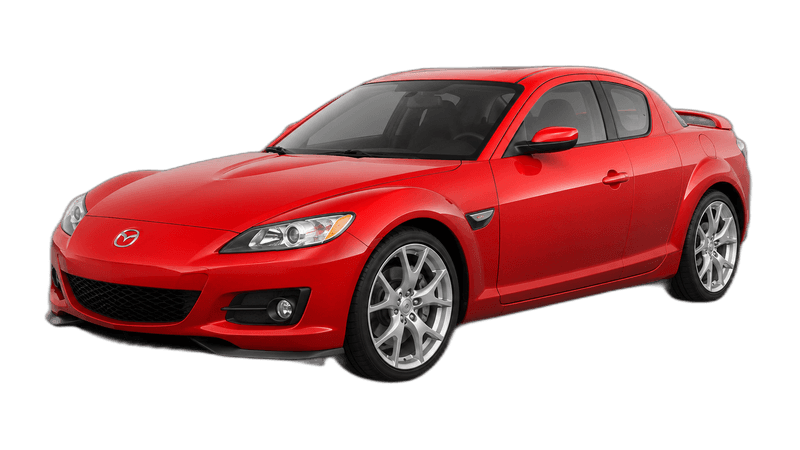
Mazda RX-8 R3
£8,000
usadoIndicative market price, updated periodically.
228cv
Potencia
6.4s
0-100 km/h
234km/h
Velocidad Máxima
£8,000
Precio Usado
The Mazda RX-8 R3 produces 228 bhp, reaches 100 km/h in 6.4 seconds and has a top speed of 234 km/h. A representative example is worth about £8,000.
Cómo empuja.
La fuerza g máxima en el instante en que pisas a fondo, estimada a partir del 0–100 y la tracción del coche.
Mazda RX-8 R3G de salida estimada a partir del 0–100 y la tracción: una aproximación honesta, no una cifra medida.
Dream Car Garage Editorial · Edited by José Teo Lorente Vallecillos · Last updated 2 November 2026
Visión General
We have not driven this car. This review is based on published specifications and the sources listed below.
Scope of this guide
This guide is scoped to the Mazda RX-8 R3, the 231 PS trim of the Series 2 RX-8 sold in the United Kingdom and Europe from late August 2008, with the 1.3L twin-rotor Renesis (13B-MSP) Wankel rotary naturally aspirated petrol engine (1308 cc), a six-speed manual gearbox and rear-wheel drive. It is not a guide to the earlier Series 1 cars from 2003, to the 192 PS RX-8 that was sold alongside them, to the special editions such as the Evolve, Nemesis, Kuro and PZ, or to the North American and Japanese cars that carry the same R3 name with different equipment. We say below where those cars differ, so that you can tell which one an advert really describes.
We have not driven this model for this article. Everything here comes from three cited sources: a July 2008 launch press release for the R3 republished by The Auto Channel, PistonHeads' multi-page Mazda RX-8 buying guide, and the government recall checker. We also read a Wikipedia article on the RX-8, a car-data page, a French guide to the R3, a short 2010 report on the end of UK sales and several web-search summaries, and we flag each point that rests on them. Where sources disagree we say so rather than pick a winner quietly.
The figures at a glance
- Engine: 1.3L twin-rotor Renesis (13B-MSP) Wankel rotary naturally aspirated petrol, 1308 cc, which PistonHeads says revs to 9,000 rpm.
- Power: 228 bhp, which is Mazda's 231 PS converted by us (231 x 0.9863 is about 227.8). The press release prints 231 PS only.
- Torque: 211 Nm, printed in the press release at 5,500 rpm.
- 0-100 km/h: 6.4 seconds, which the press release gives as 62 mph (100 km/h).
- Top speed: 234 km/h, a car-data and French-guide figure. The press release says 146 mph, which converts to about 235 km/h.
- Drive: rear-wheel drive, front-mounted engine, six-speed manual.
- Body: four-seat coupe with rear-hinged back doors and no B-pillar, a 290 litre boot, 4,430 mm long, 1,770 mm wide and 1,340 mm high on a 2,700 mm wheelbase, with 50:50 weight distribution, all from PistonHeads.
- Kerb weight: 1,379 kg for the 231 PS car on PistonHeads, or 1,390 kg on a car-data page.
What the R3 was
Mazda announced the R3 in July 2008 as a single, highly specified model with no factory-fitted options. The press release lists a sports styling pack with a sport front bumper, side skirts and a rear wing, 19-inch alloy wheels, uprated suspension, Recaro sports seats, a Bose audio system, Bluetooth, xenon headlamps, rain-sensing wipers and cruise control. UK dealers took cars from late August 2008, at a launch price of 24,995 pounds on the road. We have written that figure in words and treat it as history, not a current value.
The press release says the body is stiffer, with torsional rigidity up 5.4 per cent and flexural rigidity up 8.7 per cent, and that the final drive was shortened from 4.444 to 4.777 for stronger initial acceleration. PistonHeads agrees about the final drive and adds Bilstein dampers, 19-inch BBS alloys and a foam-filled front crossmember for the R3. It also describes a lower front splitter, side sill extensions and a rear spoiler.
Why the quoted power and dates vary
Power is the first thing to pin down. Mazda UK called the car 231 PS, which is metric horsepower. Our catalogue converts that to 228 bhp, and a car-data page prints 231 PS and 228 HP together. Parkers is reported by a search summary as giving 227 bhp, and Wikipedia gives 231 hp, 234 PS and 172 kW in one table and 228 hp for a UK edition in another. These differ by a few units, not by a different engine. The press release puts peak power at 7,500 rpm, while the car-data page and the French guide say 8,200 rpm, and we have not resolved that, so we quote no power rpm.
Dates are less tidy. PistonHeads' body page and Wikipedia both describe a 2009 update with new bumpers and lights, yet the press release shows the new bumper, LED rear lamps and 19-inch wheels on the R3 in 2008. Wikipedia says the R3 first appeared in Japan in 2008 and was reintroduced in 2009. Our date range of 2008 to 2010 reflects the UK launch in late August 2008 and a PistonHeads statement that production ended in 2010, which is a judgement, not a printed range. Wikipedia says global rotary production finished on 21 June 2012, so cars from other markets can be later.
Performance claims and what they mean
PistonHeads gives 6.4 seconds from 0 to 62 mph for the 231 PS car and 7.2 seconds for the 192 PS car. The press release agrees on 6.4 seconds. A car-data page also gives 6.4 seconds for 0-100 km/h and 6.1 seconds for 0-60 mph, which is consistent with it. These are maker or published claims, not our measurements.
The 234 km/h figure matches that car-data page, which also says 145 mph, and a French guide to the R3 that says 234 km/h. The press release says 146 mph, and Wikipedia says 146 mph and 235 km/h. The gap is rounding in the unit conversion. For the 192 PS car, Wikipedia lists 139 mph, so the R3 is the faster of the two in a straight line, but it is not a car that trades on torque. PistonHeads notes the 192 PS engine actually makes slightly more torque, quoting 162 lb ft against 156 lb ft for the 231 PS car, and that it uses a five-speed gearbox rather than six.
How the R3 differs from other RX-8 trims
The 192 PS car, which Wikipedia lists as 195 PS, is about 189 bhp by our conversion. PistonHeads says it has halogen headlamps, while the 231 PS car has xenon lamps with washers and standard self-levelling suspension. The 192 PS car is also lighter, at 1,373 kg against 1,379 kg. The R3 was sold only with the 231 PS engine.
The special editions are separate cars. PistonHeads lists the Evolve and PZ on the 231 PS engine, the Nemesis on the 192 PS engine, the Kuro as a 500-car black edition and the PZ as an 800-car Prodrive run, and Wikipedia dates the Evolve, Nemesis and Kuro to 2006 and 2007. Wikipedia also describes the R3 name in North America as the equivalent of the Japanese Type RS, so the equipment differs by market. If an advert says R3, check that the car has the 19-inch wheels, the Recaro seats and the six-speed gearbox, and that the registration is UK or European, not a grey import. PistonHeads says the UK never received an automatic, so any automatic RX-8 is an import.
Engine: flooding, oil and compression
The Renesis is the one part of this car that needs different habits. PistonHeads says the rotor tips must be kept lubricated, which is where the engine's reputation for using oil comes from. It quotes Mazda's figure when new as about 250 ml per 1,000 miles and says to check the level after every second tank of fuel. It calls the correct oil of vital importance and names a 5W30 mineral oil, and says to question the engine's health if a seller used anything else.
Rotary owners usually call the rotor tip seals apex seals, and their wear is the main reason a Renesis loses compression. The PistonHeads powertrain page does not use that term, and some of the web material we saw about seal life and rebuild costs came from sales-linked blogs that we could not verify, so we give no mileage or rebuild price. PistonHeads says to get a compression test before buying, from a rotary specialist or a Mazda dealer, and warns that a worn engine can show as poor starting when warm. Ask what the test method and reading were, and whether it was done on a warm engine.
Flooding is the second known trap. PistonHeads says the engine injects a lot of fuel to warm itself and the catalytic converter quickly, that switching off while cold floods it and makes restarting difficult, and that fuel dumped into the converter causes hot spots and shortens its life. Switching off before the engine is warm is the trigger, so ask how the car was used.
Ignition, catalytic converter and other running parts
PistonHeads describes four coil packs, one per spark plug, to be replaced every 30,000 miles at about 80 pounds each in the guide's pricing. Worn packs cause weak hot starting and a loss of power. It also advises checking the spark plugs and leads and suggests NGK or Magnecor leads as replacements. A failed secondary shutter valve in the inlet manifold can cause a lack of power and is heard as a ticking noise.
On the catalytic converter, PistonHeads quotes about 1,400 pounds for an original Mazda part and aftermarket converters from about 200 pounds, with a de-cat pipe as another option. We do not recommend a de-cat pipe, which is likely to cause problems at an MOT emissions test. Wikipedia attributes many engine failures to a clogged converter and weak coils, but marks that claim citation needed, so we treat it as a lead and not a fact. PistonHeads also says early clutches wore prematurely and that a clutch may need replacing every 30,000 miles on a hard-driven car.
Chassis, brakes and body
PistonHeads calls the suspension hard-wearing, with front double wishbones and a multi-link rear and a limited-slip differential. The main wear item is the front anti-roll bar drop links, which clunk over bumps. Brakes are ventilated at 323 mm front and 302 mm rear, and the guide says the light car is easy on them. The electric power steering is described as trouble-free, but the car is sensitive to tyre choice. Rust is described as largely absent unless there has been accident damage, though some early cars had sill spots from a poor door seal, and PistonHeads says to look inside the petrol filler cap and around the third brake light. Front oil pipes have rusted in some cars where water entered through the wheelarch liners, and Mazda supplied new pipes and liners.
Running costs
The only cost items we can source are the dated ones in the PistonHeads guide, which is from 2013: new prices of 20,000 and 22,000 pounds for the 192 PS and 231 PS cars, and used prices from about 2,000 pounds to 10,000 pounds for low-mileage 2010 R3 cars. Treat those as a sign of scale, not a current valuation. PistonHeads also says average journeys return poor fuel economy and that cars registered after March 2006 are expensive to tax because of their CO2 output. We give no current fuel, tax or insurance figures because none of the cited sources provides them for a given year.
What to check before buying
- Confirm the trim, six-speed gearbox, 19-inch wheels and Recaro seats against the V5C and the VIN.
- Ask for a recent compression test by a rotary specialist, and ask whether it was warm.
- Ask when the four coil packs, plugs and leads were last changed.
- Check the service book for the oil type, how often the level was checked and any oil added between services.
- Ask how the car was used, because many short cold starts point to flooding.
- Look at the catalytic converter history and whether it is original.
- Look underneath for sump damage, and check the front oil pipes and bumper radiators for rust.
- Test the clutch, and listen for rattles from the transmission area.
- Check the self-levelling and xenon headlamps work.
- Run the registration through the recall check described below.
Recalls and the DVSA check
PistonHeads mentions two recall items. Mazda replaced suspension arms for potentially cracked lower front ball joint sockets free of charge, and a recall added a modified Dynamic Damper Heat Insulator on manual cars, so it says to check the work was done if you hear transmission rattles. Search results also showed fuel pump ring recalls for the RX-8 in the United States and one summary of a UK tracking page said there were four UK recalls on record. We could not open that page, and we did not confirm which campaigns apply to a UK R3. Run the registration or VIN through the DVSA vehicle recall check on GOV.UK, and ask a Mazda dealer or rotary specialist to confirm anything open.
Verdict
The R3 is the best-equipped UK RX-8 and shares the 231 PS engine, at 228 bhp, 211 Nm, 6.4 seconds, 234 km/h and rear-wheel drive. It also asks more of an owner than most coupes, with an oil habit, a flooding risk and coil packs that need regular attention. If you are shopping for one, pay for a compression test, read the service history for oil and coils, and treat the published figures as claims with the caveats above. We have not driven it, so use the sources and a proper inspection to decide.
Especificaciones
| Motor | 1.3L twin-rotor Renesis (13B-MSP) Wankel rotary naturally aspirated petrol |
|---|---|
| Cilindrada | 1.3L |
| Potencia | 228 cv |
| Par Motor | 211 Nm |
| 0-100 km/h | 6.4s |
| Velocidad Máxima | 234 km/h |
| Tracción | RWD |
| País | Japan |
| Carrocería | 4-seat coupe with rear-hinged rear doors |
| Años | 2008–2010 |
| Precio Usado | £8,000 |
Specifications are manufacturer-published figures.
Preguntas Frecuentes
What is a Mazda RX-8 R3 worth?
A representative example is worth about £8,000. Actual values vary with specification, condition and history.
How much power does the Mazda RX-8 R3 have?
The Mazda RX-8 R3 produces 228 bhp and 211 Nm of torque.
How fast is the Mazda RX-8 R3 from 0 to 100 km/h?
The Mazda RX-8 R3 accelerates from 0 to 100 km/h in 6.4 seconds.
What is the top speed of the Mazda RX-8 R3?
The Mazda RX-8 R3 has a top speed of 234 km/h.
What engine does the Mazda RX-8 R3 have?
The Mazda RX-8 R3 uses a 1.3L twin-rotor Renesis (13B-MSP) Wankel rotary naturally aspirated petrol.
When was the Mazda RX-8 R3 built?
The Mazda RX-8 R3 was built from 2008 to 2010.
Is the Mazda RX-8 R3 all-wheel drive?
No. The Mazda RX-8 R3 is configured with rear-wheel drive.
Más de Mazda
Destacado en Carpedia
Best Sports Cars Under €50,000 in 2026
Nine driver's cars that deliver genuine performance without demanding a second mortgage, from a £8,000 hot hatch hero to a fire-breathing German coupe.
What Cars Should I Put in My Dream Garage?
A comprehensive guide to building a dream garage at every budget. Five balanced 5-car garages, from under GBP 100K total to unlimited, each covering daily driving, weekends, track days, road trips, and special occasions.
Dream Car Garage on a Budget: 5-Car Builds Under 500K
Four complete 5-car dream garage builds, each totalling under GBP 500,000. From track-day weapons to Italian thoroughbreds, every build uses real market prices and delivers genuine variety.