
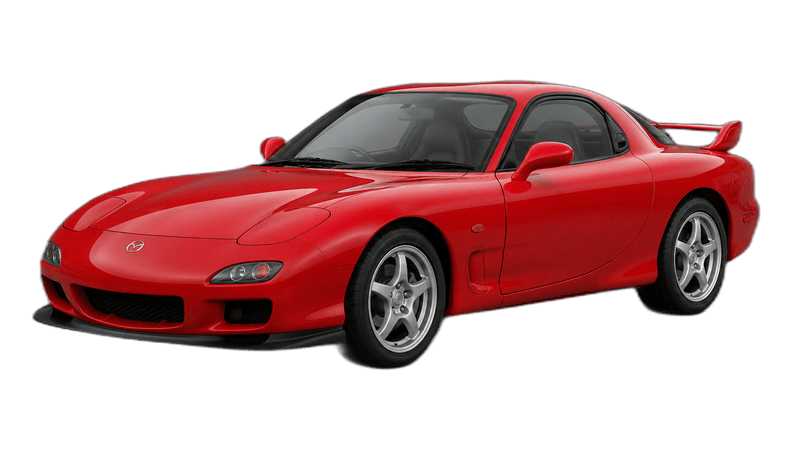
Mazda RX-7 FD
£55,000
usedIndicative market price, updated periodically.
276bhp
Power
5s
0-100 km/h
255km/h
Top Speed
£55,000
Price Used
How hard it pulls.
Peak g-force the instant you bury the throttle, estimated from the car's 0–100 time and drivetrain.
Mazda RX-7 FDEstimated peak launch g from the 0–100 time and drivetrain: an honest approximation, not a measured figure.
The Mazda RX-7 FD is a 2 seater fixed-head coupé by Mazda, with 276 bhp, 314 Nm of torque, a 0-100 km/h time of 5 seconds and a top speed of 255 km/h. Indicative used value: approximately £55,000. Actual values vary with specification, condition and history.
Dream Car Garage Editorial · Last updated 24 October 2026
Overview
We have not driven this car. This review is based on published specifications and the sources listed below.
The case for the RX-7 FD
The third-generation Mazda RX-7 FD arrived in 1992 with a 1.3-litre 13B-REW twin-turbo rotary engine, a 5-speed manual gearbox and rear-wheel drive. It was lighter and more powerful than the car it replaced, and it had a shape that still looks modern today. The FD is widely regarded as one of the best-handling cars of its era.
The rotary engine is the defining feature. It is smooth, revs freely and makes a unique noise. The twin-turbo setup provides boost from low down, and the chassis is beautifully balanced. The FD is a true driver's car, with sharp steering, strong brakes and a communicative rear end.
The FD is also a demanding car to own. The rotary engine has a finite life, and it needs a specialist who understands it. Cooling, lubrication and ignition are critical. A neglected FD can fail quickly, and a rebuild is expensive. The best cars are well maintained, lightly modified and rust-free.
What it costs to run
A minor service at a rotary specialist is £300 to £500, and a major service is £700 to £1,000. The rotary engine consumes oil by design, so check the level regularly. A full engine rebuild is £4,000 to £8,000, depending on the spec and the damage. The twin turbochargers can fail, and a replacement pair is £2,000 to £3,000.
The 13B-REW is a twin-rotor engine with two turbochargers in sequential mode. It is smooth and free-revving, but it is also thirsty and needs careful warm-up and cool-down. A rebuild by a reputable specialist is £4,000 to £8,000, and a street port or a bridge port can add cost. The turbochargers are also a wear item; a rebuilt pair is £2,000 to £3,000. The fuel system and ignition are critical, and a failing fuel pump can destroy the engine.
Tyres are £600 to £800 for a set of 17-inch or 18-inch rubber. Budget £800 to £1,200 for discs and pads. The fuel consumption is 18 to 22 mpg on a run and the mid-teens in town. Insurance is normally classic or agreed-value. The FD is not a cheap car to run, but it is not a supercar either.
Known weak points
The rotary engine is the biggest risk. Apex seals wear, and coolant seals can fail, leading to overheating and a rebuild. The cooling system is marginal on a standard car, especially in traffic or on track. The vacuum lines and solenoids that control the twin turbos are complex and prone to failure. The fuel pump and ignition system are weak points, and a failing fuel pump can cause a lean condition and engine damage.
The cooling system is marginal. The radiator, the fans and the undertray all matter, and a car that has been sitting in traffic can overheat. The coolant seals can fail, and the resulting overheating can warp the housings. The vacuum lines and solenoids that control the sequential turbos are complex; a fault can cause a flat spot or a loss of boost. The fuel pump and the ignition coils are weak points. The rear suspension bushes and the differential mount can wear.
The body is prone to rust, especially the rear arches, sills, boot floor and jacking points. The interior is fragile, and the original trim is expensive. Many cars have been modified with body kits, wheels and engine upgrades. A modified car can be worth less than a standard one unless the work is documented and high quality.
What to check before buying
The documents should be your first stop. A service history, rebuild receipts and a compression test are essential. A rotary compression test is different from a piston engine test, and it should be done by a specialist. Check the hot start, the idle and the boost response.
A healthy 13B-REW should show even pulses on both rotors; a low or uneven reading means a rebuild is due. A hot start test is also important, because a tired engine can be hard to start when warm. Check the boost pattern: the primary turbo should come in early, and the secondary should transition smoothly. A car that hesitates or surges has a problem.
Inspect the cooling system for leaks and the radiator for damage. Check the oil level and the oil metering pump. Check the vacuum lines and solenoids for cracks and leaks. A boost gauge and a fault-code scan are useful. Check the fuel pump and the ignition system.
Inspect the body thoroughly. Look at the rear arches from inside the boot, the jacking points, the sills and the floor pans. Check the boot floor and the suspension towers for rust. A paint depth gauge will show previous repairs. Check the interior for worn seats and cracked trim. Check every electrical function.
Market and depreciation
The RX-7 FD market has been strong. A good car with 60,000 to 100,000 miles was £20,000 to £35,000 at the time of writing. A low-mileage, original car was £35,000 to £50,000. The Spirit R was £60,000 or more. Project cars were £8,000 to £15,000, but they can cost more to restore than they are worth.
The RX-7 market is smaller than the Supra or Skyline market, but it is passionate. The best cars are original, low-mileage and have a documented rebuild. A car with a recent rebuild by a known specialist is worth more than a car with an unknown engine. The Spirit R is the collector's choice, but it is rare and expensive. A cheap project car is rarely a bargain.
Who it suits
The RX-7 FD suits the enthusiast who wants a beautiful, light, high-revving sports car and is prepared to maintain it properly. It is not a daily driver, and it is not a cheap hobby. It suits someone with a garage, a rotary specialist and a maintenance budget. It also suits a collector who wants one of the best-handling cars of the 1990s.
If you want a more reliable car, the Toyota Supra is the obvious alternative. If you want a more modern car, the Nissan 350Z is cheaper and more usable. If you want a lighter, more analogue car, the Mazda MX-5 is the value pick.
Alternatives
The Toyota Supra A80 is more reliable and more tunable, but it is heavier and less agile. The Nissan Skyline R34 GT-R is more advanced and more practical, but it is more expensive. The Honda NSX is more usable and more reliable, but it is less powerful. The Porsche 944 Turbo is a similar concept, with a front engine and a turbo four, but it is a different experience.
The RX-7 FD is a unique car. It is not the most reliable, but it is one of the most rewarding.
How this review was compiled
This review is based on Mazda's published technical information, owner reports from RX7Club and the RX-7 Owners Club, UK rotary specialists and current Auto Trader listings. Prices vary with mileage, service history and specification.
Specifications
Engine
1.3L Twin-turbo Rotary
Displacement
2.6L
Power
276 bhp
Torque
314 Nm
0-100 km/h
5s
Top Speed
255 km/h
Drivetrain
RWD
Country
Japan
Body Style
2 seater fixed-head coupé
Years
1992–present
Price Used
£55,000
Specifications are manufacturer-published figures.
More from Mazda


Featured in Carpedia
The JDM Underground: Why Japan Still Leads
The NSX humbled Ferrari. The GT-R embarrassed Porsche. Thirty years later, Japan's engineering philosophy is still unmatched.
What Your Dream Garage Says About You
The cars you choose when money is no object say everything about who you are, and nothing about what you drive.
Frequently Asked Questions
What are the specifications of the Mazda RX-7 FD?
The Mazda RX-7 FD is a 2 seater fixed-head coupé by Mazda, with 276 bhp, 314 Nm of torque, a 0-100 km/h time of 5 seconds and a top speed of 255 km/h. Indicative used value: approximately £55,000. Actual values vary with specification, condition and history.
How much does a Mazda RX-7 FD cost?
Indicative used value: approximately £55,000. Actual values vary with specification, condition and history.
What drivetrain does the Mazda RX-7 FD use?
The Mazda RX-7 FD is configured with rear-wheel drive.
What type of car is the Mazda RX-7 FD?
The Mazda RX-7 FD is a sports cars manufactured by Mazda in Japan. Production started in 1992.