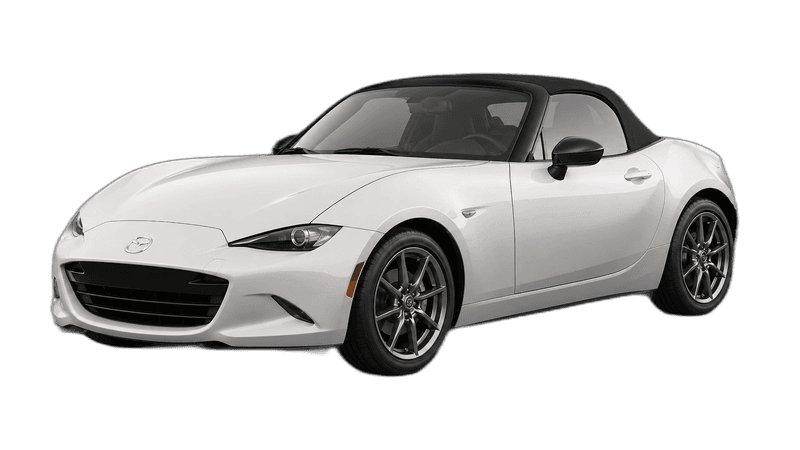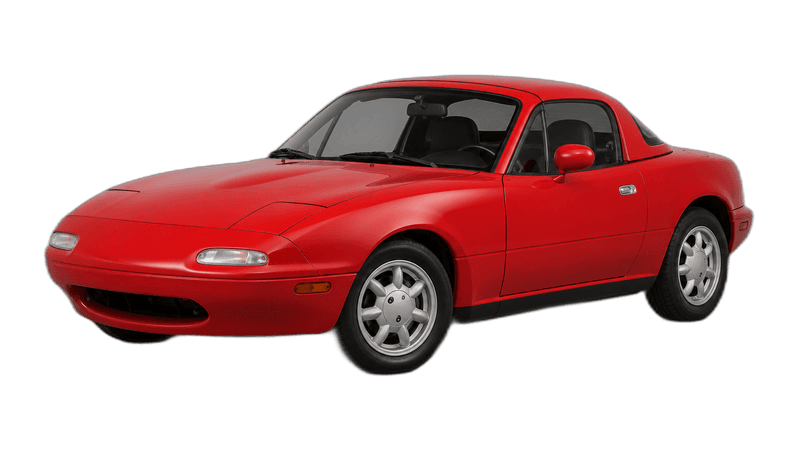
Mazda MX-5 NA
£12,000
usedIndicative market price, updated periodically.
131bhp
Power
8.5s
0-100 km/h
197km/h
Top Speed
£12,000
Price Used
The Mazda MX-5 NA produces 131 bhp, reaches 100 km/h in 8.5 seconds and has a top speed of 197 km/h. A representative example is worth about £12,000.
How hard it pulls.
Peak g-force the instant you bury the throttle, estimated from the car's 0–100 time and drivetrain.
Mazda MX-5 NAEstimated peak launch g from the 0–100 time and drivetrain: an honest approximation, not a measured figure.
Dream Car Garage Editorial · Edited by José Teo Lorente Vallecillos · Last updated 2 November 2026
Overview
We have not driven this car. This review is based on published specifications and the sources listed below.
Scope of this guide
This guide is scoped to the 1.8-litre Mazda MX-5 NA, the first-generation two-door convertible with the 1.8L naturally aspirated inline-4 petrol (1839 cc) engine and rear-wheel drive, built from late 1993 or 1994 to 1997. It is not a guide to the 1.6-litre cars that launched the model in 1989, to the detuned 1.6 that returned in 1995, to the later NB generation, or to the heavily modified, turbocharged and supercharged cars that the NA attracts. We say below where each of those differs so you can tell which car an advert is really describing.
We have not driven this model for this article. Everything here comes from three cited sources: Mazda's own newsroom for the launch and production start, a PistonHeads pocket buying guide written for the NA across both engines, and the government recall checker. We also read an evo buying guide, a reference-site summary of the NA and a car-data site, and we flag every point that rests on those. Where sources disagree, or where a catalogue figure could not be confirmed word for word, we say so.
The figures at a glance
- Engine: 1.8L naturally aspirated inline-4 petrol (1839 cc), twin cam, 16 valves, five-speed manual gearbox.
- Power: 131 bhp is the figure in our catalogue. PistonHeads prints 131hp for the 1.8, evo prints 128bhp, and a reference page gives 128 to 129 bhp for 1994 and 133 bhp for 1996.
- Torque: 152 Nm in our catalogue, with sources ranging from about 149 Nm to 155 Nm, explained below.
- 0-100 km/h: 8.5 seconds, which is PistonHeads' 0-62 mph time for the 1.8.
- Top speed: 197 km/h, about 122 mph by our conversion, from a car-data site rather than from Mazda.
- Drive: rear-wheel drive, with the engine mounted in front.
- Body: two-door convertible with a manual fabric roof.
- Weight: about 990 kg, from the car-data site and the reference page.
- Size: about 3,975 mm long, 1,675 mm wide and 1,230 mm high on a 2,265 mm wheelbase, from the car-data site.
Why the quoted power and torque vary
The power and torque numbers for the 1.8 NA are not a single clean pair. The 1.8 arrived with a rating of about 128 bhp and roughly 149 Nm, and a reference page says that rose to 133 bhp and 155 Nm for 1996. Ratings quoted in metric horsepower, in kilowatts and in brake horsepower differ by a few units, and North American, UK and Japanese cars were rated on different bases.
Our catalogue pairs 131 bhp with 152 Nm. The 131 matches PistonHeads' 131hp and is close to 133 PS, which converts to about 131 bhp. The 152 Nm matches a car-data site entry for a 130 PS car and sits between the 149 Nm and 155 Nm values on the reference page. We have not found a Mazda document that prints either figure, so treat them as catalogue values, not as a verified rating for one model year. If an advert quotes 128 bhp or 133 bhp, it is probably describing an earlier or later car rather than a different engine.
Performance claims and what they mean
PistonHeads gives 8.5 seconds from 0 to 62 mph for the 1.8, against 8.7 seconds for the original 1.6. The car-data site says 8.2 seconds for the 1.8, and one search snippet gave 8.7 seconds. A figure of 8.6 seconds appears in reference material as Mazda's 0-60 mph claim for the 1990 1.6 car, so an earlier 8.6 seconds in our catalogue looks like a 1.6 number and we have corrected it to 8.5 seconds. Since 62 mph is 100 km/h to within a rounding error, we treat the two scales as the same. These are claimed or published figures, not independent measurements.
The 197 km/h top speed matches the car-data site, which also says 122 mph. PistonHeads does not state a top speed. For comparison, the reference page quotes 116.8 mph for a 1990 1.6 car, so the 1.8 is a little quicker in a straight line but not dramatically so. The point of this car is its light weight and balance, not its straight-line numbers.
Model years and production numbers
Mazda's newsroom says the MX-5 was first shown at the Chicago Auto Show in February 1989, with mass production starting at the Ujina plant in Hiroshima in April 1989. It does not give model-year details or engine sizes for the first generation. PistonHeads says the 1.8 came in 1993, while an Australian source and the reference page place it in the 1994 model year, and market timing differs. We use 1994 to 1997 for this guide, which is a judgement, not a printed date range.
The generation total is not a number for this guide. The reference page gives 431,506 NA cars built from April 1989 to 1997, while PistonHeads says 421,107 had been built by the end of NA production. Neither figure is split by engine, so neither tells you how many 1.8 cars exist. We have therefore left the production count out of this guide rather than quote a total that mostly describes 1.6-litre and other cars.
How the 1.8 differs from the 1.6, the Eunos Roadster and the US Miata
The 1.6 launched in 1989 with about 115 bhp, which PistonHeads prints as 115hp and the reference page as 114 to 115 bhp, and PistonHeads gives it 8.7 seconds from 0 to 62 mph. The 1.8 is a different engine, not a bored-out 1.6, according to a search snippet giving its bore and stroke as 83 mm by 85 mm, and it gives more torque lower in the rev range. PistonHeads says some drivers find it less keen to rev, while evo says both engines rev past 7,000 rpm.
The 1.6 came back in 1995 with about 90 bhp on PistonHeads and 88 bhp on evo, and PistonHeads says enthusiasts generally avoid it. Check the engine size in the paperwork, because a 1.6 car from 1995 or later can look identical to a 1.8.
The Japanese Eunos Roadster is the same car under a different name. PistonHeads says grey-import Eunos cars often have air conditioning and power steering as standard, and that they have a limited-slip differential, which UK cars lacked. Some are S-spec or V-spec cars with uprated suspension, strut braces and other changes. evo says many spent their early years in Japan's salt-free climate. We found no Japanese power rating for the 1.8 in what we read, and one reference page says the Eunos was limited to 180 km/h but marks that as unsourced, so we have not repeated it as fact.
The US car was sold as the Miata. The reference page lists a Mazda badge on the front of the US car, dual airbags in a redesigned dashboard from 1994, and an optional Torsen limited-slip differential on Japanese and US cars. We did not confirm which markets received airbags, so check the car in front of you rather than the market name.
What changed for the Mk1.5 from 1994
The 1994 update is often called the Mk1.5. The reference page lists the 1.8 engine, a redesigned dashboard with dual airbags, chassis bracing for side-impact rules and a bar between the seatbelt towers. evo adds a longer-legged differential, bigger front brakes and rear bracing bars to reduce structural wobble. PistonHeads does not mention a 1994 facelift. The reference page says the base weight rose to 990 kg in 1996 as the power rose. Which of these changes reached a particular UK or Japanese car depends on the market, so look for the specification on the car.
Engine and gearbox
PistonHeads says oil leaks from the cam cover gasket and the cam-angle sensor O-ring are common and cheap to fix, and that hydraulic tappet rattle is likely on the 1.8 but usually fades soon after starting. It puts the cambelt change at every 50,000 miles, to be done with a new water pump, and says early short-nose crankshaft engines can have a loose pulley if the belt was fitted incorrectly, which can wreck the engine. That warning is tied to early cars, which suggests the 1.6, and we could not confirm whether any 1.8 is affected.
The clutch is described as durable, though the slave cylinder often fails. PistonHeads also says advancing the ignition timing is a common modification that is not a problem on premium fuel, and that DIY turbo and supercharger conversions are common. Ask for evidence of the cambelt and water pump, and treat any forced-induction car as a different proposition with a different risk.
Chassis, steering and brakes
The front wishbones corrode, so inspect them and the front crossmember. Camber, toe and castor are adjustable, and PistonHeads says a pull to one side can often be corrected by a professional set-up. Bushes can fail if larger wheels were fitted without adjusting the wishbone pivot bolts. Avoid aftermarket wheels larger than 15 inches, which spoil the ride and strain the hubs.
Rear handbrake calipers can seize and are cheap to replace. evo advises avoiding cars without power steering, because the slower rack spoils the feel. Premium tyres on the car are a sign of a caring owner, according to PistonHeads.
Running costs and practicality
PistonHeads quotes a replacement hood at about 250 pounds and a cambelt service with water pump at about 250 pounds at an independent. It also gives a new price of 14,249 pounds and used prices from 1,000 pounds upwards. The guide is undated in the text we read and car prices have moved since, so use these only as a sign of scale. evo, in an older piece, puts a healthy car at around 1,500 pounds. We give no current prices, insurance or tax figures because none of the cited sources provides them for a specific year.
We found no fuel consumption figure for the 1.8 in the cited sources, so we give none. As a small, light two-seater it has little luggage space, so check the boot and the condition of the hood before buying.
What to check before buying
- Confirm the engine size from the paperwork and the engine itself, since a 1995 or later 1.6 can look identical to a 1.8.
- Look for rust at the back edge of the sills and the rear wings, the lower edge of the boot lid, all four wheelarches and the windscreen frame, and ask to see underneath.
- Check the hood drain holes are clear, because blocked drains trap water, and look for damp in the cabin.
- Look for oil leaks at the cam cover and cam-angle sensor, and listen for tappet noise that does not fade.
- Ask for the cambelt and water pump history.
- Test the clutch, including the slave cylinder, and make sure the handbrake works.
- Inspect the front wishbones and crossmember for corrosion, and check the alignment for any pull.
- Check the battery in the boot is secured, because PistonHeads says it can dent the right-hand wing.
- Ask about turbo, supercharger or other modifications and what paperwork backs them up.
- Confirm every recall is closed, using the check below.
Recalls and the DVSA check
We did not find a recall list for the 1990s MX-5 in the sources we read, and PistonHeads does not list recalls for the NA. That does not mean there are none. Run the registration number or VIN through the DVSA vehicle recall check on GOV.UK, and ask a Mazda dealer or specialist about any open campaigns. For a grey import, ask whether the car is covered by a UK recall record at all.
Verdict
The 1.8-litre NA is a light, simple, rear-wheel drive convertible whose appeal rests on its balance rather than its numbers. If you are shopping for one, confirm the engine, check for rust before anything else, ask for the cambelt history, and treat the 131 bhp, 152 Nm, 8.5 seconds and 197 km/h figures as published or catalogue values, with the caveats explained above. We have not driven it, so use the sources and a proper inspection to decide.
Specifications
| Engine | 1.8L naturally aspirated inline-4 petrol (1839 cc) |
|---|---|
| Displacement | 1.8L |
| Power | 131 bhp |
| Torque | 152 Nm |
| 0-100 km/h | 8.5s |
| Top Speed | 197 km/h |
| Drivetrain | RWD |
| Country | Japan |
| Body Style | 2-door convertible |
| Years | 1994–1997 |
| Price Used | £12,000 |
Specifications are manufacturer-published figures.
Frequently Asked Questions
What is a Mazda MX-5 NA worth?
A representative example is worth about £12,000. Actual values vary with specification, condition and history.
How much power does the Mazda MX-5 NA have?
The Mazda MX-5 NA produces 131 bhp and 152 Nm of torque.
How fast is the Mazda MX-5 NA from 0 to 100 km/h?
The Mazda MX-5 NA accelerates from 0 to 100 km/h in 8.5 seconds.
What is the top speed of the Mazda MX-5 NA?
The Mazda MX-5 NA has a top speed of 197 km/h.
What engine does the Mazda MX-5 NA have?
The Mazda MX-5 NA uses a 1.8L naturally aspirated inline-4 petrol (1839 cc).
When was the Mazda MX-5 NA built?
The Mazda MX-5 NA was built from 1994 to 1997.
Is the Mazda MX-5 NA all-wheel drive?
No. The Mazda MX-5 NA is configured with rear-wheel drive.