Lotus Carlton
£85,000
usadoIndicative market price, updated periodically.
377cv
Potencia
5.1s
0-100 km/h
283km/h
Velocidad Máxima
£85,000
Precio Usado
The Lotus Carlton produces 377 bhp, reaches 100 km/h in 5.1 seconds and has a top speed of 283 km/h. A representative example is worth about £85,000.
Cómo empuja.
La fuerza g máxima en el instante en que pisas a fondo, estimada a partir del 0–100 y la tracción del coche.
Lotus CarltonG de salida estimada a partir del 0–100 y la tracción: una aproximación honesta, no una cifra medida.
Dream Car Garage Editorial · Edited by José Teo Lorente Vallecillos · Last updated 2 November 2026
Visión General
We have not driven this car. This review is based on published specifications and the sources listed below.
A Lotus-developed super saloon from Hethel
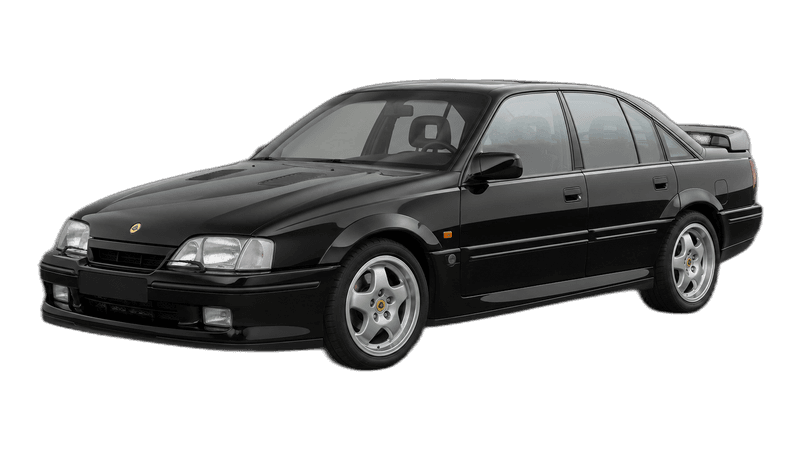
The Lotus Carlton covered here is the rear-wheel drive, four-door saloon that Lotus built from a top-specification Vauxhall Carlton or Opel Omega 3000 24-valve, with a 3.6L twin-turbo inline-6 of 3,615 cc, a six-speed manual gearbox and a glassfibre body kit. Octane says the base cars were built in Germany and sent to Lotus at Hethel in Norfolk, where the engine, chassis and body were reworked. Our catalogue lists 377 bhp and 568 Nm, with 0 to 100 km/h in 5.1 seconds and a top speed of 283 km/h. We have not driven this model for this article. This is a desk-researched ownership guide built from the Auto Express buying guide of November 2018, the PistonHeads used buying guide of April 2018, and the government recall check. We also read the Classic Trader buying guide of June 2020, the Octane buying guide of April 2024 and the Wikipedia article on the car, and we name them where we use them.
We found no Lotus or Vauxhall page that we could open. The first source in our list is therefore a magazine's buying guide, not a manufacturer release. Read the figures below as the numbers that the press prints, not as figures we confirmed.
This guide is scoped to the Lotus Carlton, sold as the Vauxhall Lotus Carlton in the UK and the Opel Lotus Omega on the Continent. The ordinary Vauxhall Carlton GSi 3000 and Opel Omega 3000 are separate cars with their own engines and spares, and only the Lotus-specific parts are covered here. The guides are from 2018 to 2024, so which faults are common today, and what cars cost, may have moved on. Where a source is silent we say so rather than invent a fault.
Checking the figures
Auto Express prints 377 bhp at 5,200 rpm, and Classic Trader and Octane print 377 bhp as well. Wikipedia gives 382 PS, which it converts to 377 hp, and PistonHeads prints 380 hp. We read the 380 as a different unit convention or a rounding choice, but none of the sources says so, so treat that as our inference. The catalogue keeps 377 bhp.
Torque is 419 lb ft at 4,200 rpm in PistonHeads and Auto Express, and Wikipedia prints 568 Nm at 4,200 rpm with about 470 Nm available from 2,000 rpm. The 568 Nm in our catalogue is the same figure converted. Wikipedia describes the boost as up to 0.7 bar from about 2,500 rpm.
The 5.1 seconds needs care. Wikipedia, Auto Express and Classic Trader print it as the 0 to 60 mph time, and PistonHeads prints it as 0 to 62 mph. None of the pages we read gives a 0 to 100 km/h figure, so the 5.1 seconds in our catalogue is a 0 to 60 mph or 0 to 62 mph time used as the 0 to 100 km/h figure. Since 62 mph is almost exactly 100 km/h the difference should be small, but nobody in our sources measured it. Wikipedia adds 0 to 100 mph in 11.1 seconds. Treat all of these as claims from the period, and note that a car in poor condition will not match them.
Top speed is 176 mph in PistonHeads, Auto Express and Classic Trader, which is 283 km/h, and Wikipedia says above 176 mph. Octane prints 174 mph as the official top speed, so the figure is not perfectly settled. A UK car should have a 180 mph speedometer, which does not mean the car can reach it. Fuel economy is not settled either. PistonHeads prints 22 mpg while Auto Express and Classic Trader print 17.6 mpg, so use neither as a promise of running costs. Auto Express gives a weight of 1,663 kg and a wheelbase of 2,730 mm.
Names, markets and the build run
The same car carries several names. Octane says the British cars have the steering wheel on the right and carry Vauxhall badges, and Wikipedia says the car was also sold as the Lotus Omega and the Opel Lotus Omega. Octane says the cars were all finished in one colour, Imperial Green. Auto Express says the only real choice was the side of the steering wheel.
Every source puts the build run at 950 cars, and production years of 1990 to 1992. PistonHeads says the car was launched in 1989, which we read as the announcement, not the start of deliveries, though it does not say so. Wikipedia says Opel planned 1,100 cars and that production stopped in December 1992 after the early 1990s recession hit sales.
The split is where the sources disagree. Wikipedia, Auto Express and Classic Trader give 320 Carltons and 630 Omegas. For right-hand drive cars, PistonHeads says 285 were intended for the UK plus one extra, Octane says 286 and Classic Trader says 285, but Auto Express says 250. We could not reconcile these numbers, and the 320 Vauxhall figure does not match the 286 right-hand drive cars, so we quote only the 950 that every source gives. If a seller states a precise production number, ask where it comes from.
Engine, cooling and timing chain
Wikipedia describes the engine as an enlarged version of the 2,969 cc 24-valve straight-six from the Opel GSi, taken to 3,615 cc and given two Garrett T25 turbochargers and a Behr intercooler. Wikipedia also says Lotus reinforced the block, fitted forged slipper pistons from Mahle, new connecting rods and a stronger crankshaft, and lowered the compression ratio. Octane agrees on the long-stroke 3.6-litre engine and the two Garrett turbos. Wikipedia gives the engine code as C36GET, which none of the buying guides repeats.
Auto Express calls the engines generally robust, and Octane says a well-kept engine can pass 150,000 miles. The wear items sit around the engine. PistonHeads says the twin turbos raise the temperature under the bonnet, which can damage wiring and connections, so look at the condition of the looms and connectors. It also says a timing chain whine appears well before the chain is a risk. Auto Express and Classic Trader are more cautious, and say a rattle or whine from the front of the engine can mean an imminent chain failure, with severe internal damage if the chain snaps. Octane also describes a noisy timing chain. A sensible reading is to ask when the chain was last inspected or replaced, not to treat noise as normal.
Cooling is the other weak area. PistonHeads, Auto Express, Classic Trader and Octane all say the viscous fan can fail, and PistonHeads and Auto Express say a failed fan can lead to a blown head gasket. Octane says it tends to fail on cars that are rarely used. Auto Express and Classic Trader say the auxiliary electric fans should only run with the air conditioning on or with coolant above 97 degrees Celsius, which you can check during a viewing, and Auto Express says a trusted mechanic should check the whole cooling system.
The stainless steel exhaust can still crack or corrode. PistonHeads says it can crack, and Auto Express and Classic Trader say the rear and centre sections can corrode, and Auto Express says to confirm the catalytic converters are fitted.
The six-speed manual, clutch and bellhousing
The car has a six-speed manual gearbox and rear-wheel drive. PistonHeads, Auto Express, Classic Trader and Octane all say the gearbox came from the Corvette ZR-1, and none of them names ZF. Wikipedia names it as the ZF S6-40 and says it is the same unit as in the ZR-1. We take the ZF name from Wikipedia alone, so verify it against a workshop manual or a specialist if the name matters for a parts search. Wikipedia also says the rear differential is a limited-slip unit shared with the V8 Holden Commodore.
The gearbox is the robust part. PistonHeads and Auto Express call it tough, and Classic Trader and Octane call it durable. Auto Express says some noise at idle is normal and suggests checking for a split rubber gaiter above the transmission tunnel, which can let more noise into the cabin. PistonHeads says a differential whine can mean an expensive rebuild.
The clutch is the area to read about before viewing. PistonHeads says the pedal should feel fairly heavy, and Classic Trader says the clutch can be heavy, unless it is about to fail. A light or notchy pedal, or one that does not return properly, points to the clutch pivot pin or the bellhousing. Auto Express and Classic Trader say the repair can mean a new pressure plate, friction plate and bellhousing, and that revised bellhousings fitted later in production did not fully cure the problem. PistonHeads names the pivot pin, pressure plate and friction plate as the likely causes. Octane says a heavy clutch can point to a worn pivot pin or pressure plate, which is the opposite of the light pedal the others describe, so test the feel and ask for records either way. Ask for receipts for any clutch work and the date it was done.
Suspension, brakes and tyres
Auto Express and Classic Trader say most of the suspension is unique to the Carlton, which affects parts. Wikipedia says the self-levelling system and the Servotronic steering came from the Opel Senator. PistonHeads says the self-levelling pump must work, and tells you to turn the key to position 2 and wait, which can take up to two minutes. A car that does not settle on its springs needs a closer look.
For wear items, PistonHeads, Auto Express and Classic Trader say front spring cup washers rust and the springs can then break or knock. Rear knocks are most likely worn trailing arm bushes, and worn wishbone bushes show up as uneven tyre wear. Look at the front springs and listen on a rough road.
Wikipedia says the brakes use 328 mm front and 300 mm rear discs with four-piston AP calipers at the front and two-piston calipers at the rear. PistonHeads says the pistons are AP at both ends. The sources agree that the brakes wear slowly, that parts are available and that they are expensive. Auto Express says to check for shudder, which suggests warped discs.
Wikipedia says the wheels are 17-inch Ronal wheels with Goodyear Eagle tyres. PistonHeads says the original Eagles are scarce and many owners use Eagle F1 tyres instead. Check the tyre age as well as the tread, and look at the wheels for kerb damage.
Body, fibreglass and corrosion
The extended wings and arches are glassfibre on a steel shell. PistonHeads says the added sections are easily damaged, so look for repairs, ripples and the joins to the steel panels. Auto Express and Classic Trader say the body kit was not always made to a high standard. They also say Lotus drilled some original panels, such as the wheel arches and sills, which may have compromised the rustproofing, so those areas may need restoration. Octane says corrosion can hide behind the glassfibre panels.
The areas to inspect are the door bottoms, the rear arches, the sunroof surround, the base of both screens, the boot floor, under the rear bumper panel, the inner rear arches, the rear door shuts and the aerial mount. Auto Express adds the extra arch supports that Lotus fitted. PistonHeads says to check the panel joins to the steel shell for ripples, so look at the paint along those lines.
Interior, authenticity and parts
PistonHeads, Auto Express and Classic Trader all say to look for the original plaque on the glovebox lid and the 180 mph speedometer. PistonHeads says original floor mats suggest a careful owner. Auto Express says the leather seats are often worn but can be reconditioned, and that most interior parts can be sourced from standard Carltons. Classic Trader expects the 1990s plastic dashboard to have aged reasonably well.
On parts overall, PistonHeads says most things can be found but many are expensive, with tyres the exception. Auto Express says clubs and forums are useful for spares, and names Autobahnstormers, an owners' club for rear-wheel drive Vauxhalls and Opels, and a Lotus Carlton website. We did not open those and cannot vouch for them. Auto Express and Classic Trader say most of the suspension is unique to the Carlton, so expect to need specialist sourcing there, and check the parts list with a specialist before you commit.
Rarity, values and modifications
Only about 286 cars were made for Britain according to Octane, so a good right-hand drive car can take time to find. Classic Trader says a few left-hand drive cars have been imported. PistonHeads, Auto Express and Classic Trader described values as going up when they wrote in 2018 and 2020, and Octane's 2024 guide is positive about the car, but we repeat no prices because they date quickly. Compare current adverts and recent sales yourself.
Modification is the main risk to value and reliability. PistonHeads says few cars remain standard and warns about chipped cars, with head gaskets, pistons, the differential and the driveshafts all at risk. Auto Express and Classic Trader give the same warning. Octane warns about modified engines. Classic Trader says a higher mileage is acceptable when servicing is documented, and says years of middling prices left some cars neglected. Prefer a standard car with records over a tuned one.
Recalls and history
None of our sources gives a recall list for the Lotus Carlton. Enter the registration in the DVSA recall service, and ask whether any work done under a campaign was recorded. Ask for a full service history, evidence of the last cooling system work, clutch and bellhousing records, and any record of accident repairs to the glassfibre panels. Wikipedia says the car was a target for thieves, so ask about security, storage and the insurer's requirements before you buy.
Buying decision
Our reading of the sources is that the Lotus Carlton is a car to buy on history, not on rarity alone. Prefer a standard right-hand drive car with a documented service history, a cooling system and viscous fan in good order, a clutch with a known age, working self-levelling, sound front springs and no rust behind the glassfibre. Be wary of tuned cars and of paperwork that quotes a precise production number or a 0 to 100 km/h time without a source. Check the figures above, remember that the guides are dated and that we have not driven the car, and have a Lotus or Vauxhall specialist inspect it before you pay.
Especificaciones
| Motor | 3.6L twin-turbo inline-6 |
|---|---|
| Cilindrada | 3.6L |
| Potencia | 377 cv |
| Par Motor | 568 Nm |
| 0-100 km/h | 5.1s |
| Velocidad Máxima | 283 km/h |
| Tracción | RWD |
| País | UK |
| Carrocería | 4-door saloon |
| Años | 1990–1992 |
| Producción | 950 |
| Precio Usado | £85,000 |
Specifications are manufacturer-published figures.
Preguntas Frecuentes
What is a Lotus Carlton worth?
A representative example is worth about £85,000. Actual values vary with specification, condition and history.
How much power does the Lotus Carlton have?
The Lotus Carlton produces 377 bhp and 568 Nm of torque.
How fast is the Lotus Carlton from 0 to 100 km/h?
The Lotus Carlton accelerates from 0 to 100 km/h in 5.1 seconds.
What is the top speed of the Lotus Carlton?
The Lotus Carlton has a top speed of 283 km/h.
What engine does the Lotus Carlton have?
The Lotus Carlton uses a 3.6L twin-turbo inline-6.
How many Lotus Carlton were made?
Lotus produced 950 units of the Lotus Carlton.
When was the Lotus Carlton built?
The Lotus Carlton was built from 1990 to 1992.
Is the Lotus Carlton all-wheel drive?
No. The Lotus Carlton is configured with rear-wheel drive.