
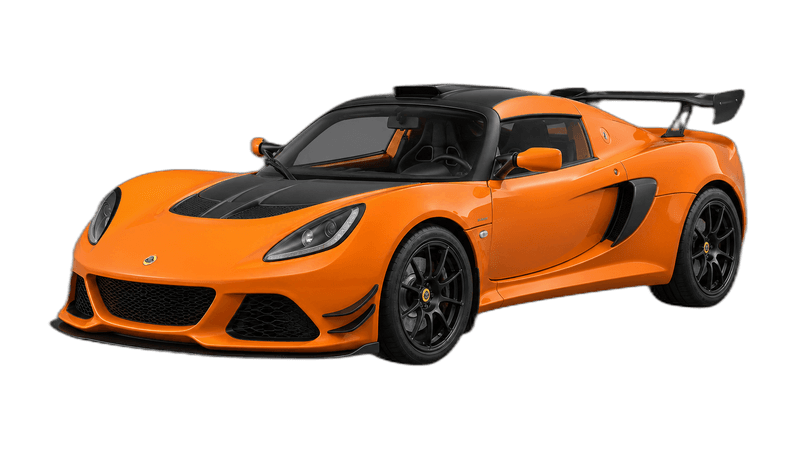
Lotus Exige Sport 380
£85,000
usedIndicative market price, updated periodically.
375bhp
Power
3.7s
0-100 km/h
286km/h
Top Speed
£85,000
Price Used
How hard it pulls.
Peak g-force the instant you bury the throttle, estimated from the car's 0–100 time and drivetrain.
Lotus Exige Sport 380Estimated peak launch g from the 0–100 time and drivetrain: an honest approximation, not a measured figure.
The Lotus Exige Sport 380 is a 2 seater fixed-head coupe by Lotus, with 375 bhp, 410 Nm of torque, a 0-100 km/h time of 3.7 seconds and a top speed of 286 km/h. Indicative used value: approximately £85,000. Actual values vary with specification, condition and history.
Dream Car Garage Editorial · Edited by José Teo Lorente Vallecillos · Last updated 2 November 2026
Overview
We have not driven this car. This review is based on published specifications and the sources listed below.
A track-bred Exige with 380 PS
The Lotus Exige Sport 380 is a two-seat, rear-wheel drive, mid-engined sports coupe built by Lotus at Hethel in Norfolk. Lotus unveiled it on 23 November 2016 as the headline car of the Exige range, sitting above the Sport 350 and carrying 380 PS from a 3.5L supercharged V6. This guide is scoped to the Series 3 Exige Sport 380 coupe, the fixed-head car described in our catalogue. Later sections say where the Roadster, Sport 350, Sport 410 and Cup 380 differ, because buyers often meet all of them in the same classified listings.
Our catalogue figures for this page are 375 bhp, 410 Nm, 3.7 seconds from 0 to 100 km/h and a 286 km/h top speed, with the car on sale from 2017 to 2018. Three of those need explaining, and the next section does so: the 0-100 km/h time is derived rather than quoted by Lotus, the torque figure is contradicted by one source, and the end year is an inference. We have not driven this model for this article. Everything here comes from the launch release as reproduced by ultimatecarpage.com, press coverage from the time of the launch, PistonHeads' used buying guide for the Series 3 Exige, and Wikipedia's model history, and we say where they disagree.
Checking the figures
Power first. The Lotus launch release gives 375 hp at 6,700 rpm. Top Gear's first drive prints both numbers together, 375bhp (or 380PS). The conversion matters: 380 PS is about 374.8 bhp, which rounds to the 375 bhp in our catalogue. An advert that says 380 and one that says 375 are describing the same engine.
Torque is where the sources part. The Lotus release, GTspirit and Wikipedia all give 410 Nm (302 lb ft) at 5,000 rpm, and we use 410 Nm. autoevolution's launch report printed 420 Nm at 4,500 rpm instead. That 420 Nm figure is what Lotus later quoted for the Sport 410, so autoevolution may have mixed the two cars up, but no independent source confirms that.
Acceleration needs care. Lotus quotes 0-60 mph in 3.5 seconds, not a 0-100 km/h time. autoevolution says you should add 0.2 seconds to reach 62 mph (100 km/h), and that the same value applies to manual and automatic cars. On that basis we carry 3.7 seconds for 0-100 km/h. It is an estimate from a press report, not a measured or manufacturer figure,.
Top speed is quoted by Lotus as 178 mph, which is about 286 km/h, and ultimatecarpage lists exactly that. Note that this figure appears in the launch material without a body-style label; Lotus did not publish a separate Roadster top speed that we could find.
Weight depends on whose definition you use. Lotus says 1,066 kg dry with the lightweight options ticked, which gives its quoted 352 hp per tonne. autoevolution says 1,076 kg dry and about 1,110 kg kerb weight. Top Gear says the Sport 380 is 1,100 kg including the lightweight options. ultimatecarpage lists 1,100 kg. Wikipedia gives 1,076 kg. None of these is wrong; they describe different specifications. Treat roughly 1,070 to 1,110 kg as the real-world range and ask what a specific car actually weighs, because it depends on which carbon, titanium and battery options were fitted.
The years are the weakest part of our row. The car was unveiled in November 2016, and ultimatecarpage lists it as introduced in 2017, so we use 2017 as the start. No source we read states when Sport 380 production ended. ultimatecarpage names the Sport 410, unveiled on 4 May 2018, as its successor, so we use 2018 as an approximate end year and flag it as an inference. Wikipedia's heading gives 2016 to 2021 for the Sport 380, but the page offers no production record behind it, and the Cup 380 carries the same span, so we have not used it. If a seller quotes a build date, ask for the registration documents and the VIN to confirm it.
The 3.5L supercharged V6 and its gearboxes
Under the engine cover is a 3,456 cc, 3.5L supercharged V6 derived from Toyota's 2GR-FE, mounted behind the seats. ultimatecarpage lists a 94.0 mm bore, an 83.0 mm stroke, 10.0:1 compression and dual VVTi. Lotus says the design had already proved itself in the track-focused 3-Eleven and the Evora Sport 410, and the Series 3 Exige first took a supercharged 3.5 litre V6 in 2012.
Lotus says the extra power over the Sport 350 came from a revised supercharger pulley that raises charge pressure, an uprated fuel pump, a recalibrated ECU and a revised exhaust system as used in the Evora 400 and Evora Sport 410. The 410 Nm peak arrives at 5,000 rpm. The car also gained a larger 48-litre fuel tank, whereas PistonHeads quotes 40 litres for the earlier Exige S, so do not assume range figures from older guides apply.
The standard gearbox is a six-speed manual with an open gate and a new gearbox oil cooler. Top Gear called the exposed shifter as much a delight for its noise as its tactility, but said it is not a dainty, light shift like an Elise's, and that if you try to fingertip a shift home you will miss it. PistonHeads, writing about the earlier Series 3 cars, notes a cable-operated shift that can be adjusted. Lotus also listed an optional six-speed automatic from spring 2017. PistonHeads says the automatic used on the Series 3 Exige can develop a harsh downshift when coasting, and suggests checking the mass airflow sensor and throttle body if no fault codes appear. That was written about the earlier cars, so treat it as a lead rather than a Sport 380 fault list.
Lotus Dynamic Performance Management offers Sport and Race settings on this car. Lotus says they increase throttle response proportionally, lower the traction slip thresholds and remove understeer recognition, and that an exhaust bypass valve opens at mid-to-high engine speeds. Top Gear notes a steering-column button that holds the exhaust flaps open and must be pressed at every start-up.
Weight, aero and the carbon parts
The Sport 380 is as much an aerodynamic exercise as a power increase. Lotus says downforce at maximum speed is 140 kg, a 60 per cent gain over the Sport 350's 88 kg, with drag unchanged. Lotus credits twin pairs of front canard wings ahead of the front wheels, a carbon front spoiler and rubber lip, carbon barge boards, a carbon rear wing and air blades behind the rear wheels. Top Gear counts about 15 kg added by the aero kit while stationary, against 10 kg saved by the forged wheels.
The weight saving in the release is itemised. The carbon aero parts save 2.7 kg, a polycarbonate rear window saves 0.9 kg, carbon race seats save 6 kg, a lithium-ion battery saves 10.3 kg, and forged wheels with two-piece grooved discs save about 10 kg. Together Lotus quotes a 26.3 kg cut, plus a further 0.3 kg from a new rear transom panel that has two rear light clusters instead of the Sport 350's four. A full titanium exhaust is an option worth a further 10 kg.
Lotus ties its quoted weights to its lightweight options, so the specification of an individual car matters more than the badge. Ask for the original build sheet and match it to the car in front of you.
Chassis, brakes and tyres
The structure is Lotus's tub of extruded aluminium sheets epoxy-bonded together, which PistonHeads says is designed to do a few trackdays every year. Steering is unassisted. Top Gear's tester found a quarter-hour of circuit lapping left a claw-hand from gripping the Alcantara wheel in the low-speed stuff, but praised the tactile result.
Michelin Pilot Sport Cup 2 tyres are standard. Lotus lists 215/45 ZR17 at the front, 10 mm wider than the Sport 350, and 265/35 ZR18 at the rear. Wheels are ultra-lightweight forged alloys in black or silver, and the brakes are AP Racing forged four-piston calipers with grooved two-piece discs. Check the tread across the whole width, because PistonHeads notes that Exige tyres inherently wear more on the inside edges, and keep an eye on the tracking.
The optional Track Pack adds Nitron two-way adjustable dampers and Eibach adjustable anti-roll bars. PistonHeads says the Series 3 car uses Bilstein dampers and Eibach springs as standard, so a Track Pack car is a different set-up again. PistonHeads also flags the brake pedal switch as a known weak point on the Series 3 Exige and says that if changing it does not fix the problem, the ABS unit may be involved, at a much higher cost. Ask what has been done and by whom.
Body, cabin and equipment
The body panels are composite, and Lotus says the car is sprayed and hand finished. PistonHeads says the amount and depth of front-end chips and scrapes gives an instant heads-up on what sort of life a car has had. Check the front splitter and canards for cracks and repairs, since these are the first parts to hit a kerb or ramp.
Inside, the carbon fibre sports seats are trimmed in Alcantara, leather or tartan, all with contrast stitching. Options include carbon sill covers, an Interior Colour Pack, air conditioning and a head unit with Bluetooth and iPod connectivity. Top Gear remarked that why Lotus bothered fitting a new Bluetooth-capable head unit was anyone's guess. Lotus listed ten paint colours, with an optional exterior accent pack in one of five colours.
Do not expect a quiet cabin. PistonHeads says the cabin is small and not easy to enter or leave, and that anyone over 6ft 2in may struggle, especially wearing a helmet. Top Gear describes the car, even with its freakish ride comfort, as still loud and single-minded: it's a Lotus.
Where the Roadster, Sport 350, Sport 410 and Cup 380 differ
The Roadster is the awkward one. Lotus's release, as reproduced by GTspirit and ultimatecarpage, says the Sport 380 is available as a roadster as standard and as a coupe as an option, and it describes the carbon roof as a 2 kg heavier alternative to a soft top. Top Gear, however, reviewed the car as the fastest Lotus hard top ever. We could not reconcile those, and we found no separate Sport 380 Roadster record in Lotus material. If you are shown a Sport 380 Roadster, confirm exactly what it is, its weight and its stated top speed. PistonHeads says the earlier Series 3 Exige S Roadster was electronically limited to 145 mph, and Auto Express says the same for the Sport 410 Roadster, so do not assume the coupe's 286 km/h applies.
The Sport 350 is the car below it, revealed on 9 December 2015: 345 hp and 400 Nm according to Wikipedia, a kerb weight of 1,125 kg and, per Lotus, 88 kg of downforce at top speed. Top Gear said Lotus told it the 380 rides more comfortably than the Sport 350, thanks to new, wider Michelin Pilot Sport Cup tyres.
The Sport 410 arrived on 4 May 2018 with 410 hp (416 PS), 420 Nm from 3,000 to 7,000 rpm, 0-60 mph in 3.3 seconds, a 180 mph (290 km/h) coupe top speed, 1,054 kg dry and 150 kg of downforce. Lotus offered it as Coupe and Roadster.
The Cup 380 is the hard-edged sibling. Wikipedia says its performance remains the same as the Sport 380's, but it adds more aero components and a larger rear wing for 200 kg of downforce, with a quoted top speed of 175 mph (282 km/h), a stripped-out interior and a dry weight of 1,057 kg. PistonHeads notes that the Series 3 Cup models lacked mud guards, so expect stone chipping inside the arches.
History, recalls and paperwork
Lotus says the first Exige was launched in 2000. The supercharged V6 Series 3 arrived in 2012, the Sport 350 was revealed in December 2015, and the Sport 380 was unveiled in November 2016, with Lotus chief executive Jean-Marc Gales saying it was no longer the best in class but in a class of its own. The Sport 410 followed in May 2018. Wikipedia records three final editions of the Exige in February 2021.
We did not find or verify any specific recall for the Sport 380 in the sources we read, and we are not saying there are none. Before you buy, enter the registration on the official GOV.UK recall checker, which shows safety recalls that have not been checked or fixed, and the MOT history on the same page. Ask the selling dealer or an authorised Lotus centre to run the VIN against any outstanding campaigns. Also check that the service book, the geometry reports and any warranty-backed work match the car.
What to check before you buy
Start with history and use. PistonHeads says the Exige is designed to do a few trackdays every year, so a car that has done a few is normal. PistonHeads suggests thinking about stepping away if an owner bangs on about unlikely sounding lap times. Ask for evidence: track receipts, tyre purchases, alignment sheets and any damage repair invoices.
The clutch is the likeliest wear item on a hard-used car. PistonHeads says there is no specific diagnostic to show its state, but you can download the number of hard launches the car has done. Ask a Lotus specialist to read that count rather than testing it with a launch yourself.
The V6 itself has a good reputation. PistonHeads says the timing-by-chain engine is not known for major common issues, the supercharger is equally stress-free, and that noisy cooling-fan bearings should mostly have been replaced under a warranty upgrade by now. That is for the earlier Series 3 cars, but the engine family is the same.
Check wheel alignment and geometry. PistonHeads warns that even light kerbing takes the edge off the handling and that geometry should be checked often. Inspect the gearshift mechanism, which is exposed, for wear and adjustment. Watch the temperature gauge on a long test run.
Finally, decide what you want. The Sport 380 is a manual, unassisted, small and loud sports car with real aerodynamic grip, not an easy daily commuter. Its weight and aero come from specific options, so insist on a documented specification. If you want a more road-focused car, the Sport 350 or Sport 410 may fit better. If you want maximum aero and stripped weight, look at the Cup 380. If you want open air, treat the Roadster as a separate car with its own figures. Whichever you choose, a pre-purchase inspection from a Lotus specialist is cheap insurance.
Specifications
Engine
3.5L supercharged V6
Displacement
3.5L
Power
375 bhp
Torque
410 Nm
0-100 km/h
3.7s
Top Speed
286 km/h
Drivetrain
RWD
Country
UK
Body Style
2 seater fixed-head coupe
Years
2017–2018
Price Used
£85,000
Specifications are manufacturer-published figures.
More from Lotus
Frequently Asked Questions
What are the specifications of the Lotus Exige Sport 380?
The Lotus Exige Sport 380 is a 2 seater fixed-head coupe by Lotus, with 375 bhp, 410 Nm of torque, a 0-100 km/h time of 3.7 seconds and a top speed of 286 km/h. Indicative used value: approximately £85,000. Actual values vary with specification, condition and history.
How much does a Lotus Exige Sport 380 cost?
Indicative used value: approximately £85,000. Actual values vary with specification, condition and history.
What drivetrain does the Lotus Exige Sport 380 use?
The Lotus Exige Sport 380 is configured with rear-wheel drive.
What type of car is the Lotus Exige Sport 380?
The Lotus Exige Sport 380 is a sports cars manufactured by Lotus in UK. Production ran from 2017 to 2018.