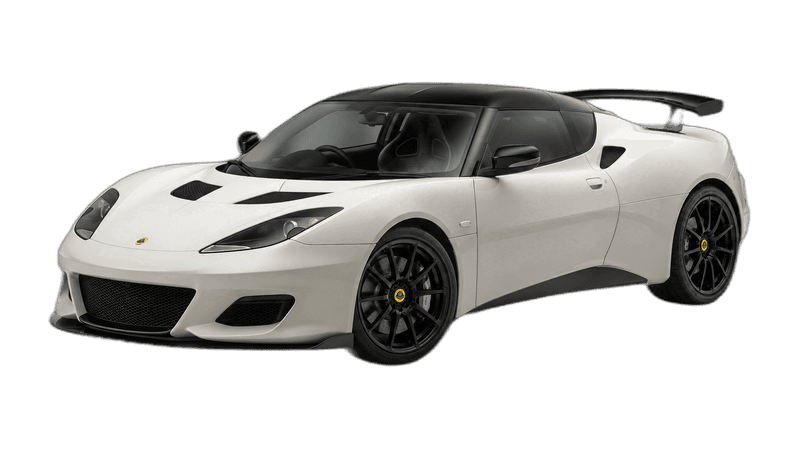
Lotus Evora GT430
£130,000
usedIndicative market price, updated periodically.
430bhp
Power
3.8s
0-100 km/h
305km/h
Top Speed
£130,000
Price Used
The Lotus Evora GT430 produces 430 bhp, reaches 100 km/h in 3.8 seconds and has a top speed of 305 km/h. A representative example is worth about £130,000.
How hard it pulls.
Peak g-force the instant you bury the throttle, estimated from the car's 0–100 time and drivetrain.
Lotus Evora GT430Estimated peak launch g from the 0–100 time and drivetrain: an honest approximation, not a measured figure.
Dream Car Garage Editorial · Edited by José Teo Lorente Vallecillos · Last updated 2 November 2026
Overview
We have not driven this car. This review is based on published specifications and the sources listed below.
The most powerful road Lotus of its day
The Lotus Evora GT430 is a mid-engined, rear-wheel-drive sports coupe built at Hethel and unveiled in July 2017. Our catalogue lists it from 2017 to 2018 with a 3.5L supercharged V6 petrol engine producing 430 bhp and 440 Nm, with 0 to 100 km/h in 3.8 seconds and a top speed of 305 km/h. This guide is scoped to the 2017 to 2018 Evora GT430 and GT430 Sport, the limited-run cars with a V6 tuned to 430 bhp. It is not about the Evora 400 or the Sport 410, which were different, less powerful cars, and it is not about the later GT410 Sport. We explain below how they differ so that you do not mix up an advert.
We have not driven this model for this article. This is a desk-researched ownership guide built from two sources we could read in full: the official Lotus Cars Evora model history page and the PistonHeads Evora 400 used buying guide by Tony Middlehurst, published on 28 March 2021, which has a section on the GT430. We could not find the original Lotus launch press release online. For the launch figures we also read reports on GTSpirit, Supercars.net, Luxurious Magazine and carsales, and the Wikipedia article on the Evora. Anything that comes only from those pages is secondhand, and we say so where it matters. We did not consult the government recall check, which needs a registration number, and you should use it yourself. Our Evora 400 guide on this site covers the car this one grew out of.
Checking the figures
Power is the least contested figure. The GTSpirit report of the launch gives 430 hp at 7,000 rpm, which it converts to 436 PS, and PistonHeads gives 430 hp. Metric horsepower is about 1.4 percent bigger than mechanical horsepower, so 430 bhp and 436 PS describe the same car, and an advert that says 436 is probably quoting PS. The Lotus model history table lists a 406 to 430 bhp range for the whole Evora 400 family and does not give a separate GT430 line, so the 430 comes from the launch coverage and PistonHeads, not from the table.
Torque is 440 Nm from 4,500 rpm in the launch coverage. PistonHeads gives 325 lb ft for the manual and 332 lb ft for the automatic, and Wikipedia gives 441 Nm in one place and 440 Nm in another. Those are rounding differences between pound-feet and newton-metres. Treat 440 Nm as the manual car's figure and expect the automatic to quote a slightly higher number.
Acceleration is where a careful reader should slow down. The launch coverage says 0 to 60 mph in 3.7 seconds, and PistonHeads says 3.7 seconds to 62 mph for both versions. Supercars.net, Luxurious Magazine and carsales give 0 to 100 km/h in 3.8 seconds, which is our catalogue figure, but those are secondhand pages and not the Lotus release itself. Wikipedia lists 3.6 seconds to 60 mph for the automatic. They are manufacturer claims, not tests we have done.
Top speed depends on the car. The winged GT430 is quoted at 190 mph, which the launch coverage and carsales give as 305 km/h. Wikipedia converts the same 190 mph to 306 km/h, so you may see either. We use 305 km/h. The GT430 Sport has no wing and, according to the Lotus model history page, reaches 196 mph or 315 km/h. PistonHeads says the manual is 16 mph quicker than the automatic, which puts the automatic at about 174 mph.
Weight also needs care. Lotus gives 1,258 kg dry for the GT430 and says the GT430 Sport is 10 kg lighter at 1,248 kg dry. PistonHeads gives 1,299 kg for the manual and 1,310 kg for the automatic, which look like kerb weights. Ask which basis an advert uses.
Production is the item most likely to be overstated. The launch coverage calls the GT430 a 60-unit special edition. PistonHeads says 60 were planned for each of the GT430 and the GT430 Sport, with the United States getting its own limited allocation, and adds that actual build numbers are unknown. So it is not clear whether 60 covers one variant or both, and we give no production count.
Engine and gearbox
The engine is the supercharged, charge-cooled 3,456 cc V6 shared with the rest of the Evora range. According to PistonHeads, the GT430 gained a new titanium exhaust and recalibrated ignition, fuelling and cam timing, and it has a baffled sump to cope with the cornering loads of its tuned chassis. PistonHeads says the original engine came from the Toyota Camry, while the Lotus history page does not mention Toyota.
PistonHeads regards the V6 as reliable, but its guide reports supercharger failures on some Evora 400s. It says the blowers were Edelbrock units, that most cases involved early US cars, and that one two-year-old UK car was rebuilt by Lotus. It does not say how many cars were affected or whether any GT430 was, so ask the seller whether the supercharger has ever been replaced, who did the work and what warranty came with it. The same guide says some 400s went flat after a week or more unused and that a trickle charger needs the boot open, so the boot light stays on while charging. A missing boot light may mean a previous owner removed it. The GT430 is a rarely driven collector car for many owners, so ask how the battery has been looked after. PistonHeads gives a 54,000 mile spark plug interval and says an independent can source plugs from Toyota for less than Lotus charges. We leave out its pound figures because they are dated.
The manual is a six-speed, and carsales lists a six-speed manual for its GT430. PistonHeads quotes weights for both manual and automatic GT430 cars, so an automatic existed. It describes the older IPS automatic as an Aisin six-speed that adds 54 kg and has no limited-slip differential, while the Lotus table says a four-speed automatic was available. We do not know which description fits the GT430 automatic, so check the gearbox on the car you are shown. PistonHeads also says the manual's cabling was tightened on the 400 and 410 but the clutch remained heavy. Try both on a test drive and listen for harsh shifts or hesitation.
Chassis, brakes and wheels
The Lotus history page describes a bonded aluminium tub of proprietary 6000 series extrusions with a torsional rigidity of 27,000 Nm per degree, a steel rear subframe that carries the engine and gearbox, and forged aluminium double wishbones, with a 39:61 front to rear weight split. That describes the Evora family and not the GT430 specifically.
PistonHeads says the GT430 has fully adjustable Ohlins and Eibach suspension, similar to the set-up Lotus engineer Gavan Kershaw used in British GT, and says it is 47 percent stiffer at the front and 20 percent stiffer at the rear than the 410. GTSpirit's report of the launch adds Ohlins TTX two-way adjustable dampers with 20 click settings and Drive, Sport, Race and Off stability modes. PistonHeads also mentions a five-stage traction control system. The same guide warns that the 410 already rides firmly on B-roads and that the GT430 is firmer still, so judge the ride on roads you actually use.
The brakes are large J-hook discs according to PistonHeads, and GTSpirit says the rear discs were made lighter to save 2 kg. We found no source with disc or pad wear data, so ask for brake invoices. PistonHeads says the GT430 has 10-spoke wheels with 295/30 Michelin Pilot Sport Cup 2 tyres, the widest Lotus could fit, and that the GT430 Sport came with 285/30 tyres with an upsize available. Cup 2 tyres are track-biased, so ask how old and how worn they are. PistonHeads warns that lightweight suspension components can lose their geometry after a modest knock, with uneven tyre wear as a warning sign, so check wear across the tread and ask for an alignment printout. It also says lacquer peeling affected some Evora alloy wheels, which the factory has generally dealt with.
Body, interior and electronics
The aero is the main difference. The Lotus history page says the GT430 has a deeper front splitter and a high-mounted rear wing producing up to 250 kg of downforce at maximum speed, and that the Sport is a wingless variant. PistonHeads says the Sport has about 100 kg of downforce. PistonHeads adds all-carbon front and rear bumpers, new front ducts and rear outlets, carbon body panels, a polycarbonate rear window in place of glass, and front number plates repositioned. Check the carbon for chips, splitter scrapes and repair marks, and look at whether the wing and mounts show signs of a hard life.
PistonHeads says the composite panels and separate front and rear sections of the Evora make repairs easier, and that panel gaps are a good place to look for accident history. For the family it lists fragile door handle components on earlier cars, dents in the tailgate from the rubber stops, boot lids that do not always respond to the dash release, fuel caps that sometimes fail to relatch, failing window motors and central locking faults, although it says the last is not unique to the Evora. It also mentions blocked air-conditioning drains that let water into the cabin, so check the footwells for damp.
We found no source that describes the GT430 interior in detail, and the catalogue and carsales list two seats. PistonHeads says the Alpine head unit on the 400 range can be temperamental, early reversing cameras were not fully reliable, and the dashtop airbag cover can bubble in warm weather or lift at one corner. Those comments are about the family, so confirm what trim the car you are shown actually has.
Recalls and history
Neither the Lotus history page nor the PistonHeads guide mentions a recall for the GT430, and PistonHeads says nothing about open campaigns. That does not mean none exist, only that our sources do not say. We do not state recall numbers or dates. Enter the registration into the government recall check, which we did not consult, and ask a Lotus dealer or specialist for open campaigns and software updates against the car's VIN.
Our catalogue gives 2017 to 2018, but none of our sources states when GT430 production ended; carsales lists the car as a 2018 model year, and GTSpirit says a North American variant was due in spring 2018. Do not rely on a year alone. Ask for the full service history, evidence of any supercharger work, accident repair records, and invoices for tyres, brakes and battery. Ask for the build plate or a Lotus letter confirming whether the car is a winged GT430 or a GT430 Sport, and its build number if the seller claims one.
Buying decision
PistonHeads describes the GT430 as the fastest and most powerful road-legal Lotus of its time and the lightest Evora to that date, and says fewer than 25 were in UK ownership in 2021 and that they rarely come up for sale. It calls the GT410 Sport a halfway house to the GT430 with most of its thrills. Prices have moved since, so compare current adverts and leave our sources' numbers aside.
Keep the variants straight. The Evora Sport 410 was revealed at Geneva in 2016 and, according to PistonHeads, saves about 70 kg against the 400 and adds a 10 hp remap. The GT410 Sport is a later, touring-oriented Evora: the Lotus page describes touring suspension, Michelin Pilot Sport 4S tyres and a revised front bumper, and PistonHeads treats it as a step below the GT430. The Lotus table's 406 to 430 bhp range spans the whole family, so do not assume the figures in this guide apply to a 400 or a 410.
Prefer a car with a clean government recall check, documented supercharger history, a healthy battery with a trickle charger left with it, even tyre wear on fresh track-capable tyres, an undamaged carbon aero kit, working electrics, a dry cabin, and written confirmation of the exact model, gearbox and output. Be ready for a firm ride and a car that is happiest on a track or a smooth road.
Specifications
| Engine | 3.5L supercharged V6 petrol |
|---|---|
| Displacement | 3.5L |
| Power | 430 bhp |
| Torque | 440 Nm |
| 0-100 km/h | 3.8s |
| Top Speed | 305 km/h |
| Drivetrain | RWD |
| Country | UK |
| Body Style | coupe |
| Years | 2017–2018 |
| Price Used | £130,000 |
Specifications are manufacturer-published figures.
Frequently Asked Questions
What is a Lotus Evora GT430 worth?
A representative example is worth about £130,000. Actual values vary with specification, condition and history.
How much power does the Lotus Evora GT430 have?
The Lotus Evora GT430 produces 430 bhp and 440 Nm of torque.
How fast is the Lotus Evora GT430 from 0 to 100 km/h?
The Lotus Evora GT430 accelerates from 0 to 100 km/h in 3.8 seconds.
What is the top speed of the Lotus Evora GT430?
The Lotus Evora GT430 has a top speed of 305 km/h.
What engine does the Lotus Evora GT430 have?
The Lotus Evora GT430 uses a 3.5L supercharged V6 petrol.
When was the Lotus Evora GT430 built?
The Lotus Evora GT430 was built from 2017 to 2018.
Is the Lotus Evora GT430 all-wheel drive?
No. The Lotus Evora GT430 is configured with rear-wheel drive.