
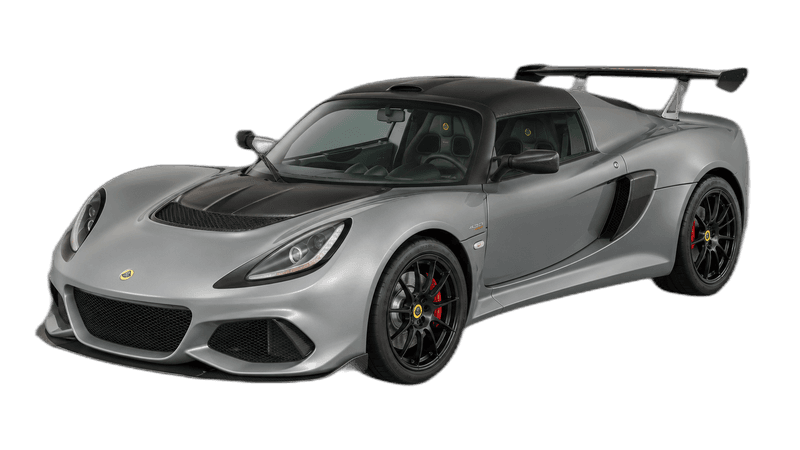
Lotus Exige Cup 430
£110,000
usedIndicative market price, updated periodically.
430bhp
Power
3.3s
0-100 km/h
290km/h
Top Speed
£110,000
Price Used
How hard it pulls.
Peak g-force the instant you bury the throttle, estimated from the car's 0–100 time and drivetrain.
Lotus Exige Cup 430Estimated peak launch g from the 0–100 time and drivetrain: an honest approximation, not a measured figure.
The Lotus Exige Cup 430 is a 2-door coupe by Lotus, with 430 bhp, 440 Nm of torque, a 0-100 km/h time of 3.3 seconds and a top speed of 290 km/h. Indicative used value: approximately £110,000. Actual values vary with specification, condition and history.
Dream Car Garage Editorial · Edited by José Teo Lorente Vallecillos · Last updated 2 November 2026
Overview
We have not driven this car. This review is based on published specifications and the sources listed below.
Scope of this guide
This guide is scoped to the Series 3 Lotus Exige Cup 430 coupe, the track-focused road-legal Exige that Lotus revealed in November 2017 and sold until the end of Exige production in 2021. It is not a guide to the Sport 380 or Sport 410, which we compare below so you can tell them apart in an advert, and it is not a guide to the earlier four-cylinder Exiges.
We have not driven this model for this article. Everything here comes from Lotus's own Exige page, a reproduction of the Lotus launch press release on ultimatecarpage.com, PistonHeads' road test of the Cup 430, PistonHeads' used buying guide for the Series 3 Exige, Wikipedia's model history and the government recall checker. Where those sources disagree, or where a figure in our catalogue could not be confirmed word for word, we say so in the text.
The figures at a glance
- Engine: 3.5L supercharged V6 petrol (3456 cc), charge-cooled, mounted behind the seats.
- Power: 430 bhp at 7,000 rpm, according to the Lotus launch release. That is about 436 PS.
- Torque: 440 Nm, 325 lb ft, with the peak starting at 4,000 rpm.
- Gearbox: six-speed close-ratio manual, with no automatic listed in the sources we read.
- Drive: rear-wheel drive.
- 0-100 km/h: 3.3 seconds in our catalogue, from the launch release.
- Top speed: 290 km/h in our catalogue, which is the 180 mph claimed at launch.
- Weight: 1,059 kg dry, 1,056 kg in the lightest specification, and 1,093 kg unladen according to PistonHeads.
- Downforce: 220 kg at the launch, and 171 kg on Lotus's current page for the Final Edition.
- Body: two-door coupe.
Why the quoted power varies
Lotus quotes this car in brake horsepower. Its Exige page for the Cup 430 Final Edition says 430 bhp, and the launch release as reproduced by ultimatecarpage.com says 430 hp at 7,000 rpm, with the same page giving 321 kW. That is 430 bhp, and it converts to roughly 436 PS (430 x 1.0139).
PistonHeads' specification table prints 436hp, which is the same engine rating shown in PS but labelled as horsepower. Wikipedia's infobox gives 430 hp (436 PS), while the body text of the same article says 430 PS (424 hp), so it contradicts itself. We follow Lotus and use 430 bhp throughout. An advert that says 430 and one that says 436 describes the same engine, not a stronger car.
Torque and where it peaks
All the sources agree on 440 Nm, about 325 lb ft. They differ on the engine speed. The launch release as reproduced on ultimatecarpage.com says the peak starts at 4,000 rpm, its separate specification page says 4,500 rpm, PistonHeads gives a plateau from 4,000 to 6,800 rpm, and Lotus's Exige page says 4,000 rpm. We would not read much into the spread: the useful point is that a flat 440 Nm is available across most of the usable range, which PistonHeads says means you do not have to rev the car hard all the time on the road.
Performance claims and what they mean
Lotus's launch release gave 3.2 seconds from 0 to 60 mph and 3.3 seconds from 0 to 100 km/h. PistonHeads prints 3.3 seconds for 0 to 62 mph. We carry 3.3 seconds for 0-100 km/h because that is the manufacturer's own launch figure. Lotus's current Exige page, however, gives 3.2 seconds for 0-100 km/h for the Final Edition. Both are manufacturer numbers for the same family of car, so treat the gap of 0.1 seconds as a difference in test conditions or specification, not a reason to prefer one car.
Top speed is where care is needed. The launch release, PistonHeads and Wikipedia's Cup 430 entry say 180 mph, which is 290 km/h, and that is the number in our catalogue. Wikipedia attaches 174 mph (280 km/h) to the Cup 430 Final Edition, and some listings quote 174 mph for the whole car. We did not find 174 mph on a Lotus page, so we do not use it, but if you are looking at a 2021 Final Edition, ask what the seller is relying on.
The launch release also says the car lapped Lotus's Hethel circuit in 1:24.8, which it described as the fastest production car lap there and 1.2 seconds quicker than the 3-Eleven Road. That is a Lotus claim, not an independent test.
Model years and production
The launch release reproduced on ultimatecarpage.com was last updated on 9 November 2017, and PistonHeads' road test followed on 14 November 2017. ultimatecarpage.com lists the car as introduced in 2018, which fits cars arriving in the UK after the reveal. We use 2017 to 2021 as the span for this guide. Lotus says it launched Cup 430 and Sport 420 Final Editions to mark the last year of Exige production, in 2021.
We found no Cup 430 production count. Lotus's Exige page says about 2,700 third-generation Exiges were built from 2011 to 2021 across all models, but gives no split by model, and the launch release describes the Cup 430 only as a limited series-production car. Wikipedia lists a Type 25 Limited Edition, built on the Exige 430 Cup, of 25 cars with 10 in right-hand drive. That is a single-source claim, so ask for evidence before paying a Type 25 premium.
How the Cup 430 differs from the Sport 380 and Sport 410
The Sport 380 is the road-biased car below it. Wikipedia gives it 375 hp (380 PS), 410 Nm, 0 to 60 mph in 3.5 seconds and 178 mph (286 km/h), and Wikipedia says the Sport 410 followed in May 2018 with 410 hp (416 PS) and 420 Nm. The Cup 430 adds 55 bhp over the Cup 380, which is 13 per cent more, according to the launch release, and is a more extreme, track-focused specification.
The Cup 430 changes are mostly aerodynamic and mechanical. Lotus says downforce is 220 kg at launch, against 171 kg quoted on its current Final Edition page, with the front share raised from 36 per cent to 45 per cent for sharper high-speed turn-in, through a new front clamshell with carbon ducts, a front splitter with a trailing lip and a larger, higher, straight carbon rear wing. It says the car makes at 100 mph the downforce the Sport 350 makes at its 170 mph top speed. The Sport 410 is quoted by Wikipedia at 150 kg total downforce, so you are comparing a clearly more aero-heavy car.
Engine, supercharger and gearbox
Lotus describes the engine as based on the Evora GT430 powertrain. It is a Toyota-derived 3,456 cc V6 with an Edelbrock supercharger and a water-to-air charge cooler. The redline is 7,000 rpm, and Lotus says the engine has a baffled sump. PistonHeads' used guide, written for the 2012 to 2016 Series 3 Exige V6, describes the V6 as having no major common issues and the supercharger as trouble-free. Because that guide covers earlier cars, treat it as a lead, not a promise for this one.
The six-speed manual has a 240 mm clutch, 12 mm larger than the Cup 380's, adding 11 per cent more friction surface according to Lotus. PistonHeads' road test says the manual box has improved but is not as crisp as a Porsche's. For the earlier cars, PistonHeads says the clutch is the likeliest wear item on a hard-used example and that you can download the number of hard launches. Ask a Lotus specialist to read that count. The same guide warns that using launch control can affect warranty cover on related components.
Weight, lightweight parts and the exhaust
Lotus quotes 1,059 kg dry, 1,056 kg in the lightest specification, and 407 hp per tonne. PistonHeads quotes 1,093 kg unladen. Lotus's current page for the Final Edition says just over 1,110 kg with a full tank, and 387 bhp per tonne. These are different definitions, not a contradiction, but they mean a quoted weight depends on the specification and the date.
The launch release lists lightweight parts that save 29 kg in total, partly offset by the charge cooler and cooling system and a higher-rated clutch. A high-flow titanium exhaust is standard and removes 10 kg from behind the rear axle, and the new front clamshell panels are 6.8 kg lighter than those on any other Exige. Lotus also lists a lithium-ion battery, a T45 steel roll bar and carbon race seats. Check which of these a given car still carries.
Chassis, brakes and tyres
Lotus lists Michelin Pilot Sport Cup 2 tyres, 215/45 ZR17 at the front and 285/30 ZR18 at the rear, on forged alloy wheels in red, black or silver. The brakes are forged four-piston AP Racing calipers with two-piece J-hook discs. PistonHeads' road test praises the brakes but says ABS intervenes noticeably under hard stopping.
Suspension is fitted with Nitron three-way adjustable dampers, which PistonHeads says were a first for Lotus, and Eibach adjustable anti-roll bars. PistonHeads says a softer set-up would suit longer journeys and that the ride could be more supple. Steering is unassisted according to the buying guide for the Series 3 car. Traction control uses a six-position switch on the steering column, with settings of 1, 3, 6, 9 and 12 per cent slip plus off, and Lotus says it works only with ESP switched off.
Running costs and practicality
PistonHeads' specification table lists 242 g/km of CO2, with no official fuel economy figure. Our sources do not cover insurance, annual road tax or service costs for this car, so we give no figures. For the earlier Series 3 cars, PistonHeads gives a service interval of 9,000 miles or annually, with geometry checks more often. Ask Lotus or a specialist for the Cup 430 schedule instead of assuming it.
The cabin is small and spartan. PistonHeads' used guide says anyone over 6ft 2in may struggle to get in and out, and the Cup 430 road test lists air conditioning, a stereo and sound insulation as extras. Treat this as a car you drive for its handling, not a quiet daily commuter.
What to check before buying
- Confirm it is a Cup 430, not a Sport 380, Sport 410 or Cup 380, by the wing, front clamshell, wheels and the chassis plate.
- Ask for the service book, the geometry reports and evidence of track use, because a few trackdays a year are normal on these cars.
- Check wheel alignment and tyre wear across the width, since PistonHeads says inside edges wear faster on the Series 3 cars.
- Look at the front clamshell, splitter and carbon wing for cracks, repairs and stone chips. PistonHeads says the Series 3 Cup models lacked mudguards, so expect chipping inside the arches.
- Ask what has been done on the brake pedal switch and ABS unit, which PistonHeads flags as a known weak point on the earlier cars.
- Check the clutch and ask for the hard-launch count to be read.
- Confirm which options are fitted, such as the roll cage, battery cut-off, extinguisher and airbag deletion.
- Check every recall is closed, using the check below.
Recalls and the DVSA check
We did not find or verify any recall specific to the Cup 430 in the sources we read, and we are not saying there are none. The GOV.UK vehicle recall checker lets you enter the registration number and shows safety recalls that have not been checked or fixed, alongside the MOT history. The page does not say whether completed recalls appear. Ask a Lotus dealer to run the VIN against any outstanding campaigns and keep the paperwork.
Verdict
The Exige Cup 430 is, in the words of Lotus's launch material, the most extreme Exige, and a rewarding, unrefined machine if you want a stripped, aerodynamic, manual rear-wheel drive car. Choose the right derivative, get a specialist inspection and treat the 430 bhp, 440 Nm, 3.3 seconds and 290 km/h figures as published claims with the caveats set out above. We have not driven it, so use the sources and a proper inspection to decide.
Specifications
Engine
3.5L supercharged V6 petrol (3456 cc)
Displacement
3.5L
Power
430 bhp
Torque
440 Nm
0-100 km/h
3.3s
Top Speed
290 km/h
Drivetrain
RWD
Country
UK
Body Style
2-door coupe
Years
2017–2021
Price Used
£110,000
Specifications are manufacturer-published figures.
More from Lotus
Frequently Asked Questions
What are the specifications of the Lotus Exige Cup 430?
The Lotus Exige Cup 430 is a 2-door coupe by Lotus, with 430 bhp, 440 Nm of torque, a 0-100 km/h time of 3.3 seconds and a top speed of 290 km/h. Indicative used value: approximately £110,000. Actual values vary with specification, condition and history.
How much does a Lotus Exige Cup 430 cost?
Indicative used value: approximately £110,000. Actual values vary with specification, condition and history.
What drivetrain does the Lotus Exige Cup 430 use?
The Lotus Exige Cup 430 is configured with rear-wheel drive.
What type of car is the Lotus Exige Cup 430?
The Lotus Exige Cup 430 is a track focused manufactured by Lotus in UK. Production ran from 2017 to 2021.