
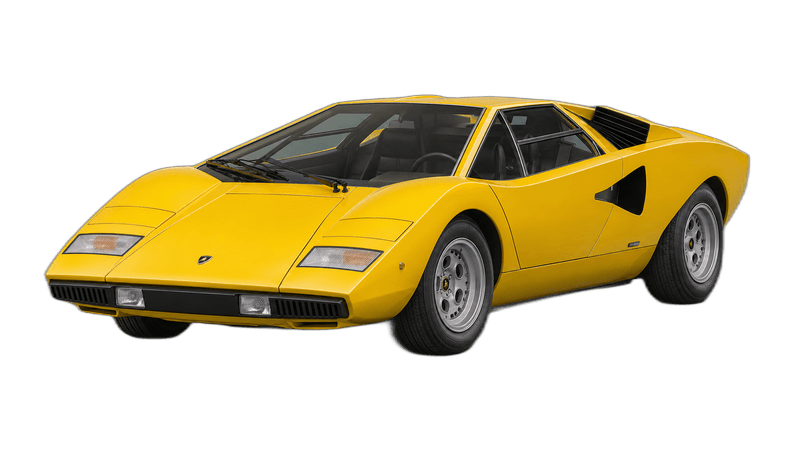
Lamborghini Countach LP400
370cv
Potencia
290km/h
Velocidad Máxima
The Lamborghini Countach LP400 is a 2-door coupé by Lamborghini, with 370 bhp, 361 Nm of torque and a top speed of 290 km/h.
Dream Car Garage Editorial · Edited by José Teo Lorente Vallecillos · Last updated 3 November 2026
Visión General
We have not driven this car. This review is based on published specifications and the sources listed below.
Scope of this guide
This guide is scoped to the Lamborghini Countach LP400, the first production version of the Countach, built at Sant'Agata Bolognese between 1974 and 1978. It is a mid-engine car with a longitudinal V12 behind the seats, a five-speed manual gearbox and rear-wheel drive. It is not a guide to the LP500 show car of 1971, to the later LP400 S, LP500 S, 5000 Quattrovalvole or 25th Anniversary cars, or to the one-off Walter Wolf Special, although we mention them where they help you tell one car from another.
We have not driven this model for this article. We are an editorial desk that reads sources, and everything below comes from pages we opened: Wikipedia, the supercars.net profile, the RM Sotheby's lot page for a 1977 car sold at Villa Erba in 2023, Lamborghini's own Countach history page, the Autozine archive page and the evo review. The LP400 is a collector car that rarely comes to market, so this page is for research and is not a buying recommendation. A guide like this cannot replace an inspection by a specialist who knows the car.
The figures at a glance
- Engine: 3.9L naturally aspirated V12. The 60 degree, double overhead camshaft engine is 3,929 cc in every source that gives a capacity. Wikipedia says the design dates from 1963 and was created by Giotto Bizzarrini, and RM Sotheby's also credits Bizzarrini. supercars.net and evo both describe six twin-throat Weber carburettors.
- Power: 370 bhp. Wikipedia prints 276 kW, 375 PS and 370 hp at 8,000 rpm. Lamborghini's own page prints 375 CV, which is the same metric horsepower. Converting 375 PS gives about 370 bhp (375 x 0.98632), and 276 kW gives about 370 bhp as well. supercars.net, RM Sotheby's, Autozine and evo print 375 bhp or 375 hp, which looks like the PS number carrying a bhp label. We use 370 bhp so that the unit is correct.
- Torque: 361 Nm. supercars.net prints 360.6 Nm (266 lb-ft) at 5,500 rpm, and evo and Wikipedia also give 266 lb-ft. Autozine prints 268 lb-ft, which is about 363 Nm. Wikipedia gives 5,500 rpm in its text and 5,000 rpm in its engine table. RM Sotheby's states no torque. We use 361 Nm, the figure that two of the sources reach by conversion.
- Top speed: 290 km/h, as a quoted figure and not a verified one. supercars.net says about 180 mph (290 km/h), evo says a claimed 180 mph, and RM Sotheby's says just under 290 km/h. The sources do not agree, as the next section explains.
- 0-100 km/h: no figure shown in this guide. We found acceleration times, but only in miles per hour, and they conflict.
- Weight: about 1,300 kg. evo says 1,300 kg, Autozine says 1,301 kg and Wikipedia's infobox says 1,300.5 kg, while supercars.net says 1,370 kg and Wikipedia's performance table gives a dry weight of 1,065 kg.
- Size: supercars.net gives a 2,450 mm wheelbase, 4,140 mm length, 1,890 mm width and 1,070 mm height.
- Production: 157 cars, per Wikipedia, supercars.net, evo, RM Sotheby's and Autozine, with caveats below.
- Price when new: supercars.net says roughly 52,000 US dollars, and evo says about 18,000 pounds in 1974.
Where the sources disagree
We would rather show the disagreement than hide it, so here is every place we found one.
Power
The sources do not disagree on the engine, only on the unit. 375 PS or CV is the factory number. Several English-language pages print it as bhp or hp. Autozine goes further and says the 375 hp figure is a manufacturer claim. We show 370 bhp and tell you why.
Top speed
This is the most contested number. Autozine says Lamborghini claimed 300 km/h (186 mph) to rival the Ferrari Daytona, that the claim was overstated, and that the car's top speed was an estimated 170 mph, which is about 274 km/h. Wikipedia's performance table lists 288 km/h (179 mph) as tested, citing a 1978 source it does not name in the text, next to a claim of 315 km/h (196 mph). supercars.net and RM Sotheby's both say about 290 km/h. evo says a claimed 180 mph and also uses the phrase 185 mph plus. The spread from about 274 to 315 km/h is wide. We keep 290 km/h because three sources land on it, but it is a quoted number, and the period-test value may be lower. We did not open a primary magazine road test.
Acceleration
Wikipedia lists 5.4 s for 0-100 km/h. evo lists 5.4 s for 0-60 mph, which is not the same measurement, so Wikipedia's label may be wrong. Autozine says 5.6 s for 0-60 mph, tested by Motor, and 13.1 s for 0-100 mph. supercars.net says about 6.8 s for 0-60 mph and 13.3 s for 0-100 mph. A 0-60 mph time is not a 0-100 km/h time and we have not converted one into the other. Because we found no clearly labelled 0-100 km/h test, this guide has no figure shown for it. A catalogue value of 5.6 matches the Autozine 0-60 mph figure, so it may be a mph time carrying a km/h label. That is our inference, and we cannot prove it.
Production count and start date
Five of the sources we read say 157 cars. supercars.net says about 157 in one place and refers to 150 elsewhere on the same page. RM Sotheby's calls its car one of only 157 first-series Periscopio models, although the Periscopio is a feature of the LP400 and not a separate production run, so we read that as the total. Search summaries of other Lamborghini pages suggested 151 and 152 units, but we did not open those pages and do not rely on them. Lamborghini's own history page gives 1,999 Countach in total, while Wikipedia's table sums to 1,983, so even the all-model total differs.
On dates, the LP500 was shown at Geneva in March 1971. Wikipedia says the LP400 was first offered for sale at the 1974 Geneva show, where 50 orders were placed. Lamborghini's history page says the Countach entered production in 1974. So 1974 is the show and the start of series production, not the first drawing, and 1978 is the end of LP400 production, after which the LP400 S followed.
History and what changed over the run
The Countach began as the LP500 at the 1971 Geneva show, designed by Marcello Gandini at Bertone. Wikipedia says its 5.0L engine failed during a 1971 road test, so a 3.9L engine was fitted for development, and that the LP500 prototype was destroyed in a crash test at MIRA on 21 March 1974. evo says the planned 5-litre, 440 bhp LP500 became the LP400 over about three years of development. Wikipedia credits chief engineer Paolo Stanzani with the longitudinal layout that puts the gearbox ahead of the engine, between the seats. RM Sotheby's says that layout centralises mass and improves high-speed stability.
The production car used a tubular spaceframe, built by Marchesi according to Wikipedia, with aluminium body panels, and double-wishbone suspension and disc brakes, according to Autozine. Wikipedia says each engine was run for five hours before fitting. The period-correct tyres were Michelin XWX, 205/70R14 at the front and 215/70R14 at the back, and evo adds that the planned Pirelli P7 tyres were not ready. The periscope-style rear-view mirror in the roof recess is the feature that gives the early cars their Periscopio name, per RM Sotheby's.
Wikipedia says that in 1975 Walter Wolf bought an LP400 and asked Giampaolo Dallara for a more powerful version. The result had a 5.0L engine rated at 453 PS. That car is a one-off and not part of the LP400 catalogue entry. The LP400 S arrived in 1978 and was a different car, with 237 built per Wikipedia and lower quoted top speeds. We keep it out of this guide.
What to check before buying
We found limited specific buying advice in the pages we could read, so this list is short and honest. Treat it as questions to put to a specialist.
- Provenance and paperwork. The RM Sotheby's lot page shows how much history one car can carry: it was built for Australia in June 1977, bought by Rod Stewart, fitted with a wide-body kit and targa roof in the US, later reversed to factory specification and restored at Lamborghini Polo Storico for 60,500 euros in 2022. It was sold with only part of its German registration papers. Ask for full documents and for evidence of every modification.
- Modifications reversed. The same lot shows that a car can be converted and then returned to original, and that a right-hand-drive car can become left-hand drive. Verify the steering side against factory records.
- Suspension and brakes. A search summary of the Classic and Sports Car buyer's guide said the nylon-lined rose joints wear quickly and rear brakes and handbrake can seize through disuse. We could not open that article's body text, so this is second-hand and unconfirmed by us.
- Gearbox and clutch. The same summary said gearbox noise is normal and that clutch work needs the engine removed. The evo review calls the gearshift direct and positive but says visibility and ergonomics are poor. Again, confirm with a specialist.
- Carburettors. supercars.net and evo both mention six twin-choke Weber carburettors. Check that the car still has the correct set-up.
- Matching numbers and chassis identity. Wikipedia and RM Sotheby's both show chassis numbers beginning 1120. Compare any chassis plate with factory records via Lamborghini Polo Storico or a registry.
Running costs and known issues
We found no source we could open that gives service intervals, engine rebuild costs, fuel economy or failure rates for the LP400, so we give none. Anyone quoting repair costs without a source is guessing. What we can say from the sources is qualitative: evo reports heavy unassisted steering, poor visibility and hard-to-read instruments, and Autozine describes a cramped cabin with heavy controls. The only cost we have is the 2022 Polo Storico restoration of one car for 60,500 euros, which covered servicing the brakes, engine, electrics, gearbox and steering rack, polishing the paint and restoring the interior. That is one car and not a typical bill.
Recalls and safety
We found no recall notice for the LP400 in any page we read, but that is not a clean bill of health, because we did not search a recall database. This is a 1970s car with no modern crash structure, no airbags and no stability control. We found no crash-test data and no safety-equipment list, so we cannot say more.
Market and value notes
Prices are high and uneven, and a few sales do not make a valuation. RM Sotheby's sold the 1977 Periscopio, chassis 1120262, for 989,375 euros at Villa Erba in May 2023. supercars.net lists a range of results without sale dates that we could read, from 330,000 US dollars for a 1976 car to 1,870,000 US dollars for a 1974 Periscopo, with other results between them and one 1976 car that did not sell at 315,000 US dollars. evo, citing The Classic Valuer, puts the lowest price paid this decade at about 237,000 pounds and the median at about 460,000 pounds, a driver-quality car at about 600,000 pounds and exceptional examples above 1 million pounds. Those figures cover different cars, years, currencies and fees, so treat them as a spread and not a price list.
What we could not find
We found no clearly labelled 0-100 km/h time, no primary magazine road test, and no reliable torque figure from the maker, so the torque is a conversion from a pound-feet value. We could not read the body text of the Classic and Sports Car buyer's guide or its A to Z page, which returned only a list of topics, so our buying points from that source are a search summary only. The Hagerty page required a login and we did not follow it. We found no recall data, no running-cost data and no crash-safety data, and we did not run any registry search.
About the photograph
This page uses the catalogue photograph for the car. Its credit is listed on the credits page.
Verdict
The LP400 is a mid-engine, rear-wheel-drive wedge with a 3.9L naturally aspirated V12 making 370 bhp and about 361 Nm. Its quoted 290 km/h is contested, there is no clean 0-100 km/h figure in our sources, and a production count of 157 is the best-supported number. What you are buying is the purest early Countach, its rarity and its paperwork. The practical advice from our reading is to insist on documentation, to ask a specialist about the chassis, suspension, gearbox and carburettors, and to treat every performance number as a claim. We have not driven it, so use the sources, the seller's records and an independent specialist inspection to decide.
Sources
- Wikipedia: Lamborghini Countach
- supercars.net: 1974-1978 Lamborghini Countach LP400 Periscopo
- RM Sotheby's: 1977 Lamborghini Countach LP400 Periscopio by Bertone (Villa Erba 2023)
- Lamborghini: Countach history page
- Autozine: Lamborghini Countach LP400 (1974-78)
- evo: Lamborghini Countach LP400 (1974-1978) review
Especificaciones
Motor
3.9L naturally aspirated V12
Cilindrada
3.9L
Potencia
370 cv
Par Motor
361 Nm
Velocidad Máxima
290 km/h
Tracción
RWD
País
Italy
Carrocería
2-door coupé
Años
1974–1978
Producción
157
Specifications are manufacturer-published figures.
Más de Lamborghini
Preguntas Frecuentes
What are the specifications of the Lamborghini Countach LP400?
The Lamborghini Countach LP400 is a 2-door coupé by Lamborghini, with 370 bhp, 361 Nm of torque and a top speed of 290 km/h.
How many Lamborghini Countach LP400 were made?
Lamborghini produced 157 units of the Lamborghini Countach LP400.
What drivetrain does the Lamborghini Countach LP400 use?
The Lamborghini Countach LP400 is configured with rear-wheel drive.
What type of car is the Lamborghini Countach LP400?
The Lamborghini Countach LP400 is a supercars manufactured by Lamborghini in Italy. Production ran from 1974 to 1978.