
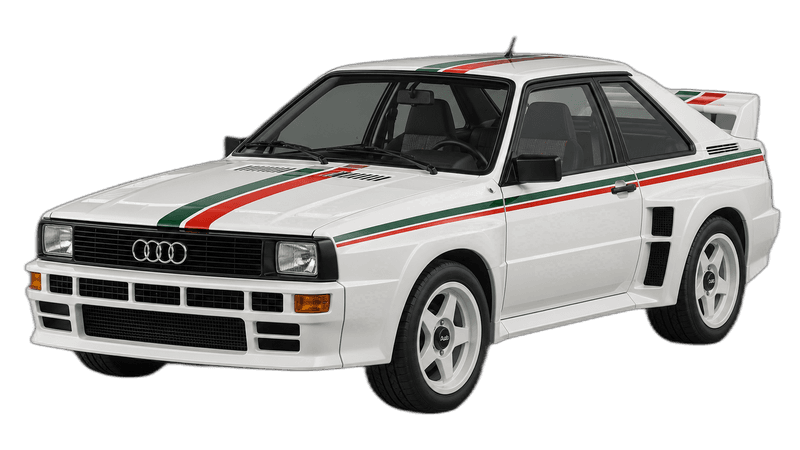
Audi Sport quattro
302cv
Potencia
250km/h
Velocidad Máxima
The Audi Sport quattro is a 2-door coupé by Audi, with 302 bhp, 350 Nm of torque and a top speed of 250 km/h.
Dream Car Garage Editorial · Edited by José Teo Lorente Vallecillos · Last updated 3 November 2026
Visión General
We have not driven this car. This review is based on published specifications and the sources listed below.
Scope of this guide
This guide is scoped to the Audi Sport quattro, the short-wheelbase road-going homologation car that Audi built in 1984 and 1985 so that its Group B rally cars could compete. It is a front-engine car with all-wheel drive, an aluminium-block 2.1-litre turbocharged five-cylinder engine ahead of the cabin and a five-speed manual gearbox. It is not a guide to the standard Audi quattro coupe that went on sale in 1980, and it is not a guide to the Sport Quattro S1 and S1 E2 competition cars, which were works rally cars with far more power and are a separate subject. We mention them only so that their numbers are not confused with the road car's.
We have not driven this model for this article. We are an editorial desk that reads sources, and everything below comes from pages we opened: Wikipedia, the RM Sotheby's lot page for a car sold in Arizona in 2015, the Gooding and Company lot page for a car sold at Amelia Island in 2019, two supercars.net profiles, a Supercar Nostalgia guide, an Autozine profile, an Autoblog auction preview, a SpeedHolics dealer listing, the FIA historic database and a Goodwood article about a competition car. This is a collector car that rarely comes to market. A guide like this cannot replace an inspection by a specialist who knows the model, and this page is for research, not a buying recommendation.
The figures at a glance
- Engine: 2.1L turbocharged inline-five, an aluminium-alloy, twin-cam, four-valves-per-cylinder unit. RM Sotheby's, Gooding and supercars.net all give 2,133 cc. The standard quattro engine is listed at 2,144 cc by supercars.net and Supercar Nostalgia, so the Sport's engine is very slightly smaller than the one in the car it was derived from.
- Power: 302 bhp. The sources quote 306 PS, which Wikipedia lists as 225 kW, 306 PS or 302 hp at 6,700 rpm. We checked the arithmetic: 306 PS multiplied by 0.98632 is about 302 bhp, and 225 kW multiplied by 1.34102 is also about 302 bhp. RM Sotheby's prints 302 hp and Gooding prints 302 BHP, though Gooding gives 6,500 rpm where the others give 6,700 rpm.
- Torque: 350 Nm at 3,700 rpm, per Wikipedia and the supercars.net specification table. Supercars.net, Supercar Nostalgia, RM Sotheby's and Autozine print 258 lb-ft, and 258 multiplied by 1.35582 is about 350 Nm, so these agree.
- 0-100 km/h: no figure shown. The 4.8 seconds that appears in several sources is attached to a different speed, and we explain this below.
- Top speed: 250 km/h. Supercars.net lists about 250 km/h or 155.3 mph in its table, and Supercar Nostalgia and the supercars.net text give 155 mph, which converts to roughly 249 km/h.
- Drive: all-wheel drive through a five-speed manual gearbox, with self-locking differentials and a 50/50 torque split per Supercar Nostalgia.
- Wheelbase: 2,204 mm, which is 320 mm shorter than the standard car.
- Weight: about 1,273 kg per Supercar Nostalgia and Autozine, 1,298 kg in the supercars.net table and 1,300 kg in the text of the second supercars.net profile.
- Production: 214 cars, on the figure most sources give.
- Price when new: 203,850 Deutschmarks, per Wikipedia and SpeedHolics. RM Sotheby's says more than 200,000 Deutschmarks.
Where the sources disagree
We say so where the sources disagree, and say which figure we chose and why.
- Power units. Supercars.net prints 306 bhp in its spec list, while Wikipedia, RM Sotheby's and Gooding give 306 PS, 302 hp and 302 BHP respectively. The 306 figure is the metric one, so calling it 306 bhp overstates the car by about four horsepower. We use 302 bhp and show the conversion. The supercars.net text of the other profile says 300 bhp, and the SpeedHolics listing says 306 hp. Treat all of these as the same engine rated in different units.
- Acceleration. The best-known figure is 4.8 seconds. RM Sotheby's, Autozine and one supercars.net profile attach it to 0-60 mph, with Autozine saying Autocar tested it. Supercar Nostalgia attaches it to 0-62 mph. The text of the other supercars.net profile says 0-100 kph in 4.8 seconds while its table says 0-60 mph. Because the same number is labelled with three different speeds and none of the sources is a maker document, we do not present it as a 0-100 km/h time and have no figure shown for that column. Autozine also gives 12.6 seconds for 0-100 mph.
- Wheelbase. Supercars.net says 2,204 mm in its table in one profile and 2,224 mm in the text of the other. Supercar Nostalgia, RM Sotheby's (86.8 in) and Wikipedia's page for the later competition car give 2,204 mm or 86.8 in. Wikipedia lists the standard quattro at 2,524 mm, and 2,524 minus 320 is 2,204, so we use 2,204 mm.
- Production. Supercars.net, Supercar Nostalgia, RM Sotheby's, Autozine, Autoblog and SpeedHolics give 214. Wikipedia says 224 short-version cars were built. Supercars.net says 224 was the number Audi committed to build, and that 214 were completed. Gooding calls its car one of 161 road-going examples. SpeedHolics says the factory reserved 20 and just 164 were sold, which does not add up to 214 by its own numbers. We use 214.
- Build period. Supercars.net says production ran from early 1984 to late 1985. Supercar Nostalgia says February 1984 to January 1986. Autozine says 1984 to 1985. We keep 1984 to 1985 for the model years and note the later end date.
- Top speed. Autozine gives 154 mph in its table (tested by Autocar) and 155 mph in its text. We use 250 km/h as the rounded 155 mph figure.
- Rally power. Wikipedia gives the early competition engine as about 304 PS, and the S1 E2 at 480 PS official and in excess of 500 PS in practice. RM Sotheby's says around 450 brake horsepower in competition tune, and Goodwood says 456 PS for the 1984 Sport Quattro. These are competition numbers, not the road car's.
History and what changed from the standard quattro
Supercars.net says the Sport Quattro debuted at Frankfurt in September 1983, with deliveries beginning in early 1984. Its profile also says Hannu Mikkola won the 1983 1000 Lakes Rally in one before it was homologated. RM Sotheby's says Audi's engineers developed the car in secret, and Autoblog says it was built to meet FIA Group B homologation rules and sold to the public in limited numbers. The FIA historic database lists homologation number 264 in Group B, dated 2 May 1984, valid until 1 January 1991. Group B required 200 road cars according to RM Sotheby's and supercars.net.
Supercar Nostalgia lists the following changes from the standard quattro. We repeat them as that page states them and have not checked them against a workshop manual.
- A shortened version of the same monocoque, built at Baur in Stuttgart rather than at Ingolstadt.
- An aluminium-alloy engine, described as Audi's first with four valves per cylinder, a KKK K27 turbocharger at 1.2 bar, an air-to-air intercooler, 8.0:1 compression and Bosch LH Jetronic fuel injection.
- Self-locking differentials, 15-inch Ronal wheels widened from 8 to 9 inches and larger brakes with four-piston calipers.
- A redesigned, smaller front end with flared arches, carbon-Kevlar and fibreglass body panels and steel doors taken from the Audi 80.
- Recaro seats, a steeper windscreen from the Audi 80 and a hard foam dashboard.
- ABS that the driver can switch off from the cockpit.
The same page says the cars were left-hand drive only and gives the colour split as Tornado Red 128, Alpine White 48, Copenhagen Blue 21, Malachite Green 15 and two special-order black cars, one of them for Ferdinand Piech. These add up to 214. It also says 164 cars were sold to customers, that ten unsold cars were prepared for the USA in 1986 for a Pikes Peak effort, and that five more were assembled from leftover parts in 1988. The page does not say whether those five are inside the 214, so we do not treat the 214 as a final audited count. None of the pages we read breaks out prototypes from the 214.
The S1 rally cars are a different car
Wikipedia places the road car under a Sport Quattro S1 heading, which causes confusion. The Group B competition cars carried the S1 name and developed rapidly. Wikipedia lists the S1 E2 of 1985 to 1986 at 2,110 cc with an official 480 PS, in practice in excess of 500 PS, a six-speed gearbox and a 3.1 second 0-100 km/h time. Goodwood says only 20 competition S1 E2 cars were built in period, with 15 believed to survive. Those cars have nothing to do with the 302 bhp road car beyond a shared shortened wheelbase and name, and none of their figures belong in this guide.
What to check before buying, and what the rarity means
Our sources are auction and listing pages, not workshop manuals, so this list reflects what those pages emphasise.
- Provenance and registration. RM Sotheby's says Sport Quattros were not officially imported to the United States, and Autoblog repeats that point for the car it previewed. Any car outside its home market deserves a close look at import and registration paperwork.
- Mileage. RM Sotheby's car showed 8,300 km said to be original, Autoblog calls the same car barely more than 5,000 miles, and Gooding's car showed just over 25,000 miles. Mileage varies widely.
- Originality. RM Sotheby's described its car as in believed-original white paint with factory-correct wheels and original tools, jack, manual and radio.
- Owner history. RM Sotheby's said its car was believed to have had two owners, Gooding's car had three owners from new, and Autoblog names a Japanese collector as the previous owner.
- Odometer. RM Sotheby's reports that its odometer was found to be stuck at a service, caused by a stripped plastic gear, with the consignor crediting the buyer 1,000 dollars. That is a small, specific reminder to confirm what the mileage really represents.
Running costs and known issues
We found little. SpeedHolics, a dealer listing, says one car received a full service in September 2022 that totalled 20,000 dollars. That is one invoice for one car, and the page does not itemise it, so it is not a typical figure. Autoblog says the car it previewed had an exhaustive service at Audi of Fairfield, Connecticut, and gives no amount. We found no tyre, insurance, engine-rebuild or turbocharger interval costs, and no list of known faults, so we give none.
Recalls and safety
We found no recall notice for the Sport quattro in any page we read, but that is not a clean bill of health, because we did not search a recall database. We found no crash-test data. SpeedHolics says it was the first Audi quattro with anti-lock brakes, and RM Sotheby's mentions selective ABS, but we found no independent safety assessment.
Market and value notes
Sale results are scattered and a few sales do not make a valuation. RM Sotheby's lists a car at its Arizona 2015 sale as sold for 401,500 dollars. Autoblog previewed that sale with an estimate of 350,000 to 475,000 dollars and noted that Sports Car Market reported a car sold by Bonhams in September 2013 for 184,860 dollars. Gooding's page shows a car sold at Amelia Island 2019 for 434,000 dollars against an estimate of 450,000 to 525,000 dollars. SpeedHolics says values are pushing toward the seven-figure range but gives no figure. These sales cover different cars, years and conditions, and the oldest two are many years old, so we are not giving a valuation.
What we could not find
We found no Audi press kit or brochure, so every performance figure comes from Wikipedia, auction houses, or enthusiast profiles. We found no 0-100 km/h time we could trust, which is why there is no figure shown for it. We found no maker statement on torque, which comes from Wikipedia and the supercars.net table and is consistent with the 258 lb-ft figures elsewhere. We found no settled production count and no breakdown of prototypes. We did not open the FIA homologation form itself, only the database summary, which lists a cylinder capacity of 2,988 for the entry and which we do not try to explain. The catalogue previously held 306 bhp and 4.9 seconds. The first is the PS figure under a bhp label, and we found no source for the second, which is why we replaced them.
About the photograph
This page uses the catalogue photograph for the car. Its credit is listed on the credits page.
Verdict
The Sport quattro is a front-engine, all-wheel-drive homologation special with a 2.1L turbocharged inline-five making 302 bhp (306 PS) and 350 Nm, a claimed 250 km/h and a wheelbase cut by 320 mm, with 214 built on the figure most sources give. What you are buying is rarity, originality and the link to Audi's Group B years, not outright speed by modern standards. The practical advice from our reading is to insist on documentation, to check import and registration history, to treat quoted prices as examples and to have the car inspected by someone who knows the model. We have not driven it, so use the sources, the seller's records and an independent specialist inspection to decide.
Sources
- Wikipedia: Audi Quattro
- RM Sotheby's: 1984 Audi Sport quattro (Arizona 2015, lot 247)
- Gooding and Company: 1984 Audi Sport Quattro (Amelia Island 2019, lot 63)
- supercars.net: 1984 Audi Sport Quattro
- supercars.net: 1984 Audi Sport Quattro (second profile)
- Supercar Nostalgia: Audi Quattro Sport guide
- Autozine: Audi Sport Quattro
- Autoblog: 1984 Audi Sport Quattro auction preview
- SpeedHolics: 1985 Audi Quattro Sport SWB (dealer listing)
- FIA historic database: Audi Sport Quattro S1
- Goodwood: Audi Sport Quattro S1 E2 at Bonhams Quail
Especificaciones
Motor
2.1L turbocharged inline-five
Cilindrada
2.1L
Potencia
302 cv
Par Motor
350 Nm
Velocidad Máxima
250 km/h
Tracción
AWD
País
Germany
Carrocería
2-door coupé
Años
1984–1985
Producción
214
Specifications are manufacturer-published figures.
Más de Audi


Preguntas Frecuentes
What are the specifications of the Audi Sport quattro?
The Audi Sport quattro is a 2-door coupé by Audi, with 302 bhp, 350 Nm of torque and a top speed of 250 km/h.
How many Audi Sport quattro were made?
Audi produced 214 units of the Audi Sport quattro.
What drivetrain does the Audi Sport quattro use?
The Audi Sport quattro is configured with all-wheel drive.
What type of car is the Audi Sport quattro?
The Audi Sport quattro is a sports cars manufactured by Audi in Germany. Production ran from 1984 to 1985.