
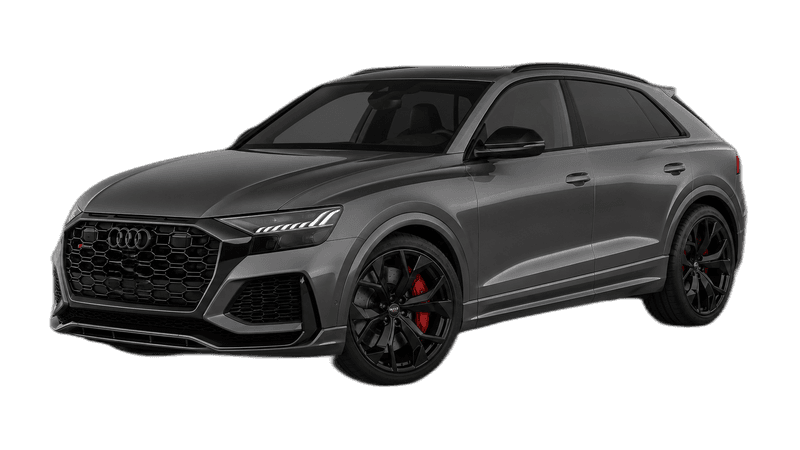
Audi RSQ8
£95,000
usedIndicative market price, updated periodically.
592bhp
Power
3.8s
0-100 km/h
250km/h
Top Speed
£95,000
Price Used
How hard it pulls.
Peak g-force the instant you bury the throttle, estimated from the car's 0–100 time and drivetrain.
Audi RSQ8Estimated peak launch g from the 0–100 time and drivetrain: an honest approximation, not a measured figure.
The Audi RSQ8 is a 5-door suv coupe by Audi, with 592 bhp, 800 Nm of torque, a 0-100 km/h time of 3.8 seconds and a top speed of 250 km/h. Indicative used value: approximately £95,000. Actual values vary with specification, condition and history.
Dream Car Garage Editorial · Edited by José Teo Lorente Vallecillos · Last updated 2 November 2026
Overview
We have not driven this car. This review is based on published specifications and the sources listed below.
Scope of this guide
This guide is scoped to the standard Audi RS Q8, the five-door SUV coupe with the 4.0L twin-turbo V8 petrol with 48V mild hybrid, quoted by Audi at 441 kW (600 PS), with permanent all-wheel drive and an eight-speed automatic gearbox. It covers the car revealed in November 2019 and sold from early 2020, and the lightly updated version announced in June 2024, because Audi kept the same power, torque and acceleration claims for the standard car through that update. It is not a guide to the RS Q8 performance, which Audi launched in 2024 with 640 PS, 850 Nm and a 3.6 second claim, nor to the Q8, SQ8 or any Q8 with a different engine. Where the performance car differs we say so below, because an advert that says only "RS Q8" can describe either.
We have not driven this model for this article. Everything here comes from three cited sources: Audi's own June 2024 press release for the updated RS Q8 and RS Q8 performance, PistonHeads' December 2019 review of the new car, and the government recall checker. We also read PistonHeads' June 2024 launch report and October 2025 UK review of the performance car, an evo report on the 2019 reveal, and an Ultimate Car Page specification summary, and we flag every point that rests on them. Where sources disagree we say so rather than pick a winner quietly. Prices are history, not valuations.
The figures at a glance
- Engine: 4.0L twin-turbo V8 petrol with 48V mild hybrid. Audi's figures are a capacity of about 4,000 cc and direct injection. We store 3996 cc, which is the figure PistonHeads prints in its spec box.
- Power: 592 bhp. Audi quotes 441 kW (600 PS), and PistonHeads prints 600hp at 6,000 rpm, which we read as the metric horsepower figure. Our own conversion is 600 PS x 0.98632, about 591.8 bhp, and 441 kW x 1.34102 is about 591.4 bhp, so 592 bhp is rounded from the PS figure. evo printed 591bhp at launch, and the difference between 591 and 592 is rounding, not a different engine. The production row we started from said 600 bhp, which is the PS number labelled as bhp.
- Torque: 800 Nm, available from 2,200 to 4,500 rpm on Audi's figures. PistonHeads prints 590 lb ft, which converts to about 800 Nm, and gives the range as 2,200 to 4,400 rpm.
- 0-100 km/h: 3.8 seconds, which is Audi's own figure. PistonHeads and evo print 3.8 seconds for 0-62 mph, so the two are the same claim expressed on different scales.
- Top speed: 250 km/h, the electronic limit. PistonHeads prints 155 mph in its spec box, which is the same limit. Audi's 2024 release says the limiter can be raised to 280 km/h or to a maximum of 305 km/h on request, and it names the optional dynamic package plus for the 305 km/h figure.
- Drive: all-wheel drive through a permanent quattro system. Audi describes a mechanical self-locking centre differential with a 40:60 front-to-rear split that can send up to 70 percent of torque to the front and up to 85 percent to the rear.
- Weight: 2,315 kg without driver on PistonHeads' figures, which evo also prints.
- Official economy on the 2019 review's spec box: 23.3 mpg and 277 g/km of CO2. Treat that as a test figure, not what an owner will see.
What the top speed numbers mean
The 250 km/h in our catalogue is the limiter, not the car's mechanical ceiling. A buyer will see three numbers in adverts: 250 km/h as standard, 280 km/h in some descriptions and 305 km/h with the dynamic package plus. Evo printed 189 mph for the package car, which agrees with 305 km/h. A South African magazine we found only as a search result printed 308 km/h, which does not match Audi, so we do not use it. We keep 250 km/h because it is what a standard car does and what the PistonHeads spec box shows. If you are viewing a car that is advertised at 305 km/h, ask for the build sheet showing the package, because we could not confirm from our sources how a higher limit is enabled on a given car.
The mild hybrid, and what we could not confirm
Ultimate Car Page and evo both describe a 48-volt system with a belt-driven alternator that recovers up to 12 kW during braking and stores it in a lithium-ion battery. PistonHeads' 2019 review says the mild hybrid system helps power the electric anti-roll control. We therefore name the mild hybrid in the engine string. The caveat is that Audi's own 2024 release, as we read it, mentions only a 48-volt lithium-ion battery for the optional electromechanical roll stabilisation and does not describe a mild hybrid system, and PistonHeads' 2025 review of the performance car says the car avoided hybrid technology to stay cheaper and lighter. We could not reconcile that with the earlier description. For a buyer the practical point is simple: ask what 48-volt hardware the specific car has, and have it checked, because we cannot tell you from sources that the 2024 car is built the same way as the 2020 car.
How the standard car and the performance car differ
Audi's release of 25 June 2024 launched two cars together. The updated RS Q8 kept 441 kW (600 PS), 800 Nm and 3.8 seconds to 100 km/h, with a new front apron, a reworked honeycomb grille, Matrix LED headlights and large digital OLED rear lights. The RS Q8 performance has 471 kW (640 PS) and 850 Nm, a 3.6 second claim and ceramic brakes as standard. PistonHeads' report from the same day says the performance car has a new exhaust and a 174 mph top speed. In October 2025 PistonHeads reviewed the performance car in the UK at 154,690 pounds, or 162,290 pounds as tested, with a weight of 2,275 kg. Those figures are for the other car. They are included only so that you can tell the two apart in an advert.
Chassis and running gear
The RS Q8 is a complicated car, and PistonHeads says so directly in its review: "It's an immensely complex car." Air suspension and all-wheel steering are standard on both 2024 cars according to Audi, and PistonHeads' 2019 review describes the electric anti-roll bars and the all-wheel steering that give the car its agility for its size. Audi's standard wheels are 22 inch with 295/40 tyres, and a 23 inch wheel is offered as an option. PistonHeads' review of the 2020 car found that the car never really settled on the 23s.
Standard brakes use 420 mm front discs and 370 mm rear discs on Audi's 2024 figures. The optional ceramic brakes have 440 mm front discs, and PistonHeads says they save 34 kg of unsprung weight in total. We found no published servicing schedule, parts price list or running cost for any of these components in the three cited sources, so we give none. Anyone who quotes you a figure for a tyre set, a disc set or an air spring is giving an estimate.
Launch, price and years
Audi revealed the car at the Los Angeles show in November 2019, and European dealers received it in the first quarter of 2020, according to the search results and reposts we read. PistonHeads' review is dated 16 December 2019 and gave a price of roughly 103,750 pounds, while evo said from 105,000 pounds. Those do not agree, and neither is a current price. We keep 2020 as the start year because that is when deliveries began. We leave the end year empty because the standard car was still on Audi's order list when its June 2024 release was written, and we found no source saying it has ended. We also found no source giving a production count, so we state none.
What to check before buying
- Confirm which car it is: the original car sold from 2020, the 2024 updated car, or the RS Q8 performance. Ask for the registration and the build sheet.
- Check the options list for the dynamic package plus, the ceramic brakes and the wheel size, because they change the top speed, the brake cost and the ride.
- Ask for service history from an Audi dealer or an Audi specialist, and ask what work has been done on the air suspension, the all-wheel steering and the active anti-roll system.
- Ask what 48-volt hardware the car has and whether any battery or generator fault has been logged.
- Inspect the wheels, tyres and discs. The standard rims are 22 inch and large, so kerb damage is easy to cause and expensive to put right.
- Look for evidence of any software changes or limiter changes, and ask what limit the car is actually set to.
- Run the registration through the recall check described below.
Recalls and the DVSA check
We did not run the government checker, because it needs a registration number or the manufacturer, model and year, and we are not looking at a specific car. The page says you can check whether a manufacturer has recalled a vehicle because of a serious safety problem, that a car's registration number is the way to see unfixed safety recalls together with its MOT history, and that without the number you can use the make, model and year. It also says that non-safety recalls are not covered by the online check and that the manufacturer will tell you directly. We found no recall notice for the RS Q8 in any of our sources, and absence from our sources is not a clean bill of health. A car imported from outside the UK may not appear on the checker at all, so ask an Audi dealer to confirm any open campaigns against the chassis number.
About the photograph
The picture at the top of this page shows a black RS Q8 in a dealer showroom in Solihull, England, photographed by Vauxford in January 2020, and it is licensed under CC BY-SA 4.0 through Wikimedia Commons. We cropped and resized it. The front plate mount is empty, so no registration is visible. Its Commons description gives the car as a 2019 model, which is the pre-update car this guide covers, so the image is a fair guide to the shape.
Verdict
The standard RS Q8 in this guide is 592 bhp (441 kW, 600 PS), 800 Nm, a claimed 3.8 seconds to 100 km/h and 250 km/h limited, with all-wheel drive, a 4.0 litre twin-turbo V8 and a lot of complicated chassis hardware. It is a heavy, quick and very capable family SUV whose headline figures matter less than its history, its options and the health of its air suspension, steering and anti-roll systems. If you are shopping for one, confirm whether it is the standard car or the performance car, insist on the options list, and treat every published figure as a claim with the caveats above. We have not driven it, so use the sources and a proper inspection to decide.
Specifications
Engine
4.0L twin-turbo V8 petrol with 48V mild hybrid
Displacement
4.0L
Power
592 bhp
Torque
800 Nm
0-100 km/h
3.8s
Top Speed
250 km/h
Drivetrain
AWD
Country
Germany
Body Style
5-door SUV coupe
Years
2020–present
Price Used
£95,000
Specifications are manufacturer-published figures.
More from Audi
Frequently Asked Questions
What are the specifications of the Audi RSQ8?
The Audi RSQ8 is a 5-door suv coupe by Audi, with 592 bhp, 800 Nm of torque, a 0-100 km/h time of 3.8 seconds and a top speed of 250 km/h. Indicative used value: approximately £95,000. Actual values vary with specification, condition and history.
How much does a Audi RSQ8 cost?
Indicative used value: approximately £95,000. Actual values vary with specification, condition and history.
What drivetrain does the Audi RSQ8 use?
The Audi RSQ8 is configured with all-wheel drive.
What type of car is the Audi RSQ8?
The Audi RSQ8 is a suvs manufactured by Audi in Germany. Production started in 2020.