
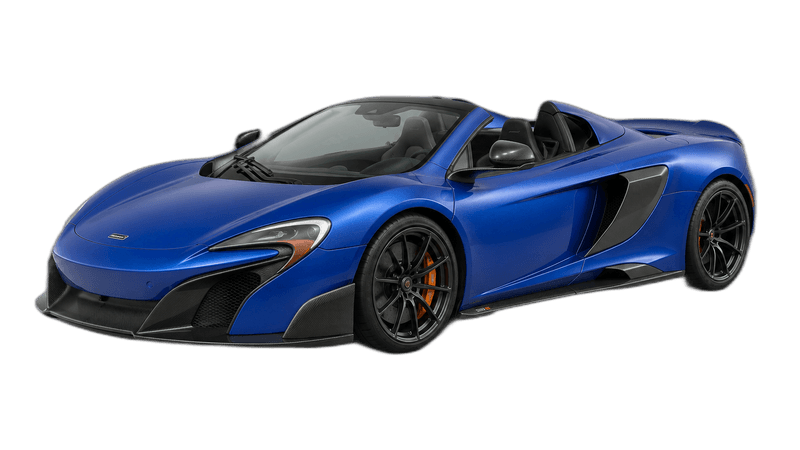
McLaren 675LT Spider
£350,000
usedIndicative market price, updated periodically.
666bhp
Power
2.9s
0-100 km/h
326km/h
Top Speed
£350,000
Price Used
How hard it pulls.
Peak g-force the instant you bury the throttle, estimated from the car's 0–100 time and drivetrain.
McLaren 675LT SpiderEstimated peak launch g from the 0–100 time and drivetrain: an honest approximation, not a measured figure.
The McLaren 675LT Spider is a 2-door convertible by McLaren, with 666 bhp, 700 Nm of torque, a 0-100 km/h time of 2.9 seconds and a top speed of 326 km/h. Indicative used value: approximately £350,000. Actual values vary with specification, condition and history.
Dream Car Garage Editorial · Last updated 27 October 2026
Overview
We have not driven this car. This review is based on published specifications and the sources listed below.
A distinct open-top Longtail
McLaren revealed the 675LT Spider after the coupe and limited it to 500 cars. It retains the 3.8-litre twin-turbocharged V8 with 675 PS, or 666 bhp, and 700 Nm, together with a seven-speed SSG and rear-wheel drive. The factory legacy page quotes 2.9 seconds to 100 km/h and 326 km/h, four km/h below the coupe. Those figures should not be replaced by the coupe's 330 km/h headline.
This is a desk-researched ownership guide. We have not driven this model for this article. The Spider's identity also needs to be separated from the 25-car MSO Carbon Series. A visual carbon package or a seller's reference to a special edition is not enough; the VIN and factory record must establish what the car actually is.
Roof mechanism and open-body inspection
The retractable hardtop is central to the Spider's ownership assessment. PistonHeads describes a three-piece roof that folds in roughly 15 to 16 seconds. Operate it through complete cycles only when conditions and the manufacturer's procedure permit, and watch for uneven movement, warnings or interference. Inspect the seals, surrounding trim and drainage paths for wear or poor adjustment.
A roof that eventually closes is not necessarily a roof that is working correctly. Ask whether any fault codes, hydraulic work or mechanical adjustments are documented. Check the tonneau and nearby panels for contact marks. Water ingress should be investigated through the roof seals and scuttle drainage rather than treated as an unavoidable convertible trait.
The carbon structure allowed McLaren to retain the coupe's dynamic brief without a conventional additional-stiffening programme. That does not make body condition irrelevant. Inspect panel alignment, windscreen condition, door operation and the underside. PistonHeads notes that soft-close doors can require adjustment and that wind noise can accompany poor sealing. Those observations are reasons for a careful check, not a claim that every Spider has the same problem.
Engine and cooling evidence
The Spider uses the same basic 675LT engine specification as the coupe, so the inspection should not be diluted into generic convertible checks. Oil level and condition need to be assessed using the correct procedure. Cooling evidence should include the coolant, thermostat behaviour, water-pump seal, turbo feed pipes and hose clips. PistonHeads also highlights the dry-sump catch tank's vulnerability to debris or tool damage and the substantial work involved in replacement.
With the undertrays removed, inspect a warmed transmission for seepage and the oil coolers for impact damage. The service file should show annual or 10,000-mile attention, with long storage periods explained. Low mileage can reduce some kinds of wear while leaving age-related questions unanswered. A battery-support routine and evidence that the car has been inspected regularly are more useful than a simple assurance that it was rarely driven.
Do not clear warnings without recording them. A McLaren specialist should be able to distinguish an old stored event from an active problem and explain what testing followed. The same applies to any recent fluid loss, overheating or limp-home history described by the seller.
Suspension, alignment and braking
The 675LT's hydraulically interconnected suspension, revised damping, wider front track and faster steering rack define much of its chassis behaviour. The buying guide identifies accumulators and front lower-arm bushes as inspection points. It also cautions that a pull can be a geometry issue rather than a steering-rack fault. Ask for alignment records and investigate any uneven tyre wear, vibration or steering offset with measurements.
Carbon-ceramic brakes were standard. Disc and pad condition should be assessed independently of the car's low mileage, and the inspection should include the hydraulic system and brake-fluid history. TPMS sensors near the front subframe can be damaged by impact, so a warning should be traced rather than ignored. Check all four tyres for age, specification and damage before any meaningful road evaluation.
The front axle lifter and parking camera are worth verifying because they affect ordinary use as well as originality. Their presence should be confirmed against the build record. A car without them is not automatically a poor car, but a seller should not describe equipment that is not fitted.
Active aero and exhaust
The Longtail Airbrake should deploy and retract correctly, without warnings or visible mounting damage. Its aerodynamic role makes correct operation more important than simply having the right rear-wing profile in photographs. Inspect the active mechanism and any related service history.
The titanium crossover exhaust is another defining component. Look for non-standard parts, heat damage and poor repairs. The underbody deflectors and trays need to be complete and securely fastened, particularly after transport or servicing. Impact damage underneath can affect more than the visible panel, so a clean exterior does not remove the need for a lift inspection.
Seats, Clubsport assumptions and cabin records
Optional P1-style fixed carbon seats should be assessed for fit as well as condition. Their shape and driving position will not suit every owner, and changing seats can create additional questions about sensors, harnesses and originality. Record what is fitted and whether any original parts accompany the car.
The coupe's safety-oriented Clubsport equipment, including a roll cage, harnesses and fire extinguisher, should not be assumed on the Spider. Romans distinguishes that equipment from the Spider's primarily aesthetic Clubsport Professional package. Equipment visible in a used car therefore needs a documented explanation. Cabin rattles, early IRIS behaviour and climate-control warnings belong in the inspection notes, while glass, aluminium oxidation and drainage deserve physical examination.
Records and inspection scope
A credible file links the VIN, factory options, 500-car identity, service history, geometry work, roof or hydraulic repairs and any replacement glass or body panels. Special-edition claims need separate evidence. Storage and battery care should be documented as carefully as mileage.
The final inspection should cover roof operation, diagnostics, cooling, transmission, hydraulic suspension, brakes, active aero and water paths. Any inaccessible area or unresolved warning should remain an open finding rather than being written off as normal for the model.
How this review was compiled
We have not driven this model for this article. McLaren's legacy page supplies the Spider's powertrain and performance. Romans International confirms the separate 500-car run and clarifies the coupe and Spider option distinctions, while PistonHeads supplies additional used-car inspection detail. No claim is made about current prices, future value or the likelihood of a particular fault.
Specifications
Engine
3.8L (3799 cc) twin-turbocharged V8
Displacement
3.8L
Power
666 bhp
Torque
700 Nm
0-100 km/h
2.9s
Top Speed
326 km/h
Drivetrain
RWD
Country
UK
Body Style
2-door convertible
Years
2016–2017
Production
500
Price Used
£350,000
Specifications are manufacturer-published figures.
More from McLaren
Frequently Asked Questions
What are the specifications of the McLaren 675LT Spider?
The McLaren 675LT Spider is a 2-door convertible by McLaren, with 666 bhp, 700 Nm of torque, a 0-100 km/h time of 2.9 seconds and a top speed of 326 km/h. Indicative used value: approximately £350,000. Actual values vary with specification, condition and history.
How much does a McLaren 675LT Spider cost?
Indicative used value: approximately £350,000. Actual values vary with specification, condition and history.
How many McLaren 675LT Spider were made?
McLaren produced 500 units of the McLaren 675LT Spider.
What drivetrain does the McLaren 675LT Spider use?
The McLaren 675LT Spider is configured with rear-wheel drive.
What type of car is the McLaren 675LT Spider?
The McLaren 675LT Spider is a supercars manufactured by McLaren in UK. Production ran from 2016 to 2017.