
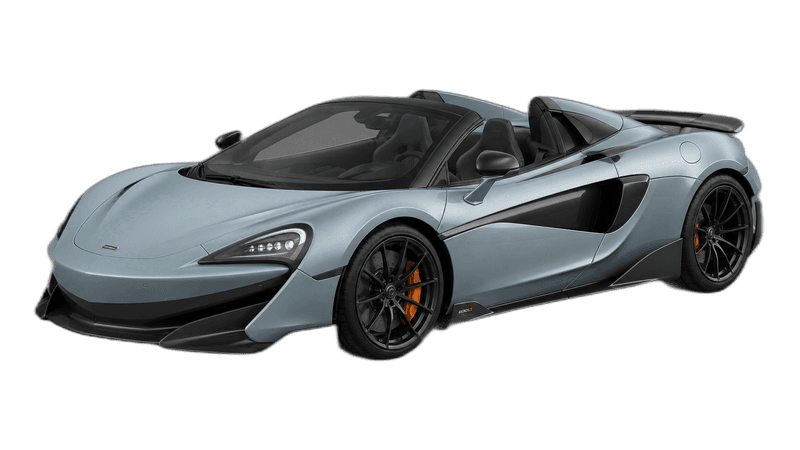
McLaren 600LT Spider
£170,000
usedIndicative market price, updated periodically.
592bhp
Power
2.9s
0-100 km/h
324km/h
Top Speed
£170,000
Price Used
How hard it pulls.
Peak g-force the instant you bury the throttle, estimated from the car's 0–100 time and drivetrain.
McLaren 600LT SpiderEstimated peak launch g from the 0–100 time and drivetrain: an honest approximation, not a measured figure.
The McLaren 600LT Spider is a 2-door convertible by McLaren, with 592 bhp, 620 Nm of torque, a 0-100 km/h time of 2.9 seconds and a top speed of 324 km/h. Indicative used value: approximately £170,000. Actual values vary with specification, condition and history.
Dream Car Garage Editorial · Last updated 27 October 2026
Overview
We have not driven this car. This review is based on published specifications and the sources listed below.
Open body, same Longtail brief
McLaren introduced the 600LT Spider after the coupe. It retains the 3.8-litre twin-turbocharged V8 with 600 PS, equivalent to 592 bhp, and 620 Nm, plus a seven-speed SSG and rear-wheel drive. Official performance is 2.9 seconds to 100 km/h and 324 km/h. The maximum speed differs from the coupe's 328 km/h and should not be copied between the two catalogue entries.
This is a desk-researched ownership guide. We have not driven this model for this article. McLaren did not release an official total production number for either 600LT body style. The Spider's run should therefore remain unquantified here rather than being estimated from dealer stock, regional deliveries or limited editions.
Retractable roof and structural inspection
The retractable hardtop sits beneath a tonneau cover and adds a powered rear window. McLaren says the MonoCell II structure required no additional strengthening for the Spider. That engineering statement does not eliminate the need to inspect the roof, seals, drainage and surrounding panels. Operate the roof through complete cycles when conditions permit and look for warnings, hesitation, uneven movement or contact marks.
Check the powered rear window independently. Inspect the tonneau, roof seals and visible drainage paths for damage or poor adjustment. Any water found inside should be traced rather than accepted as normal for an open car. The file should record roof or hydraulic repairs, diagnostic work and replacement trim.
The Spider's additional mass does not make its body immune from ordinary inspection. Examine panel alignment, undertrays and the front aerodynamic surfaces. PistonHeads describes the Spider as around 50 kg heavier than the coupe; use that comparison cautiously and do not confuse it with a measured weight for the individual car being inspected.
Powertrain and service evidence
The 3,799 cc V8 and seven-speed transmission require records that match the VIN. Annual oil and filter work, 20,000-mile coolant and clutch-oil attention and 40,000-mile gearbox oil and filter work are described in the buying guide. A car with little mileage still needs time-based evidence and an explanation for any missing years.
Inspect the cooling system, including the reservoir and hose clamps, and ask a specialist to check for stored faults and fluid loss. Battery condition is relevant to starting and key-recognition warnings. A healthy battery-support routine is useful, but it does not erase the need to investigate why warnings appeared. Any diagnostic report should preserve the original codes and the tests that followed.
The underside should be examined with trays removed where safe. Record any seepage, impact damage or loose fasteners. An inspection that only covers the visible engine bay leaves important questions unanswered, particularly on a low car whose underbody protects cooling and aerodynamic components.
Suspension, tyres and geometry
The Spider shares the 600LT's forged wishbones, hollow anti-roll bars, adaptive dampers and retuned chassis. Springs and anti-roll bars were stiffened relative to the 570S, ride height reduced and steering quickened. These details make alignment and tyre condition more informative than a generic sports-car checklist.
Regular geometry checks are advisable. PistonHeads records owner reports of front vibration on some Trofeo R-equipped cars, including one defective tyre and one warranty tie-rod case. Use those reports as prompts to measure and inspect, not as evidence that a particular Spider has a defect. Ask for an alignment printout and inspect suspension joints, wheels and tyres.
Trofeo R tyres were standard, with regular P Zero tyres available as a no-cost option. Confirm the actual fitment and its suitability for the intended use. Check age, flat spotting, damage and uneven wear. The correct response to vibration is a measured diagnosis, not an assumption that either the tyres or the steering rack must be at fault.
Brakes and aerodynamic hardware
The Spider uses carbon-ceramic brakes with six-piston front and four-piston rear calipers. PistonHeads notes uneven pad wear, so the inspection should include pad and disc condition, brake-fluid history and evidence of previous work. A clean set of wheels says little about the components behind them.
Inspect the fixed rear wing, extended diffuser, splitter and undertrays for damage and secure mounting. The top-exit exhausts and nearby heat-affected bodywork should be examined for original condition and poor repairs. Any modified exhaust needs documentation, and the buyer should establish whether the original parts remain with the car.
Nose lift, parking sensors and a rear camera were option-dependent. Verify their presence and operation rather than assuming that every Spider has them. The same applies to the active aerodynamic functions and any warnings stored in the vehicle's diagnostic history.
Seats, glass and option authenticity
Senna seats were optional and change access and driving position substantially. Standard heated and memory seats offer a different ownership experience. Try the fitted seats, inspect their condition and establish whether any change from the factory specification is documented. Clubsport Pro harnesses and a harness bar also require correct installation and completeness.
Thinner glass can be vulnerable to stress cracks. PistonHeads describes warranty replacement with a later screen, so ask for glass history and inspect the actual windscreen. Soft-close doors, window behaviour, cabin rattles and infotainment operation should be tested on the individual car. A low battery can explain some electrical symptoms, but it should not be used as a blanket explanation without diagnosis.
Security, Lux and MSO packs mean that two original Spiders can have very different equipment. The build sheet should settle air conditioning, audio, seat, lift, camera and carbon-content questions. Lightweight headline figures should not be used to declare a better-equipped car incorrect.
Production identity and final checks
The Spider followed the coupe and remained in production later. Limited editions such as the Segestria Borealis cars are separate identities and should not be used to invent a total for the standard model. The catalogue count remains unset because McLaren did not publish one.
A complete file should connect the VIN to options, service intervals, roof work, geometry, brakes, glass, warranty repairs and any paint or bodywork. The final inspection should cover diagnostics, roof operation, cooling, chassis, brakes, active aero and drainage. Any unresolved warning or inaccessible area should be stated plainly. No collectability forecast is needed to justify that work.
How this review was compiled
We have not driven this model for this article. McLaren's legacy page supplies the Spider's powertrain, performance and roof description, its anniversary material confirms the Longtail lineage, and PistonHeads supplies the used-car inspection and option detail. The guide does not assign an official production total, estimate market prices or convert isolated owner reports into failure rates.
Specifications
Engine
3.8L (3799 cc) twin-turbocharged V8
Displacement
3.8L
Power
592 bhp
Torque
620 Nm
0-100 km/h
2.9s
Top Speed
324 km/h
Drivetrain
RWD
Country
UK
Body Style
2-door convertible
Years
2019–2020
Price Used
£170,000
Specifications are manufacturer-published figures.
More from McLaren
Frequently Asked Questions
What are the specifications of the McLaren 600LT Spider?
The McLaren 600LT Spider is a 2-door convertible by McLaren, with 592 bhp, 620 Nm of torque, a 0-100 km/h time of 2.9 seconds and a top speed of 324 km/h. Indicative used value: approximately £170,000. Actual values vary with specification, condition and history.
How much does a McLaren 600LT Spider cost?
Indicative used value: approximately £170,000. Actual values vary with specification, condition and history.
What drivetrain does the McLaren 600LT Spider use?
The McLaren 600LT Spider is configured with rear-wheel drive.
What type of car is the McLaren 600LT Spider?
The McLaren 600LT Spider is a track focused manufactured by McLaren in UK. Production ran from 2019 to 2020.