
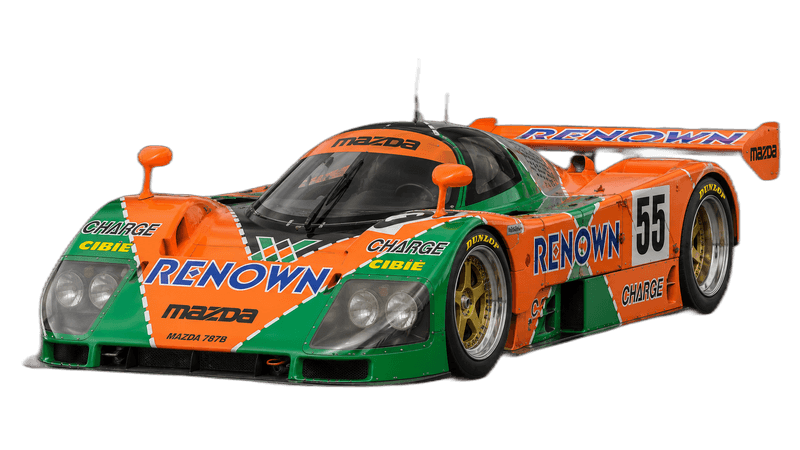
Mazda 787B
690bhp
Power
The Mazda 787B is a group c2 sports prototype by Mazda, with 690 bhp and 608 Nm of torque.
Dream Car Garage Editorial · Last updated 3 November 2026
Overview
We have not driven this car. This review is based on published specifications and the sources listed below.
Scope of this guide
This guide is scoped to the Mazda 787B, the Group C Category 2 sports prototype that Mazdaspeed and Oreca raced in 1991 and that won the 24 Hours of Le Mans that June. It is a mid-engine car with a 2.6L naturally aspirated four-rotor rotary behind the driver, a Mazda-Porsche five-speed gearbox and, as the catalogue lists it, rear-wheel drive. No page we read states the driven wheels in so many words, so the rear-wheel drive label rests on the mid-mounted engine layout and on the catalogue, and we flag it as an inference. It is not a guide to the 1990 Mazda 787, the earlier car that used the same engine family but a different chassis, and it is not a guide to any road-going rotary Mazda.
We have not driven this model for this article. We are an editorial desk that reads sources, and everything below comes from pages we opened: three pages on Mazda's own sites, the Ultimatecarpage specification sheet, Wikipedia, ConceptCarz, Driver61, the Driven Car Guide, a Racing Sports Cars chassis page and a Japanese enthusiast specification table. This is a competition car that essentially never comes to market. A guide like this cannot replace an inspection by a specialist, and this page is for research, not a buying recommendation.
The figures at a glance
- Engine: 2.6L naturally aspirated four-rotor rotary, the Mazda R26B. Mazda's own pages give the displacement as 654cc x 4 rotors, which is 2,616 cc, and Ultimatecarpage and Wikipedia's infobox print 2,616 cc.
- Power: 690 bhp. Mazda's R26B page and its anniversary site rate the engine at 700 PS at 9,000 rpm. We convert PS to bhp at 0.98632, which gives 690 bhp, and we use that number throughout. Ultimatecarpage prints the same output as 700 bhp and Wikipedia prints 700 PS as 691 hp, so you will see 700 on many pages. The difference is a unit convention, not a different engine rating. See the disagreements section for the higher and lower claims.
- Torque: 608 Nm at 6,500 rpm. Mazda's page prints 62 kg-m at 6,500 rpm, which converts to about 608 Nm, and Ultimatecarpage and Wikipedia both print 608 Nm.
- 0-100 km/h: no figure shown. We found no acceleration time in any source.
- Top speed: no figure shown. No source we read gives a top speed.
- Layout: mid-engine, longitudinally mounted engine, five-speed manual gearbox, rear-wheel drive as catalogued.
- Weight: 830 kg on Mazda's anniversary site, Ultimatecarpage and Wikipedia's infobox.
- Size: 4,782 mm long, 1,994 mm wide and 1,003 mm high on a 2,662 mm wheelbase, from Mazda's 787B page and the Ultimatecarpage sheet.
- Chassis: carbon composite monocoque (Wikipedia calls it Kevlar and carbon composite, built by Advanced Composite Technology in the UK), carbon brake discs, Dunlop tyres on 18 inch RAYS wheels.
- Cars built: three 787B chassis, per Ultimatecarpage, ConceptCarz and Wikipedia.
Where the sources disagree
The first disagreement is displacement. Every Mazda page we read treats the engine as four 654cc rotors, so 2,616 cc, and that is the displacement we use. Wikipedia's infobox agrees, but its specification table prints 5,240 cm3 for the same engine and the article does not reconcile the two. Mazda's own 787B page adds a third number: a FISA reciprocating equivalent of 4,708.8 cc. That equals 2,616 cc multiplied by 1.8, and we infer that the figure is the capacity the rules used to place a rotary in a class, though the page does not spell out the multiplier. The Le Mans paperwork therefore treated the car as a much bigger engine than the 2.6 litres it physically displaces. The catalogue value of 2,616 is the swept volume, and we keep it, with the rated equivalent noted here.
The second is power. Mazda's spec box says 700 PS at 9,000 rpm. Wikipedia's body text says the engine could reach about 900 hp at 10,000 rpm, that the Le Mans car was reportedly limited to 700 hp, and that the 1991 redline was cut to 8,500 rpm for 650 hp. ConceptCarz also reports a cap of 8,500 rpm and about 650 BHP for the 1991 race, while Driver61 says 700 hp in the race and 900 hp in qualifying. These cannot all describe the same condition, and none of them is a dyno sheet. We use the maker's 700 PS rating, converted to 690 bhp, and we treat the 650 and 900 claims as unconfirmed.
The third is weight. Mazda's anniversary site and Ultimatecarpage say 830 kg. Mazda's 787B page says over 839 kg, and Wikipedia's specification section says about 850 kg while its infobox says 830 kg. We show 830 kg and note the range.
The fourth is the distance of the winning run. Mazda's page gives 362 laps and about 4,923 km, ConceptCarz gives 4,923.2 km, and Wikipedia prints 4,932.2 km. Multiplying 362 laps by the 13.6 km lap length Mazda gives yields 4,923.2 km, so we read Wikipedia's figure as a transposition. Mazda's page also gives 13.9 km for the circuit in another sentence.
The fifth is the third chassis. Wikipedia says it was built mainly to replace the Le Mans winner in competition and retired in 1992, although the same article says it raced in 1991 after Le Mans. The Driven Car Guide says it was built at short notice for the Japanese championship and has been restored and preserved. We cannot settle which is right.
History of the car and the 1991 win
Mazda's account is that its Le Mans effort began in 1970, that the factory team Mazdaspeed was formed in 1983, and that the 787B was the culmination of its rotary Group C cars. The 787 of 1990 was an evolution of the 767 and 767B. Wikipedia says the name signalled a two-step improvement over the 767. Both 1990 cars retired at Le Mans with engine and electrical problems.
For 1991 the 787B received a continuously variable intake, which Wikipedia says raised torque to 608 Nm, plus changed suspension geometry for larger wheels and carbon ceramic brakes. Mazda's R26B page describes the engine as four sequential rotor housings with the 13B's rotor shape, peripheral ports, electronic fuel injection, a linear variable air intake, three plugs per rotor chamber and ceramic apex seals. Wikipedia names Nigel Stroud as designer and credits Jacky Ickx with advice, and Oreca ran the world championship campaign while Mazdaspeed ran the Japanese effort.
At Le Mans, the winning car, number 55, qualified 12th fastest but started 19th, because the new 3.5-litre cars filled the front rows. It won the 59th race on 23 June 1991 with Volker Weidler, Johnny Herbert and Bertrand Gachot, two laps ahead of the second-placed Jaguar, per the Driven Car Guide. The 787B in the number 18 car finished sixth and the older 787 in the number 56 car finished eighth, per Mazda and Wikipedia. ConceptCarz gives the winner's average speed as 205.133 kilometres per hour over the 24 hours, which is a race average and not a top speed. Mazda calls it the first win at Le Mans for a Japanese manufacturer and the first for a rotary engine. Driver61 adds that the post-race inspection found the engine had lost 2 percent of its power.
The car's racing life ended soon after. Wikipedia and Driver61 both say rotary engines were outlawed for the following season as the series moved to a 3.5-litre formula.
Cars built and where they are
The number built is three, from the three secondary sources that state it. Mazda's own pages do not give a total. The Driven Car Guide names chassis 787B-002 as the winner, raced as number 55, and 787B-003 as the remaining car. Racing Sports Cars lists 787B-001 as having started nine events in 1991, with a best finish of fourth. The Driven Car Guide adds that the winner's series entry number was 18 and that 55 was used only at Le Mans, because Mazda had to enter all eight World Sportscar Championship rounds.
The winning car is preserved. The Driven Car Guide says it sits in a room dedicated to the Le Mans win at the Mazda Museum in Hiroshima. Wikipedia says it was displayed at the Otaru City Museum for 20 years and returned to Mazda headquarters in November 2015, and says Mazda built two replicas, one of which went to the Le Mans museum. The 20th anniversary in 2011 saw the car restored by members of the original team and driven on the Circuit de la Sarthe, with Johnny Herbert at the wheel.
What the rarity means for a collector
Three chassis exist and the winner is in the maker's museum, and we found no record of a 787B being offered for sale. For that reason this page cannot offer a checklist of the kind a road car deserves. The practical points from our reading are limited to provenance. Chassis numbers matter, because the car number 55 was only a Le Mans number and the winner's series entry number was 18, so a car number alone does not identify a chassis. Replicas exist, and Wikipedia says Mazda built two, so any car presented as a 787B needs documentary proof of which chassis it is. Beyond that, keeping a four-rotor racing engine running is a specialist job whose requirements we cannot describe from what we read.
Running costs, known issues, recalls and market value
We found no running costs, service intervals, rebuild intervals or failure rates for the 787B, so we give none. We found no recall or safety notice, and we did not search a recall database. We found no auction result, valuation or asking price for a 787B, so we give no price. Anyone quoting one without a source is guessing.
What we could not find
We found no acceleration time and no top speed for the car, so both fields show no figure shown in the catalogue figures above. We found no dyno sheet, so the real output of the race car is unconfirmed beyond the maker's 700 PS rating and the competing 650 and 900 hp claims. We found no maker statement of the driven axle, and no maker statement of the total number built. The zwischengas.com article and the Motor Authority article both returned a 403 error and we did not work around it. A Mazda page on an origin host failed to load, and an Auto Express link returned a news listing without the article, so we did not use them. A Japanese enthusiast table gave a 1990-specification comparison, but its body text was garbled, so we used only its spec table.
About the photograph
This page uses the catalogue photograph for the car. Its credit is listed on the credits page.
Verdict
The 787B is a mid-engine, rear-wheel-drive Group C prototype with a 2.6L naturally aspirated four-rotor rotary rated at 700 PS, which we show as 690 bhp, and 608 Nm, with a race weight of about 830 kg. It matters because it won Le Mans in 1991 for Japan and for the rotary engine, and because only three were built. For a reader of this page, the useful facts are the displacement convention that made a 2.6 litre engine race as roughly 4.7 litres, the unresolved power claims, and the absence of any acceleration or top speed figure. We have not driven it, and no one should use this page to buy or authenticate a car. Use it for research and talk to a specialist.
Sources
- Mazda: 787B (Motorsports, Le Mans)
- Mazda: R26B 4-Rotor Engine (Motorsports, Le Mans)
- Mazda: Le Mans 30th anniversary commemorative site
- Ultimatecarpage: Mazda 787B specifications
- Wikipedia: Mazda 787B
- ConceptCarz: Mazda 787B
- Driver61: The Mazda 787B, rotary power at Le Mans
- Driven Car Guide: Up close, meeting Mazda's Le Mans-winning 787B
- Racing Sports Cars: chassis 787B-001
- Mazda 787B specification table (asahi-net.or.jp)
Specifications
Engine
2.6L naturally aspirated four-rotor rotary
Displacement
2.6L
Power
690 bhp
Torque
608 Nm
Drivetrain
RWD
Country
Japan
Body Style
Group C2 sports prototype
Years
1991
Production
3
Specifications are manufacturer-published figures.
More from Mazda


Frequently Asked Questions
What are the specifications of the Mazda 787B?
The Mazda 787B is a group c2 sports prototype by Mazda, with 690 bhp and 608 Nm of torque.
How many Mazda 787B were made?
Mazda produced 3 units of the Mazda 787B.
What drivetrain does the Mazda 787B use?
The Mazda 787B is configured with rear-wheel drive.
What type of car is the Mazda 787B?
The Mazda 787B is a track only manufactured by Mazda in Japan. Production ran from 1991 to 1991.