
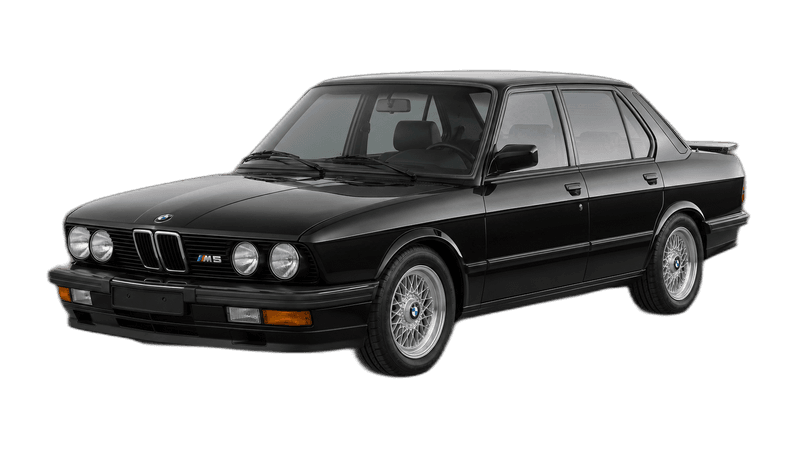
BMW M5 (F90)
£60,000
usadoIndicative market price, updated periodically.
617cv
Potencia
3.2s
0-100 km/h
250km/h
Velocidad Máxima
£60,000
Precio Usado
Cómo empuja.
La fuerza g máxima en el instante en que pisas a fondo, estimada a partir del 0–100 y la tracción del coche.
BMW M5 (F90)G de salida estimada a partir del 0–100 y la tracción: una aproximación honesta, no una cifra medida.
The BMW M5 (F90) is a 4/5 seater sedan/saloon by BMW, producing 617 bhp, and 750 Nm of torque, with a 0-100 km/h time of 3.2 seconds, and a top speed of 250 km/h, Valued at approximately £60,000.
Dream Car Garage Editorial · Last updated 24 October 2026
Visión General
We have not driven this car. This review is based on published specifications, owner reports and market listings.
A different M5 drivetrain
The F90 M5 introduced M xDrive to the M5 line, pairing a twin-turbocharged V8 with an eight-speed automatic and four-door saloon body. Its operating modes and power delivery are different from the manual E39 or V10 E60 ownership proposition. A buyer should want this particular combination rather than assume every M5 offers the same controls, costs or mechanical simplicity.
We have not driven this model for this article. This is a desk-researched guide to its specification and buying questions, not a claim about personally measured acceleration or winter grip. All-wheel drive does not shorten every stopping distance or make unsuitable tyres safe. The actual car's condition and the driver's decisions remain central to using its performance responsibly.
Standard, Competition and CS
Identify the factory derivative and installed equipment. Competition changes are not authenticated by badges alone, while the M5 CS is a separate limited-production version with different seating and other equipment. Compare build records with the physical car. A standard model with retrofitted wheels or an aftermarket tune should be described and insured as such rather than priced solely from its claimed output.
Updates during production also matter. Check the build date, cabin equipment and any relevant technical changes instead of assigning every improvement to a broad registration-year cutoff. The car should be evaluated against its actual specification and maintenance requirements. Imported examples may differ in equipment or warranty arrangements, so establish the country of first sale and local support position.
Engine and cooling inspection
Review servicing of the S63 V8, oil condition, cooling-system work and any history of overheating or warning messages. Have a suitable technician inspect for leaks and assess the installation rather than accepting an engine bay cleaned for sale as evidence of health. Repeated top-ups or unexplained repairs warrant a coherent diagnosis and invoices showing the remedy.
Do not apply every reported issue from an earlier S63 installation automatically to the F90, nor assume that a later engine is immune to expensive problems. Ask which checks are appropriate to the build and symptoms. Published buying advice provides questions, not a measured failure probability. A quiet demonstration cannot certify internal components that would require more extensive assessment.
Automatic transmission and M xDrive
Check gearbox operation cold and warm, including gentle manoeuvres and ordinary shifts. Investigate hesitation, vibration or warnings through diagnosis. A fluid change may be appropriate within a maintenance plan, but it should not be promised as the cure for an unidentified fault. Obtain guidance for this transmission and use history rather than borrowing a fixed interval from a different BMW.
The transfer system, differential and tyres should be assessed together. Confirm tyre specification, matching, age and wear pattern, then investigate persistent driveline noise or uneven wear. Test modes only where appropriate and following operating instructions. Disabling assistance or selecting a more demanding mode during an ordinary viewing is unnecessary to establish basic mechanical health and can create avoidable risk.
Chassis and braking costs
Identify the brakes fitted and request an appropriate condition assessment, particularly where carbon-ceramic equipment is present. The replacement price depends on the actual system and the work required. A general online disc price does not establish the bill for a specific car, while colour or a model badge may be misleading after modifications.
Inspect suspension, adaptive dampers, steering, wheels and the underside for damage. A powerful saloon's comfortable cabin can disguise wear during a short drive, so obtain measured findings where possible. Track use or repeated hard use needs investigation through maintenance and repair records. Low mileage is not a reliable substitute for that information.
Cabin and daily use
Test seats, climate control, cameras, displays, locks, assistance features and both keys. Check whether features advertised by the seller are factory fitted, functional and usable in the current market. A software reset that temporarily removes a warning does not establish a lasting repair. Request records where electronics or sensors have needed attention after a collision or windscreen replacement.
Try parking and garage access with the car's size in mind. Rear doors and a substantial boot can make it practical, but the intended passengers, luggage and ordinary routes should decide. Compare wheel and seat choices for comfort rather than automatically valuing the largest or most expensive options. A car that remains enjoyable to use may be preferable to a more dramatic specification that rarely leaves storage.
An ownership budget, not a tariff
Commission an inspection-led estimate for the next service, consumables and any unresolved faults. Include insurance, tax, fuel and possible transport to a capable workshop. This article has no current invoice survey supporting a standard annual running-cost figure. A warranty should be read for actual exclusions, claim limits and repair arrangements rather than treated as protection against every expensive component.
Compare cars by derivative, specification and documented condition, distinguishing asking prices from completed transactions. There is no evidence here for a permanent resale floor or a promise that a particular variant will hold value. Maintenance spending and selling costs remain real even if collector interest develops. A purchase needs to be affordable without relying on such a prediction.
Alternatives and the evidence boundary
A contemporary E63 offers another fast-saloon approach, while an older M5 changes both the driving formula and maintenance questions. Consider a less powerful car if most use is ordinary transport and the additional operating expense does not serve a clear purpose. No desk-research ranking can decide that trade-off for every owner.
The published F90 buying guide supports generation-specific investigation. It does not certify an advertised example or establish universal reliability once a checklist of jobs has been completed. Obtain a coherent history, verify specification and have the actual vehicle assessed before payment; that is more useful than treating the badge or drivetrain modes as guarantees.
Especificaciones
Motor
4.4L S63 twin-turbo V8 petrol
Cilindrada
4.4L
Potencia
617 cv
Par Motor
750 Nm
0-100 km/h
3.2s
Velocidad Máxima
250 km/h
Tracción
AWD
País
Germany
Carrocería
4/5 seater sedan/saloon
Años
2018–2023
Precio Usado
£60,000
Specifications are manufacturer-published figures.
Más de BMW
Preguntas Frecuentes
What are the specifications of the BMW M5 (F90)?
The BMW M5 (F90) is a 4/5 seater sedan/saloon by BMW, producing 617 bhp, and 750 Nm of torque, with a 0-100 km/h time of 3.2 seconds, and a top speed of 250 km/h, Valued at approximately £60,000.
How much does a BMW M5 (F90) cost?
The BMW M5 (F90) has a used market value of approximately £60,000.
Is the BMW M5 (F90) AWD or RWD?
The BMW M5 (F90) uses a AWD drivetrain configuration in a 4/5 seater sedan/saloon body style.
What type of car is the BMW M5 (F90)?
The BMW M5 (F90) is a super saloons manufactured by BMW in Germany. Production ran from 2018 to 2023.