
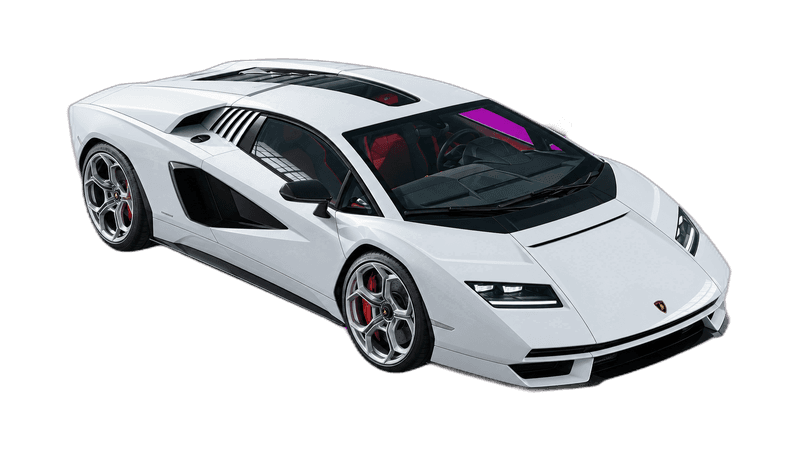
Lamborghini Countach LPI 800-4
803cv
Potencia
2.8s
0-100 km/h
355km/h
Velocidade Maxima
Como puxa.
A força g máxima no instante em que pisas a fundo, estimada a partir do 0–100 e da tração.
Lamborghini Countach LPI 800-4G de arranque estimada a partir do 0–100 e da tração: uma aproximação honesta, não um valor medido.
The Lamborghini Countach LPI 800-4 is a 2-door coupé by Lamborghini, with 803 bhp, a 0-100 km/h time of 2.8 seconds and a top speed of 355 km/h.
Dream Car Garage Editorial · Last updated 28 October 2026
Visão Geral
We have not driven this car. This review is based on published specifications and the sources listed below.
A limited-series Countach for the hybrid era
The Countach LPI 800-4 is Lamborghini's 50th-anniversary tribute to the original Countach. It was built in a run of 112 cars. The powertrain combines a 6.5-litre naturally aspirated V12 producing 780 cv with a 34 cv electric motor, for a combined 814 cv. Lamborghini quotes 355 km/h and 0 to 100 km/h in 2.8 seconds.
This is a desk-researched ownership guide. We have not driven this model for this article. The LPI 800-4 is a limited-series car with a short public history, so the guide focuses on the systems that distinguish it from a conventional Aventador and the documents that support its identity.
V12, electric motor and supercapacitor
The V12 produces 780 cv at 8500 rpm. The electric motor adds 34 cv and is fed by a supercapacitor rather than a conventional lithium-ion battery. Lamborghini says the supercapacitor provides three times more power than a lithium-ion battery of the same weight, and the electric machine plus supercapacitor weigh 34 kg. The car's dry weight is 1595 kg, giving a dry weight-to-power ratio of 1.95 kg per cv.
The supercapacitor and its power electronics are the most important difference from a standard Aventador. Ask for a hybrid diagnostic report, a check of the capacitor condition and evidence that the cooling system has been maintained. The car should be driven in electric and hybrid modes where the specification allows, and the stop-start and torque-fill behaviour should be observed.
Do not assume that a low-mileage car has a healthy supercapacitor. Age, storage and charging history can affect the system. A Lamborghini specialist should check for stored faults and confirm that the voltage and temperature readings are within the factory range.
Four-wheel steering and active suspension
The LPI 800-4 has four-wheel steering, four-wheel drive and four-wheel active suspension. These systems are integrated, so a fault in one can affect the others. Inspect the steering and suspension through diagnostics and a road assessment. Listen for abnormal noise and check for warning messages.
The car sits low, and the front lift system is useful. Test it and inspect the front splitter for contact damage. Check the dampers for leaks and the suspension arms for play. A four-wheel alignment report is useful evidence, particularly if the car has been used on poor roads or transported between countries.
Brakes, tyres and bodywork
The car uses carbon-ceramic brakes. Measure the discs and pads, check the fluid history and inspect the calipers for heat damage. The original Countach-style wheels and the wide tyres are part of the design, so confirm that the correct specification is fitted. Check the date codes on all four tyres.
The bodywork has scissor doors, a distinctive rear wing and a mix of sharp lines and large intakes. Open and close the doors carefully and check the hinges, struts and latches. Inspect the paint around the shut lines and the rear wing for damage. A limited-series car with poor paint repair is difficult to correct without affecting its value.
The front boot and rear engine cover should operate correctly. Check the underbody, the diffuser and the side skirts for contact damage. Ask for photographs of any repair and the identity of the repairing workshop.
Cabin and equipment
The cabin is based on the Aventador but has unique trim and a numbered plaque. Check that the plaque, the build number and the documentation agree. Test the seats, the screens, the climate control and the audio. The cabin is narrow, so confirm that the driving position suits the intended driver.
The Countach tribute includes retro-inspired details and modern materials. Confirm that the visible specification matches the build record. Aftermarket trim or electronic modifications should be disclosed and assessed for their effect on the warranty.
Using the hybrid system
The supercapacitor is not charged from a mains supply in the way a plug-in hybrid battery is. It recovers energy under braking and uses it to assist the engine and support low-speed manoeuvring. That means the health of the system depends on how the car has been driven and stored, not on a charging cable.
Ask the seller to demonstrate the electric assistance and the stop-start behaviour. A car that has been idle for months may have a low state of charge and may need a period of normal driving before the system behaves consistently. A persistent warning or a failure to provide assistance should be diagnosed by a Lamborghini specialist.
Check the cooling ducts and the underbody panels that protect the hybrid hardware. Debris or impact damage can affect cooling and protection. The supercapacitor and its electronics are expensive components, so a diagnostic report is more useful than a visual inspection alone.
Limited-series provenance
The 112-car production run is part of the car's identity. Ask for the build sheet, the delivery documentation, the service history and any factory correspondence. Confirm the VIN and the original market specification. A car that has been exported or repainted should have the relevant documents.
The LPI 800-4 is not a standard Aventador with a body kit. Its powertrain, chassis systems and trim are specific to the model. A specialist inspection should confirm that the unique parts are present and correct.
Storage and ownership planning
Storage is important for a hybrid limited-series car. Ask how the car has been kept, whether the supercapacitor and battery systems were maintained and what work was done before it was returned to service. A fresh service and a clean interior are not proof that the hybrid system is healthy.
Confirm the warranty position, the service intervals and the recall status. Use a Lamborghini specialist with high-voltage training. The inspection should cover the engine, the hybrid system, the transmission, the steering, the suspension, the brakes, the tyres, the structure and the electrical functions.
Sources and limitations
Lamborghini's official Countach LPI 800-4 model page and press document supply the powertrain, performance and production information, while the Few Off collection page provides context for the limited-series range. The guide makes no claim about transaction prices, future values or reliability. A factory-trained inspection and a VIN-based campaign check remain necessary.
Especificacoes
Motor
6.5 L naturally aspirated V12 with supercapacitor hybrid
Cilindrada
6.5L
Potencia
803 cv
0-100 km/h
2.8s
Velocidade Maxima
355 km/h
Tracao
AWD
País
Italy
Carroceria
2-door coupé
Anos
2022
Producao
112
Specifications are manufacturer-published figures.
Mais de Lamborghini




Perguntas Frequentes
What are the specifications of the Lamborghini Countach LPI 800-4?
The Lamborghini Countach LPI 800-4 is a 2-door coupé by Lamborghini, with 803 bhp, a 0-100 km/h time of 2.8 seconds and a top speed of 355 km/h.
How many Lamborghini Countach LPI 800-4 were made?
Lamborghini produced 112 units of the Lamborghini Countach LPI 800-4.
What drivetrain does the Lamborghini Countach LPI 800-4 use?
The Lamborghini Countach LPI 800-4 is configured with all-wheel drive.
What type of car is the Lamborghini Countach LPI 800-4?
The Lamborghini Countach LPI 800-4 is a supercars manufactured by Lamborghini in Italy. Production ran from 2022 to 2022.