
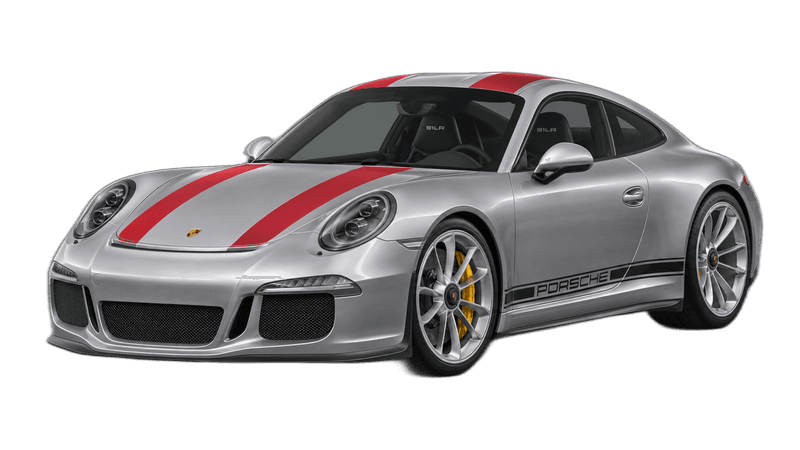
Porsche 911 R (991)
493cv
Potenza
3.8s
0-100 km/h
323km/h
Velocita Massima
Quanto spinge.
La forza g di picco nell'istante in cui affondi l'acceleratore, stimata dal tempo 0–100 e dalla trazione.
Porsche 911 R (991)G di partenza stimata dal tempo 0–100 e dalla trazione: un'approssimazione onesta, non un dato misurato.
The Porsche 911 R (991) is a 2-door coupé by Porsche, with 493 bhp, 460 Nm of torque, a 0-100 km/h time of 3.8 seconds and a top speed of 323 km/h.
Dream Car Garage Editorial · Edited by José Teo Lorente Vallecillos · Last updated 3 November 2026
Panoramica
We have not driven this car. This review is based on published specifications and the sources listed below.
Scope of this guide
This guide is scoped to the Porsche 911 R (991), the limited 2016 special that Porsche revealed at the Geneva motor show on 1 March 2016. It is a two-seat, rear-engine, rear-wheel drive coupé with a naturally aspirated four-litre flat-six behind the rear axle and a six-speed manual gearbox as the only transmission. Porsche limited the run to 991 cars. The name is a deliberate echo: the Porsche press release says the new car stands in the tradition of a road-legal racing 911 from 1967 that was built in small numbers and used in rallies, on the Targa Florio and for world record runs. This page is about the 2016 car and not about that 1967 original, and it is not a guide to the 911 GT3 RS or the standard 911 range that the 991 generation is named after.
We have not driven this model for this article. We are an editorial desk that reads sources, and everything below comes from pages we opened: a Porsche press release in German issued by Porsche Switzerland, Wikipedia, evo, GTspirit, The Drive, an RM Sotheby's lot page, a Bonhams sale report reproduced by a classic car auctions site, and a Stuttcars model page. We have not inspected, owned or tested a car. This is a collector car that rarely comes to market, so this page is for research, not a buying recommendation, and no guide can replace an inspection by a Porsche specialist.
The figures at a glance
- Engine: 4.0L naturally aspirated flat-six, 3,996 cc according to Wikipedia, in the rear-engine layout. Porsche says it is the six-cylinder boxer known from the 911 GT3 RS.
- Drivetrain: rear-wheel drive, six-speed manual only.
- Power: 493 bhp at 8,250 rpm. Porsche gives 500 PS (368 kW) at 8,250 rpm. Converting 500 PS at 0.98632 gives about 493.2 bhp, and evo and Wikipedia both print 493 bhp or 493 hp, so we use 493 bhp throughout this page.
- Torque: 460 Nm at 6,250 rpm. This is Porsche's figure and Wikipedia repeats it. evo prints 339 lb ft, which converts at 1.35582 to about 459.6 Nm, so it agrees.
- 0-100 km/h: 3.8 seconds, the figure in the Porsche press release.
- Top speed: 323 km/h, again from the press release. evo and GTspirit print 201 mph, and 201 multiplied by 1.60934 is 323.5 km/h.
- Weight: 1,370 kg in the Porsche release, GTspirit and Wikipedia, with evo adding a dry figure of 1,250 kg.
- Years: unveiled in March 2016 as a 2016 model.
- Production: limited to 991 cars.
Origins and what the car is
The press release describes a puristic sports car in a classic mould: a high-revving naturally aspirated engine, a manual gearbox and consistent lightweight construction, developed by the motorsport department at Flacht. It adds that the R extends the range of high-output naturally aspirated Porsches alongside the 911 GT3 and 911 GT3 RS, and that the drivetrain and all the lightweight body components are based on the GT3 RS, while the complete chassis comes from the GT3.
Wikipedia puts it in similar terms. It says the R shares most of its underpinnings with the GT3 RS but leaves out the roll cage, the rear wing and the associated bodywork, for a weight saving of 50 kg. The Porsche release agrees on the 50 kg, saying the R undercuts the GT3 RS by that amount. The Drive describes the car as an analogue take on the GT3 RS with a manual gearbox and a deleted rear wing, and evo says the manual gearbox uses the casing of the RS dual-clutch unit with new internals and saves about 20 kg over that unit.
Weight saving and equipment
The pages we read list a consistent set of changes:
- A carbon-fibre bonnet and front wings, and a magnesium roof, according to the Porsche release and GTspirit. The release says this lowers the centre of gravity.
- Lightweight plastic for the rear screen and rear side windows, reduced sound insulation, and no rear bench seat. evo puts the removed insulation at about 4.5 kg.
- Air conditioning and the radio and audio system are not fitted as standard. GTspirit calls them optional extras, and the Porsche release says the optional air conditioning and audio system fell victim to the diet.
- A titanium sports exhaust with central twin tailpipes.
- Carbon-fibre bucket seats with centre panels in a Pepita tartan fabric, a nod to early 911s, a 360 mm GT sport steering wheel, a short-shift gear lever and fabric door pulls.
- Carbon trim in the cabin with an aluminium plaque on the passenger side that marks the limited run.
Outside, the release says the body looks like a Carrera at first glance. The GT3 front and rear sections and the central twin tailpipes give it away. There is no fixed wing: a retractable rear spoiler from the Carrera range and an R-specific underbody diffuser provide downforce, and a redesigned spoiler lip sits on the front bumper. Stripes in red or green run across the middle of the car, and Porsche lettering appears on the sides.
Chassis, brakes and options
Both the Porsche release and GTspirit list rear-axle steering and a mechanical rear limited-slip differential. Ceramic composite brakes are standard, with 410 mm discs at the front and 390 mm at the rear. The tyres are 245 mm wide at the front and 305 mm at the rear on forged 20-inch centre-lock wheels with a matt finish. evo says the tyres are Cup 2 and that the rear steering is retained with a different response calibration. Porsche stability management was adapted for the car.
Options named by the sources are a single-mass flywheel, which Porsche says noticeably improves response and revving, and a front lift system that raises the nose by about 30 mm for everyday use. The release also mentions a button-activated throttle blip for downshifts. These options matter later, because they are part of why two cars of the same model can differ.
Which figures we chose, and why
Power and torque
Porsche's own number is 500 PS, which is 368 kW. The sources that print 493 bhp or 493 hp (evo and Wikipedia) and the sources that print 500 hp (GTspirit and the RM Sotheby's page) appear to be using different units for the same output, so we treat them as consistent. We use 493 bhp because it is the British horsepower equivalent of the metric rating, and we keep it everywhere on this page. Torque is 460 Nm in the Porsche release, on GTspirit and on Wikipedia. Stuttcars prints 338 lb ft in a listing line, which converts to about 458 Nm, a rounding difference.
Acceleration
The Porsche release says the car passes 100 km/h from rest in 3.8 seconds, and Wikipedia prints the same 3.8 seconds for 0-100 km/h. The other two pages that give an acceleration time use a different basis. evo prints a claimed 0-60 mph time of 3.8 seconds and says it suspects that is conservative, while GTspirit prints 3.7 seconds to 60 mph. We have not relabelled either of those as a 0-100 km/h time. We use 3.8 seconds because it is the maker's figure on the correct basis.
Top speed
Porsche gives 323 km/h, and GTspirit prints 201 mph (323 km/h) directly. evo also quotes 201 mph and reports that its test reached an indicated two hundred miles per hour with the car still pulling in sixth. An indicated speed is not a measured one, so we do not treat that as a test of the claim. Wikipedia says the lower drag of the R compared with the GT3 RS gives it a higher top speed.
Weight
The Porsche release gives 1,370 kg and describes it as a weight with a full tank, as the release words it. Wikipedia lists 1,370 kg as a DIN figure, and evo prints 1,370 kg kerb with a dry weight of 1,250 kg, though its text has a stray letter where the unit should be. The pages therefore use different bases, and we cannot say which basis is authoritative. We use 1,370 kg and describe it only as the figure the maker and Wikipedia print.
Years and production
Wikipedia says production was limited to 991 examples as a 2016 model. The Porsche release says the model is limited to 991 units, and GTspirit, The Drive and Stuttcars all repeat 991. The RM Sotheby's page shows a car numbered 656 of 991 with a completion date of 21 December 2016 and a delivery date of 16 February 2017. That suggests the run ended in 2016 but some cars reached customers in 2017, though it is one car and we have not seen a statement from Porsche about the final build date. We therefore show 2016 only.
Fuel use and prices at launch
The release gives combined NEDC fuel use of 13.3 l/100 km, 20.1 l/100 km in town and 9.3 l/100 km outside, with 308 g/km of CO2. GTspirit prints 21.2 mpg alongside the same 13.3 l/100 km.
At launch the UK price was 136,901 pounds according to evo and GTspirit, with UK deliveries due to begin in June 2016. evo sets that against the BMW M4 GTS at 120,500 pounds, the Lamborghini Huracán at about 155 thousand pounds and the Aston Martin Vantage GT8 at just under 90,000 pounds. The Swiss release gives a price of about 231 thousand Swiss francs including VAT and local equipment, with an extended 2 plus 2 year warranty for Swiss customers. The Drive says a US window sticker on the car in its report showed the equivalent of around 168,000 dollars.
Auctions and market notes
All the money figures below come from pages we opened and describe single cars or listings, not the market as a whole.
- Bonhams, The Zoute Sale, 7 October 2016: the report says the car hammered for 483,000 euros (539,000 dollars) against an estimate of 250,000 to 350,000 euros. It describes this as the first 911 R sold at public auction, says eleven telephone bidders competed against the room, calls the car the 135th produced, delivered new to Sweden with only 52 km, and says all 991 cars were pre-sold.
- RM Sotheby's: a car numbered 656 of 991 in Grand Prix White over Yachting Blue leather, with 19.7 miles at cataloguing, shows a total price when new of 296,480 dollars including 92,899 dollars of options, and a result of 1,105,000 dollars, sold. The page does not give a sale date.
- The Drive: an 87-mile car on a Bring a Trailer auction had a bid of 250,000 dollars with four days left when the article was written. It does not give the final result.
- Stuttcars: a sample dealer listing shows an asking price of 799,995 dollars for a car with 1,439 miles. An asking price is not a sale, and the page does not date it.
The spread between these numbers is a reminder that cars with very low mileage, unusual specification or a famous first sale can fetch very different prices, and that prices move. Check current sale results before relying on any number here.
What the rarity means for anyone researching a purchase
We found no source with a pre-purchase inspection checklist for this model, so we are not going to invent one. What the sources do tell us is that no two cars need be alike. Air conditioning, audio, the single-mass flywheel and the front lift were options, the RM Sotheby's car carried a large options total, and Porsche offered the stripes in two colours. Stuttcars says low-mile original cars command premiums and that many R-specific components are unique and expensive to replace, though it gives no examples or prices, so we treat that as a general claim and not a finding. The practical advice we can give is the generic kind: get the full history, confirm the specification against the build record with a Porsche specialist, and pay for an expert inspection.
What we could not find
- A Porsche English-language press release or technical data page that we could read in full.
- Any statement from Porsche of the exact last build date, so there is no figure shown for it. The sources say 2016 and one auction car was delivered in 2017.
- A single agreed basis for the 1,370 kg weight.
- Measured, independent acceleration or top-speed figures. The 3.8 seconds and 323 km/h are maker claims, and evo's indicated reading is not a measurement.
- Reliability data, recalls or a model-specific list of faults. No page we read gave any, so the page says nothing about them.
- We could not open Top Gear (access refused), Car magazine (payment required), Autocar (payment required), Drive.com.au, Elferspot, Classic Driver, Broad Arrow and several other auction pages (access refused).
About the photograph
The page uses the catalogue photograph for this model, and its credit is listed on the credits page.
Verdict
The 911 R is easy to summarise from the pages we read: a GT3 RS engine and chassis hardware in a quieter body, with a manual gearbox, no rear wing and less weight, built in a run of 991. Our figures are 493 bhp, 460 Nm, 3.8 seconds to 100 km/h and 323 km/h, with the caveats that the weight is quoted on different bases and that the performance numbers are Porsche's claims. The auction and listing figures show a car that sold for several times its launch price, but they describe individual cars and may not describe today's market. Treat this page as a research aid, not a buying recommendation.
Sources
- Porsche Schweiz: Wolf im Schafspelz, der neue Porsche 911 R (press release, 1 March 2016, German)
- Wikipedia: Porsche 991 (911 R section)
- evo: Porsche 911 R review
- GTspirit: Official 2017 Porsche 911 R
- The Drive: There's an 87-mile Porsche 911 R up for auction right now
- RM Sotheby's: 2016 Porsche 911 R lot page
- Bonhams The Zoute Sale 2016 results (Porsche press release, via classic-car-auctions.info)
- Stuttcars: Porsche 911 R (991) model page
Specifiche
Motore
4.0L naturally aspirated flat-six
Cilindrata
4.0L
Potenza
493 cv
Coppia
460 Nm
0-100 km/h
3.8s
Velocita Massima
323 km/h
Trazione
RWD
Paese
Germany
Carrozzeria
2-door coupé
Anni
2016
Produzione
991
Specifications are manufacturer-published figures.
Altre di Porsche
Domande Frequenti
What are the specifications of the Porsche 911 R (991)?
The Porsche 911 R (991) is a 2-door coupé by Porsche, with 493 bhp, 460 Nm of torque, a 0-100 km/h time of 3.8 seconds and a top speed of 323 km/h.
How many Porsche 911 R (991) were made?
Porsche produced 991 units of the Porsche 911 R (991).
What drivetrain does the Porsche 911 R (991) use?
The Porsche 911 R (991) is configured with rear-wheel drive.
What type of car is the Porsche 911 R (991)?
The Porsche 911 R (991) is a sports cars manufactured by Porsche in Germany. Production ran from 2016 to 2016.