
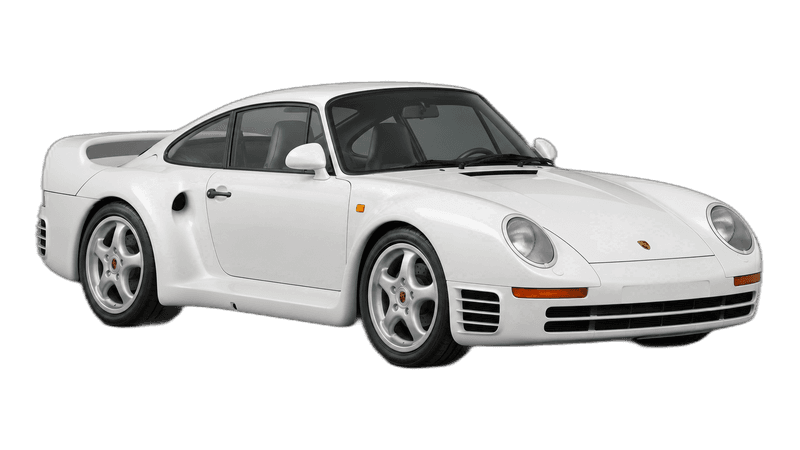
Porsche 959 Komfort
444bhp
Power
3.7s
0-100 km/h
317km/h
Top Speed
How hard it pulls.
Peak g-force the instant you bury the throttle, estimated from the car's 0–100 time and drivetrain.
Porsche 959 KomfortEstimated peak launch g from the 0–100 time and drivetrain: an honest approximation, not a measured figure.
The Porsche 959 Komfort is a 2-door coupé by Porsche, with 444 bhp, a 0-100 km/h time of 3.7 seconds and a top speed of 317 km/h.
Dream Car Garage Editorial · Last updated 28 October 2026
Overview
We have not driven this car. This review is based on published specifications and the sources listed below.
Porsche's technology flagship
The Porsche 959 was developed from the company's Group B programme and became a road car in the mid-1980s. It uses a 2.85-litre twin-turbocharged flat-six producing 450 PS, a six-speed gearbox and an electronically controlled four-wheel-drive system. Porsche quotes 317 km/h and 0 to 100 km/h in 3.7 seconds.
Porsche records 292 series-production road cars built in 1987 and 1988. The total becomes larger when prototypes, competition cars and later factory completions are included. The 959 Sport is rarer still, with 29 examples sold according to Porsche. The standard car is known as the Komfort.
This is a desk-researched ownership guide. We have not driven this model for this article. The 959 is a complex, hand-built car with model-specific systems, so the guide focuses on the inspection points that require specialist knowledge.
Engine and sequential turbos
The flat-six uses air-cooled cylinders and water-cooled four-valve cylinder heads. Two turbochargers operate sequentially: one provides boost at lower engine speeds and the second joins under higher load. The system was designed to reduce lag, but it adds complexity.
Ask for the boost behaviour to be checked by a specialist. Listen for abnormal noise, check the vacuum lines and inspect the turbochargers for oil leaks. A car that has been stored may have perished hoses and seized wastegates. A boost leak can cause poor performance and may not trigger an obvious warning.
The engine uses titanium connecting rods and a dry-sump lubrication system. Check the oil pressure, the oil condition and the evidence of leaks. A compression test and a leak-down test are useful. A rebuild is a specialist operation, and parts can be difficult to source.
The six-speed gearbox has a G ratio for terrain, reflecting the car's rally origins. It is not a conventional low-range transfer case. Check that every gear engages cleanly and that the clutch operates correctly.
PSK four-wheel drive and active suspension
The 959 uses the Porsche-Steuer Kupplung system, which varies the torque split between the front and rear axles. The driver can select programmes, and the system responds to conditions. The car also has speed-sensitive adjustable dampers, self-levelling suspension, ABS and tyre-pressure monitoring.
These systems are the heart of the 959 ownership experience. Ask for a diagnostic report and evidence that the PSK, the dampers and the ride-height system have been maintained. Test every selectable mode and listen for abnormal pump or actuator noise. A warning that has been disabled is not a repair.
The hydraulic suspension uses accumulators and lines that can age. Check for leaks, correct ride height and uneven behaviour. A car that has been sitting may need new accumulators, seals and fluid. The parts are specialist items, so a pre-purchase inspection should identify what is needed.
Body, wheels and tyres
The body mixes Kevlar and glass-fibre-reinforced epoxy panels with aluminium doors and a bonnet. Inspect the panels for cracks, poor repairs and accident damage. The composite structure can hide damage that is not obvious from the paint.
The 959 uses hollow magnesium wheels with a sealed tyre chamber and a tyre-pressure monitoring system. Corrosion and damage to the wheels are concerns, and the original Denloc tyre system is difficult to support today. Ask which tyres are fitted, whether the wheels are original and how the pressure monitoring system has been maintained.
A car with non-standard wheels or tyres should be assessed for clearance, speed rating and effect on the drivetrain. The 959's performance makes correct tyres essential.
Brakes, steering and road behaviour
The 959 has ABS and ventilated disc brakes, but the system is period technology and needs maintenance. Inspect the discs, pads, calipers and fluid. A car that has been stored may have seized calipers or degraded hoses. Test the brakes at low speed before any high-speed assessment.
The steering is unassisted and should feel direct. Check the front and rear suspension for play, leaks and correct ride height. The PSK system can change the car's behaviour, so a test drive should include a variety of surfaces and speeds. Do not explore the limits on a public road.
The 959 is a heavy car with a complex drivetrain. A specialist should check the wheel bearings, the driveshafts and the differential. Any vibration or unusual noise should be investigated before the car is used at speed.
Storage and recommissioning
Long storage can be as significant as high mileage. Seals, hoses, fuel-system components, accumulators and electrical connections all age. Ask when the car was last driven, how it was stored and what work was done before it returned to the road.
A recent service invoice should list the work, the parts and the diagnostic findings. A cosmetic detail and a fresh MOT are not enough. A 959 specialist should check the fuel system, the brakes, the suspension, the PSK and the engine before the car is used at speed.
Documentation and inspection
Ask for the chassis number, the factory records, the service history and the ownership file. The 959's value depends on provenance, originality and correct systems. A car with a documented restoration by a recognised specialist is easier to assess than one with gaps in its history.
Use a Porsche Classic centre or a recognised 959 specialist. The inspection should cover the engine, the turbo system, the PSK, the suspension, the brakes, the wheels, the tyres, the body and the electrical systems. Ask for a cold start, a diagnostic scan and a written report.
Sources and limitations
Porsche's official 959 history supplies the production and technical context, while the Stuttcars buyer's guide and the Unusual Cars model guide provide the ownership and inspection topics. The guide makes no claim about transaction prices, future values or universal reliability. A specialist inspection and a documented provenance check remain necessary.
Specifications
Engine
2.85 L twin-turbocharged flat-six
Displacement
2.8L
Power
444 bhp
0-100 km/h
3.7s
Top Speed
317 km/h
Drivetrain
AWD
Country
Germany
Body Style
2-door coupé
Years
1987–1988
Production
292
Specifications are manufacturer-published figures.
More from Porsche


Frequently Asked Questions
What are the specifications of the Porsche 959 Komfort?
The Porsche 959 Komfort is a 2-door coupé by Porsche, with 444 bhp, a 0-100 km/h time of 3.7 seconds and a top speed of 317 km/h.
How many Porsche 959 Komfort were made?
Porsche produced 292 units of the Porsche 959 Komfort.
What drivetrain does the Porsche 959 Komfort use?
The Porsche 959 Komfort is configured with all-wheel drive.
What type of car is the Porsche 959 Komfort?
The Porsche 959 Komfort is a sports cars manufactured by Porsche in Germany. Production ran from 1987 to 1988.