
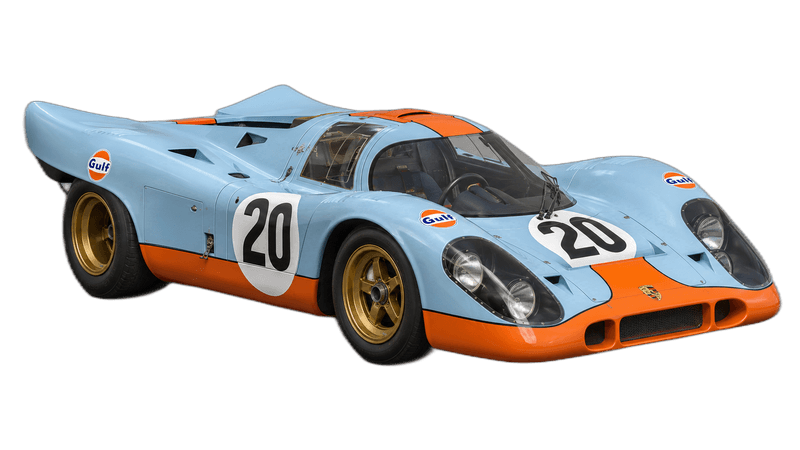
Porsche 917 K
572bhp
Power
360km/h
Top Speed
The Porsche 917 K is a 2-door racing coupé by Porsche, with 572 bhp and a top speed of 360 km/h.
Dream Car Garage Editorial · Edited by José Teo Lorente Vallecillos · Last updated 3 November 2026
Overview
We have not driven this car. This review is based on published specifications and the sources listed below.
Scope of this guide
This guide is scoped to the Porsche 917 K, the Kurzheck (short-tail) racing coupe that Porsche ran in the 1970 and 1971 seasons. It is mid-engine and rear-wheel drive, with an air-cooled flat-12 sitting behind the driver. This is a competition car, not a road car. It was built to race, we found nothing in any source describing a roadgoing version, and the catalogue lists it as track only. For that reason we give no ownership or running-cost advice beyond what a source states, and we found no source that states any. This page is about history, the two Le Mans wins, the engine's growth from 4.5 litres to about 4.9 litres, homologation, and how rarity and provenance work for individual chassis.
We have not driven this model for this article. We are an editorial desk that reads sources. Everything below comes from pages we opened: several Porsche newsroom pages including a one-page Porsche data sheet for the 1971 car, a Christophorus feature, the Le Mans 24 Hours website, Wikipedia, the Gooding and Company press release for one chassis, Carscoops, Stuttcars and Supercar Nostalgia. These cars almost never come to market. A page like this cannot replace a specialist inspection of a specific chassis, and it is for research, not a buying recommendation.
The figures at a glance
- Engine: 4.5L flat-12, the air-cooled twelve-cylinder in its original 1970 size. Wikipedia's infobox lists 4,494 cc for this engine. The same car later ran larger engines, covered below.
- Power: 572 bhp. Porsche's 50-years-of-Le-Mans page and Stuttcars give 580 hp for the 1970 car, with Stuttcars adding 426 kW at 8,300 rpm. That 580 is a metric horsepower (PS) class number, and 426 kW matches it. We convert 580 PS at 0.98632 to get 572 bhp. The catalogue row says 580 bhp, which treats a PS figure as bhp, so we correct it. Wikipedia prints 600 bhp for the 4.9-litre version, and Porsche's 1971 data sheet prints 441 kW (600 PS), which converts to about 592 bhp.
- Torque: no figure shown. None of the sources we read gives a torque figure for the 917 K, so we do not give one.
- 0-100 km/h: no figure shown. We found no acceleration time for the car in any source.
- Top speed: 360 km/h. This is the figure on Porsche's 1971 data sheet for the 4,907 cc car, so it is a maker figure for the later 4.9-litre car, not for the 4.5-litre car. Treat it as a ceiling that depended on gearing and on the circuit.
- Weight: Wikipedia lists 820 kg; Porsche's 1971 data sheet lists 800 kg.
- Dimensions (Wikipedia, 917 K): 4,120 mm long, 1,980 mm wide, 940 mm high, on a 2,300 mm wheelbase.
Where the sources disagree
Several numbers do not match across the pages we read, and we say so rather than picking silently.
- Power. Wikipedia says the 4.5-litre engine produced around 520 bhp in 1969, 600 bhp for the 4.9-litre version and a maximum of 630 bhp by 1971. The Christophorus feature says over 630 bhp for the 5.0-litre engine against 500 bhp for the 4.5-litre. A Porsche newsroom history page gives 620 hp for the 1970 race car, and another Porsche page says the engine packs almost 600 hp. Porsche's 1971 data sheet says 600 PS. We use 580 PS (572 bhp) for the 4.5-litre car because Porsche's 50-years-of-Le-Mans page and Stuttcars both give 580.
- Engine size. Wikipedia's text says the engine started at 4.5 litres, was bored to 4.9 litres and then to 5 litres later in 1970. Its infobox lists 4,494, 4,999 and 5,374 cc. Porsche's data sheet gives 4,907 cc for 1971, and a Porsche newsroom page about a 1971 Spa car calls it a bored-out five-litre. A chassis list on Wikipedia gives 4,494 cc for the K rows. We therefore treat 4.5 litres as the 1970 size, about 4.9 litres as the 1970-1971 development, and do not claim a single answer for any one chassis.
- Weight: 820 kg against 800 kg, as above. Porsche's data sheet says the 1971 magnesium-frame car needed a 55-litre oil tank to reach the 800 kg minimum, so 800 kg is a regulatory floor as well as a figure.
- Production. See the section on rarity below, where the count is the biggest disagreement.
- Homologation date. Wikipedia says the 917 was homologated for May 1969. Supercar Nostalgia says 25 completed cars were shown on 20 April 1969 and that homologation took effect on 1 May. The Le Mans website also says 25 cars were displayed at the factory on 20 April 1969.
History: from the 917 to the Kurzheck
The 917 came out of a rule change. The Le Mans website and Supercar Nostalgia both say the sports-car authority cut the homologation requirement from 50 cars to 25 for the five-litre Sports class, and Wikipedia dates the cut to April 1968. Porsche built a flat-12, its first twelve-cylinder engine, and showed 25 finished cars to inspectors in April 1969. That first car was the long-tailed 917 and it was difficult to drive. Supercar Nostalgia says the two works 917s started first and second at Le Mans in 1969 but failed to finish. The Christophorus feature adds that Attwood and Vic Elford led by six laps after 21 hours before a gearbox failure.
Wikipedia says the Kurzheck was developed after a late-1969 test at the Osterreichring, where a short tail was taped together with aluminium sheet. The 917 K made its public debut at the 24 Hours of Daytona in January 1970 against the Ferrari 512S. The Christophorus feature says Porsche developed the short-tail car with John Wyer's JW Automotive team. Stuttcars says the cut-off tail added downforce and cost as much as 30 mph of top speed. Wikipedia says the long-tail 917 L was about 25 mph faster down the straights. That trade of top speed for stability is the point of the K.
Le Mans 1970 and 1971
On 14 June 1970 the red-and-white Porsche Salzburg 917 KH with start number 23, driven by Hans Herrmann and Richard Attwood, won Porsche's first overall Le Mans victory. Porsche's page gives the distance as 4,607.811 kilometres or 343 laps. Stuttcars gives the same laps and 2,863.15 miles. Second was the Martini Racing long-tail car of Gerard Larrousse and Willi Kauhsen, which Porsche calls a 917 LH, and third was a 908/02 driven by Rudi Lins and Helmut Marko. Wikipedia says only seven finishers were ranked in a wet race and that the winner had the 4.5-litre engine. It also says JW Automotive entered three 917 Ks, two with the 4.9-litre engine and one with the 4.5-litre, and that all of them were out after 12 hours. Attwood told Christophorus he asked for the smaller engine so as not to stress the gearbox, after the 1969 gearbox failure.
In 1971 the Martini Racing 917 of Helmut Marko and Gijs van Lennep won. Porsche's data sheet says they averaged 222.3 km/h over 5,335 kilometres, which set two records that stood for 39 years. It also says the car had new shark fins at the rear, stated to give more directional stability and lower drag, that it was the first Porsche raced with a magnesium space frame, and that it ran an engine of 4,907 cc. Wikipedia says it was a 1-2 for the Martini and JW Automotive 917 Ks ahead of two Ferrari 512M, and that the record stood until 2010. The data sheet also says this chassis was completed on 5 June and ended its racing career with the win.
Rarity, chassis and provenance
Rarity of a 917 K is about individual chassis, not a model run. Each car has a numbered history of drivers, teams, crashes, rebuilds and re-bodying, and the sources we read treat that history as the value. Wikipedia lists chassis individually, noting for example that chassis 053, the 1971 Le Mans winner with a magnesium frame, is on display at the Porsche Museum, and that magnesium chassis 051 was scrapped after tests. We cannot verify any of that against the metal.
How many were built is not settled. Wikipedia's infobox says 25 917s were built for 1969-1970 and 12 917 Ks for 1970-1971, yet its production section gives 43 naturally aspirated cars (36 K, 5 long-tail and 2 Spyders) plus 16 turbocharged cars, 59 in total, and another passage says over 50 chassis in total. The figure of 25 is the homologation batch of the original long-tail car, not a count of the K. The 12 and the 36 for the K cannot both be right. We found no source that states a single number for the 917 K, so the catalogue's production count should stay empty.
Two chassis show how provenance works in sales. Gooding and Company's press release for chassis 917-024 says it was used in 1970 Le Mans testing by Brian Redman and Mike Hailwood, sold to Jo Siffert, leased to Steve McQueen's Solar Productions for the film Le Mans, and stored for about 25 years before its 2001 rediscovery and a restoration by Graber Sportgarage finished in 2017. Gooding estimated 13 to 16 million US dollars. Carscoops says it sold for 14.8 million US dollars in 2017, though other outlets in search results quoted 14.08 million, and we could not open those pages to settle it. Carscoops also reports that chassis 917-022, a second film car, appears to have last sold at auction in 2000 for 1.32 million US dollars before Mecum offered it at a January sale (the Wikipedia chassis list gives 18 January 2025). Those are two cars, two different eras and a film connection, so they are not a price list.
What we could not find
We found no torque figure, no acceleration time, no maker figure for the 4.5-litre car's top speed, no single production count for the K and no fuel-consumption or maintenance data. A search snippet suggested a Porsche archive page lists 340 km/h for the 1970 car, but the page we opened did not show it, so we do not use it. We found no Porsche data sheet for the 1970 car, only the 1971 one. A separate Supercar Nostalgia page on the 917 K and a nesn report of the 2017 sale returned not found, and a Rennlist and a Hagerty page were blocked, so we did not use them. We did not look for running costs because this is a competition car, and we found no recall or safety data.
About the photograph
This page uses the catalogue photograph for the car. Its credit is listed on the credits page.
Verdict
The Porsche 917 K is a mid-engine, rear-wheel-drive racing coupe. In its 1970 form it had a 4.5L flat-12 at about 572 bhp (580 PS), and by 1971 Porsche's data sheet shows a 4,907 cc engine at 600 PS and 360 km/h. It won Le Mans in 1970 and 1971, and its significance is that history. A guide cannot replace a specialist inspection, and this page is for research, not a buying recommendation. We have not driven it, and torque and 0-100 km/h remain no figure shown.
Sources
- Porsche Newsroom: Porsche 917 KH data sheet (1971 Le Mans winner)
- Porsche Newsroom: Porsche achieved the first overall victory at Le Mans 50 years ago
- Porsche Newsroom: In praise of the fast car (Le Mans winners 1970)
- Porsche Newsroom: Porsche 917 KH in Singapore (1971 Spa car)
- Porsche Newsroom: The Porsche story 6 (917 and Le Mans)
- Porsche Christophorus: Natural born winner (917 K)
- 24h-lemans.com: 917 exhibition, where it all began
- Wikipedia: Porsche 917
- Gooding and Company: 1970 Porsche 917K, chassis 917-024 press release
- Carscoops: Steve McQueen's Porsche 917K could smash auction records (August 2024)
- Stuttcars: Porsche of the Day, 1970 Porsche 917 K-70
- Supercar Nostalgia: Porsche 917 historical and technical appraisal
Specifications
Engine
4.5L flat-12
Displacement
4.5L
Power
572 bhp
Top Speed
360 km/h
Drivetrain
RWD
Country
Germany
Body Style
2-door racing coupé
Years
1970–1971
Specifications are manufacturer-published figures.
More from Porsche
Frequently Asked Questions
What are the specifications of the Porsche 917 K?
The Porsche 917 K is a 2-door racing coupé by Porsche, with 572 bhp and a top speed of 360 km/h.
What drivetrain does the Porsche 917 K use?
The Porsche 917 K is configured with rear-wheel drive.
What type of car is the Porsche 917 K?
The Porsche 917 K is a track only manufactured by Porsche in Germany. Production ran from 1970 to 1971.