
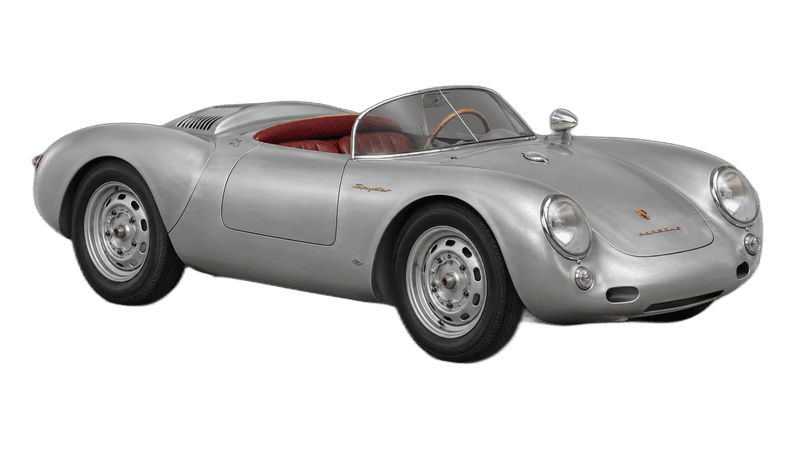
Porsche 550 Spyder
108cv
Potenza
220km/h
Velocita Massima
The Porsche 550 Spyder is a 2-door roadster by Porsche, with 108 bhp, 121 Nm of torque and a top speed of 220 km/h.
Dream Car Garage Editorial · Edited by José Teo Lorente Vallecillos · Last updated 3 November 2026
Panoramica
We have not driven this car. This review is based on published specifications and the sources listed below.
Scope of this guide
This guide is scoped to the Porsche 550 Spyder, the lightweight open sports-racer that Porsche built from 1953 to 1956 around a four-cam engine. It is a mid-engine, rear-wheel drive car with the engine mounted ahead of the rear axle, and Porsche's own press kit describes it as a mid-engine sports car with an aluminium body. We treat the original 550 as the subject. The 550A, introduced in 1956 with a new space frame and a stronger engine, gets its own section because the sources describe it differently, and we keep its figures apart from the 550 figures. Racing-tuned RS versions are mentioned only where a source mentions them.
We have not driven this model for this article. We are an editorial desk that reads sources, and everything below comes from pages we opened: a Porsche Museum press kit, a Porsche stories page, Wikipedia, Stuttcars, Silodrome, and two RM Sotheby's lot pages. This is a collector and competition car that rarely comes to market, and many replicas exist, so a guide like this cannot replace an inspection by a recognised Porsche specialist. This page is for research, not a buying recommendation.
The figures at a glance
- Engine: 1.5L naturally aspirated flat-four, the Porsche Type 547, an all-aluminium, air-cooled, four-cam boxer. Wikipedia gives 1,498 cc (bore and stroke 85 mm by 66 mm in most 550s) and calls it naturally aspirated. The Porsche press kit also prints 1498 ccm.
- Power: 108 bhp. Wikipedia prints 110 PS (108 hp; 81 kW) at 6,200 rpm. The Porsche stories page prints 110PS, the press kit prints 81 kW (110 HP), and Stuttcars prints 110 bhp at 6200 rpm. We multiply 110 PS by 0.98632 to get about 108 bhp, which matches the 108 hp that Wikipedia prints. Converting 81 kW with the factor 1.34102 gives about 109, so the sources straddle 108 and 109 and the "110" is the metric horsepower number printed under several unit labels. We use 108 bhp throughout.
- Torque: 121 Nm. Wikipedia prints 121 N-m (89 lb-ft) at 5,000 rpm. Stuttcars prints 88.5 ft lbs at 5000 rpm, which is the same figure within rounding.
- 0-100 km/h: no figure shown. The only acceleration time we found is a 0-60 mph time of 7.0 seconds on Stuttcars, and we do not relabel a 0-60 mph time as a 0-100 km/h time. Wikipedia gives no acceleration figure at all.
- Top speed: 220 km/h. The Porsche press kit prints 220 km/h and the Porsche stories page says almost 220km/h. Stuttcars prints 137 mph, which is about 220 km/h at 1.609 km per mile.
- Drive: rear-wheel drive. Wikipedia describes a rear mid-engine, rear-wheel-drive layout, with a limited-slip differential and a 4-speed manual at launch, then a 5-speed manual from 1956.
- Weight: sources disagree. Wikipedia says approximately 550 kg, and the Porsche stories page says 590kg. We do not pick one.
- Production: about 90 cars from 1953 to 1956. See the production section below, because the pages we read give different counts for different groupings.
Why the catalogue power figure changes
The production catalogue row for this page showed 110 bhp. None of the sources we read contradicts the number 110, but it is a metric horsepower figure, 110 PS, and 110 PS is not 110 bhp. Using the stated conversion, 110 PS is about 108 bhp, and that is what we propose. Stuttcars does print 110 bhp, so a reader who sees 110 bhp elsewhere is not necessarily seeing an error, only a different rounding convention. We prefer 108 bhp because the maker's own pages are in PS or kW and Wikipedia gives the converted 108 hp figure.
History and development
The Porsche stories page says the 550 Spyder debuted at the 1953 Paris Motor Show, with production from 1953 to 1956. The Porsche press kit labels the model year as 1954 and calls the car Porsche's first model built specifically for racing. Wikipedia says the car won the Nurburgring Eifel Race in May 1953, its first race, and took class wins at the 1953 24 Hours of Le Mans and the Carrera Panamericana. Stuttcars instead dates the class win at the Carrera Panamericana to 1954 and describes it as the 1500cc class. The press kit says the car won its class and placed third overall at the Carrera Panamericana against larger-engined rivals. We cannot reconcile the years from these pages alone, so treat the exact race-by-race dates as unsettled.
The engine is the heart of the story. Wikipedia calls it the Type 547 or Fuhrmann engine, after Dr. Ernst Fuhrmann. Stuttcars adds dry-sump lubrication and dual-plug ignition to the four-cam layout. RM Sotheby's calls it a complex 1.5-liter four-cam boxer-four. Wikipedia credits Erwin Komenda as designer and gives a wheelbase of 2,100 mm, a length of 3,600 mm, a width of 1,610 mm and a height of 980 mm. The same page says the 550A gave Porsche its first overall win in a major sports car event, at the 1956 Targa Florio, and that the car usually finished in the top three of its class. The Porsche stories page nicknames the car the Giant Killer and says it earned five class victories at Le Mans between 1953 and 1958.
The successor is the Porsche 718 (RSK) from 1957, according to Wikipedia, and Silodrome says the 550A was replaced in 1957 by the 718 RSK.
Variants and what changed over the run
The 550
Stuttcars describes a tubular ladder chassis with an aluminium body and gives the first production car as chassis 550-0016, completed on 20 January 1955. It also lists two hardtop coupe prototypes and 13 spyder-bodied prototypes ahead of the production run. Wikipedia lists two body styles, a 2-door coupe and a 2-door spyder. The catalogue row calls the body a 2-door roadster, which is a fair description of the spyder, and we keep it. Silodrome says the 550 had a four-speed fully synchronized gearbox. Wikipedia says the 1956 five-speed had first and reverse unsynchronized.
The 550A
Wikipedia dates the 550A to 1956 and says it had a lighter, more rigid spaceframe chassis. RM Sotheby's, in its Monterey 2018 lot text, says a full tube spaceframe replaced the 550's heavier welded internal structure, that the rear swing axle was replaced by a low-pivot arrangement, and that a "semi-first" gear was added to the close-ratio four-speed transaxle. Its Villa Erba 2019 lot text adds that torsional stiffness was tripled, that a front anti-roll bar and dual-circuit brakes were fitted, and that the complete body weight was reduced by 27 kg. That page puts the 550A at 530 kg excluding fuel but including the compulsory spare wheel.
The 550A power figure is higher. RM Sotheby's prints about 135 hp at 7,200 rpm in full racing tune on one lot and 135 bhp at 7,200 rpm on the other, with Weber 40 DCM carburettors replacing Solex units. Silodrome prints up to 135 hp. None of the pages we read prints a PS figure for the 550A, so we do not convert it, and we have not put it in the catalogue. The torque figures for the 550A disagree: RM Sotheby's prints 107 foot-pounds, while Silodrome prints 89+ ft lbs. For top speed, RM Sotheby's says the factory claimed nearly 150 mph, which is about 241 km/h at 1.609 km per mile. That figure belongs to the 550A, not to the 220 km/h we use for the 550.
How many were built
The count depends on the source and on what is counted. Wikipedia says only 90 Porsche 550s were produced, and the Porsche stories page says just 90 were built between 1953 and 1956. Silodrome says approximately 90 examples of the 550 Spyder. Stuttcars is internally mixed: its spec box says 75 units, but its text says a total of 90 builds of the type 550, of which 43 were non-race customer cars. For the 550A, Stuttcars says 40 were built, and RM Sotheby's says just 40 examples were produced and that one car was the 15th of 40.
We could not tell from these pages whether the 40 550A cars are counted inside the 90 or sit on top of it. We chose 90 for the catalogue because the maker's story page and Wikipedia agree on it, and we treat it as an approximate figure for the original 550 run. We chose 1953 to 1956 for the years for the same reason, even though the press kit labels the car as a 1954 model and Stuttcars starts the RS Spyder at 1954.
Known history of an individual car
Wikipedia says James Dean's car was one of the first 90 built, numbered 130, VIN 550-0055. It says he traded in his 356 Super Speedster for it on 21 September 1955 and died on 30 September 1955 in a collision at the Cholame Junction in California. We mention this only because Wikipedia records it. We did not research the car's later history, and we cannot say what became of it.
What to check before buying
Very few of these cars change hands, and the market is complicated by the fact that Wikipedia says the 550 is among the most frequently reproduced classic cars. The pages we read are not buying guides, so the following is a list of the things the sources imply, not a specialist's checklist.
- Authenticity first. With replicas common, any claim of originality needs chassis and engine provenance checked by a specialist. RM Sotheby's lot pages list chassis, engine and gearbox numbers, and one Monterey lot page states that an addendum confirms the correct gearbox number.
- Engine identity. One RM Sotheby's page says a replacement four-cam engine was built to replace the original, number 90109. Matching engine numbers clearly matter on a car where a replacement engine is documented.
- 550 or 550A. The frame, rear suspension, gearbox and engine output differ between them, so know which one you are looking at.
- Body and chassis. The bodies are aluminium, and the 550 used a ladder chassis while the 550A used a space frame. Both are specialist structures, and we found no inspection advice for either.
- Documentation. The lot pages we read describe bills of sale and numbered components. Ask for the same.
Running costs and recalls
We found no running-cost data, no service schedule, no fuel-consumption figure, no failure rates and no parts prices for this car, so we give none. We found no recall or safety notice, but we did not search a recall database, and a car this old and this lightweight is a competition car by design. We found no crash-test data.
Market and value notes
A few sales do not make a valuation, and the pages we read do not state sale dates beyond the event names.
- RM Sotheby's Monterey 2018, Lot 230: a 550A, chassis 550A-0116, sold for $4,900,000 USD.
- RM Sotheby's Villa Erba 2019, Lot 140: a 1957 550A with Wendler body, the 15th of 40 examples per the lot text, sold for 3,380,000 euros.
- Wikipedia says a 1958 550A Spyder sold at Bonhams in 2018 for $5,170,000, the highest auction price for a 550. We did not open the Bonhams lot page, so we treat that as Wikipedia's claim.
We found no current valuation guide and no price when new, and we will not guess either.
What we could not find
We found no torque figure from Porsche itself, no 0-100 km/h time, and no PS figure for the 550A. We found no reconciliation of the 75, 90 and 43 production figures on Stuttcars, no single agreed weight, and no running-cost or recall data. The Hagerty valuation page for a 1955 car redirected to a login page, so we did not read it and did not try to get around the redirect. We did not open any Bonhams page. Wikipedia and Stuttcars are enthusiast and reference sources, so the Nm, 0-60 mph and weight claims are not backed by a maker document we read.
About the photograph
This page uses the catalogue photograph for the car. Its credit is listed on the credits page.
Verdict
The 550 Spyder is a mid-engine, rear-wheel drive competition car with a Type 547 1.5L naturally aspirated flat-four rated at 110 PS, which we state as 108 bhp, 121 Nm of torque, a quoted 220 km/h, and no 0-100 km/h figure shown because no source gave one. What you are researching is a car of about 90 examples from 1953 to 1956, with a stronger 550A that two sources say was built in about 40 examples, and with replicas that are common. Confirm which model it is, who built the engine, and what the chassis numbers say, and bring a specialist. We have not driven it, so use the sources, the seller's records and an independent specialist inspection to decide, and treat this page as research, not a buying recommendation.
Sources
- Porsche Newsroom: Porsche 550 Spyder (Porsche Museum press kit)
- Porsche stories: A history of the iconic Porsche Spyder name
- Wikipedia: Porsche 550
- Stuttcars: Porsche 550 RS Spyder (1954-1956)
- Silodrome: Porsche 550A Spyder
- RM Sotheby's: 1957 Porsche 550A Spyder (Monterey 2018, Lot 230)
- RM Sotheby's: 1957 Porsche 550A Spyder by Wendler (Villa Erba 2019, Lot 140)
Specifiche
Motore
1.5L naturally aspirated flat-four
Cilindrata
1.5L
Potenza
108 cv
Coppia
121 Nm
Velocita Massima
220 km/h
Trazione
RWD
Paese
Germany
Carrozzeria
2-door roadster
Anni
1953–1956
Produzione
90
Specifications are manufacturer-published figures.
Altre di Porsche
Domande Frequenti
What are the specifications of the Porsche 550 Spyder?
The Porsche 550 Spyder is a 2-door roadster by Porsche, with 108 bhp, 121 Nm of torque and a top speed of 220 km/h.
How many Porsche 550 Spyder were made?
Porsche produced 90 units of the Porsche 550 Spyder.
What drivetrain does the Porsche 550 Spyder use?
The Porsche 550 Spyder is configured with rear-wheel drive.
What type of car is the Porsche 550 Spyder?
The Porsche 550 Spyder is a sports cars manufactured by Porsche in Germany. Production ran from 1953 to 1956.