
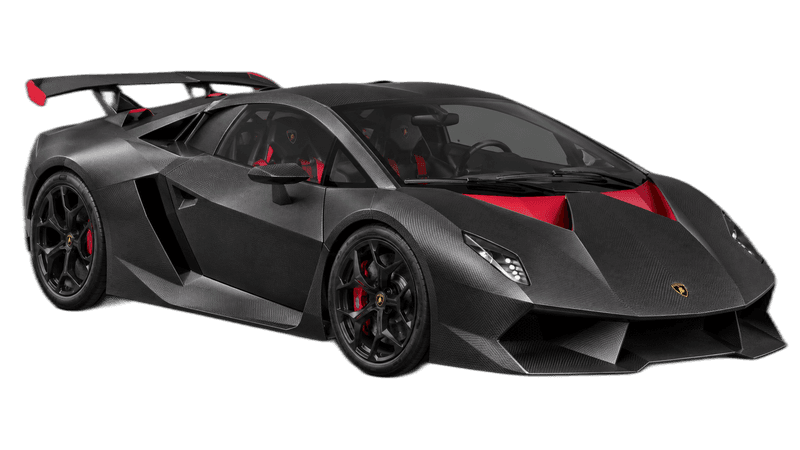
Lamborghini Sesto Elemento
562cv
Potenza
2.5s
0-100 km/h
Quanto spinge.
La forza g di picco nell'istante in cui affondi l'acceleratore, stimata dal tempo 0–100 e dalla trazione.
Lamborghini Sesto ElementoG di partenza stimata dal tempo 0–100 e dalla trazione: un'approssimazione onesta, non un dato misurato.
The Lamborghini Sesto Elemento is a 2-door track coupé by Lamborghini, with 562 bhp, 540 Nm of torque and a 0-100 km/h time of 2.5 seconds.
Dream Car Garage Editorial · Edited by José Teo Lorente Vallecillos · Last updated 3 November 2026
Panoramica
We have not driven this car. This review is based on published specifications and the sources listed below.
Scope of this guide
This guide is scoped to the Lamborghini Sesto Elemento, the carbon-fibre track special that Lamborghini unveiled at the 2010 Paris Motor Show. It is a mid-engine, all-wheel drive car with a 5.2L naturally aspirated V10 taken from the Gallardo Superleggera, and it was planned from the start as a car for track use only. It is not a guide to the Gallardo, the Murcielago or any road-going Lamborghini, which we mention only as the technical background the sources give us.
We have not driven this model for this article. We are an editorial desk that reads sources, and everything below comes from pages we opened: Wikipedia, the Italpassion specification page, two GTspirit articles (from 2013 and 2016), a Top Gear Philippines report from 2011 and an Auto Bild report from the 2010 show. This is a car that almost never comes to market, so a written guide cannot replace an inspection by a specialist who knows it, and this page is for research, not a buying recommendation.
The figures at a glance
- Engine: 5.2L naturally aspirated V10, an odd-firing Lamborghini V10 borrowed from the Gallardo Superleggera, per Wikipedia and Auto Bild. None of the pages we read mentions a turbocharger or supercharger, which is why we call it naturally aspirated. No source we read gives a cubic-centimetre figure, so we show only the 5.2 litre size the sources print.
- Power: 562 bhp. The sources disagree on how to print it. Wikipedia gives 570 PS (419 kW; 562 hp), Auto Bild gives 570 PS, Italpassion and GTspirit's 2016 article give 570 hp, and GTspirit's 2013 article gives 570bhp. We take the 570 PS metric rating and convert it with the factor 0.98632, which gives about 562 bhp, and that matches the 562 hp that Wikipedia prints. We use 562 bhp everywhere on this page.
- Torque: 540 Nm. Wikipedia prints 540 N-m (398 lbf-ft) and Italpassion prints 540 Nm. The other pages we read give no torque figure, so this rests on two pages.
- 0-100 km/h: 2.5 seconds. Wikipedia describes it as Lamborghini's claim, and Auto Bild, Italpassion, GTspirit and Top Gear Philippines all repeat it. Treat it as a maker claim, not an independent test.
- Top speed: no figure shown. The pages we read disagree widely, as explained in the performance section below, so we do not put one number in the catalogue.
- Drive: all-wheel drive, with a six-speed e-gear automated manual per Wikipedia. Auto Bild mentions e-gear shifting, a differential and all-wheel drive.
- Weight: 999 kg kerb weight, per Wikipedia, Auto Bild, Italpassion and GTspirit. GTspirit and Auto Bild give a power-to-weight ratio of 1.75 kg per hp (Auto Bild writes 1.75 kg per PS), which is simply 999 kg divided by 570.
- Production: 20 cars were announced, though a doubt about the real number is explained below.
- Size: Italpassion lists a length of 4.24 m, a height of 1.17 m and a width including mirrors of 2.04 m.
Not road legal
Italpassion states the car is "Not approved for road use (track use)". Top Gear Philippines says it was "destined only for track use", and Wikipedia says the car was planned for track use only and that the production cars were not road legal. Wikipedia adds that only two cars have been converted to road-legal versions by their owners. We could not find a second page that confirms those two conversions, so we repeat the claim only as Wikipedia's. The practical point is that this is a track car, and a buyer looking at one should expect questions about registration, import and insurance that we cannot answer from our sources. On any legal point, take advice from a specialist.
History and development
Wikipedia, Auto Bild and GTspirit all say the Sesto Elemento was first shown at the 2010 Paris Motor Show. Italpassion gives the presentation date as 30 September 2010, and the Auto Bild report is dated 29 September 2010. The name means "sixth element" and refers to carbon, which sits sixth in the periodic table, per Auto Bild and Italpassion.
Wikipedia says the shape was drawn by Filippo Perini and that the car is assembled at Sant'Agata Bolognese in Italy. It says about 80 percent of the car is carbon fibre, including the chassis, body, drive shafts, wheels and suspension parts, and that it was the first car to use forged carbon fibre, in the tub and the suspension arms. Wikipedia says that material was developed with Callaway Golf Company and that Boeing helped with the carbon fibre development. We read those claims on one page only, so we flag them as Wikipedia's. Italpassion describes a carbon monocoque and an all-carbon composite structure, which fits.
The car began as a show car. Top Gear Philippines, in a report dated 14 September 2011, says Lamborghini confirmed it would build 20 units for track use only, with first deliveries planned for the beginning of 2013. Wikipedia places the announcement of production plans in mid-2011. GTspirit reported in June 2013 that the production-specification car had been photographed in London, that it had appeared at Monterey Car Week in 2012, and that all the cars were already sold. GTspirit also notes one visible production difference, a black rear diffuser housing where the show car had a red one.
Performance claims compared
We found several different statements about performance, and they do not all agree.
- 0-100 km/h in 2.5 seconds is the figure that all six pages agree on, and Wikipedia calls it Lamborghini's claim.
- 0-200 km/h in 8 seconds is given by both Wikipedia and Italpassion.
- Top speed is the problem. Wikipedia prints 387 km/h (240.3 mph) but marks it as needing a citation. GTspirit's 2016 article says 320 km/h. Italpassion says 300 km/h. Auto Bild says "well over 300 km/h" in German. The Top Gear Philippines and GTspirit 2013 pages give no top speed.
These claims cannot all be the same number. Wikipedia's figure is the highest and the one its own page flags as unsupported, so we do not use it. We also do not choose between 300 and 320, because none of the pages we read cites a test or a maker document for either. That is why the catalogue entry shows no figure shown for top speed. If you see a number quoted elsewhere, treat it as a claim and ask where it came from.
Power-to-weight is the car's real selling point in the sources: 570 PS in a 999 kg car, with Wikipedia comparing the weight to subcompact cars. We did not test it, and we cannot say how the car feels or behaves.
What changed over the run
We found no evidence of variants. The sources describe one production specification, based on the show car, and the only visible change we found is the black rear diffuser housing noted above. We found no model-year updates, no special editions and no performance revisions, and we will not invent any.
Production count and years
The count is not as clean as it looks. Italpassion calls it a limited series of 20 cars, GTspirit's 2016 article calls a delivered car "one of only 20 models to ever be produced", and Top Gear Philippines says 20 units. GTspirit's 2013 article is more careful and says the car was widely rumoured to get a 20-unit production run. Wikipedia lists 20 in its infobox, but its text says some believe only 10 were built, based on VIN records, and that Lamborghini has not publicly confirmed the number. We keep 20 as the announced and most widely repeated figure, and we say plainly that it is not independently verified.
The years are also uncertain. Italpassion gives 2011 as the production start and 2012 as the end. Wikipedia gives 2012. Yet GTspirit reported a car being photographed in 2013 and a car delivered to Hong Kong on 3 March 2016 by Kingsway Cars Ltd, so deliveries clearly ran later than the build window Italpassion shows. We therefore treat 2011 to 2012 as a build window from one specialist page, not a delivery record.
What the rarity means
With a run of at most 20, few of these cars will ever be offered, and the sources we read do not report any sale at auction. The only prices we found are new-car prices. Wikipedia gives US$2.92 million per car at the mid-2011 announcement and also lists a reference citing US$2.2 million, without reconciling the two. Italpassion lists a starting price of 2,200,000 euros, 2,500,000 US dollars and 1,900,000 pounds sterling, without options. GTspirit's 2013 article calls it the 2.2 million dollar supercar. Those are all list or reported prices, not resale values, and we found no valuation guide. We will not estimate a current worth.
Because we found no inspection reports, owner reports or service data, we cannot give a buying checklist from the sources. What a buyer would reasonably ask a specialist to look at, given only what we read, is the following.
- Which of the 20 cars it is, and whether the seller can document that, given the doubt about the real build count.
- Its carbon-fibre structure, since the sources say the chassis, body, wheels and suspension parts are carbon. We found no repair or inspection guidance.
- The e-gear gearbox and the all-wheel drive system, for which we found no service information.
- Its registration and road-legal status, including whether it is one of the two cars Wikipedia says were converted.
- Documentation of delivery and ownership history.
Running costs and known issues
We found no running-cost data, no service schedule, no fuel-consumption figure, no failure reports and no repair costs for this car in any page we read. We give none. We also found no recall notice and no crash-test or safety-equipment data. That is not a clean bill of health, since we did not search a recall database. Anyone running one on a circuit should rely on a specialist and on the track operator's own rules.
What we could not find
We found no Lamborghini press release or maker page, so every figure above comes from Wikipedia, a specification aggregator and motoring reports, not from Lamborghini directly. We found no cubic-centimetre displacement, no torque figure beyond Wikipedia and Italpassion, no reliable top speed, no body-style description such as coupe, no sale results and no running-cost data. Several pages blocked or failed us and we did not work around any of them: Autocar returned a payment-required error, Auto123 refused the connection, Drive.com.au and Winding Road returned access-forbidden errors, Superyachts returned a payment-required error, and Car and Classic returned an access-forbidden error. One Carscoops address and one Lambocars address we tried did not carry the Sesto Elemento article.
About the photograph
This page uses the catalogue photograph for the car. Its credit is listed on the credits page.
Verdict
The Sesto Elemento is a mid-engine, all-wheel drive, track-only special with a 5.2L naturally aspirated V10 rated at 570 PS, which we convert to 562 bhp, plus 540 Nm of torque, a 999 kg kerb weight and a maker-claimed 2.5 seconds from 0-100 km/h. The sources agree on the carbon-fibre construction, the Paris 2010 debut and the track-only intent, and they disagree about top speed and about whether 20 or only 10 were built. We have not driven it, and we found no top speed we could trust, so the catalogue shows no figure shown there. If you are researching one, ask for documentation, treat the claims here as claims and have a specialist inspect the actual car. This page is for research, not a buying recommendation.
Sources
- Wikipedia: Lamborghini Sesto Elemento
- Italpassion: Lamborghini Sesto Elemento specification page
- GTspirit: 1 of 20 Lamborghini Sesto Elemento delivered in Hong Kong (3 March 2016)
- GTspirit: Production spec Lamborghini Sesto Elemento photoshoot in London (9 June 2013)
- Top Gear Philippines: Lamborghini Sesto Elemento to go into production (14 September 2011)
- Auto Bild: Pariser Autosalon 2010, Lamborghini Sesto Elemento (29 September 2010)
Specifiche
Motore
5.2L naturally aspirated V10
Cilindrata
5.2L
Potenza
562 cv
Coppia
540 Nm
0-100 km/h
2.5s
Trazione
AWD
Paese
Italy
Carrozzeria
2-door track coupé
Produzione
20
Specifications are manufacturer-published figures.
Altre di Lamborghini
Domande Frequenti
What are the specifications of the Lamborghini Sesto Elemento?
The Lamborghini Sesto Elemento is a 2-door track coupé by Lamborghini, with 562 bhp, 540 Nm of torque and a 0-100 km/h time of 2.5 seconds.
How many Lamborghini Sesto Elemento were made?
Lamborghini produced 20 units of the Lamborghini Sesto Elemento.
What drivetrain does the Lamborghini Sesto Elemento use?
The Lamborghini Sesto Elemento is configured with all-wheel drive.
What type of car is the Lamborghini Sesto Elemento?
The Lamborghini Sesto Elemento is a track only manufactured by Lamborghini in Italy.