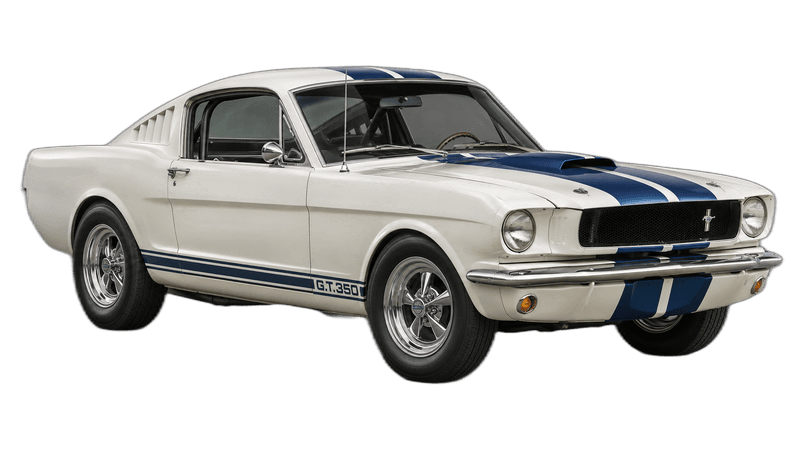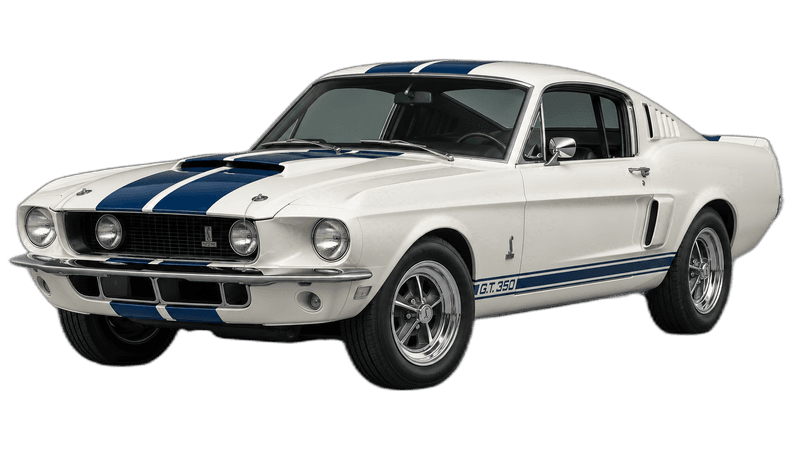
Shelby Mustang GT350 1967
306cv
Potencia
208km/h
Velocidad Máxima
The Shelby Mustang GT350 1967 produces 306 bhp and has a top speed of 208 km/h.
Dream Car Garage Editorial · Edited by José Teo Lorente Vallecillos · Last updated 3 November 2026
Visión General
We have not driven this car. This review is based on published specifications and the sources listed below.
Scope of this guide
This guide is scoped to the Shelby Mustang GT350 (1967), the second-generation GT350 built by Shelby American on the restyled 1967 Ford Mustang fastback. It is a two-door, front-engine, rear-wheel drive fastback with a Ford 289 cubic inch V8 (4.7 litres), a four-speed manual gearbox as the usual choice and an automatic as an option. The page covers the 1967 model year only. The 1967 GT500, which used a larger engine and shared the showroom, is a different car and is mentioned only where a source puts the two side by side. The earlier 1965 and 1966 GT350 cars and the 1968 car are outside the scope.
We have not driven this model for this article. We are an editorial desk that reads sources, and everything below comes from pages we opened: Wikipedia, Silodrome, the Mustang Specs site, Amazing Classic Cars, the Nevada Shelby American Automobile Club, Conceptcarz, the Car Memories specification pages, TopSpeed, DK Engineering, Revology Cars, Speedholics, two RM Sotheby's lot pages and a Hagerty auction listing. We have not inspected, owned or tested a car. This page is for research, not a buying recommendation, and a guide like this cannot replace a specialist inspection by someone who knows these cars.
The figures at a glance
- Engine: 4.7L naturally aspirated V8, the 289 cubic inch Ford small block in its high-performance K-code form, fed by a single Holley four-barrel carburettor, mounted front-engine.
- Drivetrain: rear-wheel drive, with a four-speed manual or an optional automatic.
- Power: 306 bhp at 6,000 rpm. Several sources print 306 hp, and Conceptcarz prints 306 BHP. Other pages print 271 hp, and we explain the gap below.
- Torque: 446 Nm. The sources print 329 lb ft, and 329 multiplied by 1.35582 gives 446.1 Nm, which also matches the 446 Nm printed by Conceptcarz.
- 0-100 km/h: no figure shown. The sources we read give 0-60 mph times (about seven seconds, 7.1 seconds, 7.5 seconds and one outlier of 4.8 seconds), and a 0-60 mph time is not a 0-100 km/h time, so we have not converted or relabelled any of them.
- Top speed: 208 km/h. Three pages print 129 mph, and 129 multiplied by 1.60934 gives 207.6 km/h.
- Kerb weight: 3,360 lb with a 53/47 front to rear split according to Car Memories.
- Years: 1967 only.
- Production: 1,175 GT350s according to Amazing Classic Cars and Revology Cars, with a caveat covered below.
- New price: 3,995 dollars according to TopSpeed.
What the 1967 car was
Several of the pages we read describe the same shift. The 1967 Mustang was restyled to be larger and heavier, and the GT350 moved with it. Wikipedia says the body was heavier, with a longer fibreglass hood, new front and rear fascias, separate high-beam headlamps in the grille, horizontal taillights, an integrated rear spoiler and rear brake-cooling scoops. Mustang Specs adds two driving lights in the grille, scoops replacing the rear quarter windows, a fibreglass deck lid with a spoiler, and tail lights borrowed from the 1967 Cougar. It also says air conditioning and an AM/FM radio were offered for the first time and that a two-point roll bar came with the Deluxe interior package. Silodrome compares the car with the first-generation GT350 and says the performance upgrades carried over while new features made it more practical for everyday use.
The common thread is that the 1967 car was a more complete road car than the stripped original. Amazing Classic Cars is more specific about what was lost. It says power steering and power brakes became mandatory options on all Shelbys, that the Koni shocks were replaced by cheaper adjustable Gabriel units, and that traction bars and the limited-slip differential were dropped. It also says the Mustang gained about 140 pounds in its 1967 facelift. Wikipedia, by contrast, says power assist was standard, describes a power-assisted recirculating ball steering box and lists 11.3 inch front discs with rear drums. Car Memories gives the same disc size and a 16:1 steering ratio with 3.5 turns lock to lock. The RM Sotheby's lot pages we opened both list power steering and power brakes on the cars offered, which fits the idea that these were effectively standard in practice.
Car Memories gives a wheelbase of 108 inches, and both Car Memories and Mustang Specs give rear axle ratios of 3.89:1 with the manual gearbox and 3.50:1 with the automatic. Car Memories lists a first gear ratio of 2.32:1.
Which power figure we chose, and why
Power is where the sources disagree most, and the disagreement is more interesting than the numbers.
Most pages print 306 horsepower for the 289: Wikipedia, Silodrome, Mustang Specs, Conceptcarz, Car Memories, TopSpeed and Revology all use it. Car Memories and Conceptcarz both attach 6,000 rpm to it. Conceptcarz writes the figure as 306 BHP. Against that, the Nevada Shelby American Automobile Club lists the GT350 engine as the 271 horsepower Ford Hi-Po block and heads, and Amazing Classic Cars describes a 271 hp K-code engine under the hood while its own specification table prints 306 hp at 6,000 rpm. DK Engineering words it the other way round, saying Shelby had raised output from 271 to 306 horsepower. Amazing Classic Cars adds that after exhaust and header changes the real output fell to somewhere around 250 hp, while Ford kept advertising 306.
None of the pages we read says whether 306 is an SAE gross or a net figure, so we are not going to label it. We use 306 bhp throughout this page because it is the figure the large majority of pages print, and we treat it as a published rating and not as a measured one. The 271 hp figure is described by those pages as the K-code engine's own rating, and the sources do not explain how the two numbers relate, so we are describing a gap we cannot close. A Hagerty auction listing for one car mentions a dyno result of 343 hp, but that was on an engine rebuilt in 2024 by a specialist and is a single car's claim, not a specification.
Torque follows the same pattern. Silodrome, Mustang Specs, Conceptcarz, Car Memories and TopSpeed all print 329 lb ft. The rpm varies: Conceptcarz and Car Memories say 4200 rpm and Amazing Classic Cars says 3200 rpm. We use 446 Nm.
Performance, and what we could not convert
Period-style performance figures are the weakest part of the record. Wikipedia and TopSpeed say about seven seconds to 60 mph, Conceptcarz and Car Memories print 7.1 seconds with a quarter mile in 15.3 seconds at 91 mph, Mustang Specs prints both about seven seconds in its text and 7.5 seconds in its table, and Amazing Classic Cars prints 4.8 seconds, which looks out of line with everything else. Revology Cars attributes the 7.1 second time to IPMS USA reviews. Because every one of these is a 0-60 mph time, there is no figure shown for 0-100 km/h on this page.
Top speed is similarly spread: 129 mph from Conceptcarz, Car Memories and Revology, 133 mph from Amazing Classic Cars, and 140 mph from Wikipedia (which also prints 230 km/h), TopSpeed and Mustang Specs. We use 129 mph, which is 208 km/h by our stated conversion, because it is the figure that comes with a quarter mile time and an attribution to period reviews, and it is also the lowest of the three groups, so we are not overstating the car.
Production count
The figure we use is 1,175. Amazing Classic Cars prints a production table listing 1,175 GT350s, 2,048 GT500s and two one-off GT500 prototypes for a total of 3,225, and Revology Cars quotes the Collector Car Market Review as saying Shelby American produced 3,225 Shelby Mustangs in 1967, including 1,175 GT350s and 2,048 GT500s. Two other pages disagree: Mustang Specs lists 1174 in its table, and DK Engineering says just 1135 GT350s were produced in 1967. The Nevada Shelby American Automobile Club page gives the serial sequence running from 0001 to 03225, which is consistent with the 3,225 total but does not split it. Wikipedia's article, in the part we read, gives 2,048 for the GT500 and no GT350 total. We use 1,175 because two pages agree on it and it adds up to the stated total once the two prototypes are counted, but a one-car difference in one source and a much larger one in another is a reminder that these are secondary counts, not a registry export.
The supercharger question
Some descriptions of the 1967 car mention an option of a Paxton supercharger. The record is mixed. The Nevada Shelby American Automobile Club lists a Paxton supercharger and air conditioning as optional on the GT350, Mustang Specs says it was carried over from the previous year, Car Memories says it was offered on the GT350 only, and Revology Cars says a small number of supercharged cars were produced. The part of Wikipedia we read mentions the supercharger for 1966 and 1968 and not for 1967. We therefore treat it as an option reported by several specialist pages, with the caveat that the sources do not give a count, a price or power figures for supercharged cars. Every figure on this page is for the naturally aspirated car.
What the surviving cars tell us
The 1967 car sits between the lightweight early GT350s and the big-block GT500. We can say what some sale pages show, not what the car is worth. RM Sotheby's Palm Beach 2020 sale (lot 125) shows a restored green car with a 289, a four-speed manual, power steering and brakes selling for 115,500 dollars. RM Sotheby's California 2013 sale (lot 778) shows an original black plate car in Wimbledon White with about 71,000 miles, built on 12 July 1967 according to the Shelby Registry entry the lot quotes, which also sold for 115,500 dollars. A Hagerty listing for a Lime Gold car with a rebuilt K-code engine closed with a last bid of 170,000 dollars on 26 August 2024, and the page does not say whether the car sold. The seller said it was one of only four 1967 GT350s built with its option combination. Speedholics describes another early car as just the twelfth GT350 produced for the model year and says about two hundred early cars shipped with red marker lights in the rear scoops that were ruled illegal in many states and removed. Dollar prices in listings are asking or past results for single cars, not valuations, and they will have moved.
What to check before buying
Only some pages gave specifics, so this list is short and drawn from the Nevada Shelby American Automobile Club page, the RM Sotheby's and Hagerty pages and Speedholics.
- Numbers and codes: the Nevada page explains the Shelby VIN and the Ford VIN pattern, with engine code K for the 289 and body code 02 for the two-door fastback. Documentation matters.
- Carburettor: the same page says the GT350 used a 715 cfm Holley, or a 595 Autolite on automatic cars. Amazing Classic Cars prints a six-hundred-cfm Holley, so the sources do not agree and a specialist should confirm what a given car should have.
- Early-car details: Nevada says early cars had functional brake scoops and no interior code, and that the first two hundred cars had running lights on the upper scoops. Speedholics lists other early features such as a one-piece grille with inboard high-beam lights.
- Engine swaps and 427 claims: Nevada says dealers swapped engines on special order, owners made changes after purchase, Shelby built probably fewer than six 427 cars, and that documenting such cars is impossible without original paperwork.
- Dealer options: the Koni shocks were dealer-installed, and proving a car had them when sold new needs paperwork.
- Paper trail: the Hagerty listing mentions a Marti Report, an intact Shelby body tag, date-coded carburettor and intake, and original valve covers, and an RM Sotheby's lot cites the Shelby Registry build date.
We found no source on rust, bodywork or running costs for this specific year, so we say nothing about them.
What we could not find
- No 0-100 km/h time for the 1967 GT350, so there is no figure shown for it.
- No statement of whether 306 is a gross or net rating, and no explanation of the 271 hp figure.
- No registry-level production count: 1,175 is a secondary figure and two other pages print 1174 and 1135.
- No factory or period road test we could open.
- No count of supercharged cars, no list of recalls, and no maintenance cost data.
- The Wikipedia article is long, and we read only the first part of it, which did not include a 1967 GT350 production figure.
About the photograph
The page uses the catalogue photograph for this model, and its credit is listed on the credits page.
Verdict
Read together, the pages we opened describe a 1967 GT350 as a refined, heavier and more usable Shelby than the 1965 and 1966 cars, with a 4.7L naturally aspirated V8 quoted at 306 bhp and 446 Nm, a top speed of about 208 km/h on the most common figure, and 1,175 built by the best-supported count. Power, speed and acceleration are all quoted inconsistently, authenticity is the central question for any buyer, and several of the sources are enthusiast or sales pages, not engineering records. We have not driven this model for this article, and a specialist inspection and registry paperwork are the only sensible route for anyone thinking of buying.
Sources
- Wikipedia: Shelby Mustang
- Silodrome: 1967 Shelby GT350
- Mustang Specs: 1967 Shelby GT350 guide
- Amazing Classic Cars: 1967 Shelby Mustang GT350
- Nevada Shelby American Automobile Club: 1967 Shelby information
- Conceptcarz: 1967 Shelby Mustang GT350
- Car Memories: 1967 GT350 and GT500 specifications
- TopSpeed: 1967 Ford Shelby Mustang GT350
- DK Engineering: Shelby Mustang GT350 (1967)
- Revology Cars: 1967 Shelby GT350 model guide
- RM Sotheby's: 1967 Shelby GT350 (Palm Beach 2020)
- RM Sotheby's: 1967 Shelby GT350 (California 2013)
- Hagerty Marketplace: 1967 Shelby GT350 auction listing
- Speedholics: 1967 Shelby GT350 Fastback
Especificaciones
| Motor | 4.7L naturally aspirated V8 |
|---|---|
| Cilindrada | 4.7L |
| Potencia | 306 cv |
| Par Motor | 446 Nm |
| Velocidad Máxima | 208 km/h |
| Tracción | RWD |
| País | United States |
| Carrocería | 2-door coupé |
| Años | 1967 |
| Producción | 1,175 |
Specifications are manufacturer-published figures.
Preguntas Frecuentes
How much power does the Shelby Mustang GT350 1967 have?
The Shelby Mustang GT350 1967 produces 306 bhp and 446 Nm of torque.
What is the top speed of the Shelby Mustang GT350 1967?
The Shelby Mustang GT350 1967 has a top speed of 208 km/h.
What engine does the Shelby Mustang GT350 1967 have?
The Shelby Mustang GT350 1967 uses a 4.7L naturally aspirated V8.
How many Shelby Mustang GT350 1967 were made?
Shelby produced 1,175 units of the Shelby Mustang GT350 1967.
When was the Shelby Mustang GT350 1967 built?
The Shelby Mustang GT350 1967 was built from 1967 to 1967.
Is the Shelby Mustang GT350 1967 all-wheel drive?
No. The Shelby Mustang GT350 1967 is configured with rear-wheel drive.