Shelby Cobra Daytona Coupe
£32,000,000
usedIndicative market price, updated periodically.
385bhp
Power
306km/h
Top Speed
£32,000,000
Price Used
The Shelby Cobra Daytona Coupe produces 385 bhp and has a top speed of 306 km/h. A representative example is worth about £32,000,000.
Dream Car Garage Editorial · Edited by José Teo Lorente Vallecillos · Last updated 3 November 2026
Overview
We have not driven this car. This review is based on published specifications and the sources listed below.
Scope of this guide
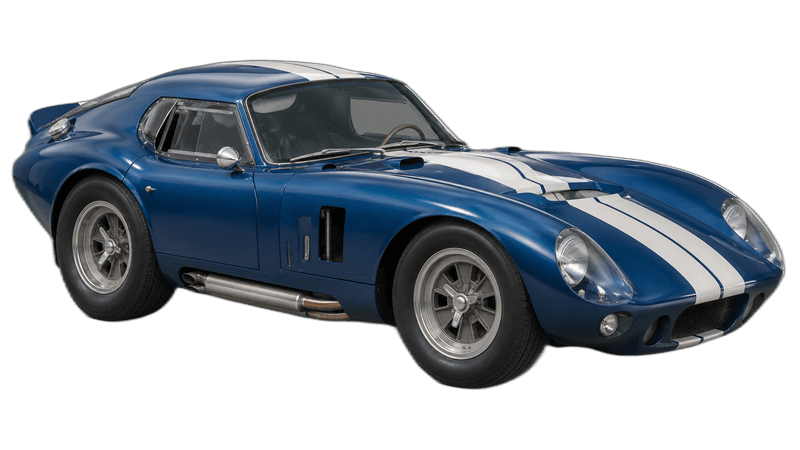
This guide is scoped to the Shelby Cobra Daytona Coupe, the closed-body racing Cobra that Shelby American built in 1964 and 1965 to beat Ferrari in the GT class of the world manufacturers' championship. It is a two-door, front-engine, rear-wheel drive coupé with a Ford 289 cubic inch V8 (4.7 litres) and a four-speed manual gearbox, wrapped in a hand-made aluminium body designed by Peter Brock. The page covers the six original cars only. It does not cover the seventh, never-completed big-block car that some histories mention, and it does not cover the continuation cars and replicas built decades later. We keep those separate below because the numbers get mixed up all the time.
We have not driven this model for this article. We are an editorial desk that reads sources, and everything here comes from pages we opened: Wikipedia, Sportscar2, Autozine, the supercars.net specification page and its report on the car's heritage documentation, The Drive, Robb Report Malaysia, Conceptcarz, a Gooding press release, Old Cars Weekly, RM Sotheby's, Jalopnik, the introduction to a Velocetoday history, and a Spanish-language auction report. We have not inspected, owned or tested a car. These are competition cars that almost never come to market, so a guide like this cannot replace a specialist inspection, and this page is for research, not a buying recommendation.
The figures at a glance
- Engine: 4.7L naturally aspirated V8, the Ford 289 cubic inch small-block, 4,727 cc, mounted front-engine, with four Weber twin-choke carburettors in the sources that name them.
- Drivetrain: rear-wheel drive, four-speed manual gearbox.
- Power: 385 bhp at 6,750 rpm. This is a gross figure. Autozine states it as 385 hp gross and converts it to about 325 hp net on its own page, so the net figure is lower. We use 385 bhp throughout.
- Torque: 461 Nm. Sportscar2 gives 340 lb ft at 4,000 rpm (its table says 341), and supercars.net gives 340 lb ft with a metric equivalent of 460.98 N m. Multiplying 340 by 1.35582 gives 460.98, which rounds to 461 Nm. Like the power, it is a gross figure.
- 0-100 km/h: no figure shown. The sources we read give 0-60 mph times instead (see the performance section), and we have not relabelled any of them as a 0-100 km/h time.
- Top speed: 306 km/h. Sportscar2 and supercars.net both print 190 mph, and 190 mph multiplied by 1.60934 is 305.8 km/h. Higher claims exist, and we explain them below.
- Years: 1964 to 1965.
- Weight: 1,043 kg in Wikipedia and on the supercars.net specification page, and 1,090 kg ("less than 1,100 kg") in Autozine.
- Production: six original cars. A seventh car and later continuation cars are separate and are not counted in this figure.
History and what the car was for
The Daytona Coupe exists because an open Cobra was slow on the long straights. Conceptcarz says an October 1963 test showed that a closed body gave a lower centre of gravity, less drag and a higher top speed by about 20 mph. Old Cars Weekly puts the gain at 25 mph, so the sources do not agree on the exact amount, and we simply say the gain was in the order of twenty-odd miles per hour. The Drive says the first car, chassis CSX2287, was converted from a Mark II Cobra roadster that crashed at the 1963 Le Mans, and Wikipedia says Brock built that prototype largely by hand around a wooden frame. Robb Report adds that Brock was 24 when he designed it and that the target was Ferrari's 250 GTO.
Six cars were built. Every source we opened that gives a count says six, including Wikipedia, The Drive, Robb Report, Conceptcarz, RM Sotheby's ("just six Cobra Daytonas were constructed in period"), Autozine and Jalopnik. The first was built at Shelby's race shop in Venice, California, and the other five had their chassis built at Shelby's and were then flown to Italy, where Carrozzeria Gransport in Modena made the bodies. Several pages spell the coachbuilder Grandsport, which is the same firm. The original chassis numbers named in the sources are CSX2286, CSX2287, CSX2299, CSX2300, CSX2601 and CSX2602.
Racing record
The debut came at the Daytona Continental in February 1964. Wikipedia says Dave MacDonald took pole position, while Autozine and the supercars.net specification page say a pit fire ended the car's run, and Conceptcarz says it dominated the first half of the race before the fire. In 1964 the coupes won their class at Sebring, and CSX2299 won the GT class at Le Mans with Dan Gurney and Bob Bondurant, fourth overall. Wikipedia says Ferrari still took the 1964 GT class title, with Shelby second by six points.
In 1965 the coupes took the GT class title by 19 points, according to Wikipedia, which also calls Shelby the first American constructor to win an FIA international title. The clinching race was at Reims on 4 July 1965 (Old Cars Weekly names Bob Bondurant as the driver in CSX2601). Ford then gave Shelby the GT40 programme, and every source that discusses the end of the Coupe says that this ended its development. RM Sotheby's puts it as the team being pulled onto GT40 work at the peak of the Daytona's success.
Which figures we chose, and why
Power and torque
Power is the figure sources disagree about least in kind but most in meaning. Sportscar2, the supercars.net specification page and Autozine all print 385 bhp or hp. The catch is that it is a gross figure, not a net one. Autozine converts it to about 325 hp net itself, so a reader comparing the car with a modern net figure should expect it to look lower. Wikipedia, Conceptcarz, Robb Report, The Drive and the Gooding page give no power figure at all. We chose 385 bhp because the three pages that give a figure agree and because it is the figure most people will see quoted. We could not find a period Shelby document or an engine dynamometer sheet for an original car, so treat it as a quoted rating and not as a measured one.
Torque follows the same logic. Sportscar2 gives 340 lb ft in its text and 341 in its table, Autozine gives 341 lb ft gross, and supercars.net gives 340 lb ft. We used 340 lb ft and converted it with the stated factor of 1.35582 to 461 Nm.
Top speed: Riverside, Le Mans and Bonneville are different claims
Top speed is the messiest number, because the sources are describing different things. We list them separately and then say which we used.
- Riverside: Wikipedia says Ken Miles took the prototype to 186 mph (299 km/h) at Riverside, and The Drive says the early tests showed the car could reach the 186 mph target, with later development taking it north of 190 mph.
- Development figure: Sportscar2 and the supercars.net specification page both print 190 mph. This is where our 306 km/h comes from, using 190 mph multiplied by 1.60934 and rounded.
- Le Mans: Wikipedia says CSX2299 reached over 196 mph (315 km/h) on the Mulsanne Straight in 1964. Robb Report says 310 km/h, reached with Ken Miles driving once the design was fully sorted. Neither of these is the same claim as the 190 mph figure, and we cannot tell from the pages whether they are exact readings.
- Bonneville: Wikipedia and RM Sotheby's both say the coupes set 25 records there (Wikipedia dates them to November 1965 and names chassis CSX2287). None of the pages we opened gives a Bonneville top speed, so we are not attributing a speed to Bonneville.
- Gearing matters: Autozine says 142 mph with the short final-drive ratio, attributed to a 1981 Car and Driver test, and at least 190 mph with the tall ratio used in racing. We could not confirm from the page which car that test used. Sportscar2 has a table column that shows 162 mph, which contradicts its own text.
We chose 306 km/h (190 mph) as the conservative, repeatedly printed figure, and we treat the Le Mans claim of 315 km/h as a headline claim that is plausible for a race-geared car on the Mulsanne but not an official measurement we can verify.
Acceleration
No page we read gives a 0-100 km/h time, so there is no figure shown for it. The 0-60 mph times that do exist disagree: Sportscar2 gives 4.0 seconds in its text and 3.9 in its table, supercars.net gives about 4.01 seconds, and Autozine gives 4.4 seconds from the 1981 Car and Driver test it cites. These are 0-60 mph figures with different gearing and different sources, and we have not converted or relabelled them. Sportscar2 and supercars.net also give 0-100 mph at 8.8 seconds, and Autozine gives 10.5 seconds, again on a different basis.
Dimensions
Dimensions disagree too. Wikipedia gives a wheelbase of 2,286 mm, a length of 4,150 mm, a width of 1,720 mm and a height of 1,180 mm. The supercars.net specification page gives the same wheelbase but a length of 4,610 mm, a width of 1,753 mm and a height of 1,422 mm. We would not rely on either set of overall dimensions without checking against a drawing, and we have not used them in the figures above.
The survivors, the seventh car and the continuation cars
Wikipedia lists what happened to each of the six originals, and we repeat only what it says, with the other pages named where they add detail.
- CSX2287, the prototype: sold in 1966 for roughly $4,000 to $5,000 according to Wikipedia, later owned by Phil Spector, lost by the mid-1970s, rediscovered in 2001 and now at the Simeone Foundation Automotive Museum. It was the first car on the National Historic Vehicle Register in January 2014, and the supercars.net report says it was the first automobile recorded under the Secretary of the Interior's heritage documentation standards, with the record held at the Library of Congress.
- CSX2299: the 1964 Le Mans class winner, shown at the Shelby American Collection in Boulder, Colorado. Conceptcarz says two of the cars are in that collection.
- CSX2300: the third car completed, according to Gooding and Jalopnik. It raced in Europe in 1964 and 1965, then in Japan until 1968, and Carroll Shelby bought it in 1975 and kept it until 1998. Wikipedia says RM Auctions sold it for $4.4 million in August 2000.
- CSX2601: won four GT class races in 1965 according to Wikipedia, and sold for $7.25 million at Mecum's Monterey auction on 15 August 2009, a record for an American-built car at public auction at the time (Old Cars Weekly).
- CSX2286 and CSX2602: Wikipedia says CSX2286 was unfinished for Le Mans in 1964, raced in 1965 and later crashed at Laguna Seca in 2012 before being restored, and CSX2602 raced at Le Mans in 1965 for Scuderia Filipinetti and retired with engine failure.
The seventh car is not a Daytona Coupe
Wikipedia and the Velocetoday history introduction both mention a 427 "Type 65" Super Coupe, chassis CSB3054, planned on a later Ford-designed Mark II chassis for the 1965 prototype class. Both say Shelby never officially completed it and exclude it from the count of six. The Drive describes a separate 427 big-block development coupe, and says the truck carrying it crashed on the way to Le Mans, so it never raced; the page quotes 550 hp for that big-block project, which is not a Daytona Coupe figure. We keep both out of the six.
Continuation cars and replicas are not the originals
Wikipedia says Shelby American announced 50 continuation Daytonas in July 2015, some with aluminium bodies and some with fibreglass, and The Drive describes six big-block continuation cars with a four-speed manual gearbox. RM Sotheby's catalogued a continuation car, chassis CSX2616, at its Arizona sale in 2021, with a stroked 289 reported at 441 hp on an engine dynamometer; the lot was not sold, and the page does not say how many continuation cars exist. These are different cars with different engines and different numbers, so none of their figures appear in the specification above.
Value and market notes
Prices tell you how unusual these cars are, but they come from only a handful of sales, so treat them as illustrations and not as a price guide. We quote only the figures that the sources give, with their dates.
- Robb Report Malaysia says Shelby sold some originals for under $7,000 each when they were new, and that market experts now value them at nearly $30 million. The page is undated.
- Gooding's press release offers CSX2300 at the Pebble Beach auctions on 14 and 15 August 2026 with an estimate in excess of $25,000,000. Gooding's page gives no result.
- A Spanish-language report dated 30 August 2026 says CSX2300 sold at Gooding and Christie's on 28 August 2026 for $42,905,000, the most ever paid for an American car at auction. We could not confirm this from the auction house or a second source, and that report also says CSX2300 was the first of the six, which contradicts Gooding's and Jalopnik's statement that it was the third completed. Treat the figure as reported, not confirmed.
- The earlier public sales in the sources are the $7.25 million Mecum sale of CSX2601 in 2009 and the $4.4 million RM sale of CSX2300 in 2000.
What to check before buying
None of the sources we read gives a buyer's inspection list for an original Daytona Coupe, and with six cars in the world that is to be expected. The only practical points the sources support are provenance ones: the chassis number (the six are CSX2286, CSX2287, CSX2299, CSX2300, CSX2601 and CSX2602), the race and ownership history, and whether a car described as a Daytona Coupe is an original, a continuation car or a replica. Because continuation cars and replicas are also sold under the Daytona name, documentary proof of identity matters more than any condition checklist. We have no running costs, known-issue or recall information, and we are not going to invent any.
What we could not find
- A 0-100 km/h time: no figure shown in any source we opened.
- A period Shelby document or independent test for the quoted power, torque and top speed. The figures above are quoted by secondary pages.
- A Bonneville top speed, even though several pages mention the records.
- A full page from Hagerty (its valuation pages redirect to a login), the full Velocetoday chassis history (we only read the free introduction), Drive.com.au and Winding Road (both returned errors), and the Shelby American and Simeone Museum pages.
- Confirmation of the August 2026 sale price from the auction house.
About the photograph
The page uses the catalogue photograph for this model, and its credit is listed on the credits page.
Verdict
The Shelby Cobra Daytona Coupe is the clearest case in this catalogue of a number that depends on what you count. On the sources we read, six original cars were built in 1964 and 1965; the 4.7L naturally aspirated V8 was quoted at 385 bhp gross, which is about 325 hp net, with about 461 Nm of torque; and the safe top speed to quote is 306 km/h, with higher Le Mans claims attached to specific cars and gearing. We have no figure for 0-100 km/h. Anyone chasing a specific chassis, or a car sold as a continuation or replica, needs a specialist inspection and documentary proof, and this page is for research only.
Sources
- Wikipedia: Shelby Daytona Coupe
- Sportscar2: AC Cobra 289 and Shelby Daytona Coupe
- Autozine: Shelby Daytona Coupe (1964)
- supercars.net: 1964-1965 Shelby Cobra Daytona Coupe specifications
- supercars.net: Daytona Coupe CSX2287 in the Historic Vehicle Register
- The Drive: 1964 Cobra Daytona Coupe going back into production
- Robb Report Malaysia: Design Classic, 1964 Shelby Daytona Cobra Coupe
- Conceptcarz: Shelby Cobra Daytona Coupe
- Gooding Christie's: Daytona Coupe CSX2300 press release
- Old Cars Weekly: Daytona Cobra breaks U.S. auction record
- RM Sotheby's: 1964 Shelby Cobra Daytona Coupe Continuation (CSX2616)
- Jalopnik: Carroll Shelby's Daytona Coupe heads to auction
- Velocetoday: History of the six Cobra Daytona Coupes (introduction)
- WWWhatsnew: Shelby Cobra Daytona Coupe auction report (Spanish)
Specifications
| Engine | 4.7L naturally aspirated V8 |
|---|---|
| Displacement | 4.7L |
| Power | 385 bhp |
| Torque | 461 Nm |
| Top Speed | 306 km/h |
| Drivetrain | RWD |
| Country | United States |
| Body Style | 2-door coupé |
| Years | 1964–1965 |
| Production | 6 |
| Price Used | £32,000,000 |
Specifications are manufacturer-published figures.
Frequently Asked Questions
What is a Shelby Cobra Daytona Coupe worth?
A representative example is worth about £32,000,000. Actual values vary with specification, condition and history.
How much power does the Shelby Cobra Daytona Coupe have?
The Shelby Cobra Daytona Coupe produces 385 bhp and 461 Nm of torque.
What is the top speed of the Shelby Cobra Daytona Coupe?
The Shelby Cobra Daytona Coupe has a top speed of 306 km/h.
What engine does the Shelby Cobra Daytona Coupe have?
The Shelby Cobra Daytona Coupe uses a 4.7L naturally aspirated V8.
How many Shelby Cobra Daytona Coupe were made?
Shelby produced 6 units of the Shelby Cobra Daytona Coupe.
When was the Shelby Cobra Daytona Coupe built?
The Shelby Cobra Daytona Coupe was built from 1964 to 1965.
Is the Shelby Cobra Daytona Coupe all-wheel drive?
No. The Shelby Cobra Daytona Coupe is configured with rear-wheel drive.