
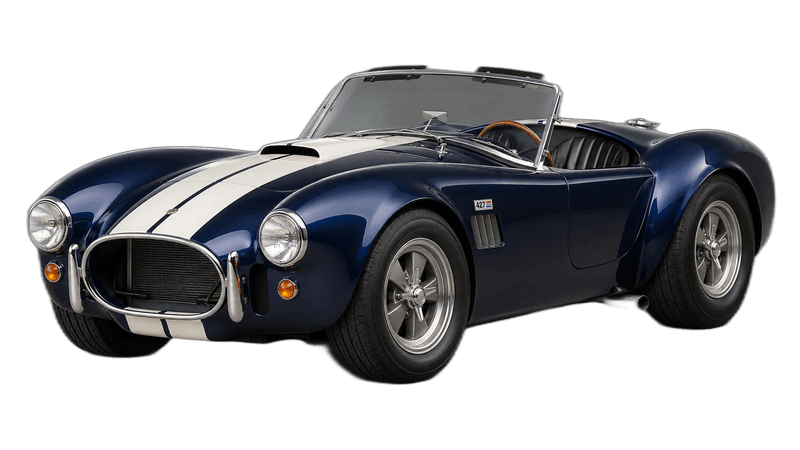
Shelby Cobra 427
425cv
Potencia
264km/h
Velocidad Máxima
The Shelby Cobra 427 is a 2-door roadster by Shelby, with 425 bhp, 651 Nm of torque and a top speed of 264 km/h.
Dream Car Garage Editorial · Edited by José Teo Lorente Vallecillos · Last updated 3 November 2026
Visión General
We have not driven this car. This review is based on published specifications and the sources listed below.
Scope of this guide
This guide is scoped to the Shelby Cobra 427, the Mark III Cobra that Carroll Shelby's team and AC Cars built from 1965 to 1967 around Ford's big-block 7.0 litre FE V8. It is a two-seat, front-engine, rear-wheel drive roadster with a four-speed manual gearbox, an aluminium body over a tubular steel frame, and coil-spring suspension at all four corners. We mean the standard car, the one the sources describe as the street version. We do not cover the S/C (semi-competition) cars, the true competition cars, the earlier 260 and 289 small-block Cobras, or the modern continuation and replica cars.
We have not driven this model for this article. We are an editorial desk that reads sources, and everything below comes from pages we opened: Wikipedia (two articles), Supercars.net, Apex Automag, ConceptCarz, an RM Sotheby's lot page, SlashGear, a dealer listing from WOB Cars, the Sports Car Market buyer's guide, The Classic Valuer, and HotCars. We have not inspected, owned or tested a car. A Cobra 427 is a rare, very valuable collector car, so this page is for research, not a buying recommendation, and no guide can replace a specialist inspection and a check of the car's documented history.
The figures at a glance
- Engine: 7.0L naturally aspirated V8, the Ford FE 427 cubic inch engine, fed by a single 780 CFM Holley four-barrel carburettor on the side-oiler version, mounted front-engine.
- Drivetrain: rear-wheel drive with a four-speed manual gearbox.
- Power: 425 bhp at 6,000 rpm. We chose this figure and explain the competing numbers further down.
- Torque: 651 Nm at 3,700 rpm. The pages print 480 lb ft, and 480 multiplied by 1.35582 gives 650.8 Nm, which rounds to 651 Nm. Wikipedia prints 651 N m directly.
- 0-100 km/h: no figure shown. The pages we read give 0-60 mph times of 4.2 seconds and, in one quoted magazine test, about 4.5 seconds. A 0-60 mph time is not a 0-100 km/h time, so we do not convert or relabel it.
- Top speed: 264 km/h. Wikipedia and Supercars.net both print 164 mph and 264 km/h, and 164 multiplied by 1.60934 gives 263.9 km/h. ConceptCarz prints 165 mph.
- Weight: 1,068 kg (2,355 lb) according to Wikipedia, 1,035 kg (2,282 lb) according to Supercars.net.
- Years: 1965 to 1967. Production of the Mark III started on 1 January 1965 according to Wikipedia.
- Production: about 260 street cars, with a competition run alongside. The counts are discussed below because the sources do not agree.
History and what changed
Wikipedia explains that the Mark III was designed with Ford in Detroit and was a big step up from the earlier small-block cars. The main chassis tubes grew from 76.2 mm (3 in) to 101.6 mm (4 in), the front transverse leaf spring gave way to coil springs all around, and the body gained wide fenders and a larger radiator opening. Sports Car Market adds that the brakes were four-wheel discs enlarged for the higher speed and weight, that the steering stayed manual rack-and-pinion, and that the bodywork was substantially wider. Supercars.net says the first unpainted chassis arrived from AC in October 1964 and the engine was fitted in January 1965. The Wikipedia article on the AC 428 also says the first Mark III chassis with a 427 powertrain was built in October 1964.
The plan was a racing car first. Wikipedia says only 56 of the 100 cars needed for homologation had been built before the FIA inspector arrived in April, and that the Mark III was not homologated for 1965 and was not raced by the Shelby team that year. The AC 428 article puts it a little differently, saying only 53 cars had been built by late February and that the FIA refused to approve the car for 1965. Supercars.net also says 53. We read the 53 and 56 figures as different snapshots of an unfinished run, and the pages do not reconcile them. Wikipedia adds that 31 unsold competition cars were fitted with windscreens and dual-quad side-oiler R-code 427 engines for street use, which is where the S/C name comes from, since it stands for semi-competition.
The engines in the street cars
This is where care is needed, because a Cobra 427 did not always have a 427 engine. Wikipedia describes the street chassis run, CSX or CSB numbers 3101 to 3360, in three parts: the first 100 had dual-quad top-oiler 427 engines, the next 105 or so had Ford's 428 FE, and the final 55 went back to the 427 side-oiler, mostly with a single four-barrel carburettor. Apex Automag agrees in spirit, noting that the Cobra 427 name covers cars with both 427 and 428 cubic inch engines, and its example car is listed with a 428 and 355 hp. SlashGear goes further and says Shelby often fitted the cheaper 428 Police Interceptor, which it rates at 340 horsepower, and quietly swapped some for side-oilers when customers complained. SlashGear gives no number of cars affected, and we treat its account as a popular explanation and not as a documented count.
The side-oiler name comes from the oil passage on the side of the block. SlashGear says it feeds the crankshaft and main bearings before the valve train, replacing the earlier top-oiler layout that starved the main bearings in racing above 5,000 rpm. Sports Car Market calls the side-oiler block the most desirable competition engine and says it was used in NASCAR and in the GT40 programme. It also says to tell a 427 from a 428 by casting numbers, date codes and internal specification, and not by badges.
Which figures we chose, and why
Power
The sources give several power numbers for the same car. Wikipedia prints 425 hp (317 kW, 431 PS) at 6,000 rpm for the standard car and 485 hp for the S/C. ConceptCarz prints 425 bhp at 6,500 rpm. HotCars prints 425 hp and 480 lb ft for the standard model and 485 hp for the semi-competition cars. Supercars.net is less consistent: its text says 410 bhp at 6,000 rpm for the standard engine, its summary table says 416 bhp at 6,000 rpm, and a Car and Driver entry it quotes says 410 bhp at about five and a half thousand rpm. SlashGear lists the racing side-oiler at 475 horsepower with 12.5:1 compression, which is a rating for the racing engine in general and not for the road car.
We use 425 bhp throughout, because three pages agree on it and it is the number Wikipedia gives for the standard car. Converting Wikipedia's 431 PS at 0.98632 gives 425.1 bhp, so the PS and bhp figures match. None of the pages we read says whether 425 is a gross or a net rating, and Wikipedia's article does not say either. We therefore do not label it either way. We only know it is the figure that the later references repeat, and a rating of that era may not match what a given engine produced.
Torque
Wikipedia, ConceptCarz, Supercars.net and HotCars agree on 480 lb ft, with the rpm given as 3,700 or 3,500 depending on the page. We use 651 Nm at 3,700 rpm, matching Wikipedia. The Car and Driver entry quoted by Supercars.net lists 462 ft lbs at about two and three-quarter thousand rpm, which is a different figure from a different source. Apex Automag lists 460 lb ft for its 428-engined example.
Acceleration
Supercars.net and ConceptCarz both print 0-60 mph in 4.2 seconds, and the quarter mile in 12.4 and 12.5 seconds respectively. The Car and Driver entry in Supercars.net gives about 4.5 seconds to 60 mph. Neither Wikipedia nor Apex Automag gives an acceleration time. No page we read gives a 0-100 km/h time for the standard 427, so there is no figure shown for it. Sports Car Market makes a more useful point than any single number: it says traction, not engine output, limited acceleration, and that a 427 Cobra could overwhelm its rear tires at relatively low revs.
Top speed
Wikipedia and Supercars.net print 164 mph (264 km/h) for the standard car and 185 mph (298 km/h in Wikipedia) for the S/C. ConceptCarz prints 165 mph (265.5 km/h). We use 264 km/h because two pages state it directly and it matches the 164 mph conversion. The Car and Driver entry quoted by Supercars.net also lists about 165 mph, so the sources agree to within one mile per hour.
Years and production count
We show 1965 to 1967 because Wikipedia gives those years. The Classic Valuer says Shelby produced the model from 1964 to 1967 and ConceptCarz labels the series 1965 to 1968, so the edges are not agreed. Counts are messier still:
- Wikipedia: about 260 street cars (3101 to 3360), plus a competition run that it says reached 56 of the 100 planned, and an infobox total of 343 coil-spring Cobras that it does not break down by model.
- Apex Automag: 291 Cobra 427 cars in total, made up of 260 street production cars and 31 competition cars.
- WOB Cars: approximately 260 street-specification Mark III cars and 31 S/C cars built from unsold competition chassis.
- Supercars.net: a summary table of 343 built, with a note that only 53 of the 100 cars needed for homologation were built by the deadline.
- ConceptCarz: roadster production for 1965 of 350 units.
- RM Sotheby's: big-block cars were never mass-produced, with just over 300 built.
Our figure of about 260 is the street-car number that Wikipedia, Apex Automag and WOB Cars agree on, and it is a count of street chassis numbers. As explained above, some of those cars were delivered with 428 engines, so it is not a count of cars that left the factory with a 427. The wider totals of 343 to 350 appear to mix in competition cars and the other variants, but the pages do not itemise them.
Running costs and ownership notes
None of the pages gives fuel economy, service intervals, tax figures or an insurance cost. Sports Car Market lists the ownership realities in general terms: the engine is physically large and heavy compared with the small-block 289, side pipes can burn occupants getting in and out, weather protection is minimal, and leaks and wind noise are normal. Steering effort is substantial at low speed. We found no recall notices in the pages we read, and a 1960s hand-built roadster should be assumed to need regular specialist attention.
What to check before buying
Only Sports Car Market gave us specifics, so this is its checklist and nothing more:
- Chassis number and documentation: original cars fall within documented CSX series numbers, but a number alone is not enough, and paperwork, physical characteristics and ownership history should agree. A genuine 427 should have the coil-spring chassis with the larger main tubes.
- Engine identity: confirm 427 or 428 by casting numbers, date codes and internal specification. A documented period replacement engine may be acceptable.
- S/C and competition claims: Sports Car Market says appearance proves almost nothing, because side pipes, roll bars, hood scoops and bumper fittings are easily added.
- Replicas and continuation cars: they range from fibreglass kits to accurate aluminium reproductions, and continuation cars are not original 1960s cars.
- Structure and mechanicals: look for corrosion, fatigue, old accident repairs and cracks at suspension mounting points, and check control arms, bushings, wheel bearings, brake hoses, calipers and master cylinders.
- Fuel system: old hoses, pumps, lines and tanks near a hot V8 are a fire risk.
- Originality: seats, gauges, steering wheels, roll bars and windscreens were often changed, especially on race cars, and period photographs can help establish the original specification.
The WOB Cars listing shows why this matters. It describes a car as not fully original, with a 427 fitted to replace the original 428 Police Interceptor engine, a body modified in the style of an S/C, and a chassis number that appears as 3220 in one place and CSX3220 in another. It also gives two different dates for when the engine swap happened, the 1970s in one place and early in the car's life in another. A dealer page is not a verdict, but it illustrates how cars drift from their factory specification.
Market and value notes
These cars sell for very large sums, and the sources we read are not on the same basis. RM Sotheby's listed CSX 3259, a 1966 street car, at its 2023 Monterey sale with an estimate of 1.2 to 1.4 million dollars, and the page shows the result as not sold, with no hammer price. The same page says the car was invoiced to a Michigan dealer for 6,275 dollars on 30 June 1966. The Classic Valuer, on the page version we read, gives a median price of 897,703 pounds for an average-condition car of the 1964 to 1967 model, a highest recorded sale of 4,351,917 pounds at Mecum on 16 January 2021, and a lowest since 2020 of 126,822 pounds at Worldwide Auctioneers on 3 September 2022. It does not say which low-priced sales were genuine cars. ConceptCarz lists a base price of 8,000 dollars for the period car. The Sports Car Market page has an auction table by year, but it does not label the variant, so we do not quote it. Prices move and condition and provenance dominate, so treat all of this as background and not as a valuation.
What we could not find
- A 0-100 km/h time for the standard 427: no figure shown. The pages only give 0-60 mph.
- Whether the 425 bhp rating is gross or net: none of the pages we read states it.
- An agreed total production count and an agreed set of build years, as explained above.
- Hagerty's 1965 to 1967 Cobra 427 buyer's guide returned HTTP 403 Forbidden and Hagerty's market page did the same, so we do not cite them.
- Fuel economy, running costs, recalls or reliability statistics for the standard 427 specifically.
About the photograph
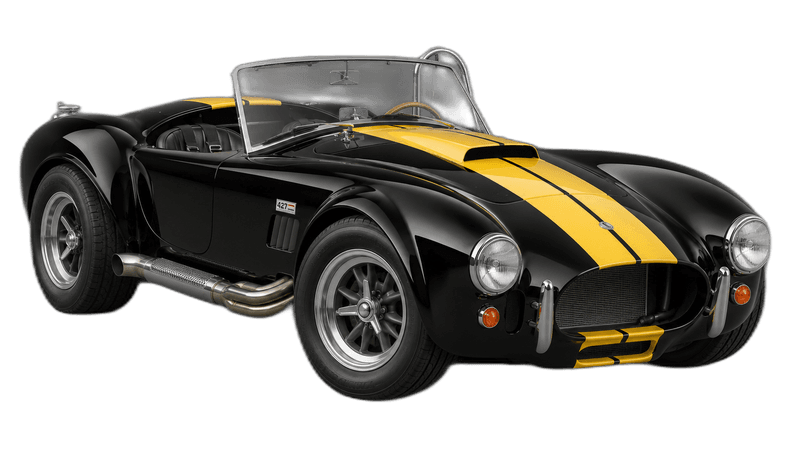
The page uses the catalogue photograph for this model, and its credit is listed on the credits page.
Verdict
The Shelby Cobra 427 is the point where the Cobra stopped being a light roadster with a small-block V8 and became a wide, coil-sprung machine built around a 7.0L naturally aspirated V8. On the figures we trust it makes 425 bhp, 651 Nm and a top speed of 264 km/h, although we have no 0-100 km/h time and the sources disagree about power, build counts and even which engine some street cars received. Treat the model name as a family of cars, check the engine and chassis documentation before taking any claim at face value, and use this page as a research aid and not as a buying recommendation.
Sources
- Wikipedia: AC Cobra
- Wikipedia: AC 428
- Supercars.net: 1965 Shelby Cobra 427 Roadster
- Apex Automag: 1967 Shelby Cobra 427
- ConceptCarz: 1965 Shelby Cobra 427 specifications
- RM Sotheby's: 1966 Shelby 427 Cobra (CSX 3259), Monterey 2023
- SlashGear: Why the Ford 427 is called the Side-Oiler
- WOB Cars: 1966 Shelby Cobra 427 Mark III listing
- Sports Car Market: Buyer's Guide to the Shelby Cobra
- The Classic Valuer: Shelby Cobra 427 buyer's guide
- HotCars: What makes the Shelby Cobra 427 so macho
Especificaciones
Motor
7.0L naturally aspirated V8
Cilindrada
7.0L
Potencia
425 cv
Par Motor
651 Nm
Velocidad Máxima
264 km/h
Tracción
RWD
País
United States
Carrocería
2-door roadster
Años
1965–1967
Producción
260
Specifications are manufacturer-published figures.
Más de Shelby
Preguntas Frecuentes
What are the specifications of the Shelby Cobra 427?
The Shelby Cobra 427 is a 2-door roadster by Shelby, with 425 bhp, 651 Nm of torque and a top speed of 264 km/h.
How many Shelby Cobra 427 were made?
Shelby produced 260 units of the Shelby Cobra 427.
What drivetrain does the Shelby Cobra 427 use?
The Shelby Cobra 427 is configured with rear-wheel drive.
What type of car is the Shelby Cobra 427?
The Shelby Cobra 427 is a sports cars manufactured by Shelby in United States. Production ran from 1965 to 1967.