
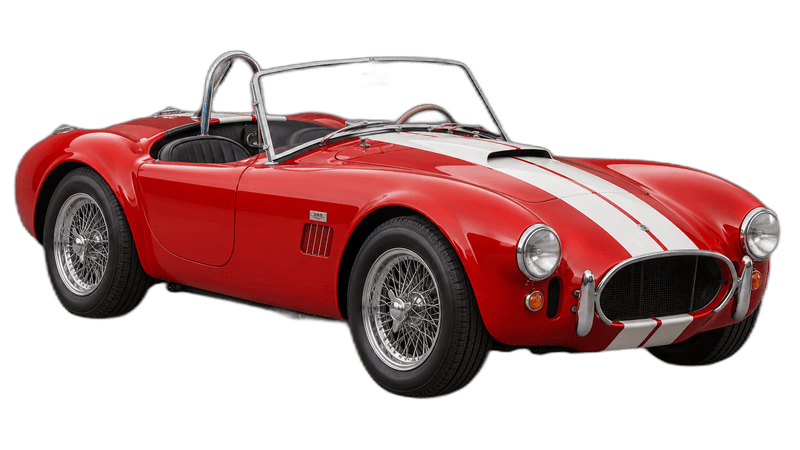
Shelby Cobra 289
271cv
Potencia
222km/h
Velocidad Máxima
The Shelby Cobra 289 is a 2-door roadster by Shelby, with 271 bhp, 426 Nm of torque and a top speed of 222 km/h.
Dream Car Garage Editorial · Edited by José Teo Lorente Vallecillos · Last updated 3 November 2026
Visión General
We have not driven this car. This review is based on published specifications and the sources listed below.
Scope of this guide
This guide is scoped to the Shelby Cobra 289, the small-block, leaf-sprung Cobra that Shelby American built on AC Cars chassis and that is usually called the Mark II when it carries the rack-and-pinion steering introduced in 1963. It is a two-seat roadster with a front-engine layout, a 4.7 litre Ford V8 under the bonnet, a four-speed manual gearbox and rear-wheel drive. The page covers the 289 cubic inch cars of 1963 to 1965. It does not cover the earlier 260 cubic inch cars except where they help explain the change, it does not cover the coil-sprung big-block Mark III, and it does not drift into the 427.
We have not driven this model for this article. We are an editorial desk that reads sources, and everything below comes from pages we opened: Wikipedia, Sportscar2, RM Sotheby's, K500, Classic Ponycars, Conceptcarz, The Classic Valuer, Silodrome and Supercars.net. We have not inspected, owned or tested a car. Cobras of this age are collector cars that rarely come to market, so this page is for research, not a buying recommendation, and it cannot replace an inspection by a specialist who knows the chassis numbers and the history.
The figures at a glance
- Engine: 4.7L naturally aspirated V8, 4,727 cc (289 cubic inches), Ford Windsor small-block, mounted front-engine, overhead valve, with a single four-barrel Holley carburettor on the street cars.
- Drivetrain: rear-wheel drive, four-speed Borg Warner manual gearbox, transverse leaf spring suspension at both ends.
- Power: 271 bhp. Sources print it at 6,000 rpm or at 5,750 rpm, and none says whether it is a gross or a net rating.
- Torque: 426 Nm. The sources print 314 lb ft (and one prints 312 lb ft). We convert 314 lb ft at 1.35582, which gives 425.7 Nm, rounded to 426 Nm.
- 0-100 km/h: no figure shown. The sources give 0-60 mph times, and a 0-60 mph time is not a 0-100 km/h time, so we have not relabelled one.
- Top speed: 222 km/h. The sources print 138 mph, and 138 mph multiplied by 1.60934 is 222.1 km/h. Classic Ponycars prints 222 kph itself.
- Weight: 1,050 kg (2,315 lb) for the Mark II, according to Wikipedia and Silodrome.
- Years: 1963 to 1965.
- Production: 528 Mark II cars, a figure three of the pages we read agree on.
History and what changed over the run
The Cobra began as an AC Ace chassis, designed by John Tojeiro, fitted by Carroll Shelby with an American V8. K500 describes the recipe as a tubular chassis and aluminium roadster body paired with a lightweight American V8. Wikipedia says the first 75 Mark I cars, including the prototype, used the 4.3 litre (260 cubic inch) Windsor V8, and that the remaining 51 Mark I cars used the 4.7 litre (289 cubic inch) engine. Silodrome gives the same split and totals 126 Mark I cars. Most 260 cars were later upgraded to 289 by Shelby, according to Wikipedia, which is why true 260 cars are now rare.
Classic Ponycars dates the first 289-powered car, chassis CSX2075, to January 1963. It also dates the first production rack-and-pinion car, CSX2127, to March 1963, and says the earlier worm-and-sector steering was used up to chassis CSX2125. Sportscar2 describes the steering change as taking place in late 1962, so the pages differ slightly on the date. We use the chassis numbers because they are the more specific claim, but a reader who needs an exact build date should consult a registry.
The Mark II is the car most people mean by a Cobra 289. Conceptcarz says Shelby's chief engineer Phil Remington and AC's chief engineer Alan Turner redesigned the front end, and that the worm-and-sector steering, which caused unpredictable steering geometry changes, was replaced with rack and pinion. Wikipedia and Silodrome add that the rack came from the MGB and the column from the Volkswagen Beetle. The transverse leaf suspension was kept.
According to Wikipedia, the dimensions are the same as the Mark I: a wheelbase of 2,286 mm, a length of 3,848 mm, a width of 1,549 mm and a height of 1,245 mm. The Mark II weighs more than the Mark I, which Wikipedia puts at 916 kg, and Silodrome gives the weights as 2,019 lb for the Mark I and 2,315 lb for the Mark II.
The run ended in 1965. Sportscar2 says production ended in the summer of 1965 and that the Mark III, with a new chassis and a 427 Ford V8, replaced the Mark II. Conceptcarz describes the Mark III as having 4 inch main tubes, coil springs at all four corners, wider fenders and a bigger radiator opening. That is a different car and we leave it out.
Several variants sit around the standard roadster, and we mention them only to mark the edge of this guide:
- Dragonsnake: a drag-racing package. Sportscar2 says five were built by Shelby and three more by individual customers, and that Shelby began offering a drag option after a Mark I won at Riverside in February 1963.
- Daytona Cobra Coupe: a works Le Mans car with four Weber carburettors. Sportscar2 gives it 385 bhp and says six coupes were built. It is not a road car and is outside this guide.
- A 390 cubic inch experiment: Sportscar2 says CSX2196, built in 1964, used a 390 engine and performed poorly at Sebring because development time was limited.
- UK sales: Sportscar2 says right-hand drive 289s were available in mid-1963 but were not officially introduced to the UK market until late 1964.
Engine, power and the Hi-Po label
The pages we read call the Mark II engine by several names. Sportscar2 calls it the 289 cubic inch Ford Windsor HiPo (High Performance) overhead valve engine, with 271 bhp and an 11:1 compression ratio. RM Sotheby's calls it a High-Output 289 cubic inch V8, reportedly producing 271 hp. Classic Ponycars gives 271 bhp for the 289 and 260 bhp for the 260 cubic inch engine. K500 and the Supercars.net specification table also print 271 bhp.
So the sources agree on 271 bhp, and we use it everywhere in this guide. They do not agree on the engine speed at which it is made. Sportscar2 prints 5,750 rpm, while Classic Ponycars and Supercars.net print 6,000 rpm. We cannot say which is right from what we read.
None of the pages tells us whether 271 is a gross or a net rating. Older American figures and modern ones are often not measured the same way, so a direct comparison with a modern car's power output should be treated with care. We simply do not know the test basis, and we have not guessed it.
Conceptcarz prints a different set of power numbers: 260 hp for the 260 engine, and 370 hp in the article text but 360 hp in the table for a racing 289. We read those as racing-tune figures and not as the road car, so we did not use them.
Torque is closer. Sportscar2 prints 312 lb ft at 4,500 rpm in its text and 314 lb ft in its table. Classic Ponycars and Supercars.net print 314 lb ft at 3400 rpm. We chose 314 lb ft because three entries agree on it, and the conversion gives 426 Nm. The 312 lb ft figure would convert to about 423 Nm at the same factor.
Performance, and why there is no 0-100 km/h time
Every performance number we found for the 289 is an imperial one, and they do not agree:
- 0-60 mph: 5.2 seconds at K500, 5.4 seconds at Sportscar2, 5.5 seconds at Classic Ponycars and Supercars.net, and RM Sotheby's says only under six seconds.
- 0-100 mph: 13.7 seconds in the Sportscar2 text (14.0 in its table) and 13.0 seconds at Classic Ponycars.
- Standing quarter mile: 14.4 seconds in the Sportscar2 text (13.8 in its table) and 13.9 seconds at Classic Ponycars.
None of this gives a 0-100 km/h time, so there is no figure shown for it on this page. A figure near 60 mph is a different speed from 100 km/h (about 62 mph), and we do not want to blur the two. Conceptcarz also prints a 4.2 second 0-60 mph time and a 153 mph top speed at Riverside, but both are described as 1962 results for the 260 engine, so we did not carry them into the 289 figures.
Top speed is also spread. Sportscar2, K500 and Classic Ponycars print 138 mph, Supercars.net prints about 135 mph (217.3 km/h) and RM Sotheby's prints 130 mph. We use 138 mph because three pages agree, which gives 222 km/h. The pages do not say how the numbers were measured, so treat all of them as period claims.
How many were built
Wikipedia says about 528 Mark II Cobras were built from 1963 to the summer of 1965. Sportscar2 gives 528 units and Silodrome gives 528 cars, all with the Ford 289. We use 528.
Other numbers appear in the same pages and mean different things. RM Sotheby's calls its car one of just 453 street 289 Cobras, and Supercars.net repeats the 453 figure. Neither page explains how it was counted. Wikipedia gives 655 leaf-spring cars across the Mark I and Mark II together, and 343 coil-spring cars. Classic Ponycars gives 348 coil-spring 289 cars built by AC for the European market from May 1966 to February 1969, and Sportscar2 gives 27 AC 289 cars sold in Europe until late 1968. Those are different cars and different build lines.
What to check, and what the sources say about value
Only a few of the pages give specifics, so this is a short list and not an inspection scheme.
- Steering type: Conceptcarz and Classic Ponycars describe the move from worm-and-sector to rack and pinion, with the rack-and-pinion car starting at CSX2127. RM Sotheby's calls its 1964 car a desirable late-production example with rack-and-pinion steering. We read that as saying the later steering matters to buyers.
- Documentation: the RM Sotheby's lot lists the chain of ownership, an invoice trail from AC Cars to Shelby America, and restoration records. The sources do not say what a buyer should verify, but they show the sort of paperwork that sale carried.
- Chassis number: the cars carry CSX numbers, and the pages use them to date the changes. A specialist can tie a car's number to the build lists. We have not seen such a list.
The sources give some prices, and we repeat them with their context:
- RM Sotheby's lists a 1964 Shelby 289 Cobra, chassis CSX2208, as sold at its Amelia Island 2023 auction for 1,655,000 US dollars. The same page says the original suggested retail price was 5,584.05 US dollars as optioned new.
- The Classic Valuer reports a median auction price of 754,622 pounds across the 289 Cobras it tracks, with a highest sale of 2,957,095 pounds at RM Sotheby's (US) on 14 August 2021 and a lowest since 2020 of 88,254 pounds at Barrett-Jackson on 27 January 2024. It records 154 auction appearances and 106 sales, a 69 per cent sell-through rate. The site converts prices to pounds and counts the whole 1962 to 1965 range, so the figures are not directly comparable to the RM Sotheby's dollar price.
These are historic sale records, not valuations. Prices move and condition, originality and provenance dominate, so a reader should not use them as an asking-price guide.
What we could not find
- No 0-100 km/h time in any source, so no figure shown.
- No statement of whether the 271 bhp figure is gross or net.
- No agreed top speed, torque or engine speed for peak power. The differences are explained above.
- No production figure that is clearly specific to the 289 alone. The 528 figure is for the Mark II, and the 453 figure is described only as street cars.
- An Ultimate Car Page address we tried returned an unrelated car, so we did not use it. We did not try to get around either.
- K500 shows only a preview, and its buying advice and price data are behind a subscription.
- No recall or reliability list for the 289. The pages we read are history and auction pages.
About the photograph
The page uses the catalogue photograph for this model, and its credit is listed on the credits page.
Verdict
The Cobra 289 is a light, short, front-engine roadster with 271 bhp from 4.7L naturally aspirated V8 power and rear-wheel drive. The pages we read put its top speed at about 222 km/h and its torque at 426 Nm by our conversion, but they offer no 0-100 km/h time. About 528 Mark II cars were built, and the market records we read run from 81,700 pounds in 2018 to nearly three million pounds in 2021, with one dollar sale at 1,655,000 US dollars. The steering change, the chassis number and the paperwork are the points the sources return to. Treat this page as a research aid and not as a buying recommendation, and use a Cobra specialist for any real inspection.
Sources
- Wikipedia: AC Cobra
- Sportscar2: The AC Cobra 289 Sports Car
- RM Sotheby's: 1964 Shelby 289 Cobra (Amelia Island 2023)
- K500: AC Cobra 289 (1962-1966)
- Classic Ponycars: Carroll Shelby's AC Cobras
- Conceptcarz: Shelby Cobra 289
- The Classic Valuer: Shelby Cobra 289 buyer's guide
- Silodrome: AC Shelby Cobra 289
- Supercars.net: 1963 Shelby Cobra 289
Especificaciones
Motor
4.7L naturally aspirated V8
Cilindrada
4.7L
Potencia
271 cv
Par Motor
426 Nm
Velocidad Máxima
222 km/h
Tracción
RWD
País
United States
Carrocería
2-door roadster
Años
1963–1965
Producción
528
Specifications are manufacturer-published figures.
Más de Shelby
Preguntas Frecuentes
What are the specifications of the Shelby Cobra 289?
The Shelby Cobra 289 is a 2-door roadster by Shelby, with 271 bhp, 426 Nm of torque and a top speed of 222 km/h.
How many Shelby Cobra 289 were made?
Shelby produced 528 units of the Shelby Cobra 289.
What drivetrain does the Shelby Cobra 289 use?
The Shelby Cobra 289 is configured with rear-wheel drive.
What type of car is the Shelby Cobra 289?
The Shelby Cobra 289 is a sports cars manufactured by Shelby in United States. Production ran from 1963 to 1965.