
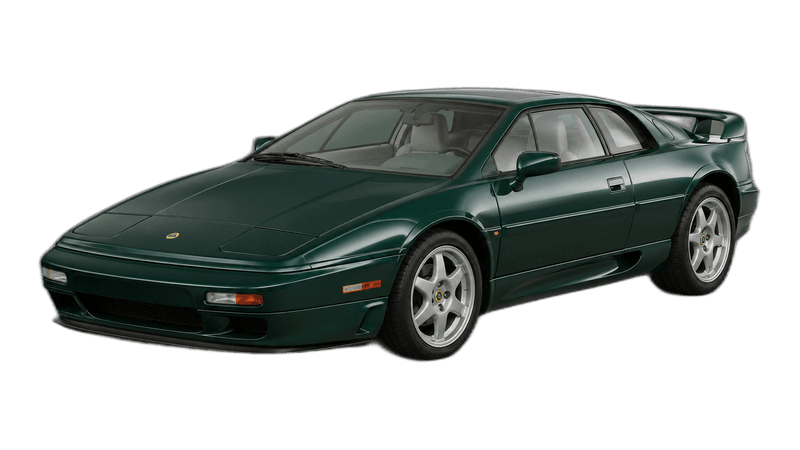
Lotus Esprit V8
£50,000
usadoIndicative market price, updated periodically.
350cv
Potencia
4.4s
0-100 km/h
282km/h
Velocidad Máxima
£50,000
Precio Usado
Cómo empuja.
La fuerza g máxima en el instante en que pisas a fondo, estimada a partir del 0–100 y la tracción del coche.
Lotus Esprit V8G de salida estimada a partir del 0–100 y la tracción: una aproximación honesta, no una cifra medida.
The Lotus Esprit V8 is a 2-door coupe by Lotus, with 350 bhp, 400 Nm of torque, a 0-100 km/h time of 4.4 seconds and a top speed of 282 km/h. Indicative used value: approximately £50,000. Actual values vary with specification, condition and history.
Dream Car Garage Editorial · Edited by José Teo Lorente Vallecillos · Last updated 2 November 2026
Visión General
We have not driven this car. This review is based on published specifications and the sources listed below.
Scope of this guide
This guide is scoped to the Lotus Esprit V8 sold from 1996 to 2004, the rear-wheel drive two-door coupe with the Lotus Type 918 twin-turbo V8 and a five-speed manual gearbox. It is not a guide to the earlier four-cylinder Esprits, and we say below where they and the later V8 derivatives differ, so you can tell which car an advert is really describing.
We have not driven this model for this article. Everything here comes from the Lotus Cars website history page for the Esprit, a PistonHeads used buying guide written for this exact car, and the government recall checker. Where those sources disagree, or where a figure in our catalogue could not be confirmed word for word, we say so in the text.
The figures at a glance
- Engine: 3.5L twin-turbo V8 petrol, 3,506 cc, 32 valves, Lotus Type 918.
- Power: 350 bhp. Lotus prints bhp, and PistonHeads prints 350 hp at 6,500 rpm.
- Torque: 400 Nm. PistonHeads gives 295 lb ft at 4,250 rpm, which is the same torque in imperial units.
- Gearbox: five-speed manual, with rear-wheel drive.
- 0-100 km/h: 4.4 seconds in our catalogue, with an important caveat explained below.
- Top speed: 282 km/h in our catalogue, which is Lotus's 175 mph.
- Weight: 1,379 kg from Lotus, 1,378 kg from PistonHeads.
- Fuel economy: 21.2 mpg official combined, according to PistonHeads.
Torque, power and the units
A quick check matters here, because the torque number is easy to misread. Lotus lists 400 Nm of torque. PistonHeads lists 295 lb ft. Multiply 295 by 1.356 and you get about 400, so the two sources agree. The figure is 400 newton metres, not 400 lb ft. A car with 400 lb ft would be a very different animal, and nobody sells the Esprit V8 as one.
Power is simpler. Lotus quotes 350 bhp and PistonHeads quotes 350 hp. Those are effectively the same rating. Neither source we read gave a PS figure, so the 355 PS that appears on some enthusiast pages is not something we have confirmed, although it is the metric equivalent of 350 bhp.
PistonHeads also warns that weight and power data for these cars is hard to pin down, and that the numbers should be treated as relative rather than definitive. We agree. Treat any single figure as a rating from a particular document, not a measurement of the car on the forecourt.
Performance claims and what they mean
The 4.4 seconds we carry in the catalogue needs care, because it is not a 0-100 km/h test that either of our sources states. The Lotus history page gives no acceleration time for the V8. PistonHeads gives 4.9 seconds for 0-62 mph in its specification table, although the text of its article says only that the car does 0-60 mph in "a four", without a decimal.
A figure of 4.4 seconds to 60 mph circulates in period summaries. We saw it in a US consumer guide to the 2000 model year, but that page is not one of our three listed sources. Since 60 mph is a little under 97 km/h, a 4.4 second 0-60 mph claim would not be a 0-100 km/h time either. If you compare 4.4 with 4.9, you are comparing a 0-60 mph claim from a secondary source with a 0-62 mph figure from PistonHeads, and they differ by half a second.
Top speed is stated by Lotus as 175 mph. That is 281.6 km/h, which we round to 282 km/h. The page does not print a kilometre figure, so the 282 is our own conversion.
Model years and how many were built
Lotus says the Esprit V8 was shown at the Geneva Motor Show in 1996, and both sources give 1996 to 2004 as the production span. PistonHeads says the V8 was dropped from the brochure in 2004. The Lotus page is slightly inconsistent, because one passage says the Esprit ended in 2002, while another says the last car left Hethel in 2004. We use 1996 to 2004.
Production numbers are harder. PistonHeads says that over 10,000 Esprits were built in total and fewer than 1,500 of them were V8s. Lotus's specification table lists approximately 1,613 for all models, and it is not clear whether that counts every V8 derivative. Our catalogue previously carried 1,237. We could not tie that number to either listed source, so we have removed it rather than present it as fact.
Where the other Esprits differ
- Esprit S4 and GT3: the last four-cylinder cars, with a turbocharged four-cylinder engine. Lotus attaches the S4 and GT3 names only to that generation. PistonHeads dates them to 1994. They are not V8 cars and this guide does not describe them.
- Esprit V8 SE: the luxury version, which is how Lotus's page labels it, and PistonHeads calls it the everyday car. PistonHeads says about five in six V8s were SEs.
- Esprit V8 GT: the lighter, sportier version, with PistonHeads counting around 200 of them.
- Sport 350: a 1999 car of about 1,300 kg with a remapped engine, the same 350 bhp peak at different revs, stiffer springs, a carbon rear wing and AP Racing brakes. PistonHeads says no more than 50 were built.
- Final Edition: Lotus says 82 of these were built between 2002 and 2004, as the last cars.
Engine
The Type 918 is an all-aluminium, flat-plane 3.5L twin-turbo V8 petrol with two Garrett turbochargers. Lotus describes it as an all-new Lotus-designed engine and gives its weight as 220 kg with all ancillaries. PistonHeads says it was claimed to be capable of far more than 350 bhp, but that Lotus limited it because the Renault gearbox could not cope with a potential 500 hp.
PistonHeads describes throttle response as not instant, with little thrust below about 2,500 rpm, and boost of about half a bar. It also says the redline is 7,000 rpm and that the engine is therefore not highly stressed. Early cars before 1998 could leak water between the liners and block, and the repair needed the engine removed. PistonHeads says the sealant was changed on later cars, so an unrepaired example is unlikely.
Cambelt, cooling and ancillaries
The cambelt is the most important service item. PistonHeads says to check the tension every 12,000 miles and replace the belt every 36,000 miles, and warns that the valves bend if it breaks. Ask for dated invoices rather than a verbal promise.
Radiators can leak and fans can break, so look at the cooling system carefully. Exhausts and heat shields can crack. The coil packs sit between the engine and the intake plenum, and PistonHeads says they can overheat because of that position. Air conditioning is fitted, but PistonHeads says the compressors and related parts were not reliable.
Gearbox and clutch
The five-speed gearbox comes from Renault, and PistonHeads calls it the weakest link in the car. Lever throw is slow, and the clutch pedal is heavy even when new. Hard driving can break second and fifth gears or the input shafts, and tuned cars running more boost are more vulnerable. PistonHeads says a lighter AP Racing clutch was planned later in production. Ask any seller which clutch and gearbox history the car has, and whether the car has ever been tuned.
Chassis, brakes and body
PistonHeads praises the steering feedback and the handling, supported by the steel spine chassis. Ground clearance is limited and there was no nose-lift option, so steep drives and speed humps need care. The brake pedal has short travel, which makes gentle low-speed stops harder, and the lower suspension arm bushes are consumable.
PistonHeads notes that only one of the two fuel filler points works, that the bonnet release is in the footwell, and that the small front compartment holds the spare wheel, fuses and washer bottle. The roof panel is removable and could be ordered in glass.
Interior and practicality
Parts sharing is obvious. PistonHeads says the steering wheel came from a Saturn and the switches from a Peugeot 106. There is no glove box or centre console, only a document pocket between the seats. It also lists creaks, wind noise and tyre noise, poor rear visibility and reflections in the near-flat windscreen at night. Tall drivers may find the seating and pedals uncomfortable.
Running costs
PistonHeads gives 21.2 mpg official combined but says real-world use is nearer 14 mpg. The tank holds nearly 16 gallons, which gives a range of about 300 miles. PistonHeads quoted a new price of 60,000 pounds and used cars from 52,000 pounds in August 2024. Those are dated figures and will have moved, so get current advertised prices. Our sources do not cover insurance or annual road tax for this car, so we give no figures. Parts and servicing are available from Esprit Engineering near Salisbury, according to PistonHeads.
What to check before buying
- Confirm which Esprit it is: V8, SE, GT, Sport 350 or Final Edition, and not an S4 or GT3.
- Ask for the cambelt change date and the tension checks.
- Look for coolant leaks, a weeping radiator and working fans, and check the heat shields and exhaust.
- Drive the car to test second and fifth gears, the clutch weight and any noise from the gearbox.
- Ask about any engine tuning or boost increase.
- Check the lower suspension arm bushes, brakes and tyres, and the condition of the air conditioning.
- Confirm that every recall is closed, using the check below.
Recalls and the DVSA check
PistonHeads does not list any recalls for the Esprit V8 in its guide, so we have none to repeat. Run the car through the government recall check at the link below using the registration number or VIN. We did not verify how far back the checker's records go for a 1996 to 2004 car, so also ask Lotus or a specialist whether any recall action applies to the car you are looking at.
Verdict
The Esprit V8 is a rare, fast and rewarding Lotus with a famously weak Renault gearbox, a cambelt that must not be neglected, and widely varied ownership experiences. If you want one, choose the right derivative, insist on service evidence and treat the 350 bhp, 400 Nm, 4.4 seconds and 282 km/h figures as published ratings with the caveats above. We have not driven it, so use the sources and a proper inspection to decide.
Especificaciones
Motor
3.5L twin-turbo V8 petrol
Cilindrada
3.5L
Potencia
350 cv
Par Motor
400 Nm
0-100 km/h
4.4s
Velocidad Máxima
282 km/h
Tracción
RWD
País
UK
Carrocería
2-door coupe
Años
1996–2004
Precio Usado
£50,000
Specifications are manufacturer-published figures.
Más de Lotus
Destacado en Carpedia
Best Sports Cars Under €100,000 in 2026
Nine sports cars from €50,000 to €100,000 that deliver genuine GT-class performance, including a junior Aston, a Japanese analogue icon, and the most underrated Porsche money can buy.
Best First Supercars to Buy in 2026
Eight supercars that reward first-time ownership without punishing inexperience, selected for mechanical approachability, established specialist networks, and the kind of driving experience that earns its licence.
Preguntas Frecuentes
What are the specifications of the Lotus Esprit V8?
The Lotus Esprit V8 is a 2-door coupe by Lotus, with 350 bhp, 400 Nm of torque, a 0-100 km/h time of 4.4 seconds and a top speed of 282 km/h. Indicative used value: approximately £50,000. Actual values vary with specification, condition and history.
How much does a Lotus Esprit V8 cost?
Indicative used value: approximately £50,000. Actual values vary with specification, condition and history.
What drivetrain does the Lotus Esprit V8 use?
The Lotus Esprit V8 is configured with rear-wheel drive.
What type of car is the Lotus Esprit V8?
The Lotus Esprit V8 is a sports cars manufactured by Lotus in UK. Production ran from 1996 to 2004.