
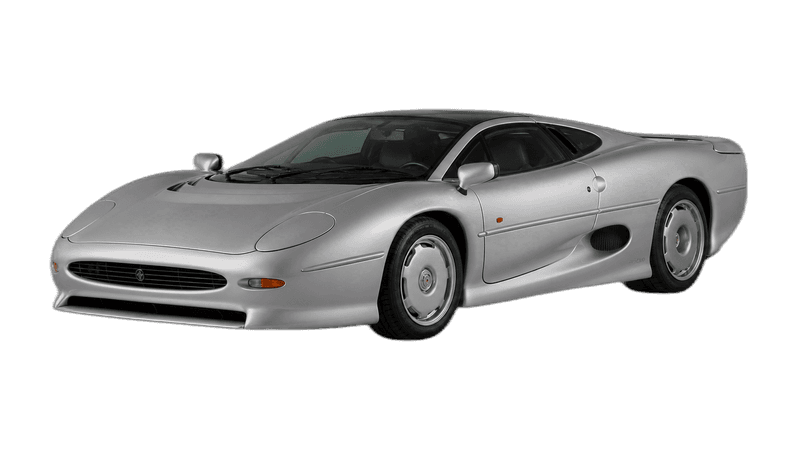
Jaguar XJ220
£450,000
usadoIndicative market price, updated periodically.
542cv
Potencia
3.6s
0-100 km/h
343km/h
Velocidad Máxima
£450,000
Precio Usado
Cómo empuja.
La fuerza g máxima en el instante en que pisas a fondo, estimada a partir del 0–100 y la tracción del coche.
Jaguar XJ220G de salida estimada a partir del 0–100 y la tracción: una aproximación honesta, no una cifra medida.
The Jaguar XJ220 is a 2-door coupé by Jaguar, with 542 bhp, 644 Nm of torque, a 0-100 km/h time of 3.6 seconds and a top speed of 343 km/h. Indicative used value: approximately £450,000. Actual values vary with specification, condition and history.
Dream Car Garage Editorial · Edited by José Teo Lorente Vallecillos · Last updated 2 November 2026
Visión General
We have not driven this car. This review is based on published specifications and the sources listed below.
Scope of this guide
This guide is scoped to the standard road-going Jaguar XJ220 production car, the two-seat, mid-engine, rear-wheel drive coupe with the 3.5L twin-turbo V6 petrol (3498 cc) engine, built by hand by JaguarSport (a joint venture between Jaguar and Tom Walkinshaw Racing, TWR) at Bloxham, Oxfordshire, from 1992 to 1994. It is not a guide to the 1988 show concept, which was shown with a V12 and four-wheel drive, nor to the XJ220 S, the XJ220 C race cars or the separate XJR-15. We say below where those cars differ, so that you can tell which one an advert really describes.
We have not driven this model for this article. Everything here comes from three cited sources: a Jaguar media newsroom article marking 20 years since the launch (30 January 2012), PistonHeads' used buying guide by Tony Middlehurst (29 December 2024), and the government recall checker. We also read the Jaguar Daimler Heritage Trust page for one pre-production car and a Wikipedia article, and we flag every point that rests on them. Where sources disagree we say so rather than pick a winner quietly. Prices are history or ranges, not valuations.
The figures at a glance
- Engine: 3.5L twin-turbo V6 petrol (3498 cc), mounted behind the cabin, from TWR.
- Power: 542 bhp, which is Jaguar's 550 PS converted by us (550 x 0.98632 is about 542.5, which we round down to 542). Jaguar prints PS, not bhp.
- Torque: 644 Nm, which is Jaguar's 475 lb ft converted by us (475 x 1.3558 is about 644). PistonHeads prints 474 lb ft at 4,500 rpm.
- 0-100 km/h: 3.6 seconds is the nearest figure we have, and it is a 0-62 mph time from the PistonHeads specification table. Jaguar's own words are 0-60 mph in under four seconds. We treat 62 mph as 100 km/h.
- Top speed: 343 km/h, the Jaguar Daimler Heritage Trust's conversion of 213 mph, which is also the figure in the Jaguar article.
- Drive: rear-wheel drive and mid-engine, with a five-speed manual gearbox and an AP Racing twin-plate clutch.
- Weight: 1,470 kg in the Jaguar article and 1,456 kg on PistonHeads.
- Construction: bonded aluminium honeycomb structure, which the Jaguar article calls immensely strong.
What the XJ220 was
The car started as a concept at the 1988 British Motor Show, designed by Keith Helfet. It was signed off for production in December 1989 with TWR as the partner, and the first customer car was completed in June 1992. The Jaguar article says the car, at 213 mph, had the highest maximum speed of any production car when it appeared. PistonHeads reports that interest after the 1988 show ran to well over a thousand people, that option holders paid deposits of around 50,000 pounds each, and that a 1990 price of 348,000 pounds had become 420,000 pounds by the time deliveries began. The Jaguar article gives the retail price of the first customer car as 470,000 pounds, while the Heritage Trust page gives a 400,000 pound list price. Those three prices do not agree and we do not try to reconcile them. All of them are history, not current values.
How many were built
The count is the weakest number in this guide. The Jaguar media article says 275 cars had been built when production ended in 1994. The Jaguar Daimler Heritage Trust page says 281 were produced by Jaguar Sport between 1992 and 1994. PistonHeads gives a range of 270 to 282 and notes that the allocation certificate was for 350 cars, though Jaguar did not reach 300. Wikipedia prints 282, 275 and 281 in different places. We use 281, because it is the Heritage Trust's stated total, and we say plainly that it is a figure from one source, not a settled fact. If an advert quotes a chassis number or a build number, ask which count the seller is using.
PistonHeads also says 69 cars were right-hand drive, including 18 bought by the Brunei royal family, and that 32 cars entered the United States under the show or display exemption before the 25-year rule applied. The Jaguar article says chassis 004 was one of ten pre-production vehicles, and the Heritage Trust page describes another pre-production car, so it is not always clear whether pre-production cars are inside the totals above.
Why the quoted power and speed vary
Jaguar says 550 PS. PistonHeads prints 550hp at 7,200 rpm, measured at 40 degrees Celsius, and says Jaguar Sport estimated about 580hp at 18 degrees. Wikipedia prints 550 PS (542 hp). These are the same engine rated in different units and conditions, which is why we state the conversion. Metric horsepower and brake horsepower differ by about 1.4 per cent, so a 550 PS car is a 542 bhp car. We have not checked how each outlet labelled its figure.
Top speed has even more versions. Jaguar's article and the Heritage Trust say 213 mph. The Jaguar article says chassis 004 reached 213 mph at Fort Stockton in Texas in 1991. PistonHeads gives 212 mph at Nardo, 217 mph after the catalytic converters were removed and the rev limit raised, and a figure of 222 mph on a virtual straight, and its specification table says 220 or thereabouts. Wikipedia says the 217 mph run does not equal a true straight-road figure. Treat 213 mph (343 km/h) as the maker's claim and the others as test conditions, not what a catalogue car does today.
Weight is not tidy either. The Jaguar article says 1,470 kg and PistonHeads says 1,456 kg, and PistonHeads itself warns that weight and power data are hard to pin down with absolute certainty and should be treated as relative.
Drivetrain, and a source conflict
The standard car is rear-wheel drive. The Heritage Trust page says the production car had a TWR V6 and rear-wheel drive only, in contrast to the concept's V12 and four-wheel drive. PistonHeads' specification table says rear-wheel drive too, but its key considerations text and engine section describe all-wheel drive, which contradicts its own table. We follow the specification table and the Jaguar sources. If an advert claims all-wheel drive for a standard car, ask for evidence.
On the engine's ancestry, sources differ. The Heritage Trust calls it a TWR V6. PistonHeads says it was derived from the XJR-10 and XJR-11 racing engines, while Wikipedia says it was based on the Austin Rover V64V built for the MG Metro 6R4 rally car and redesigned by TWR. We have not resolved this and do not rely on it.
How the XJ220 differs from other versions
The 1988 concept had a V12, four-wheel drive, scissor doors and adjustable features that were dropped for weight and cost, according to PistonHeads. The production car has conventional doors and a fixed rear spoiler.
The XJ220 S was a lighter, more powerful car. The Jaguar article says the first one, chassis 220-803, was built from spare parts from the Le Mans cars, with one-piece carbon fibre clamshells and a claimed 700 PS. PistonHeads says six were homologated by TWR in 1993 with 700hp, 1,050 kg and a top speed of 229 mph, and that the lower weight came with a competition interior and a straight-through exhaust. The XJ220 C raced at Le Mans in 1993, where a class win was later revoked over the catalytic converters, per Wikipedia. If an advert mentions carbon panels, a large wing, 700 PS or a race history, it describes a different car from the one in this guide. The XJR-15 is a separate car that none of our sources describe, so we say nothing more about it.
Engine, gearbox and clutch
PistonHeads calls boost lag part of the car's character, not a fault. Its stated weak points are mechanical rather than engine-internal: the AP clutches were not fully reliable and are expensive to replace, and folklore says the clutch slave cylinder corrodes and tears its seals if the car sits outside in British weather. The Jaguar article confirms the five-speed gearbox and the AP Racing twin-plate clutch. PistonHeads warns that storing luggage in the engine bay risks severe overheating. We found no source listing engine failures, but that absence is not a guarantee of reliability, so ask for the full service record and a specialist inspection.
Chassis, brakes and body
The brakes are AP Racing discs with four-pot calipers, per the Jaguar article. PistonHeads calls the brakes the weak link, says ABS was removed while servo assistance was kept, and says modern upgrades are available. The steering is unassisted and takes significant effort. At high speed on a test track the bonnet lifted and the wipers flapped above 120 mph at Nardo, and the fixed glass roof makes the cabin hot in sunny weather. Visibility for some manoeuvres is poor and the door openings are tight. PistonHeads also questions how well the door-mounted instruments survive long-term use.
The Jaguar article lists 18-inch Speedline rear wheels with 345/35 Bridgestone Expedia tyres. PistonHeads says the original Bridgestone tyres were unavailable for a time and that successor tyres, developed with Bridgestone and Don Law, arrived in mid-2017. Check tyre age and brand on any car, because some may still be on old rubber.
Running costs and parts
The only costs we can source come from the 2024 PistonHeads guide, and they are thin. Jaguar claimed up to 32 mpg. The 90-litre fuel cells are PVC and have a six-year replacement schedule, and PistonHeads says replacement reputedly costs around 30,000 pounds. When Jaguar's ten-year spares obligation ended, it sold its remaining stock to Don Law Racing in Staffordshire. The article gives no servicing or insurance figures, so we give none either.
Buying notes
PistonHeads traces values from a 111-mile car sold at auction for 105,000 pounds in 2003, through typical cars near 300,000 pounds in 2017, to a current guide of from 500,000 pounds, with two left-hand-drive Dutch cars listed at 698,000 euros and 615,000 euros in late 2024. These are asking prices and anecdotes, not valuations, and we have not tracked the market. Most of the condition risks above are expensive to fix, so budget for specialist work.
What to check before buying
- Confirm the chassis number and build details against the V5C and ask Jaguar Classic or the Heritage Trust what history they hold.
- Confirm it is a standard road car and not an XJ220 S, an XJ220 C or a modified car.
- Check the clutch, slave cylinder and gearbox for wear or leaks.
- Ask when the fuel cells were last replaced, given the six-year schedule.
- Look at the brakes and any upgrades, and ask what has been changed from standard.
- Check tyre age, brand and size against what Jaguar fitted.
- Check the cooling system and any history of overheating.
- Run the registration through the recall check described below.
Recalls and the DVSA check
PistonHeads does not mention any recall, and the Jaguar article does not either. We did not find a recall list for the XJ220 and we did not run the government checker, which needs a registration number or the manufacturer, model and year. The page says it shows outstanding safety recalls and the MOT history, and that non-safety recalls come from the manufacturer directly. Run the registration through the check on GOV.UK, and ask a Jaguar specialist to confirm anything open.
Verdict
The standard XJ220 is 542 bhp, 644 Nm, a claimed 3.6 seconds and 343 km/h, rear-wheel drive and mid-engine, in a hand-built aluminium honeycomb coupe made in a run of about 281. It rewards an owner who accepts specialist servicing and costly parts. If you are shopping for one, confirm which version it is, insist on a full history, and treat the published figures as claims with the caveats above. We have not driven it, so use the sources and a proper inspection to decide.
Especificaciones
Motor
3.5L twin-turbo V6 petrol (3498 cc)
Cilindrada
3.5L
Potencia
542 cv
Par Motor
644 Nm
0-100 km/h
3.6s
Velocidad Máxima
343 km/h
Tracción
RWD
País
UK
Carrocería
2-door coupé
Años
1992–1994
Producción
281
Precio Usado
£450,000
Specifications are manufacturer-published figures.
Más de Jaguar
Preguntas Frecuentes
What are the specifications of the Jaguar XJ220?
The Jaguar XJ220 is a 2-door coupé by Jaguar, with 542 bhp, 644 Nm of torque, a 0-100 km/h time of 3.6 seconds and a top speed of 343 km/h. Indicative used value: approximately £450,000. Actual values vary with specification, condition and history.
How much does a Jaguar XJ220 cost?
Indicative used value: approximately £450,000. Actual values vary with specification, condition and history.
How many Jaguar XJ220 were made?
Jaguar produced 281 units of the Jaguar XJ220.
What drivetrain does the Jaguar XJ220 use?
The Jaguar XJ220 is configured with rear-wheel drive.
What type of car is the Jaguar XJ220?
The Jaguar XJ220 is a luxury manufactured by Jaguar in UK. Production ran from 1992 to 1994.